zenpundit.com » 2012

Archive for 2012

Strategy and Creativity: Part I.

Tuesday, October 9th, 2012

“War is more than a true chameleon that slightly adapts its characteristics to the given case. As a total phenomenon its dominant tendencies always make war a remarkable trinity–composed of primordial violence, hatred, and enmity, which are to be regarded as a blind natural force; of the play of chance and probability within which the creative spirit is free to roam; and of its element of subordination, as an instrument of policy, which makes it subject to reason alone.”
                                                                                                -Carl von Clausewitz, On War

“Thus the highest form of generalship is to balk the enemy’s plans; the next best is to prevent the junction of the enemy’s forces; the next in order is to attack the enemy’s army in the field; and the worst policy of all is to besiege walled cities….Therefore the skillful leader subdues the enemy’s troops without any fighting; he captures their cities without laying siege to them; he overthrows their kingdom without lengthy operations in the field. With his forces intact he will dispute the mastery of the Empire, and thus, without losing a man, his triumph will be complete. This is the method of attacking by stratagem.”
                                                                                             – Sun Tzu, The Art of War 

This blog is read by many people with a deep interest in strategy coming from different philosophical and professional perspectives. While I have my own speculations  based on years of study, I would like to begin by first posing a few questions to the readership:

  • What is the relationship between strategy and creativity?
  • Or between strategic thinking and creative thinking?
  • Is “doing strategy” primarily an act of planning, calculation and rational problem-solving or is it also a profoundly creative and intuitive enterprise?
  • If we get better at thinking creatively, do we become better, more effective strategists? The reverse?
  • Is creativity more useful in “grand strategy” (or “statecraft”, if you prefer) and policy than in straightforward “military strategy”?

The floor is yours, strong argument is welcomed.

At Play in the Fields of the Lord

Monday, October 8th, 2012

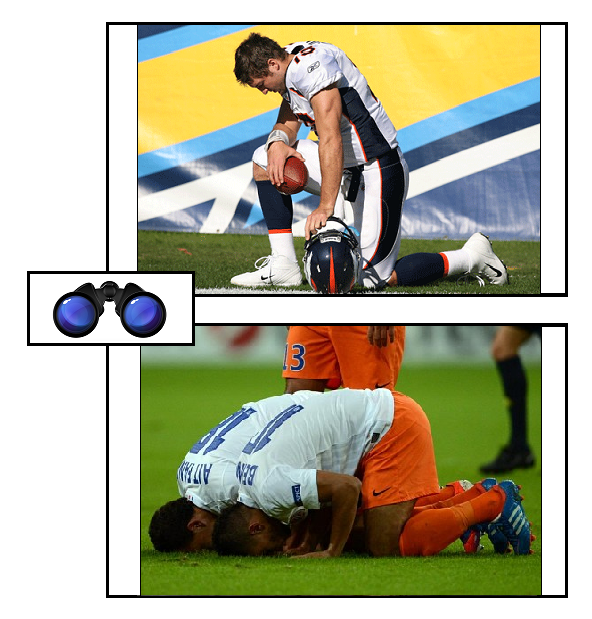
[ by Charles Cameron — two ways of playing football, two faiths ]
.

Image sources:

Tim Tebow: Urban Faith
Karim Ait-Fana and Younes Belhanda: Al Arabiya

Form is insight: the bow to arrow paradox

Monday, October 8th, 2012

[ by Charles Cameron — a post in my importance of form in intelligence series — ]
.

Ben Turner‘s tweet today —

neatly encapsulates the “counterintuitive” paradox by which bow and arrows — and catapults too, for that matter — work. You pull back to send forwards.

**

The Chicago Tribune report which Turner links to contains the following paragraphs:

Gurdon spoke of his own unlikely career as a young man who loved science but was steered away from it at school, only to take it up again at university.

He still keeps an old school report in a frame on his desk: “I believe he has ideas about becoming a scientist… This is quite ridiculous,” his teacher wrote. “It would be a sheer waste of time, both on his part and of those who have to teach him.”

What’s funny here is that our new-minted Nobelist liked this comment well enough to frame it. He has shown the teacher in question to be wrong, no doubt about it, and perhaps given others who have received similarly negative advice some encouragement along the way.

But here’s my question: did that unflattering report somehow propel him to greater effort?

**

For your thinking pleasure in the matter of the bow to arrow paradox:

reverse psychology
blowback
reculer pour mieux sauter
counterintuitive
unintended consequences

It’s really quite a party for the party-going mind. Does your mind party?

**

There will be more posts in this “form is insight” series, as time and tide permit.

Recommended Reading

Monday, October 8th, 2012

Gunpowder & Lead (Drunken Predator Drone) –Pakistan’s “Sovereignty” Canard 

….Every time I cross the border, every time an American missile hits Pakistani soil, Pakistan’s government exercises their sovereignty by choosing not to blow me out of the sky. I operate openly, and Pakistan’s doing so would be a huge bummer, butwell within their technical capacity. Yes, the sole act of not starting a war doesn’t equate to government permission. But sovereignty implies a range of options and authorities beyond war, and Pakistan has visibly exercised that sovereign authority in the recent past.

After the May 2011 bin Laden raid (which, as a side note, constituted a real sovereignty violation, with no warning whatsoever and American boots on the ground deep inside Pakistan) bilateral relations were already sour. But on November 17th of that year, a nighttime gun battle between NATO and Pakistani forces (the latter of whom were suspiciously close to fleeing Taliban) resulted in an air strike that killed 26 Pakistani border police near a village called Salala. Pakistan halted trucks resupplying NATO forces in Afghanistan, kicked American drone operations out of the Shamsi air base, and demanded an unprecedented cessation of drone strikes.

And we listened. Drone strikes that had been commonplace ground to a total halt. It took six weeks before U.S.-Pakistani ties had mended to the point where the strikes could resume. In contrast, it took six months of diplomacy and a public apology before Pakistan reopened the “Ground Lines of Communication.” This incident made it clear that, behind closed doors, Pakistani authorities could grant authority for American air strikes in the tribal areas- but they could also take it away. That’s sovereignty.

Pundita –Lara Logan to Gen. John Allen: “American soldiers continue to die because of the support Pakistan gives to America’s enemies.” Allen to Logan: “You’ve just stated the truth.” 

CBS correspondent Lara Logan has earned respect as a war reporter in the only way anyone can earn such respect — through sheer slog work over years in very dangerous situations. So today her views are as much an important part of her interviews as those of the persons she questions.  Her latest report from Afghanistan, The Longest War, broadcast during last Sunday’s 60 Minutes, features her discussion with a Taliban commander about al Qaeda in Afghanistan and ‘insider’ killings of NATO troops, and with ISAF/US commander Gen. John Allen and Afghanistan’s President Hamid Karzai. The entire report is worth viewing (also available in transcript form) but here I focus on her exchanges about Pakistan:

CTOvision (Alex Olesker) –History of Cyber Intelligence Discussion 

….Gourley began with his own question for the panelists. Can we meaningfully explore the history of cyber in an unclassified way? Jay Healey, who is currently the lead investigator for the Cyber Conflict Studies Association’s cyber history book, thought you could. Right now so much information comes from the private sector, and hence is unclassified. Today’s model of cyber information sharing relies on the private sector to provide the intelligence, as it is typically their networks and infrastructure that comes under attack. In the theoretical division of labor, it is then the government’s role to solve the problem, but in practice, it has always been the network owners and private companies that take action, suggesting that the relationship should be reversed. As it stands, classified information isn’t terribly important as it stays within the government anyway. Devost added that while classified information is valuable and government agencies should be studying that history themselves, we can still form a cogent story without it for the private sector. Sean Kanuck noted that the unclassified parts of the story are typically the most important. More critical for the full story is including two kinds of cyber analysis that work best together: the forensic, which is done both by government and industry, and the analytic, which can determine why the attack occurred and is performed by the intelligence community but also by business intelligence. RADM Cox answered that while the classified aspects of history are required to get the full picture, the account without them can still be a useful and accurate one.

The first comment from the audience was that when we study history to understand cyber, we should go back even further, which led to a discussion of valuable historical works that can inform intelligence. Some suggested reading from audience members and panelists included Machiavelli, Alvin and Heidi Toffler’s War and Anti-War, the 1999 Chinese PLA manual Unrestricted Warfare, international law and humanitarian law textbooks, and The Victorian Internet, which explores the first cyber attacks and cyber espionage using telegraphs.

Volokh Conspiracy –Cybersecurity and Attribution — Good News At Last? 

….Right now, policymakers are intent on improving network security, perhaps by pressing the private sector to improve its security, or by waiving outmoded privacy rules that prevent rapid sharing of information about attackers’ tactics and tools.

Those things would improve our network security, but not enough to change our strategic position – which is bad and getting worse.  The hard fact is that we can’t defend our way out of the current security crisis, any more than we can end street crime by requiring pedestrians to wear better and better body armor.

That’s why I’ve been urging a renewed strategic focus on catching attackers and punishing them.  Catching and punishing rulebreakers works for street crime.  It even works for nation states.  So why hasn’t it worked in the realm of network attacks?  Mostly because our intelligence community insists that attribution is just too hard.

I think that’s wrong, and I’ll spend this post explaining why.

My theory is simple: The same human flaws that expose our networks to attack will compromise our attackers’ anonymity. Or, as I put it in speeches, “The bad news is that our security sucks.  The good news is that their security sucks too.”

War is Boring – I’m Hit! I’m Hit!’

City Journal (Sol Stern) –The Curriculum Reformation

The Carnegie Endowment – New Leaders, New China?

The Hudson Institute –Global Tribunals V. U.S. Values

The Claremont Institute –Boys to Men

Slate – Cormac McCarthy Cuts to the Bone (hat tip to Feral Jundi

RAND –Do Targeted Killings Work?

RECOMMENDED VIEWING:

Haaretz on the Temple Mount, pt II: axis mundi

Sunday, October 7th, 2012

[ by Charles Cameron — Jerusalem, and the Temple Mount in particular, as the still point in the turning world — Midrash, Haaretz, a map from 1581, M Eliade, TS Eliot, Navaho Night Way ]
.

There is tremendous poetic force to the notion of the axis mundi, the mythic center around which all else revolves.


.

In an earlier post, I quoted this saying, which exemplifies the power of the “center of the world” motif as applied to Israel and the Temple Mount:

As the navel is set in the centre of the human body,
so is the land of Israel the navel of the world…
situated in the centre of the world,
and Jerusalem in the centre of the land of Israel,
and the sanctuary in the centre of Jerusalem,
and the holy place in the centre of the sanctuary,
and the ark in the centre of the holy place,
and the foundation stone before the holy place,
because from it the world was founded.

– Midrash Tanchuma, Qedoshim.

**

Let’s give that room to breathe.

**

There are those who will dismiss all such images and words as irrelevant, impractical, foolish, irrational — Jerusalem is not the center of the earth any more than the earth is the center of the solar system — but to a poet they are words in a familiar language, not of fact but of imagination and love. They are poetry.

Sadly, in my view, the members of the various movements to rebuild the Jerusalem Temple on or near the sites of the Al-Aqsa Mosque and Dome of the Rock on the Noble Sanctuary / Temple Mount take the poetry of the Mount as axis mundi literally and all too politically — as happens not infrequently with authentic poetry.

Phrased as political prose, the idea just isn’t the same, as these words from Shany Littman‘s Haaretz article addressed in the prequel to this post will demonstrate:

Rivka reminded us that over and above the sheer experience and the historical tales, the visit had a purpose: to understand the essence of the Jewish home through the Temple, as the visit revolved around a bride on her wedding day. Holding up a page containing what looks like a satellite image of planet Earth, she showed how, from a certain angle, the Land of Israel and Jerusalem appear to be at the center of the world, in its innermost circle. “I give lessons to women about modesty,” she said. “I show them this image and replace the word ‘modesty’ with the word ‘inwardness.’ The innermost circle, the most hidden, is the Land of Israel, Jerusalem, the Temple, the Holy of Holies. What is modesty, what is a modest, inward place? It is hidden, the place least visible to the eye.”

But the bride was contentious: “You could take that photograph from a different angle and then Jerusalem will not be in the center.” “True,” Rivka replied, “but here we see that the State of Israel is at the heart of the world. If the world knew how much it would gain from us building the Temple, they would heap good stones on us, because they will profit from it. The most prosperous countries in the world are the Western ones; China, Africa and Asia are poor.”

A questioning eyebrow was raised. “Don’t look at the industry,” Rivka said. “Look at the miserable people, who are not allowed to have more than one child and don’t have proper housing and suffer from tsunamis and earthquakes. Look at the suffering they are undergoing. And why? Because the Jewish people resides close to the Temple, the world on this side gains; where we do not reside [i.e., the East] the world loses. This is the place that coordinates and pinpoints all the prayers and the connection with the Master of the Universe. If we are not here, they lose. And we lose, too.”

and, in the words of Prof. Weiss from the same article:

I want to take the movements to a place that is more sensible: a Temple-based state, where the state’s entire content revolves around the Temple.”

**

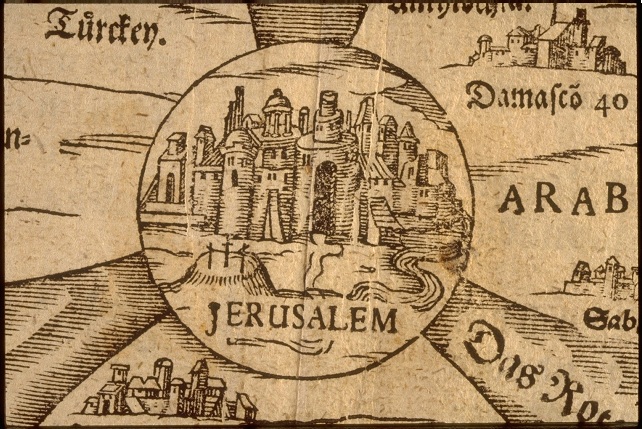
Map (above) by Heinrich Bunting from a copy of Itinerarium Sacrae Scripturae (1581) in the Jerusalem as the center of the world exhibition at the University of Southern Maine’s Osher Map Library, detail below:
**

For more on the symbolism of the axis mundi, see Mircea Eliade‘s essay Symbolism of the Centre in his book Images and Symbols — or consider these lines from TS Eliot‘s poem-series, Four Quartets:

At the still point of the turning world. Neither flesh nor fleshless;
Neither from nor towards; at the still point, there the dance is,
But neither arrest nor movement. And do not call it fixity,
Where past and future are gathered. Neither movement from nor towards,
Neither ascent nor decline. Except for the point, the still point,
There would be no dance, and there is only the dance.
I can only say, there we have been: but I cannot say where.
And I cannot say, how long, for that is to place it in time.
The inner freedom from the practical desire,
The release from action and suffering, release from the inner
And the outer compulsion, yet surrounded
By a grace of sense, a white light still and moving…

**

In many ways, both Eliot’s words and those of the Midrash remind me of the beauty found in the prayers of the Navaho Night Chant:

In beauty may I walk.
All day long may I walk.
Through the returning seasons may I walk.
On the trail marked with pollen may I walk.
With grasshoppers about my feet may I walk.
With dew about my feet may I walk.
With beauty may I walk.
With beauty before me, may I walk.
With beauty behind me, may I walk.
With beauty above me, may I walk.
With beauty below me, may I walk.
With beauty all around me, may I walk.
In old age wandering on a trail of beauty, lively, may I walk.
In old age wandering on a trail of beauty, living again, may I walk.
It is finished in beauty.

To my reading eye as a poet, these are all expressions of the same kind — invocations of the human spirit by rhythm and imagery — true poems, visions. They offer us a form of nourishment and insight not easily found today — nourishment and insight which shrivel and die when reduced to politics or prose.

**

For more on the Navaho chantways, and the balance called “sa’a naghai bik’e hózhó” which this prayer embodies, see John Farella, The Main Stalk: A Synthesis of Navajo Philosophy.
Switch to our mobile site

