zenpundit.com » 2012

Archive for 2012

The Journal of Military Operations

Tuesday, August 7th, 2012
The Journal of Military Operations  

A new peer-review “journalzine” from the IJ  Group, which publishes Infinity Journal.  The difference between the two is that Infinity focuses on strategy while the former, as the masthead implies, is dedicated to military operations as well as tactics. If you do not know what the difference between strategy and tactics are….well….reading these should help. The Editor is Dr. Jim Storr, a.k.a  Colonel Storr, author of the well regarded The Human Face of War.  Registration is free.

The maiden issue of JoMO has articles from two friends of ZP, Deputy Editor Wilf Owen and Adam Elkus.

Ironically, Wilf is  arguing against the existence of an operational level of war or the utility of separating operational art from sound understanding of tactics and strategy and criticizes Soviet strategist A.A. Svechin:

“The Operational Level of War Does Not Exist”

….Thus the definitions of strategy and tactics were and are simple, coherent and highly workable. While armies conducted ‘operations’, such activity did not impinge on the delineation of strategy and tactics. Conducting operations did not an operational level of war make!

The operational level of war is strongly associated with Soviet military thought. A.A. Svechin is often seen as the originator of the idea, when he discussed ‘Operational Art’ (operativnoe iskustvo) as conceptual connection between tactics and strategy.[iii] He defined an operation as ‘the effort of troops directed towards the achievement of a certain intermediate goal in a certain theatre of military operations without interruptions.’[iv] In the very next sentence he went on to explain that operations were designed to destroy or encircle a portion of the enemy forces to force a withdrawal of other forces, to capture or hold a ‘certain line or geographical area.’ Destroying a portion of the enemy’s armies is what battles traditionally sought to do. Svechin’s description equates strongly with battle and thus tactics, at least in terms of the outcome described.

Much Soviet and Russian writing (and Western analysis of it) on the Operational Level of War is, once subject to rigour, paper-thin and mostly a sophistry that arbitrarily creates a false and unneeded link between strategy and tactics. The extremely high losses suffered by Soviet Forces in WW2 are not symptomatic of anything other than bad tactics poorly executed. If the acme of operational art is encirclement operations, then at what level of command does this operational level of war take place? A platoon can encircle an enemy section, just as much as an army group can encircle an enemy army.

Svechin’s fundamental intellectual problem was not that he did not understand strategy or tactics, but how to function as a strategist in a society where politics as normally understood no longer existed and adherence to yesterday’s policy could be regarded as today’s evidence of treason. Indeed, this is what ultimately resulted in Svechin’s demise during the Great Terror despite his best effort to the contrary. Whatever the other merits of defining an “operational level of war” or “operational art” Sevechin was looking for an ideological safe harbor, a purely “technical” realm where military officers could do the campaign planning war required without the act of planning or doing strategy itself being ideologically suspect in Stalin’s eyes.  In 1937, this was a hopeless task, but Svechin’s legacy carved out a degree of professional autonomy for Red Army general staff officers in milder times that was unthinkable under Stalin’s rule.

Adam Elkus explains “D&D”:

“The Continuing Relevance of Military Denial and Deception”

….From the end of the Cold War onwards, Western militaries have rightly assumed that military competitors would attempt to disguise their power and deceive to draw attention away from their real capabilities and intentions. Moreover, the West’s enemies also are frequently authoritarian states for whom cheating and deception is basic political behavior. The attractiveness of deception operations and capabilities to opponents ranging from Mao’s China to Saddam Hussein’s Iraq provides empirical support for this prejudice.

But democracies are also capable of information manipulation and deception. The United States was able to exercise remarkable control over information in the 1991 Gulf War, not only shaping the media coverage’s tenor, but also protecting secrets. It is true that America cannot do so today in regards to its remotely piloted vehicle (‘drone’) program and its cyber operations in Iran. But while this demonstrates the difficulty of conducting D&D in democracies, it is not proof that D&D is impossible.

Now that the West has become fiscally weaker and weary of war, denial and deception will be crucial to engaging and destroying both conventional and irregular forces. Currently, the United States is employing special operations forces, paramilitary intelligence capabilities, and regular air and sea military platforms to acquire and target al-Qaeda affiliated groups in Africa, the Middle East, and South Asia. Information denial is key to this campaign, lest press leaks alert al-Qaeda to ongoing operations. The US reliance on human intelligence also presents opportunities for adversary deception operations, like the Jordanian double agent who executed a hit against an American spy base in Khost in 2009.

Future conventional campaigns are likely to also hinge on the employment of denial and deception. Information denial has always been a hallmark of successful Western operations, but deception has been neglected due to the brute fact of Western qualitative and material superiority. If one marches with big battalions and has better troops, platforms, and weapons, why do any extra effort to engage in deception? At times, such as during Operation Moshtarak in Afghanistan and Israeli operations in Lebanon and Gaza, operational objectives have been served by telegraphing the attack in advance in order to allow civilians to leave the target zone and intimidate the enemy.

I think Adam is on the right track here with his analysis. In an age of austerity, as the advanced states field shrinking, increasingly expensive, militaries, this will force a return to the employment of force-multiplying stratagems that are supplementary to and supportive of the employment of military force and coercion.

Scarcity is the mother of strategic invention.

Percussions and repercussions

Monday, August 6th, 2012

[ by Charles Cameron — ecology, fire, forests, an elevator in Denver, and how one thing leads to another ]
.

Guy Davenport, a stylist worthy of his Masters

.

HeraclitusHerakleitos — sees this world as one seamless “all” in constant motion and taking many forms — with what we call “fire” as the recurring form within that flux that he can point to by name, using it as his best metaphor for that “all”…

In the beautiful translation of Guy Davenport (drawn here from fragments 28 and 29 in his book, 7 Greeks, p 161:

Everything becomes fire, and from fire everything is born, as in the eternal exchange of money and merchandise.

This world, which is always the same for all, neither god nor man made: it has always been, it is, and always shall be: an everlasting fire rhythmically dying and flaring up again.

**

This is just a quick post, a little creativity flaring up and dying down again while I am preparing longer pieces on Nidal Hassan (as discussed by Daveed Gartenstein-Ross, JM Berger and emptywheel), a zennish biography of John Cage, and Rain (with a capital roar) in African religion and urban settlements.

I was glancing at Chris Bright‘s entry Anticipating Environmental “Surprise” in State Of The World 2000, and my eye was caught by the phrase, “Surface fires do not climb trees and become crown fires.”

I’d never heard of “surface fires” and “crown fires” before, and “crown fires” in particular had me thinking there’s poetry here…

So I took a deep breath, slowed down, and read more carefully. And as I was reading the whole short section that began with those words, one part of my mind was soaking in the vivid images the text conjured up for me, but another part was calculating percentages in what seemed to be a rapidly accelerating descent.

I have tried to picture that double effect — of lush rainforest and the numbers that illustrate its fiery fall — in what follows:

**

100%

Surface fires do not climb trees and become crown fires. They just crackle along the forest floor, here and there, as little patches of flame, going out at night, when the temperature drops, and rekindling the next day. They will not kill the really big trees, and they do not cover every bit of ground in a burned patch. But they are fatal to most of the smaller trees they touch. Overall, an initial surface fire may kill perhaps 10 percent of the living forest biomass.

90%

The damage may not look all that dramatic, but another tract of forest may already be doomed by an incipient positive feedback loop of fire and drying. After a surface fire, the amount of shade is reduced from about 90 percent to around 60 percent, and the dead and injured trees rain debris down on the floor. So a year or two later, the next fire in that spot finds more tinder, and a warmer, drier floor. Some 40 percent of forest biomass may die in the second fire. At this point, the forest’s integrity is seriously damaged; grasses and vines invade and contribute to the accumulation of combustible material.

50%

The next dry season may eliminate the forest entirely.

0%

.
**

Those falling numbers remind me of the floors whizzing by in an elevator I once frequented in Denver — where the framed elevator license said, ominously enough, Type: Plunger.

And so here we are at “Ground floor: Perfumery, Stationery and leather goods”.

One very simple part of how complex the world we live in really is has to do with repercussions…

Recommended Reading & Viewing

Monday, August 6th, 2012

Top Billing! Grand Blog Tarkin (Jon Jeckell) – The Jedi Way of War

….While it seems the Jedi would be the only institution competent in warfare after thousands of years of peace, they were the worst possible choice on many levels. What institution within the Republic retained any practical knowledge of warfare? Some private institutions and individual planetary governments, such as Naboo, had their own modest security forces, but the Republic seemed to lack any other institution capable of employing coercion on behalf of the state. This study will elide the political, policy and civil society aspects and focus on explaining why the Jedi Order were a uniquely poor choice to lead the Grand Army of the Republic. Although it superficially appears the Jedi are the only ones capable of taking on this burden, they suffered from numerous institutional biases and a philosophy that impeded their ability to understand what was happening or adapt to realities of their new role. Leading a massive Army was not a linear extension of the skills the Jedi possessed, and they lacked the ability to gain those skills.

Although the Jedi were renowned diplomats and keepers of the peace, they were not politicians or strategists, and never critically examined the Separatist’s grievances to identify the root causes of the conflict. Without understanding the causes of conflict, they failed to develop a theory of victory. Without this, they merely continued to pursue of the Separatist leaders and the destruction of their army after the first engagement. They failed to reframe from their roles as individual combatants to leaders of an Army for a multitude of reasons explored below.

The much talked about post of the week where science fiction meets strategic analysis.

Diane Ravitch –Rahm and Other People’s Children 

One of the themes of the corporate reform movement is this:

“We know what’s best for other people’s children but it is not what’s best for mine.”

Many of the leading corporate reformers went to elite prep schools and/or send their children to them.

Schools like Exeter, Andover, Deerfield Academy, Sidwell Friends, the University of Chicago Lab School, Lakeside Academy (Seattle), Maumee Country Day School (Toledo). At these schools there are beautiful facilities, small classes, experienced teachers, well-stocked libraries, science laboratories, and a curriculum rich in the arts, sciences, languages, and other studies.

I hope you read this post about Chicago billionaire and school board member Penny Pritzker. She sends her children to the University of Chicago Lab School, which has the best of everything, but feels no embarrassment that the children of Chicago who attend public schools that she oversees do not have the same advantages.

Mayor Rahm Emanuel sends his children to this school. Arne Duncan is a graduate of it.

Remember that theme: Other People’s Children.

This reader thought about what Mayor Rahm Emanuel wants for his own children. Why doesn’t he want the same for all Chicago’s children? 

Good charter schools tend to be based upon delivering a different, innovative, curriculum well or serving a specific, generally disadvantaged, student population (the original, largely forgotten and abandoned, justification for charter schools). The founder is usually there on site, putting in long hours, leading by example, working with children, because their educational vision is a mission and labor of love. Their own kids are usually their first students.

Unfortunately, that has little or nothing to do with the Corporate Ed Reform pushed by both President Obama and Governor Romney, which rides on the reputation of the mom & pop charters but frequently fails to live up to it because their mission is a profit-maximizing business model devised by and lobbied for by hedge funds and private equities firms to divert public tax dollars to investors at the lowest delivery cost possible.  That model is not compatible with quality education and isn’t intended to be. If it were, the owners and investors would be enrolling their own children in the highly regimented, rote-learning script, worksheet based schools and “virtual charter” scams they are pushing on states, cities and school districts.

Conspicuously, they don’t.

WPR (Steve Metz )- A Necessary Evolution: U.S. Military Strategy Goes Invisible 

….It also became clear that the belief that removing Saddam Hussein or the Taliban from power would strike a mortal blow against al-Qaida and other terrorist organizations was unfounded. If anything, the war in Iraq added to the terrorism problem by radicalizing thousands more terrorists and giving them an opportunity to acquire training and experience. Even the demise of the Taliban regime in Afghanistan, though it forced al-Qaida to relocate and reorganize, was not the body blow to terrorism that the Bush administration hoped. Rather than deterring extremists, it motivated new ones. 

Terrorism, it turned out, was not a nail after all. 

But a strange thing happened along the way to this simple discovery: The United States developed a different form of offensive military action — reliance on invisible or less-visible actions such as strikes by special operations forces and unmanned aerial vehicles — which held more promise. While they might not have led to a decisive and unambiguous victory over terrorism, these approaches certainly degraded the extremists’ capabilities. 

Google lends it’s analytical heft and cool graphics in a not so subtle effort to aid supporters of the UN Small Arms Treaty. Some of the stats for third world nations, or major arms exporters like Russia, appear impossibly small or are absent. For example, somehow, I think Afghanistan has imported some weaponry in the past twenty years. Click through and see if you agree.

John Robb – How Do You Attract Resilient People? Give Them Room to Grow 

Fred Leland –Check out My Latest P1 Column: Patterns of behavior, officer safety, and ‘the rule of opposites’

SWJ Blog –Why There’s Nothing Illegal about CIA Drone Pilots  

Eide Neurolearning Blog –The Steps of Creativity – Early Crowd sourcing and Prototyping 

Gunnar Peterson – Security > 140 Conversation with Jason Chan 

Abu Muqawama – Guest Post: The Last Argument of Tyrants 

Feral Jundi –California: Sacramento International Airport Dropping TSA

Shloky.com – VIDEO: THE WORLD THAT SCVNGR/FOURSQUARE/ETC WANT

RECOMMENDED VIEWING:

IVN Article:Competition in the Age of Frenemies

Saturday, August 4th, 2012

I have a short piece up at IVN:

Competition in the Age of Frenemies 

competition in the age of frenemies 47130 Competition in the Age of Frenemies

Credit: lib.utexas.edu

Ideology is being replaced by realpolitik in the world political arena, with competition and cooperation between frenemies perhaps becoming the norm. The war on terror began on September 11, 2001 in New York City and Washington DC, where teams of terrorists professing a militant brand of Sunni Islamism killed thousands of Americans using commercial airliners, brought down the World Trade Center, damaged the Pentagon and caused roughly $100 billion in direct and indirect economic damage and possibly $2 trillion in subsequent expenditures on military operations and security.

….By 2012, the global picture has drastically changed. Osama bin Laden is dead and his fanatical followers are able to operate freely only in the poorest, most remote or desolate regions of the earth – northern deserts of Mali, the lawless hinterlands of Yemen, Pakistan’s wild tribal belt and ruined villages in war-torn Syria. Instead of a laser-like focus on al Qaida, the next President will have to  worry more about economic collapse in Europe, China bullying it’s neighbors over the South China Sea, civil wars in Mexico and Syria and Iran’s quest for the nuclear bomb. 

Read the rest here. 

This is a quick synopsis of an idea I am playing with lately.

It is of course, contingent. If Egypt takes a nasty turn and a post-Assad Syria falls to Salafi-Takfiri extremists ( creating a religious variant of the old Nasserite UAR alliance) we might be talking about a “Sunni Axis” with a radicalized Pakistan giving new life to transnational, revolutionary jihadism.

Without that , the prospects for al Qaida’s vision of political Islam look increasingly grim. As the the AQ strategist al-Suri noted, the loss of Afghanistan in 2001 as a secure base of operations, training ground and state sponsor was a heavy blow to the forces of radical Islamism.  A lack of replacement after ten years is an embarrassing state of affairs for a militant movement whose political center of gravity in the Islamic world is the claim of doing God’s will against the infidel.

Techno-Mahdi?

Saturday, August 4th, 2012

[ by Charles Cameron — of no practical importance, yet curious indeed, Mahdism, Pakistani history, shamanism, magic, the Kwakiutl / Tlingit, religion ]
.

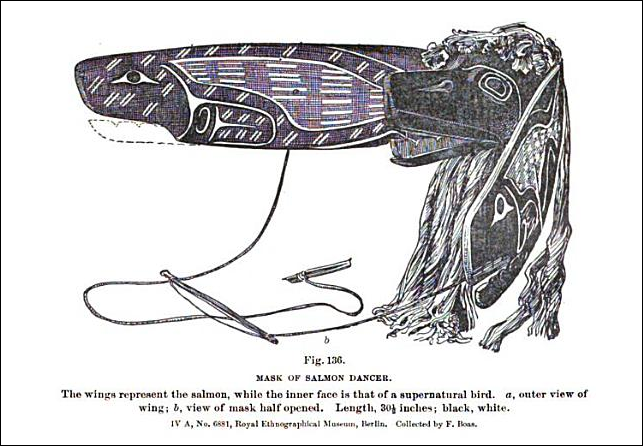
Kwakiutl Salmon Dancer's mask

.

I really don’t have much to say about this, but I’d like to note it as one more instance of Mahdism cropping up in unlikely places. And a h/t to Scott McWilliams @macengr for pointing me to the story. I can’t entirely vouch for its accuracy since I don’t have easy access to 1970s Pakistani newspapers, but I’ve seen allusions to the same story dating back a couple of years

When the Pakistani army and bureaucratic establishment realized that Mujib-ur-Rehman’s Awami League and Zulfiqar Ali Bhutto’s PPP were attracting people—with no other party able to draw even 5000 to its rallies—they imported Zohra Fona, a woman from Indonesia, pregnant with Imam Mehdi. She had visited several Islamic countries, it was propagated, where rulers had offered prayers in her Imamat [i.e. she led the prayers even if a woman is not supposed to do that].

Many Muslim intellectuals and scholars claimed through their writings and lectures that the time for Imam Mehdi’s appearance had arrived. A new Islamic world was about to emerge. During this period the Islamic parties, including Jamat-e-Islami, perpetrated violence. Members started attacking liberal and progressive professors, doctors, writers, journalists as well as their houses. They also burned many libraries and collections of books.

Zohra Fona claimed that the child in her womb recited Azaan [call for prayers] and could lead the prayers. Ulema like Maulana Okarvi and Ehtesham Ul Haque went to see Zohra Fona and listened to Azan with ears close to lady’s womb. Prayer events were arranged for her in open places as well as in the larger mosques, and the Ulema [religious scholars] were praying behind her. She would stretch her legs towards Kaaba [Mecca], directing her womb toward the pulpit. Suddenly Azaan would start coming from her womb or from another private part. The Ulema were so shameless that they were offering prayers while focusing their eyes on her private parts.

Back then the left was very organized so it was difficult to explain this farce. Finally the Pakistan Medical Association and doctors at Jinnah Hospital, Karachi decided to unearth the drama. Several lady gynecologists were asked to help; they knew that this kind of thing could not happen. But Zohra Fona was very clever. Whenever doctors were pursuing her to take a medical examination she avoided with help from the Pakistani security forces. But one day, when she was unable to escape, the doctors of Jinnah hospital, Karachi conducted an examination. The doctors recovered a small tape recorder from her womb.

Does the bit about the tape-recorder in the womb sound a bit far-fetched? Here’s another version, this one from The [International] News:

Zohra Fona, a blessed Indonesian woman, arrived in Pakistan just ahead its first general elections. She was said to be expecting a child who would be Imam Mehdi. She had visited several Islamic countries where, and it was propagated, that rulers had offered prayers in her imamat. Many ulema began to claim that the time for Imam Mehdi’s coming had arrived.

Zohra Fona claimed that the child recited Azaan. Reputed ulema like Maulana Okarvi and Ehteshamul Haque met Zohra Fona and listened to the Azaan with ears close to the lady’s stomach. She began to draw huge crowds to mosques and parks where she led prayers. Our reputed ulema would join the prayers.

Woe betide this country! Some leftist and agnostics at Karachi’s Jinnah Hospital decided to put the legend to scientific test. It was revealed that the holy woman was not even pregnant with an Azan-reciting messiah but had a recording device tied to her body. She immediately left for Indonesia once the farce was exposed.

That sounds more plausible.

**

A word of caution here.

Just as theater and film sometimes deploy “deux ex machina” interventions to immerse their audiences more deeply into their created micro-worlds, so have shamanic performances.

I’ve written about this before in an email to a religious scholars’ list, and in these days when even self-plagiarism is disdained, I am going to repeat here what I wrote then, with very minor changes:

It’s my recollection that [Tlingit / Kwakiutl winter ceremonials] were both entertainment for the long winter nights and “schooling” for the young, and I have a vivid recall of reading somewhere a shaman’s admission to an anthro of the exact nature of the dramatic means by which the shaman’s capacity to defeat death was demonstrated.

I read this in the early eighties, but searching on the web I’ve found something that comes close — Clellan Stearns Ford’s record of Charles James Nowell’s memories in _Smoke from their fires: the life of a Kwakiutl chief_. Around p 120, there are two stories, the first about a girl who “turned the wrong way” during a dance, the second about a girl who is put in a box and burned. In both cases, the nature of the trickery is described but in the version I read all those years ago, the two stories were one — the girl who was put in a box in the fire pit and “burned to death” escapes through a false bottom to the box along a tunnel into the adjoining room, and her voice then issues as if from her ashes, via a kelp tube that goes from the tunnel to the adjoining room where she’s now standing.

She describes her descent into the sea realm, where she is chastened and eventually granted a boon to return to the tribe. A canoe sets out to fetch her, but by the time the audience sees it set out, she’s already secured by rope to the far side of the boat, and at a suitable distance is hauled aboard and brought back to shore, alive.

A child seeing this would be mightily predisposed to believing the shaman had healing powers, and by the time the ruse was revealed, that underpinning of faith is already in place.

In the Nowell version, even the adults, who “know” the deception involved, are deceived: “The fire burned and the box burned, and she was still singing inside, and then the box go up in flames, and they can see her burning there in her blue blanket, and all her relatives just cry and cry. Although they know it is not real, it looks so real they can’t help it. It was all a trick. There was a hole under the box with a tunnel leading out of the house, and the woman went out of the box and put a seal in her place wrapped in a blue blanket, and then someone sang into the fire through a kelp tube, her song. Oh, it looked real!”

The Winter ceremonials of the Pacific Northwestern tribes are by turns opera, history, religion and “general education” to the children of the tribe, and “continuing education” to their elders…

Do we have anything to equal them?

Bearing such things in mind, we may want to consider trickery — a quality of the trickster gods, after all, in many mythologies — a not entirely illegitimate activity for a religious performer…


Switch to our mobile site