zenpundit.com » 2012

Archive for 2012

Two annexes to my post: It’s an abomination!

Saturday, July 21st, 2012

[ by Charles Cameron — finding feedback loops in blindspots, truths in symbols, strength in ideas ]
.

photo credit: Mobile News UK

.

It is in the nature of analogical thinking that it moves sideways, or more precisely, in honeycomb fashion, rather than forwards — and so it is that my just completed post It’s an abomination! leads me to two other considerations:

**

My first is to compare the situation of the Pakistani gentleman preparing and selling flags for burning

The man who dominates much of the supply chain of American flags to religious groups, 30-year-old Mamoon-ur-Rasheed – who’s been publishing anti-American placards and hand-made stars and stripes since his school days, when he was angered by the Clinton administration’s sanctions on Pakistan following its nuclear weapons testing in 1998 – is now remarkably dispassionate about his services, as well as about the short shelf-life of his flammable goods.

“We work hard for our product, and we get paid for our product,” says Rasheed, clad in a camouflage baseball cap and seated behind a desk that takes up most of the space in his eight-by-six-foot office in Gulashan-e-Iqbal, one of the city’s oldest working class neighborhood.

“So what if it burns? The purpose of the flag is to last for an hour. It’s unfortunate, but if the demand is for an hour, then the supplier must meet such demand too,” he says.

— with the no less entrepreneurial fellows in Cambodia who capture birds for the express purpose of selling them to those who wish to set them free:

Merit release — procuring animals that are about to be slaughtered and releasing them back into the wild — is a tradition practiced, to different degrees, by various Buddhist groups each year. It sounds like a good — and yes, meritorious — idea, but you might want to think twice before trying it. Why?

Well, as Conservation Magazine reports, hundreds of thousands of birds are caught in Asia each year just so they can be bought for merit release, putting them through the unnecessary stress of catching them just to be set free again. But there’s more. Many of these birds are infected with avian flu virus and other pathogens, and they can infect other birds, animals and people when they’re released. According to the study, published in Biological Conservation, 10 percent of the Cambodian birds the researchers tested were infected with avian influenza. “The presence of pathogenic viruses and bacteria among birds available for merit release is a concern both to wild bird populations and to humans involved in the trade,” the authors write.

The lesson here being that there are always more things going on than catch the eye, and that feedback loops in your blindspots are liable to getcha

**

My second is to compare Coleridge‘s observation about symbols:

On the other hand, a Symbol is characterized by a translucence of the Special in the Individual or of the General in the Especial or of the Universal in the General. Above all by the translucence of the Eternal through and in the Temporal. It always partakes of the Reality it renders intelligible; and while it enunciates the whole, abides itself as a living part in that Unity, of which it is the representative.

with the quote from Anais Nin that I referenced recently in relationship with Marisa Urgo‘s comment on Zawahiri:

The personal, if it is deep enough, becomes universal, mythical, symbolic…

And here the moral is that words can at times cut deeper than sticks and stones — in the words of that 2006 National Strategy for CT I just quoted, that winning the War on Terror means winning the battle of ideas — or as another poet, Muriel Rukeyser famously put it, that:

The universe is made of stories, not of atoms.

It’s an abomination!

Saturday, July 21st, 2012

[ by Charles Cameron — the perils of adding scriptures to scripture, tearing or burning them — and flags, paper money too ]
.


.

It may be that the last time you used the word abominable it was in relation to a snowman. It’s not a word that’s frequently on my tongue, I have to admit, but an Israeli MK apparently used it — or it’s Hebrew equivalent — to describe the New Testament, which he was in the process of ripping up.
.


.

Shades of Pastor Jones burning a copy of the Quran!

**

The thing is, when you have a sacred scripture it’s delimited, it’s hands-off! And if someone else comes along and adds a slim volume or two, it’s an abomination, almost by definition, sight unseen.

Thus the New Testament is an abomination to Knesset member Michael Ben Ari, according to YNet:

“This abominable book (the New Testament) galvanized the murder of millions of Jews during the Inquisition and during auto da fe instances,” Ben Ari said adding that “Sending the book to MK’s is a provocation. There is no doubt that this book and all it represents belongs in the garbage can of history.”

And please note, I am definitely not suggesting that Ben Ari is representative of all Jews — nor, for that matter, Pastor J. Grant Swank of all Christians. Yet from Swank’s perspective, the Tanakh and New Testament are scriptures, but, and I’m quote him:

Obama’s so-called holy writ is the abominable Koran.

The Qur’an is a later scripture, neh?

And Swank’s tirade gets better. Still speaking of the President of the United States, he continues:

His hope for eternity is unknown; but if he becomes a suicide bomber for Allah, he will be guaranteed pronto a score of virgins for everlasting. His hope for the present seems to be his reliance upon Islam’s Koran furthered by his clandestine support of Islam World Rule via czars and a shadow government given to overthrowing our Republic.

And then on the other side of the political aisle there’s Mitt Romney‘s Latter-day scripture, The Book of Mormon, which bills itself as Another Testament of Jesus Christ. It too has been considered an abomination.

I don’t know if people still use the word much when talking about the Book of Mormon, it’s considerably less controversial these days than the Qur’an — but abominable was what Arthur Cleveland Coxe called it in his 1855 Sermons on doctrine and duty, writing of Joseph Smith:

an obscure and illiterate individual, in our great West, was busily forging the abominable “Book of Mormon,” which, fourteen months later, he foisted into the world…

People really don’t like other people making add-ons to their scriptures, do they?

**

Scriptures — and flags.

Look, I weep for a religion some of whose adherents kill when their scripture is burned or defiled, and I am glad for a religion that condemns such killings. As you might expect, there are tearers and burners in all three Abrahamic religions, and all three religions have those who object to such tearings and burnings.

And yes, the ratios of religiously-provoked modes of destruction vary across religions and across centuries…

**

But what of flags?

I raise the issue because a fellow in Pakistan who manufactures flags for burning, Mamoon-ur-Rasheed, was in the news recently, and made this point:

Isn’t flag burning positive, compared to American atrocities? And also compared to the Taliban? We’re not attacking mosques. … We’re not targeting American embassies. We’re not killing anyone. Nor are we flying drones around, we’re just burning flags, mere pieces of cloth, and then we’re done. It’s over.

Setting aside Rasheed’s political opinion, Matthew Wallin at American Security Project asks the right questions in the security context:

Is it really over after the deed is done? Does anger against the United States dissipate? What do people do after they have gone home after a flag burning?

A key question to answer is: how much of these protests are translating into actual violence? This is an element that must be understood to determine if flag burning is simply a form of protest, or if those involved are planning more sinister actions. We must also seek to understand to what degree these protests endanger traditional diplomacy efforts and the challenges faced by members of the Pakistani government attempting to pursue diplomatic cooperation with the United States. If they are harmless expressions of anger and frustration, we have an obligation to understand this.

But that’s really just the beginning of a much wider-ranging discussion, philosophically speaking, which Rasheed’s comments also address:

what’s the relation of a symbolic object to the reality is symbolizes? If a flag is hurt, does it hurt the United States? If a Bible is burned, does it hurt Christianity? God?

If the word “spider” was an actual, live spider, arachnophobes couldn’t read the rest of this sentence… Is Picasso’s signature on a two dollar check worth as much as his signature on a check for a thousand bucks? Come to that, when paper money goes up in smoke when a house catches fire, where does the value go?

And yet, and yet, we are very attached to our flags, our scriptures — and our money.

**

The poet Coleridge in his Statesman’s Manual suggests:

On the other hand, a Symbol is characterized by a translucence of the Special in the Individual or of the General in the Especial or of the Universal in the General. Above all by the translucence of the Eternal through and in the Temporal. It always partakes of the Reality it renders intelligible; and while it enunciates the whole, abides itself as a living part in that Unity, of which it is the representative.

So. Do we find this translucence in our scriptures, in our flags, in our money, in our fellow humans — in the world around us?

Guest Post: Shlok Vaidya Reviews Kill Decision by Daniel Suarez

Saturday, July 21st, 2012

Shlok Vaidya is a longtime friend of zenpundit.com and is a consultant on technology and security issues, including terrorism and the Naxalite insurgency. When I heard that Shlok had received a coveted advance copy of the latest novel by Daniel Suarez, I cordially invited him to cross-post his review here. Vaidya blogs on books, technology, warfare and resilient communities at Shloky.com.

REVIEW: KILL DECISION BY DANIEL SUAREZ

by Shlok Vaidya

Kill Decision is startlingly real. And equally plausible.

Suited masters of perception playing games with reality while skipping scotch in Crystal City. D.C.’s incestuous relationship between big defense business and… everyone else. Nameless, compartmentalized operators fighting through the night in cesspools loosely labeled as countries. Drones raining from the skies.

For those familiar with the constellation of clandestine units, private military contractors, and information warriors that comprise much of America’s counter-terrorism capacity, this book will feel very, very real.

(If you’re not up to speed, I heartily recommend Marc Ambinder’s The Command as a quick/cheap/quality introduction to that world.)

But Kill Decision takes that reality a step forward. In a way that perhaps cements Suarez’s position as the best near-future fiction author of the post-9/11 era. He folds in equal parts science, warfare, and informed futurism to take today’s sleek drones to their logical conclusion. The results will gnaw on your brain like a swarm of gnats, for weeks after you read the book.

This is possible, of course, due in large part to his foundation in John Robb’s work (something Suarez graciously mentions in his acknowledgements). Readers of Brave New War and Global Guerrillas will find themselves nodding along.

Kill Decision is that real, yet, like Suarez’s Freedom and Daemon, it’s also a lot of fun. Great action sequences that just scream MAKE A MOVIE. Compelling characters. Quality narrative. It’s all in here.

Grab it today if you want to see tomorrow.


Review: Poetry of the Taliban

Friday, July 20th, 2012

[ by Charles Cameron — poetry, humanity, dehumanizing, enmity and amity, image and likeness ]
.

I wrote this review-essay for Books & Culture: A Christian Review — the book review site associated with Christianity Today — where it was published earlier today. I am grateful to my old friend John Wilson for permission to cross-post it here.

I posted a reading of a single poem from the same anthology here on ZP in May: Change: a poem from The Poetry of the Taliban

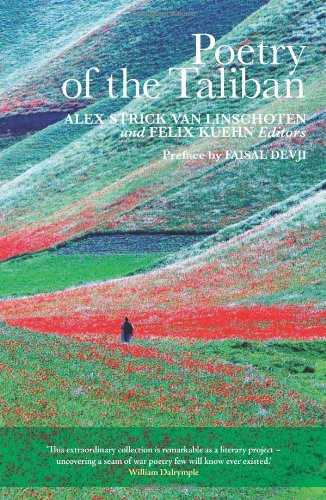
Poetry of the Taliban (Columbia/Hurst)

Columbia University Press, 2012
176 pp., $24.50Buy Now


CHARLES CAMERON

Poetry of the Taliban

Regarding the image and likeness.

Which heart’s voice is this that directly enters into my heart?
Which brute’s ears are these that are deaf to this?
Which sigh of the defenceless is shaking God’s domain?

The poet is Dr. Faizullah Saqib, and the poem is taken from an anthology of poetry written by the Taliban, our enemies. Could it not have been written when an earlier generation of mujaheddin, resisting the Soviet occupation, were our friends? What is this thing, enmity?

Poetry is not simply another weapon the Taliban have decided to use for wartime purposes. Poetry is integral to Afghan culture, and while there are “official” Taliban poems, the flourishing “unofficial” poetry of the Taliban is the place where their Afghan love of poetry takes flight, and the varied aspects of war have been woven into it in much the same way that helicopters have been woven into Afghan carpets: as part of the pattern. There’s an interesting quote on the Textile Museum of Canada website, in fact, relating to Afghan war rugs: “On their rugs flowers turned into cluster bombs, birds turned into airplanes.”

War changes us, war changes everything. Most significantly, I’d suggest, war changes the nature of those we label enemies. We do this anti-sacramental thing, we de-humanize them. As Samiullah Khalid Sahak writes in a poem in this volume,

They don’t accept us as humans,
They don’t accept us as animals either.
And, as they would say,
Humans have two dimensions.
Humanity and animality,
We are out of both of them today.

We are not animals,
I say this with certainty.
But,
Humanity has been forgotten by us,
And I don’t know when it will come back.
May Allah give it to us,
and decorate us with this jewellery,
the jewellery of humanity,
For now it’s only in our imagination.

War tends to do this; it strips people of their humanity—and the stripping tends to boomerang. As Archbishop Desmond Tutu put it,

when we dehumanize someone, whether you like it or not, in that process you are dehumanized. A person is a person through other persons. If we want to enhance our personhood, one of the best ways of doing it is enhancing the personhood of the other.

I said we “do this anti-sacramental thing, we de-humanize’ those we identify as the enemy. And there are really two significant points here, one to do with dehumanizing the other and its impact on us, while the other has to do with the sacramental—with humanizing and loving the other.

Brigadier General S. L. A Marshall, later the official historian of the European theater in World War II for the US Army, found by asking soldiers in the field that “out of an average of one hundred men along the line of fire only fifteen men … would take any part with the weapons.” As a Guardianarticle put it much later,

Marshall’s astonishing contention, debated vigorously ever since, was that about 75% of second world war combat troops were unable to fire their weapons on the enemy. Guns were discharged, but they would be deliberately aimed over the heads of the enemy. The vast majority of soldiers couldn’t actually kill. And, in the midst of combat, they became de facto conscientious objectors.

Marshall’s conclusion, contained in his 1947 book Men Against Fire, was that:

It is therefore reasonable to believe that the average and healthy individual—the man who can endure the mental and physical stress of combat—still has such an inner and usually unrealized resistance towards killing a fellow man that he will not of his own volition take life if it is possible to turn away from that responsibility.

And the result of this?

Lt. Col. Dave Grossman, a former Ranger who has taught psychology at West Point, wrote in 2007, “Since World War II, a new era has quietly dawned in modern warfare: an era of psychological warfare, conducted not upon the enemy, but upon one’s own troops.” That too is a sort of boomerang effect: we now find ourselves needing not only to dehumanize the enemy, but to desensitize (and how different is that?) ourselves.

Grossman, whose book On Killing: The Psychological Cost of Learning to Kill in War is another major contribution to our understanding here, goes on to describe the “triad of methods used to enable men to overcome their innate resistance to killing” as including “desensitization, classical and operant conditioning, and denial defense mechanisms”:

During the Vietnam era millions of American adolescents were conditioned to engage in an act against which they had a powerful resistance. This conditioning is a necessary part of allowing a soldier to succeed and survive in the environment where society has placed him. If we accept that we need an army, then we must accept that it has to be as capable of surviving as we can make it.

But if society prepares a soldier to overcome his resistance to killing and places him in an environment in which he will kill, then that society has an obligation to deal forthrightly, intelligently, and morally with the psychological repercussions upon the soldier and the society. Largely through an ignorance of the processes and implications involved, this did not happen for Vietnam veterans—a mistake we risk making again as the war in Iraq becomes increasingly deadly and unpopular.

And what’s the basis for this? Sebastian Junger hung out for the better part of a year with troops in one of the most heavily contested parts of Afghanistan’s Korengal Valley, describing what he saw there in the bookWar and the film Restrepo, which he directed. Junger commented not so long ago in the Washington Post:

I can’t imagine that there was a time in human history when enemy dead were not desecrated. Achilles dragged Hector around the walls of Troy from the back of a chariot because he was so enraged by Hector’s killing of his best friend. Three millennia later, Somali fighters dragged a U.S. soldier through the streets of Mogadishu after shooting down a Black Hawk helicopter and killing 17 other Americans …. Clearly, the impulse to desecrate the enemy comes from a very dark and primal place in the human psyche. Once in a while, those impulses are going to break through.

And:

They are very clear about the fact that society trains them to kill, orders them to kill and then balks at anything that suggests they have dehumanized the enemy they have killed.

But of course they have dehumanized the enemy—otherwise they would have to face the enormous guilt and anguish of killing other human beings …. It doesn’t work …, but it gets them through the moment; it gets them through the rest of the patrol.

People who fight wars find it easier to kill people they have dehumanized. Perhaps, as Junger suggests, it makes it easier to handle, for a while, the burden of having killed. But then comes the post-traumatic stress, the label “PTSD,” the rising tide of military suicides.

It’s almost easier for me to go to the sacramental side.

All terror is sacramental, Joseba Zulaika suggests in Terror and Taboo: The Follies, Fables, and Faces of Terrorism—an “outward and visible sign of an inward and spiritual grace,” as evidenced by the stories of miracles recounted by bin Laden’s mentor Abdullah Azzam in his book, The Signs of the Merciful in the Jihad of Afghanistan.

It is with sacramental eyes, then, that we must understand and oppose terror, as William Cavanaugh in Torture and Eucharist suggests we should the “disappearances” and torture under the Pinochet regime in Chile. The issue, again, is that of personhood, of humanity, of the image and likeness.

Of which the poets Samiullah Khalid Sahak and Faizullah Saqib speak.

Sun Tzu in The Art of War advises us to know our enemy. Christ goes further, and instructs us to love. He instructs us in loving:

But I say unto you, Love your enemies, bless them that curse you, do good to them that hate you, and pray for them which despitefully use you, and persecute you.

Somehow, we are to understand a new relationship of enmity with amity.

Perhaps the poetry of the Taliban can show us something of our enemy’s humanity, brutal and angelic by turns, as is that humanity with which we ourselves contend:

Like those who have been killed by the infidels,
I counted my heart as one of the martyrs.
It might have been the wine of your memory
that made my heart drunk five times.
The more I kept the secret of my love,
This simple ghazal spoke more of my secrets.
—Khairkhwa

Charles Cameron is a writer, teacher, and game designer.

At the round earths imagin’d corners

Friday, July 20th, 2012

[ by Charles Cameron — mapping, holding two worldviews in mind at one time, a conductor’s score, complexity thinking ]
.


.

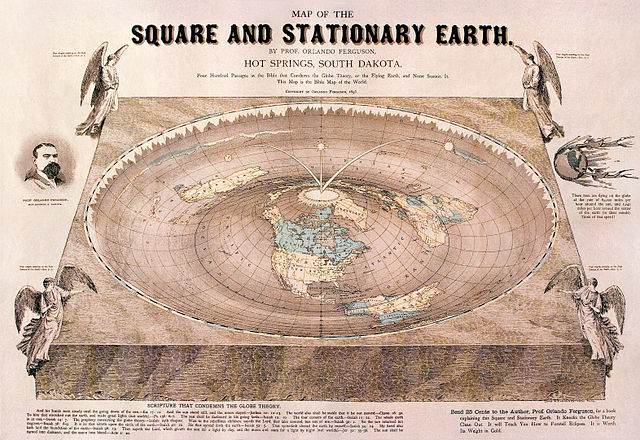
About a year ago, the Atlantic reported that the Library of Congress had been given a map of the flat earth, designed according to Biblical principles — yet showing knowledge of the border between the United States and Canada…

Thanks to a post from Jason Wells, I saw it today.

The view that the earth is flat is one worldview, of course, and no longer the prevailing one. As Nicholas Jackson noted at the Atlantic:

The interesting thing about the map is that it was created about 120 years ago by Orlando Ferguson, then a practicing physician in Hot Springs [South Dakota]. This is more than 500 years after most educated people gave up on the idea of the Earth as flat and accepted the spherical viewpoint first expressed by the Ancient Greeks.

**

It is, however, possible to hold two worldviews in mind at the same time. John Donne manages it in the first line of his extraordinary poem, written at a time when the two views were clashing:

At the round earths imagin’d corners, blow

AT the round earths imagin’d corners, blow
Your trumpets, Angells, and arise, arise
From death, you numberlesse infinities
Of soules, and to your scattred bodies goe,
All whom the flood did, and fire shall o’erthrow,
All whom warre, dearth, age, agues, tyrannies,
Despaire, law, chance, hath slaine, and you whose eyes,
Shall behold God, and never tast deaths woe.
But let them sleepe, Lord, and mee mourne a space,
For, if above all these, my sinnes abound,
‘Tis late to aske abundance of thy grace,
When wee are there; here on this lowly ground,
Teach mee how to repent; for that’s as good
As if thou’hadst seal’d my pardon, with thy blood.

Donne accomplishes the task of holding two worldviews in mind at one time with four simple words: “round earths imagin’d corners”.

**

I don’t know how many melodic “lines of thought” the mind can hold in counterpoint at once. I do know it’s an important cognitive skill for us to cultivate. A classical conductor must surely be able to hold as many lines as there are in this page of Olivier Messaien‘s Oiseaux:

As I pointed out in a recent comment here, “somewhere above three and before eleven there’s a point — Miller’s ‘magical number seven, plus or minus two‘ where the human mind can’t hold any more detail, so that’s a cut-off of sorts.”

Well, Messaien clearly imagines the conductor’s mind can follow more than eleven paths…

**

And then there’s Bob Milne.

I’ll let the Philosophy Compass take it from here:

Bob is predominantly known for his piano concerts of Ragtime and Bogie-Woogie music – and was given the moniker of ‘National Treasure’ by the United States Library of Congress. It was at one of these concerts that drew the attention of Penn State neuroscientist Kerstin Bettermann. At his concerts, Bob often carries on conversations, telling stories and jokes, while simultaneously modulating key signatures over the polyrhythmic Ragtime music. In their broadcast, Radiolab discusses with Dr. Bettermann why this is so surprising.

Language use and musical competency often use the same neural resources: the prototypical language areas in the left hemisphere of the brain, and the working memory circuit that keeps information available and rapidly accessible for a short-period of time. Our ability to use language and engage with music should, on most models of the brain, be competing for these neural resources and interfere with one another. Not so with Bob – he appears to be able to tackle both tasks with ease. Further, while most people can approach this kind of competency in multi-tasking, it usually involves many learning trials, a process of sedimenting the learning into what psychologists call procedural memory, which may have its roots in a different brain region, the cerebellum. But Bob can hear a tune just once, and play it back with commentary.

But that’s not all Bob can do.

In their interview, Dr. Bettermann heard Bob claim something extraordinary. He claims not only to be able to hear a symphony in his head, but that he normally does this with two symphonies simultaneously. Where most individuals would only hear a cacophonous mess – Bob claimed he could dial the relative volume of either symphony up or down, and could zoom in or out of individual instrumentations. To return to the considerations above, Bob further states on the Radiolab website that he does this while driving – another procedural memory task and presumable source of interference. But when Dr. Bettermann challenged him, Bob reluctantly claimed that he could probably do the same (not while driving, mind you) with four simultaneous symphonies.

The claim is something like this: Bob states that he can hold and listen to four symphonies with different keys, instrumentation, tempo and style in his working memory at the same time. And what is stunning is that when they put Bob into an fMRI machine, they verified his claim. Bob could be stopped at any time during his imaginative trip through the four simultaneous symphonies, and hum out the exact phrase that the original recording would be on. Remarkable.

**

This in turn takes us back to that point Edward Said made, which gave me the basic concept for my Said Sympohony (must get back to that soon):

When you think about it, when you think about Jew and Palestinian not separately, but as part of a symphony, there is something magnificently imposing about it. A very rich, also very tragic, also in many ways desperate history of extremes — opposites in the Hegelian sense — that is yet to receive its due. So what you are faced with is a kind of sublime grandeur of a series of tragedies, of losses, of sacrifices, of pain that would take the brain of a Bach to figure out. It would require the imagination of someone like Edmund Burke to fathom.

Edward W. Said, Power, Politics, and Culture, p. 447 — from the section titled “My Right of Return,” consisting of an interview with Ari Shavit from Ha’aretz Magazine, August 18, 2000.

I asked in a post yesterday how good we now are at modeling or simulating ideas in the “war of ideas” — just for a moment, suppose we could think through all complex geopolitical issues in this polyphonic, contrapuntal way…

**

Okay, you deserve a reward for faithful reading if you’ve come this far with me. Here’s the incomparable Richard Burton reading Donne’s poem — the text is up above, if you want to follow along:


Switch to our mobile site