zenpundit.com » 2012

Archive for 2012

In memoriam: a tipi and a garden, II

Tuesday, May 29th, 2012

[ by Charles Cameron — Memorial Day, USA ]
.

2. The garden:


.

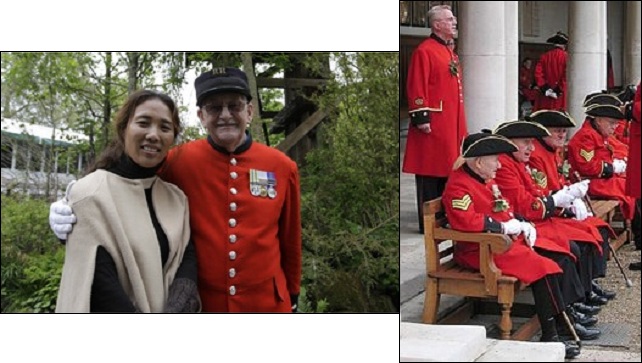
The Chelsea Flower Show is one of the minor Great British Occasions — a stroll in the park with some of the Kingdom’s finest horticulturalists displaying their best, and not usually the place you’d go to be reminded of war, though the show itself does take place in the grounds of the Royal Hospital, Chelsea, the home of the Chelsea Pensioners

.

.

It is only appropriate, then, to find this picture of Skippy, a Pensioner from the Korean War, with Korean designer Hwang Ji-hae, whose garden this year won a gold medal for its representation of the DMZ between North and South Korea…

.

.

with its abandoned watchtowers and partially overgrown barbed-wire fences…

.

.

its bottles, carrying messages from those on one side of the line to friends and family unreachable on the other…

.

.

its benches made of wood and dog-tags, its memories…

.

.

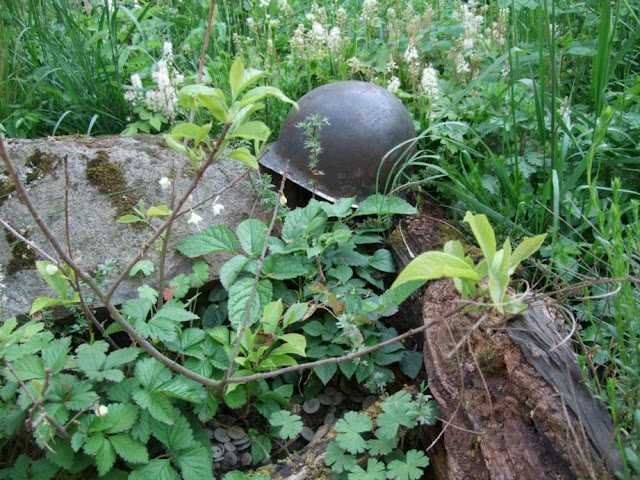
and the wildflowers that have been taking over the DMZ, reasserting nature’s primacy where men’s wars were fought.

*

Hwang Ji-hae named her garden Quiet Time: DMZ Forbidden Garden:

This year’s “DMZ Forbidden” garden is “going to be a symbolic place honoring everyone who suffered because of the war,” Hwang said in an interview with the Korea JoongAng Daily in December in her studio in Gwangju.

The garden is a recreation of the Demilitarized Zone between North and South Korea, which has been kept nearly untouched for six decades since the 1953 Armistice Agreement. The zone has become a diverse habitat for various kinds of rare plants and animals.

To Hwang, the DMZ has become the “most beautiful garden on the planet,” though it symbolizes the legacies of the war and the tragic division of the Korean Peninsula at the same time, the artist said in the interview.

“The DMZ was formed organically after a major upheaval. It was created because of the war but is now a symbol of peace.”

According to a press release issued by Hwang’s agency on Tuesday night after winning the prize, 60 percent of the plants in the “DMZ Forbidden” garden are from Korea and some of them are indigenous to the DMZ area.

Hwang said that some of the British veterans of the Korean War she met last year talked about plants they saw in Korea, and they asked her to find them.

“There are six plants that are indigenous to the area near the DMZ, including Geumgang chorong [a type of bellflower], and they will all be part of the garden I’m creating,” she said during the interview in December.

“This is my way of thanking the veterans.”

In memoriam: a tipi and a garden, I

Monday, May 28th, 2012

[ by Charles Cameron — Memorial Day, USA ]
.

1. The tipi:


.

Inside the night, Afghanistan; in Arghandab, Afghanistan, a small American army base; inside the base beside the chapel a tipi; within the tipi photos of the fallen, cigarettes, an open bible, strong bonds, strong memories.

.

.

If you look closely, you will see cigarettes offered in front of the photos of the 21 members of 1-17th Infantry Battalion, 5th Brigade, 2nd Infantry Division who had died here at the time Michael Yon, himself a former Green Beret turned warzone photojournalist, took the series of photos from which these two are taken – and which I urge you to visit this Memorial Day:

Soldiers put cigarettes in front of each photo, though they say that many of the fallen did not smoke.

Kanani Fong, friend of this blog, quotes a Blackfoot warrior’s poem in her comment on Michael Yon’s post:

What is life?
It is the flash of a firefly in the night.
It is the breath of a buffalo in the wintertime.
It is the little shadow which runs across
the grass and loses itself in the sunset.

I don’t think a church bureaucracy has the insight yet, in these non-smoker times, to call a cigarette a sacrament – yet there’s something sacramental about the friendship that comes with the giving of a cigarette to a fellow soldier, wounded and dying. And to my Lakota friends tobacco is a sacrament: a tobacco offering, ground pushing upward into sky, a prayer.

The buffalo too are sacred to the Lakota: it was White Buffalo Calf Woman who brought them the sacred Pipe.

I ask that you visit Michael Yon’s site, and make a small donation to help him keep up the work he’s doing. Just this month he was in Burma.

The bible is open to Psalm 31, verse 5:

Into thine hand I commit my spirit: thou hast redeemed me, O Lord God of truth.

All the President’s NSCs

Monday, May 28th, 2012

Rei Tang, who I had the pleasure of meeting and breaking bread with at the last Boyd & Beyond Conference, is guest-posting at Rethinking Security on a topic dear to my heart, presidential national security decision making. Mr. Tang nailed it here and I give his post a very strong endorsement as a “must-read”:

Guest Post: Essence of Decision (Part I of III)

“Maximize the President’s optionality.” Spoken in bureaucratese, this is what Thomas Donilon wanted to do as he took over the role of President Barack Obama’s national security adviser. Like most bland things in national security, this phrase is loaded. Graham Allison compares Donilon to Robert F. Kennedy who protected President John F. Kennedy’s options during the Cuban Missile Crisis. It speaks to how the president sees his relationship to the executive branch, his inclinations and limits. It speaks to how the president chooses and trusts his advisers and officers.

For a confident new president who respected national security pragmatists like Jim Jones, Joe Biden, Robert Gates, Hillary Clinton, Leon Panetta, and Dennis Blair, making national security policy should have been straightforward. Obama and, former NATO supreme allied commander and marine commandant, General Jones created an open and orderly national security policy process—layers of interagency committees teeing up options to the National Security Council. Every department and agency would have a chance to say something. This would lead to good policy. But it ran into problems. In the NSC staff, now the “national security staff,” those who had been through the campaign with Obama had their access to the president downgraded. In the Afghanistan surge decision, the Department of the Defense and the military had boxed in the president. The more open the process, the more policy became stuck in the bureaucracy. In crisis decision-making, which takes up an extraordinary amount of bandwidth and which is politically delicate, bureaucracy can’t be allowed. 

The president came to find out this is not what he wanted. As the president gained experience, what he did want shows in the people who survived and thrived in the administration. They understand politics. Donilon, Panetta, Biden, and McDonough have worked on campaigns and understand the imperative of mitigating Obama’s political problems on national security. They’ve not only put in place the national security policy structure, but they control it—the information, the direction. They’ve expanded the president’s space to make careful, deliberate decisions. And to have “no leaks.”

Read the rest here.

It is interesting that in coming into office, President Obama, a deliberative and elite academic lawyer by education and temperament, set up a formal, Sherman Adams-ish NSC process befitting President Eisenhower and instead gravitated to a looser, more “politicized-personalized” model favored by Presidents Kennedy and (to a lesser extent) Nixon. This evolution suited Mr. Obama’s much grubbier, bareknuckles experience from his early days as a cog in Chicago’s Democratic Daley Machine, where politics is king and the ur-Rules are “Don’t back no losers” and “We don’t want nobody that nobody sent”.

A president always gets the NSC he wants but very seldom the NSC his office deserves. A corollary to this is that a totally dysfunctional NSC is no bar to having foreign policy success. During the Nixon administration, when Henry Kissinger was National Security Adviser, the machiavellian NSC decision process with the various principals was less in need of an orderly manager than a competent psychiatrist ( and this was, at times, seriously considered!); yet the co-dependent partnership between Nixon and Kissinger yielded numerous strokes of brilliance and strategic coup d’oeil in foreign policy.

The statutory requirements of the NSC are skeletal, which permits every POTUS flesh out the system he desires by selection of personnel and the initial executive orders issued to guide the business and interagency work of the NSC.  A president who feels uncomfortable with picking qualified “outsiders” -i.e. academic stars (Kissinger, Brzezinski) will have an NSC that is going to rely heavily upon foreign service officers, military officers and IC personnel “on loan” or after retirement from their perspective departments and agencies.  This will not be an NSC that will be apt to challenge bureaucratic conventional wisdom when preparing option papers,  but at it’s best this kind of NSC can be an honest broker and competent enforcer of presidential decisions because the staff is wise to bureaucratic tricks to stymie or delay administration policy. Eisenhower and Bush I were extremely comfortable with NSCs staffed by “professionals” and demanded very close working relationships with and between principals (SECSTATE, SECDEFENSE etc.).

An NSC dominated by gifted outsiders and political loyalists offers the opportunity for more creative and effective exercise of presidential prerogatives in foreign policy.  The president will have more options and a more critically thorough vetting of policy proposals from State, Defense and the IC.  As a result, because the NSC is trying to be both policy advocate as well as referee, the interagency friction and malicious leaking against bureaucratic rivals is apt to be very high – as was seen during the Nixon, Carter and Reagan administrations ( the last administration saw six NSC advisers in eight years, a factor of instability that added to the friction).

In either case, presidents sometimes attempt to “operationalize” policy that is particularly important to them from the NSC, which is not really designed or budgeted for such tasks. This has had mixed results, historically, with successes like the China Opening, bringing into custody the Achille Lauro highjackers and the operation to kill Osama bin Laden as well as political debacles like Iran-Contra or the secret invasion of Cambodia. The need to work through other bureaucracies makes the NSC doing “end runs” risky and vulnerable to hostile leaks and critical Congressional reaction (particularly if oversight had been circumvented).

To understand a president’s NSC is to comprehend how the administration really works.

SUGGESTED READINGS:

Brown, Cody. The National Security Council: A Legal History of the President’s Most Powerful Advisers. Project on National Security Reform/Center for the Study of the Presidency. 1020 19th Street, NW, Suite 250. Washington, DC. 2008.

Cramer, Drew & Mullins, Grant. “Lessons Learned from Prior Attempts at National Security Reform“. The Project on National Security Reform, Overarching Issues Working Group, College of William & Mary

Daalder, Ivo H. In the Shadow of the Oval Office: Profiles of the National Security Advisers and the Presidents They Served–From JFK to George W. Bush. Simon & Schuster, New York, NY. 2009

Federation of Atomic Scientists. “History of the National Security Council 1947-1997”. http://www.fas.org/irp/offdocs/NSChistory.htm

Dalleck, Robert. Nixon and Kissinger: Partners in Power. Harper Perennial. New York, NY. 2007

Gates, Robert. From the Shadows. Simon & Schuster. New York, NY. 1996.

Kissinger, Henry. White House Years. Simon & Schuster. New York, NY. 2011.

Menges, Constantine. Inside the National Security Council. Touchstone Books. 1989.
Conceptual blending

Monday, May 28th, 2012

[ by Charles Cameron — cross posted from Sembl — creativity as the blending of ideas ]
.

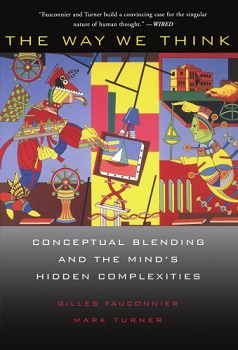
Gilles Fauconnier and Mark Turner‘s The Way We Think: Conceptual Blending and the Mind’s Hidden Complexities gives us a fascinating look at the way the human mind weaves a world out of seemingly disparate elements — in a very similar manner to that in which the creative mind weaves an aha! out of seemingly disparate ideas. The book deals with the formation of perceptions as well as ideas, but it was a specifically conceptual blend that intrigued me the other day.

First, they note that when we use expressions like “I had reached the boiling point. I was fuming. He exploded.” we are making a metaphorical mapping in which “a heated container maps to an angry individual, heat maps to anger, smoke and steam (signs of heat) map to signs of anger, explosion maps to uncontrolled rage.” Then they add in the “folk theory of physiological effects of anger” including ” increased body heat, blood pressure, agitation, redness of face” – and thus we have a threefold scheme, in which physiology, emotions and the physics of heat are intricately cross-correlated, so that we can say without much thought “He was so mad I could see smoke coming out of his ears”.

Here Fauconnier and Turner describe the mechanics of this remarkable conceptual blending process – which can yield such a seemingly unremarkable phrase:

In addition to the metaphoric mapping between Heat and Emotions and the vital-relation connection between Emotions and Body, there is a third partial mapping between Heat and Body. In this mapping, steam as vapor that comes from a container connects to perspiration as liquid that comes from a container, the heat of a physical object connects to body heat, and the shaking of the container connects to the body’s trembling.

The three partial mappings set the stage for a conventional multiple blend in which the counterparts in the inputs are fused, yielding, for example, a single element that is heat, anger, and body heat and a different single element that is exploding, reaching extreme anger, and beginning to shake. Once we have this blend, we can run it to develop further emergent structure and we can recruit other information to the inputs to facilitate its development.

*

What interests me here is the phrase:

the inputs are fused, yielding, for example, a single element that is heat, anger, and body heat

and what it reminds me of is CS Lewis writing in The Allegory of Love:

It must always be remembered … that the various senses we take out of an ancient word by analysis existed in it as a unity.

Thus the King James Version of the Bible, John 3.8, reads:

The wind bloweth where it listeth, and thou hearest the sound thereof, but canst not tell whence it cometh, and whither it goeth: so is every one that is born of the Spirit.

In the Greek, the word here translated wind is pneuma, and the sentence accordingly means “the pneuma blows where it wills, and you hear its sound but can’t tell where it comes from or is going: and so it is with all those born of pneuma“…

Recalling Lewis’ remark about the “various senses we take out of an ancient word”, this in turn means simultaneously and without separation:

the wind blows where it wills, and you hear its sound but can’t tell where it comes from or is going: and so it is with all those born of wind…

the breath blows where it wills, and you hear its sound but can’t tell where it comes from or is going: and so it is with all those born of breath…

and:

spirit blows where it wills, and you hear its sound but can’t tell where it comes from or is going: and so it is with all those born of spirit…

Take this a step further, realize that spirit can be defined as what inspires us, and we have:

inspiration blows where it wills, and you hear its sound but can’t tell where it comes from or is going: and so it is with all those born of inspiration…

Four meanings, all making good sense, and all present simultaneously and inseparably in the one gospel phrase…

*

Now consider that Fauconnier and Turner are speaking of how “three partial mappings set the stage for a conventional multiple blend in which the counterparts in the inputs are fused, yielding, for example, a single element that is heat, anger, and body heat” and compare it with Lewis’ “unity” from which we take out “the various senses” by “analysis”, as applied to the “ancient word” pneuma, with its meaning encompassing wind, breath, spirit… inspiration.

Are wind, breath and spirit or inspiration in fact three “primitives” that conceptual mapping in ancient Greek thought has brought together? What do we gain, and what do we lose if we view them this way?

And what do we lose, what do we gain if we view them as a single rich concept, now reduced to three or four separate — and separately less complexly interesting — ideas?

In Memoriam

Sunday, May 27th, 2012

Executive Mansion,
Washington, Nov. 21, 1864.

Dear Madam,

I have been shown in the files of the War Department a statement of the Adjutant General of Massachusetts that you are the mother of five sons who have died gloriously on the field of battle. I feel how weak and fruitless must be any word of mine which should attempt to beguile you from the grief of a loss so overwhelming. But I cannot refrain from tendering you the consolation that may be found in the thanks of the Republic they died to save. I pray that our Heavenly Father may assuage the anguish of your bereavement, and leave you only the cherished memory of the loved and lost, and the solemn pride that must be yours to have laid so costly a sacrifice upon the altar of freedom.

Yours, very sincerely and respectfully,

A. Lincoln

Switch to our mobile site