zenpundit.com » 2012

Archive for 2012

Vivaldi, veiling and revelation…

Wednesday, March 14th, 2012

[ by Charles Cameron — some glorious music, Venice, Kandahar ]
.

I was listening to Pergolesi‘s Stabat Mater the other day, and talk came around to the question of whether women would have sung the two solo parts – whether they were written for soprano and contralto, in other words, or for treble and counter-tenor – all of which reminded me that the “red priest” Vivaldi was, for over thirty years, maestro of the Ospedale della Pietà orphanage in Venice.

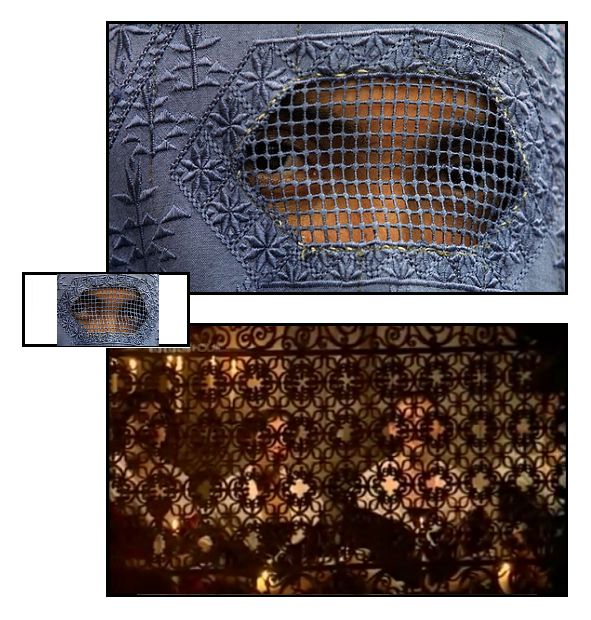
The Ospedale’s all-woman choir performed many of his sacred choral works in church, hidden from view if not speculation in a high balcony behind an iron grille…

The BBC has an hour-long documentary on the subject of Vivaldi’s Women, which features the Ospedale but also the contemporary choir and orchestra, Vivaldi’s Women, more properly known as the Schola Pietatis Antonio Vivaldi.

The (lower) image of the present-day women’s choir singing behind one of those grilles – accompanied by a voice-over reading from a fashionable “grand tour” diary of the day which reports that the “grilles conceal the angels of loveliness” (the writer was perhaps aware, perhaps not, that many of the orphans in Vivaldi’s day would have been scarred or deformed by the pox or their parents’ syphilis) reminded me of another contested icon of “women behind a grille” – this time, the traditional Afghan chadari (upper image)…

*

I have exchanged greetings through a grille with Carmelite nuns in California, and they clearly appreciated the sanctuary that their enclosure offered them…

My point is not to argue the superiority of bikini over burqa or vice versa: it is to offer you a chance to hear some Vivaldi or Pergolesi, and to consider the issue of veiling and revealing — intimacy’s equivalent of secrecy and transparency — from what was for me at least an unexpected and fresh angle.

One quick illustrated quote from Secretary Clinton

Wednesday, March 14th, 2012

[ by Charles Cameron — sometimes i post things so obvious they might actually be useful ]
.

One quick annotated quote from Sec. Clinton‘s speech at the U.S. Institute of Peace China Conference, March 7th:

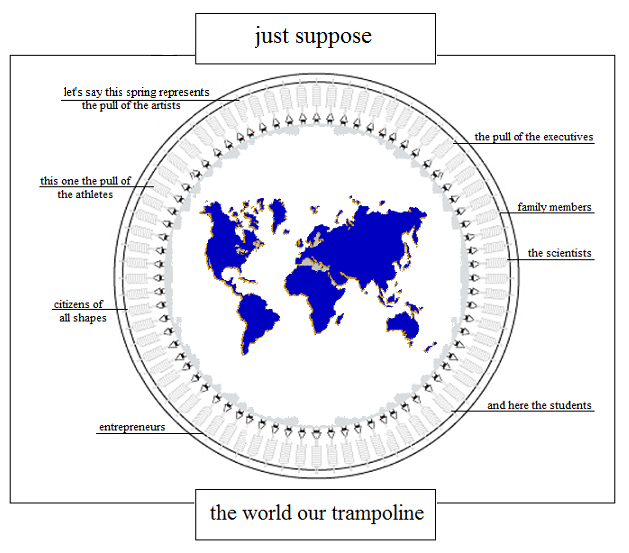
Now when I say “we,” I do not mean only our governments, as important as they are. Every day, across both of our countries, executives and entrepreneurs, scientists and scholars, artists and athletes, students and teachers, family members and citizens of all kinds shape and pull and add to this relationship. Together, they represent a vast range of priorities, concerns, and points of view. And they are all stakeholders in how we build toward a shared future.

It’s really that list I’m after…

There are seven billion individuals bouncing up and down on our trampoline, some of them holding hands, some of them in gangs that want to trip up rival gangs, or make a clearing for themselves and themselves alone, some too weak to bounce much at all…

and each time each one of us lands, we impact the trampoline from a different angle, stretch it a different way – tugging it to the will of the artist, the entrepreneur, the child, the retiree, the curious, the aggressive, the meek…

As we know, the earth is round, which is to say three-dimensional – but the tugs on it, the tensions, are more complicated than that, in fact they’re complex, n-dimensional – and constantly shifting.

Hilary Clinton wants to wake up in the morning, have coffee – and model that! – along with, and in balance with, her counterpart in another huge mass of population, half a globe and at least six philosophies away…

The coffee’s good, but it’s not enough — what we all could use is a new mode of thinking.

*

Maps courtesy of www.theodora.com/maps used with permission

Request for help regarding a hadith

Tuesday, March 13th, 2012

[ by Charles Cameron — no extremism in religion, did Muhammad say that? ]
.

1.

Illustrated above is the banner of the Khudi blog from Pakistan, offering a hadith in support of its vision, which it describes as follows:

As a movement Khudi stands against all forms of extremism, including those that use religion to justify a certain agenda. But simply saying ‘no’ to extremism isn’t good enough – it’s essential to challenge and undermine the arguments used by extremists and to refute the religious justifications they put forward.

However, challenging extremism in this way doesn’t mean that Khudi is eligible to comment on religious matters or issue fatwas about the length of the beard or the hijaab. At Khudi we believe religious beliefs are a personal matter that each individual may take guidance on from their respective religious authorities. Thus, our volunteers and friends belong to a variety of faiths and sects and span the religious spectrum, from conservative to liberal. The important thing is that we stand firmly by the principle of respecting each other’s difference.

2.

I’m intersted in Khudi, not least because it seems to be a brainchild of Maajid Nawaz, one of the ex-jihadists who founded the Qulliam Foundation in London:

Quilliam is the world’s first counter-extremism think tank set up to address the unique challenges of citizenship, identity and belonging in a globalised world. Quilliam stands for religious freedom, equality, human rights and democracy.

Khudi appears to be Quilliam’s Pakistan equivalent, more or less.

3.

Here’s the deal. The Khudi blog website header illustrated above cites Bukhari 9.582 as saying:

Beware of extremism in religion, for extremism destroyed those who went before you.

I would like to be able to point to that hadith with confidence in my own writings, and I’d be happy to give appropriate attribution to the Khudi blog. but first I need help in clearing up some questions I have about it.

Specifically, when I went to verify the hadith for scholarly accuracy before quoting it — not being a reader of Arabic, and thus being dependent on what resources in English I can muster — I found to my surprise that the
hadith-search function for MulsimOnline gave the following result for Bukhari 9.582:

Narrated Ibn `Abbas:

(regarding the Verse):– ‘Neither say your prayer aloud, nor say it in a low tone.’ (17.110) This Verse was revealed while Allah’s Apostle was hiding himself in Mecca, and when he raised his voice while reciting the Qur’an, the pagans would hear him and abuse the Qur’an and its Revealer and to the one who brought it. So Allah said:– ‘Neither say your prayer aloud, nor say it in a low tone.’ (17.110) That is, ‘Do not say your prayer so loudly that the pagans can hear you, nor say it in such a low tone that your companions do not hear you.’ But seek a middle course between those (extremes), i.e., let your companions hear, but do not relate the Qur’an loudly, so that they may learn it from you.

“Not too soft, not too loud” bears a kind of family resemblance to “nothing in excess” — but it’s not the same thing, and I rather doubt that the words in Bukhari rendered by one translator as “Neither say your prayer aloud, nor say it in a low tone” would be rendered by another as “Beware of extremism in religion” — and I don’t see anything there that would correspond with the phrase “for extremism destroyed those who went before you”.

4.

Okay, all this set me digging a little further, and I next found a hadith reported at the ProphetEducation site, which reads as follows:

On the authority of Ibn Abbas (May Allah be pleased with him):

“Very early in the morning on the day of ‘Aqabah, the messenger of Allah (blessings and peace of Allah be upon him) while riding on his camel said to me: ‘pick some pebbles for me’. I then picked seven hurling pebbles for him. While dusting them of his hands he said: thou shall not cast except with such pebbles. Then he said: O mankind! Beware of extremism in religion for those before you were destroyed as a result of extremism in religion”

Related by Ibn Majah, Hadith no.(3029).

5.

So.

Did the folks putting the Khudi site together just get the hadith citation wrong — or is there more here than meets my eye? I would very much appreciate any help in explaining what at present seems to me a somewhat confusing picture.

If the hadith is authentic and can be found as stated in Sahih Bukhari, the pre-eminent source for hadith, and can be referenced from the English translation of Bukhari on the USC site, that would itself be a help. If so, it would also be of interest to know what kind of hermeneutic AQ deploys to get around it.

And if it is always found in the original sources, Bukhari or otherwise, in association with the comments about small “hurling pebbles” — why, that raises yet other questions.

6.

TIA — in this case meaning thanks in advance, not transient ischemic attack!
Quite the contrast

Tuesday, March 13th, 2012

[ by Charles Cameron — the Joseph Kony rumpus, and Robert Fowler on the religious zealotry of AQIM ]
.

Above:

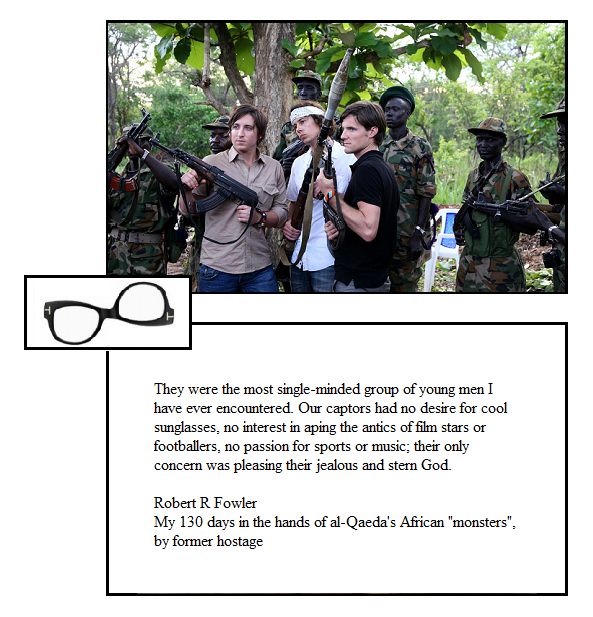
In the Glenna Gordon photo above the text is Jason Russell, the film-maker who put together the Joseph Kony 2012 campaign, who says of himself:

I am a rebel soul: dream evangelist. I am obsessed with people. I tell stories by making inspiring movies that move people’s emotions, and then I take those emotions and transform them into action. My middle name is Radical. I married my best friend.

— radical, yeah, and looking “tough” — or as one commentator on the Visible Children tumblr said, “posing”:

Here’s a photo of the founders of Invisible Children posing with weapons and personnel of the Sudan People’s Liberation Army. Both the Ugandan army and Sudan People’s Liberation Army are riddled with accusations of rape and looting, but Invisible Children defends them, arguing that the Ugandan army is “better equipped than that of any of the other affected countries”, although Kony is no longer active in Uganda and hasn’t been since 2006 by their own admission. These books each refer to the rape and sexual assault that are perennial issues with the UPDF, the military group Invisible Children is defending.

Below:

By way of contrast: the text below the photo is culled from Robert R Fowler‘s searing account of his al-Qaeda in the Islamic Maghreb (AQIM, but please don’t call it AA-kem) captors. As he also said:

Kidnappings of Westerners have fueled debate among securocrats as to whether our AQIM captors might simply bandits flying an Islamic flag of convenience. I know that to be the wrong answer. Our kidnappers were utterly focused religious zealots who believed absolutely in their cause. They sought to expel Western infidels from Muslim lands and to destroy what they saw as apostate Western-stooge governments who were usurping God’s purposes across the Muslim world. The concepts and ideals we hold most dear were anathema to them: liberty, freedom, justice, democracy, human rights, equality between the sexes — all matters which they considered to be the exclusive province of Allah.

Yes, that contains the popular idea that “they hate us for our freedoms” — but in the context of what I can only call ruthless religious idealism.

Fowler is very clear on that. And no posing.

Sounds like Fowler’s book, A Season in Hell, goes right onto the anti-library lists.

The End and Ends

Tuesday, March 13th, 2012

The End by Sir Ian Kershaw

I am currently reading The End, about the last year of the Third Reich and the Nazi death spiral toward Germany’s absolute destruction. It is a fascinating, mass suicidal, political dynamic that was mirrored to an even greater degree of fanaticism by Nazi Germany’s Axis partner, the Imperial Japanese. Facing the prospect of certain defeat, the Germans with very few exceptions, collectively refused every opportunity to shorten the agony or lighten the consequences of defeat and stubbornly followed their Fuhrer to the uttermost doom. It made no sense then and still does not now, seven decades later.

Adolf Hitler’s personal authority over the life and death of every soul in Germany did not end until his last breath. When surrounded by Soviet armies, trapped in his Fuhrerbunker in the ruin of Berlin, all it took for Hitler to depose his most powerful paladins, Hermann Goering and Heinrich Himmler was a word. They still commanded vast military and paramilitary security forces – Himmler had been put in charge of the Home Army as well as the SS, Gestapo and German police – but when Hitler withdrew his support and condemned them, their power crumbled. Goering, the glittering Nazi Reichsmarchal and second man in the state, was ignominiously arrested.

Even in Gotterdammerung, the Germans remained spellbound, like a man in a trance placing a noose around his own neck.

Currently, the chattering classes of the United States are uneasily working their way toward a possible war with Iran, or at least a confrontation with Teheran over their illegal nuclear weapons program (some people will object that, technically, we are not certain that Iran has a weapons program. This is true. It is also irrelevant to the diplomatic dynamic created by Iran’s nuclear activities which the regime uses to signal regularly to all observers that they could have one).  There is much debate over the rationality of Iran’s rulers and the likely consequences if Iran is permitted to become a nuclear weapons state. There is danger and risk in any potential course of action and predictions are being made, in my humble opinion, far too breezily.

In the run-up to war or negotiation, in dealing with the Iranians and making our strategic calculations, it might be useful to recall the behavior of the Germans.


Switch to our mobile site