zenpundit.com » 2012 » August

Archive for August, 2012

Who among us can comprehend religion? — Mahdi & Second Coming

Wednesday, August 8th, 2012

[ by Charles Cameron — the Second Coming in Mahdist eschatology, Abu Musab al-Suri: a first addendum to my post responding to Scott Atran ]
.

I quietly asked “who among us can comprehend religion?” in the header to my most recent post responding to Atran on FP, and here and in the post that follows this one, I want to stir some thoughts on the topic.

**

First, here’s a snippet of today’s twitterfeed that caught my attention:

Bright folks, each one of them — and Vatyma is right, Lebovich nails it tecommending Filiu‘s book.

**

Okay, larger than life with my in-house advantage, here’s my response:

**

And here’s Jean-Pierre Filiu, talking specifically about Abu Musab al-Suri‘s attention to the Second Coming — understood as an accompaniment to the coming of the Mahdi and defeat of the Antichrist / Dajjal — in his Apocalypse in Islam, p. 191:

Abu Musab al-Suri endorses all the accepted traditions concerning Jesus and the Antichrist, notably among them the homicidal hadith about the stones and trees that denounce the Jews hiding behind them. But he innovates in supplementing it with a related saying, according to which the concealed presence of “impure Christians” will also be betrayed in the same fashion.

BTW, that’s the gharqad tree hadith, on which see (a) the Charter of Hamas, article 7, and (b) Anne Marie Oliver & Paul Steinberg, The Road to Martyr’s Square, pp 19-24.

Here’s Filiu again, a little later on the same page, still expounding Abu Musab:

The Antichrist, harassed by two angels who denounce his lies, will attempt to follow [the Muslims into Jerusalem], but at this juncture Jesus will return from heaven and strike him down.

**

Abu Musab dedicates the last hundred pages of his 1,600-page Call for Global Islamic Resistance to his eschatological views — and as Filiu notes, and as I have quoted before:

There is nothing in the least theoretical about this exercise in apocalyptic exegesis. It is meant instead as a guide for action. …

So there you have it: in the view of the man Brynjar Lia calls the Architect of Global Jihad, popular Sunni eschatology — including the return of Jesus — has detailed implications for prophetically informed strategic jihadist planning.

Religion: why it is indeed imperative, as Scott Atran suggests, for us to understand it.

Landmines in Paradise Garden

Wednesday, August 8th, 2012

[ by Charles Cameron — pros and cons of an important piece by Scott Atran — who among us can comprehend religion? ]
.

At play (Minesweeper) in the Fields of the Lord (Bosch, Garden of Eden)

.
Scott Atran, the anthropologist who gave us the book Talking to the Enemy, has got it right (as to importance) but wrong (as to procedure) in his latest, significant piece on Foreign Policy, God and the Ivory Tower: What we don’t understand about religion just might kill us.

First, the importance of the issue he’s discussing – understanding religions (emphatically plural, IMO):

Religion molds a nation in which it thrives, sometimes producing solidarity and sacred causes so powerful that citizens are willing to kill or die for a common good (as when Judea’s Jews around the time of Christ persisted in rebellion unto political annihilation in the face of the Roman Empire’s overwhelmingly military might). But religion can also hinder a society’s ability to work out differences with others, especially if those others don’t understand what religion is all about. That’s the mess we find ourselves in today, not only among different groups of Americans in the so-called culture wars, but between secular and Judeo-Christian America and many Muslim countries.

Time and again, countries go to war without understanding the transcendent drives and dreams of adversaries who see a very different world. Yet we needn’t fly blindly into the storm.

Atran is exactly right: we needn’t fly blindly into the storm — but to avoid flying blindly we need to understand those “drives and dreams of adversaries who see a very different world” — and to avoid flying into the storm at all we may (all of us, friends and foes alike) need to understand our own “transcendent drives and dreams” better than we do at present.

The question is, who can help us do that?

That’s what I mean by the procedure — the path that should be taken to achieve that kind of understanding. And note: there are different kinds of understanding — theoretical, imaginative, visceral… dispassionate, empathetic, impassioned…

**

Atran’s answer is science:

Science can help us understand religion and the sacred just as it can help us understand the genome or the structure of the universe. This, in turn, can make policy better informed.

There’s only one problem there. I can believe that scientists of extraordinary breadth and insight – Einstein, Bohr, Oppenheimer, Gell-Mann, Feynman probably – and social scientists — Bateson certainly, Victor Turner, Atran perhaps – my lists are not exhaustive – could make useful suggestions for scientific approaches to the field of religion.

But scientists in general? As Atran notes:

If you look at the prestigious U.S. National Academy of Sciences or Britain’s Royal Society, well over 90 percent of members are non-religious. That may help explain why some of the bestselling books by scientists about religion aren’t about the science of religion as much as the reasons that it’s no longer necessary to believe.

Non-believers may “get” what’s dangerous about religions, but they almost certainly won’t “get” what’s marvelous and inspiring about them.

And believers are no better – they may get what’s great about their own tradition, but still see nothing but perdition in the traditions of others…

So to get a decent set of insights worth experimenting with — or modeling, for that matter — requires a blend of subtle thinkers to include some social anthropologists, some scholars of comparative religion, some sociologists with fine-tuned statistical skills, some depth psychologists… believers, skeptics, atheists and agnostics… with a whole wild variety of plumages, specialties and interests.

Yes, and some poets, historians, some hard scientists. Yes.

**

How easy is it to get things wrong?

In his paper Reframing Sacred Values [link is to .pdf] written with Robert Axelrod — the political scientist whose contest for winning strategies for the iterated Prisoner’s Dilemma game put “tit for tat” and agent based modeling on the map in his books The Evolution of Cooperation and The Complexity of Cooperation — Atran speaks of “Rational versus Devoted Actors“.

The distinction is a significant one. And the paper itself is important because, as Atran and Axelrod suggest:

Counterintuitively, understanding an opponent’s sacred values, we believe, offers surprising opportunities for breakthroughs to peace. Because of the emotional unwillingness of those in conflict situations to negotiate sacred values, conventional wisdom suggests that negotiators should either leave sacred values for last in political negotiations or should try to bypass them with sufficient material incentives. Our empirical findings and historical analysis suggest that conventional wisdom is wrong. In fact, offering to provide material benefits in exchange for giving up a sacred value actually makes settlement more difficult because people see the offering as an insult rather than a compromise. But we also found that making symbolic concessions of no apparent material benefit might open the way to resolving seemingly irresolvable conflicts.

But who is to say which actors are “devoted”?

The most devoted may be the one who stands in most need of redemption, the one who has sinned the most, not the one who has been the most pious. Let me put that another way: the most devoted may be the drunken reveler rather than the regular church- or mosque-goer.

**

Consider:

Inigo was a courtier, a conquistador, a musketeer. The commandments were of course unquestionable in theory, but practice was entirely another matter. Church was for times of danger or for celebration of victory, and he never prayed so hard to our Lady as before a duel. In his last years when he had no need to be boastful, he was quoted by his secretary- biographer: “Though he was attached to the faith, he lived no way in conformity with it and did not avoid sin. Rather, he was much addicted to gambling and dissolute in his dealings with women, contentious and keen about using his sword.”

Inigo found plenty of trouble…

A scientist might not think such a person a reliable example of religious fervor. An antagonist of religion might think it illustrates the flaws of religion perfectly.

The passage in question comes from a life of St. Ignatius of Loyola, founder of the Jesuits.

Religion is a subtle matter. We may think it a matter of belief, but it may be a matter of behavior – orthopraxy vs orthodoxy is the distinction the folks in religious studies make — or of visionary experience.

It may “take one to know one” – as Thomas Merton, the Catholic contemplative understood the Buddhist contemplatives he met. But then he was open to the possibility that others might have intuitions not dissimilar to those he himself had had. “I’m deeply impregnated with Sufism,” he once wrote — Sufism being the mystical strand in Islam. Indeed, I received a letter from him myself while still a student at Oxford, in which he wrote of his life in the Abbey of Gethsemani, “here you get beaten for being a dervish. I am bruised for this all day long.”

**

But again, one can be blinded by one’s own faith to the merits of the faiths of others. And this is also a subtle business.

Retired US Gen. Jerry Boykin, for instance, said in April last year (link is to YouTube video):

Sharia law is a very serious threat in America. We are being invaded by a group of people who see it as their absolute imperative to establish a legal system in America which will in fact destroy our Constitution to be replaced by this thing called Sharia law.

One wonders what Boykin might make of the late California Presbyterian teacher, RJ Rushdoony — a figure, I’m guessing, far to the General’s right?

As is widely known, the New Testament contains a “Great Commission” which Christ gave to his apostles after his Resurrection:

Then Jesus came to them and said, “All authority in heaven and on earth has been given to me. Therefore go and make disciples of all nations, baptizing them in the name of the Father and of the Son and of the Holy Spirit, and teaching them to obey everything I have commanded you. And surely I am with you always, to the very end of the age.” — Matthew 28:18-20.

Rushdoony, in his master work The Institutes of Biblical Law, makes it clear that in his views, this constitutes a divine mandate to bring Biblical law into effect in all nations: “The fulfillment of that covenant is their great commission: to subdue all things and all nations to Christ and His law-word” (Institutes, p. 14) and this is to be achieved in terms of a single world order, “The goal is the developed Kingdom of God, the New Jerusalem, a world order under God’s law” (Institutes, p. 357).

Sadly, the church no longer recognizes the full implications of the Great Commission, and has fallen into a heresy that is political in nature: “The church today has fallen prey to the heresy of democracy” (Institutes, p. 747). In truth, the laws of a democratic society will need to be replaced by the laws of God as set forth in the Old Testament: “While all Scripture is God’s law word, the heart of that law is the law of Moses” (Institutes, p. 675).

Here’s where it gets trickier, though:

Slavery, too, will need to be reinstituted: “The (Biblical) Law here is humane and also unsentimental. It recognizes that some people are by nature slaves and will always be so. It both requires that they be dealt with in a godly manner and also that the slave recognizes his position and accepts it with grace” (Institutes, p. 251).

**

This thing called “religion” is difficult to pin down. It has extremes that appear unconscionable even to many who claim devotion to the same scriptures as do the extremists. It features violence, peace, apocalypse as destruction and apocalypse as fresh creation.

Atran is an anthropologist – he surely knows this.

The study of religion involves walking through a minefield — in the gardens of Paradise…

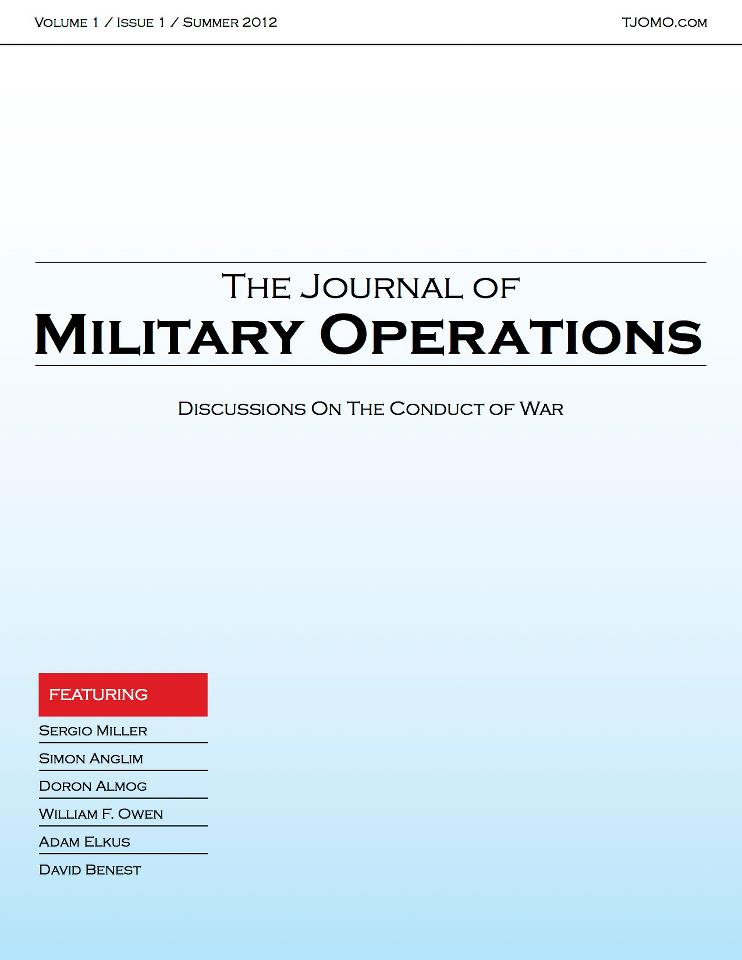
The Journal of Military Operations

Tuesday, August 7th, 2012

The Journal of Military Operations  

A new peer-review “journalzine” from the IJ  Group, which publishes Infinity Journal.  The difference between the two is that Infinity focuses on strategy while the former, as the masthead implies, is dedicated to military operations as well as tactics. If you do not know what the difference between strategy and tactics are….well….reading these should help. The Editor is Dr. Jim Storr, a.k.a  Colonel Storr, author of the well regarded The Human Face of War.  Registration is free.

The maiden issue of JoMO has articles from two friends of ZP, Deputy Editor Wilf Owen and Adam Elkus.

Ironically, Wilf is  arguing against the existence of an operational level of war or the utility of separating operational art from sound understanding of tactics and strategy and criticizes Soviet strategist A.A. Svechin:

“The Operational Level of War Does Not Exist”

….Thus the definitions of strategy and tactics were and are simple, coherent and highly workable. While armies conducted ‘operations’, such activity did not impinge on the delineation of strategy and tactics. Conducting operations did not an operational level of war make!

The operational level of war is strongly associated with Soviet military thought. A.A. Svechin is often seen as the originator of the idea, when he discussed ‘Operational Art’ (operativnoe iskustvo) as conceptual connection between tactics and strategy.[iii] He defined an operation as ‘the effort of troops directed towards the achievement of a certain intermediate goal in a certain theatre of military operations without interruptions.’[iv] In the very next sentence he went on to explain that operations were designed to destroy or encircle a portion of the enemy forces to force a withdrawal of other forces, to capture or hold a ‘certain line or geographical area.’ Destroying a portion of the enemy’s armies is what battles traditionally sought to do. Svechin’s description equates strongly with battle and thus tactics, at least in terms of the outcome described.

Much Soviet and Russian writing (and Western analysis of it) on the Operational Level of War is, once subject to rigour, paper-thin and mostly a sophistry that arbitrarily creates a false and unneeded link between strategy and tactics. The extremely high losses suffered by Soviet Forces in WW2 are not symptomatic of anything other than bad tactics poorly executed. If the acme of operational art is encirclement operations, then at what level of command does this operational level of war take place? A platoon can encircle an enemy section, just as much as an army group can encircle an enemy army.

Svechin’s fundamental intellectual problem was not that he did not understand strategy or tactics, but how to function as a strategist in a society where politics as normally understood no longer existed and adherence to yesterday’s policy could be regarded as today’s evidence of treason. Indeed, this is what ultimately resulted in Svechin’s demise during the Great Terror despite his best effort to the contrary. Whatever the other merits of defining an “operational level of war” or “operational art” Sevechin was looking for an ideological safe harbor, a purely “technical” realm where military officers could do the campaign planning war required without the act of planning or doing strategy itself being ideologically suspect in Stalin’s eyes.  In 1937, this was a hopeless task, but Svechin’s legacy carved out a degree of professional autonomy for Red Army general staff officers in milder times that was unthinkable under Stalin’s rule.

Adam Elkus explains “D&D”:

“The Continuing Relevance of Military Denial and Deception”

….From the end of the Cold War onwards, Western militaries have rightly assumed that military competitors would attempt to disguise their power and deceive to draw attention away from their real capabilities and intentions. Moreover, the West’s enemies also are frequently authoritarian states for whom cheating and deception is basic political behavior. The attractiveness of deception operations and capabilities to opponents ranging from Mao’s China to Saddam Hussein’s Iraq provides empirical support for this prejudice.

But democracies are also capable of information manipulation and deception. The United States was able to exercise remarkable control over information in the 1991 Gulf War, not only shaping the media coverage’s tenor, but also protecting secrets. It is true that America cannot do so today in regards to its remotely piloted vehicle (‘drone’) program and its cyber operations in Iran. But while this demonstrates the difficulty of conducting D&D in democracies, it is not proof that D&D is impossible.

Now that the West has become fiscally weaker and weary of war, denial and deception will be crucial to engaging and destroying both conventional and irregular forces. Currently, the United States is employing special operations forces, paramilitary intelligence capabilities, and regular air and sea military platforms to acquire and target al-Qaeda affiliated groups in Africa, the Middle East, and South Asia. Information denial is key to this campaign, lest press leaks alert al-Qaeda to ongoing operations. The US reliance on human intelligence also presents opportunities for adversary deception operations, like the Jordanian double agent who executed a hit against an American spy base in Khost in 2009.

Future conventional campaigns are likely to also hinge on the employment of denial and deception. Information denial has always been a hallmark of successful Western operations, but deception has been neglected due to the brute fact of Western qualitative and material superiority. If one marches with big battalions and has better troops, platforms, and weapons, why do any extra effort to engage in deception? At times, such as during Operation Moshtarak in Afghanistan and Israeli operations in Lebanon and Gaza, operational objectives have been served by telegraphing the attack in advance in order to allow civilians to leave the target zone and intimidate the enemy.

I think Adam is on the right track here with his analysis. In an age of austerity, as the advanced states field shrinking, increasingly expensive, militaries, this will force a return to the employment of force-multiplying stratagems that are supplementary to and supportive of the employment of military force and coercion.

Scarcity is the mother of strategic invention.

Percussions and repercussions

Monday, August 6th, 2012

[ by Charles Cameron — ecology, fire, forests, an elevator in Denver, and how one thing leads to another ]
.

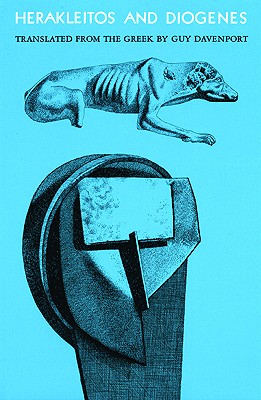
Guy Davenport, a stylist worthy of his Masters

.

HeraclitusHerakleitos — sees this world as one seamless “all” in constant motion and taking many forms — with what we call “fire” as the recurring form within that flux that he can point to by name, using it as his best metaphor for that “all”…

In the beautiful translation of Guy Davenport (drawn here from fragments 28 and 29 in his book, 7 Greeks, p 161:

Everything becomes fire, and from fire everything is born, as in the eternal exchange of money and merchandise.

This world, which is always the same for all, neither god nor man made: it has always been, it is, and always shall be: an everlasting fire rhythmically dying and flaring up again.

**

This is just a quick post, a little creativity flaring up and dying down again while I am preparing longer pieces on Nidal Hassan (as discussed by Daveed Gartenstein-Ross, JM Berger and emptywheel), a zennish biography of John Cage, and Rain (with a capital roar) in African religion and urban settlements.

I was glancing at Chris Bright‘s entry Anticipating Environmental “Surprise” in State Of The World 2000, and my eye was caught by the phrase, “Surface fires do not climb trees and become crown fires.”

I’d never heard of “surface fires” and “crown fires” before, and “crown fires” in particular had me thinking there’s poetry here…

So I took a deep breath, slowed down, and read more carefully. And as I was reading the whole short section that began with those words, one part of my mind was soaking in the vivid images the text conjured up for me, but another part was calculating percentages in what seemed to be a rapidly accelerating descent.

I have tried to picture that double effect — of lush rainforest and the numbers that illustrate its fiery fall — in what follows:

**

100%

Surface fires do not climb trees and become crown fires. They just crackle along the forest floor, here and there, as little patches of flame, going out at night, when the temperature drops, and rekindling the next day. They will not kill the really big trees, and they do not cover every bit of ground in a burned patch. But they are fatal to most of the smaller trees they touch. Overall, an initial surface fire may kill perhaps 10 percent of the living forest biomass.

90%

The damage may not look all that dramatic, but another tract of forest may already be doomed by an incipient positive feedback loop of fire and drying. After a surface fire, the amount of shade is reduced from about 90 percent to around 60 percent, and the dead and injured trees rain debris down on the floor. So a year or two later, the next fire in that spot finds more tinder, and a warmer, drier floor. Some 40 percent of forest biomass may die in the second fire. At this point, the forest’s integrity is seriously damaged; grasses and vines invade and contribute to the accumulation of combustible material.

50%

The next dry season may eliminate the forest entirely.

0%

.
**

Those falling numbers remind me of the floors whizzing by in an elevator I once frequented in Denver — where the framed elevator license said, ominously enough, Type: Plunger.

And so here we are at “Ground floor: Perfumery, Stationery and leather goods”.

One very simple part of how complex the world we live in really is has to do with repercussions…

Recommended Reading & Viewing

Monday, August 6th, 2012

Top Billing! Grand Blog Tarkin (Jon Jeckell) – The Jedi Way of War

….While it seems the Jedi would be the only institution competent in warfare after thousands of years of peace, they were the worst possible choice on many levels. What institution within the Republic retained any practical knowledge of warfare? Some private institutions and individual planetary governments, such as Naboo, had their own modest security forces, but the Republic seemed to lack any other institution capable of employing coercion on behalf of the state. This study will elide the political, policy and civil society aspects and focus on explaining why the Jedi Order were a uniquely poor choice to lead the Grand Army of the Republic. Although it superficially appears the Jedi are the only ones capable of taking on this burden, they suffered from numerous institutional biases and a philosophy that impeded their ability to understand what was happening or adapt to realities of their new role. Leading a massive Army was not a linear extension of the skills the Jedi possessed, and they lacked the ability to gain those skills.

Although the Jedi were renowned diplomats and keepers of the peace, they were not politicians or strategists, and never critically examined the Separatist’s grievances to identify the root causes of the conflict. Without understanding the causes of conflict, they failed to develop a theory of victory. Without this, they merely continued to pursue of the Separatist leaders and the destruction of their army after the first engagement. They failed to reframe from their roles as individual combatants to leaders of an Army for a multitude of reasons explored below.

The much talked about post of the week where science fiction meets strategic analysis.

Diane Ravitch –Rahm and Other People’s Children 

One of the themes of the corporate reform movement is this:

“We know what’s best for other people’s children but it is not what’s best for mine.”

Many of the leading corporate reformers went to elite prep schools and/or send their children to them.

Schools like Exeter, Andover, Deerfield Academy, Sidwell Friends, the University of Chicago Lab School, Lakeside Academy (Seattle), Maumee Country Day School (Toledo). At these schools there are beautiful facilities, small classes, experienced teachers, well-stocked libraries, science laboratories, and a curriculum rich in the arts, sciences, languages, and other studies.

I hope you read this post about Chicago billionaire and school board member Penny Pritzker. She sends her children to the University of Chicago Lab School, which has the best of everything, but feels no embarrassment that the children of Chicago who attend public schools that she oversees do not have the same advantages.

Mayor Rahm Emanuel sends his children to this school. Arne Duncan is a graduate of it.

Remember that theme: Other People’s Children.

This reader thought about what Mayor Rahm Emanuel wants for his own children. Why doesn’t he want the same for all Chicago’s children? 

Good charter schools tend to be based upon delivering a different, innovative, curriculum well or serving a specific, generally disadvantaged, student population (the original, largely forgotten and abandoned, justification for charter schools). The founder is usually there on site, putting in long hours, leading by example, working with children, because their educational vision is a mission and labor of love. Their own kids are usually their first students.

Unfortunately, that has little or nothing to do with the Corporate Ed Reform pushed by both President Obama and Governor Romney, which rides on the reputation of the mom & pop charters but frequently fails to live up to it because their mission is a profit-maximizing business model devised by and lobbied for by hedge funds and private equities firms to divert public tax dollars to investors at the lowest delivery cost possible.  That model is not compatible with quality education and isn’t intended to be. If it were, the owners and investors would be enrolling their own children in the highly regimented, rote-learning script, worksheet based schools and “virtual charter” scams they are pushing on states, cities and school districts.

Conspicuously, they don’t.

WPR (Steve Metz )- A Necessary Evolution: U.S. Military Strategy Goes Invisible 

….It also became clear that the belief that removing Saddam Hussein or the Taliban from power would strike a mortal blow against al-Qaida and other terrorist organizations was unfounded. If anything, the war in Iraq added to the terrorism problem by radicalizing thousands more terrorists and giving them an opportunity to acquire training and experience. Even the demise of the Taliban regime in Afghanistan, though it forced al-Qaida to relocate and reorganize, was not the body blow to terrorism that the Bush administration hoped. Rather than deterring extremists, it motivated new ones. 

Terrorism, it turned out, was not a nail after all. 

But a strange thing happened along the way to this simple discovery: The United States developed a different form of offensive military action — reliance on invisible or less-visible actions such as strikes by special operations forces and unmanned aerial vehicles — which held more promise. While they might not have led to a decisive and unambiguous victory over terrorism, these approaches certainly degraded the extremists’ capabilities. 

Google lends it’s analytical heft and cool graphics in a not so subtle effort to aid supporters of the UN Small Arms Treaty. Some of the stats for third world nations, or major arms exporters like Russia, appear impossibly small or are absent. For example, somehow, I think Afghanistan has imported some weaponry in the past twenty years. Click through and see if you agree.

John Robb – How Do You Attract Resilient People? Give Them Room to Grow 

Fred Leland –Check out My Latest P1 Column: Patterns of behavior, officer safety, and ‘the rule of opposites’

SWJ Blog –Why There’s Nothing Illegal about CIA Drone Pilots  

Eide Neurolearning Blog –The Steps of Creativity – Early Crowd sourcing and Prototyping 

Gunnar Peterson – Security > 140 Conversation with Jason Chan 

Abu Muqawama – Guest Post: The Last Argument of Tyrants 

Feral Jundi –California: Sacramento International Airport Dropping TSA

Shloky.com – VIDEO: THE WORLD THAT SCVNGR/FOURSQUARE/ETC WANT

RECOMMENDED VIEWING:


Switch to our mobile site