zenpundit.com » 2012 » September

Archive for September, 2012

Of films, riots and hatred II: when islands are the issue

Monday, September 17th, 2012

[ by Charles Cameron — comparative riotology, with sidelong glances at goats and a single mole ]
.


.

It’s not always disrespect for the Prophet that causes people to burn flags and attempt to break into embassies

This week, the disputed sovereignty of some uninhabited islands has done the trick quite nicely in Beijing, where rioters have attempted to breach the Japanese embassy and burned the Japanese flag (upper image, above) in a manner that’s somehow reminiscent of the breaching of the US embassy and corresponding burning of the US flag (lower image) in Cairo .

I imagine that if one was Japanese or Chinese, one might consider the Beijing protests over the ownership of the Senkaku / Diaoyu / Tiaoyutai Islands to be the primary troubling news-story about embassies, rioting and gross breaches of diplomatic protocol this week.

There’s a strange kind of parallax involved here, I think. Or perhaps: what’s in the foreground depends on where you stand.

But that’s not to say there’s an exact equivalence between the situations, just that bearing one in mind may shed some light on the other.

**

I hope to get into the layers and layers of motivation that feed a riot in a subsequent post, but for now I’d just like to point to one similarity between the two situations. In each case, there’s an undertow of strong feeling that surfaces at a certain point — and astonishes us by its force.

In the case of the disputed islands, it may be Chinese feelings about Japanese behavior towards them in World War II that are triggered by Japanese claims on the islands. As China Daily USA says:

Japan has to recognize China’s sovereignty over the Diaoyu Islands and atone for its past aggressions and atrocities, and take measures to punish those Japanese who deny the country’s violent past, in the way that Germany has been doing for decades. Only if Japan does that will China and other Asian countries see it as a normal country. Otherwise, China should prepare for a long-term struggle.

Or as the Israeli Arutz7 puts it:

As

The dispute with Japan is now part of the legacy of World War II and China claims that under the Potsdam Declaration of 1945, Japan was obligated to return all the territories seized illegally.

The above means that the dispute over the islands is now connected to one of the most highly charged issues in Sino-Japanese history, making it a matter of national honor for the Chinese that is not subject to negotiation.

Note here that the question is expressly one of honor.

It is significant, too, that the Chinese can be described as lenient towards their protesters attaching the sovereign embassy of a sovereign nation, just as the Egyptian government has been described as lenient towards their protesters attacking the sovereign embassy of the United States:

In the interim, China has allowed anti-Japanese demonstrators a relative freehand (“Their feelings are perfectly understandable” explained the Chinese Foreign Ministry) and the Japanese Embassy in Beijing has issued warnings to Japanese citizens and businessmen to take precautionary measures.

**

I strongly believe that undertows, as I am calling them here, are among the most important topics for monitoring and analysis — and that the fact that they so often take us by surprtise is a good reason to pay them closer analytic attention.

They surface in dreams, in graffiti, in conspiracy theories, in all the liminal spaces. And they can have game-changing impact: Great Game Changing impact.

That, btw, is why Cass Sunstein‘s paper on conspiracy theories is one we should consider in detail here on ZP one of these days.

**

Of course, as this recent map from the Economist shows

— there are also oil and gas fields nearby.

What drives a crowd to riot and what interests the powers that be may be two very different sides to the same affair.

**

Curious Goat Fact accompaning the above map:

In the 1970s Japanese ultra-rightists took two goats on a 2,000km (1,250-mile) trip southwest from Tokyo to a group of uninhabited rocks near Taiwan called the Senkaku Islands. In the absence of humans willing to live in such a remote outpost, the hardy creatures would be the vanguard of a new push to solidify Japan’s hold over the islets, which are also claimed by China and Taiwan.

Supplementary Mole Fact:

The Senkaku mole is an endangered species.

**

Does comparing Beijing 2012 with Cairo 2012 change the emphasis with which you view recent events in Cairo and elsewhere?

Do you find the analogy between Cairo 2012 (upper panel above) and Tehran 1979 (lower panel) more convincing?

Look, I think the making of analogies is one of the chief ways — if not the chief way — in which we make “instinctive” judgments, which we then back up with appropriately selected data and reasoning. If you like, it’s subject to our own mental version of undertow in terms of what analogies we chose and how strongly we then weigh them — unless we take responsibility for the process, and begin to explore how it actually works in our own minds, and in the public mind…

Analogy is an extremely powerful instrument of thought — and it’s about time we understood it as well as we understand linear logic.

Of films, riots and hatred I: Benedict XVI in Lebanon

Sunday, September 16th, 2012

[ by Charles Cameron — where to begin? let’s start with peace ]
.
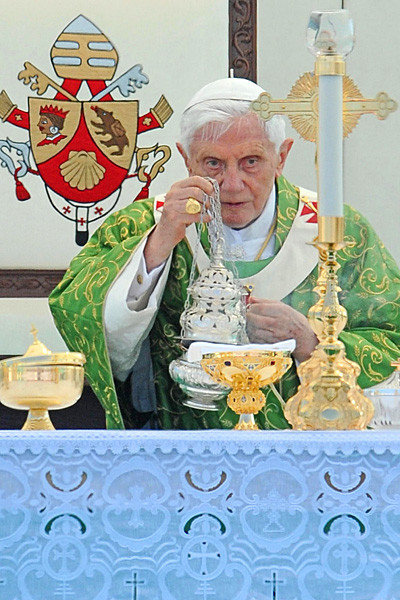
Photo credit: Ciro Fusco, EPA

.

Pope Benedict XVI has been in the Lebanon these last three days, and after an extremely turbulent week in which many discordant religious and / or “religious” notes have been sounded, I thought I’d begin what I imagine will be a series of posts from my POV on the mayhem with some words of peace (Heb: Shalom; Ar: Salaam) from the Pontiff, seen above celebrating an open air mass on the Beirut beachfront.

**

The Pope was in the Lebanon to sign a Catholic document of some significance, the Apostolic Exhortation Ecclesia in Medio Oriente, and it is from that document that I would like to extract some specific paragraphs:

Here’s the kernel of the situation as the Pope sees it, going into it —

How many deaths have there been, how many lives ravaged by human blindness, how many occasions of fear and humiliation! … How sad it is to see this blessed land suffer in its children who relentlessly tear one another to pieces and die!

— grief at human folly.

**

Benedict then begins to address the situation, offering us his definition of peace:

For the sacred Scriptures, peace is not simply a pact or a treaty which ensures a tranquil life, nor can its definition be reduced to the mere absence of war. According to its Hebrew etymology, peace means being complete and intact, restored to wholeness. It is the state of those who live in harmony with God and with themselves, with others and with nature.

Since we are not yet in harmony with each other…

Authentic witness calls for acknowledgment and respect for others, a willingness to dialogue in truth, patience as an expression of love, the simplicity and humility proper to those who realize that they are sinners in the sight of God and their neighbour, a capacity for forgiveness, reconciliation and purification of memory, at both the personal and communal levels.

He observes that such a dialogue should be theologically oriented rather than politically driven:

The Church’s universal nature and vocation require that she engage in dialogue with the members of other religions. In the Middle East this dialogue is based on the spiritual and historical bonds uniting Christians to Jews and Muslims. It is a dialogue which is not primarily dictated by pragmatic political or social considerations, but by underlying theological concerns which have to do with faith.

This dialogue can be grounded in in the one God common to the Abrahamic faiths:

Jews, Christians and Muslims alike believe in one God, the Creator of all men and women. May Jews, Christians and Muslims rediscover one of God’s desires, that of the unity and harmony of the human family. May Jews, Christians and Muslims find in other believers brothers and sisters to be respected and loved, and in this way, beginning in their own lands, give the beautiful witness of serenity and concord between the children of Abraham.

It will demand humility rather than triumphalism:

The truth cannot unfold except in an otherness open to God, who wishes to reveal his own otherness in and through my human brothers and sisters. Hence it is not fitting to state in an exclusive way: “I possess the truth”. The truth is not possessed by anyone; it is always a gift which calls us to undertake a journey of ever closer assimilation to truth. Truth can only be known and experienced in freedom; for this reason we cannot impose truth on others; truth is disclosed only in an encounter of love.

I imagine that some will find here an echo of the Qur’an:

Let there be no compulsion in religion.

— Quran 2. 256

Thus far the pope has expressed his grief at the circumstances, and outlined the basic issues between religions. He now turns his analysis to the situation within the religions:

Like the rest of the world, the Middle East is experiencing two opposing trends: secularization, with its occasionally extreme consequences, and a violent fundamentalism claiming to be based on religion.

Benedict is well know for his opposition to the “occasionally extreme consequences” of secularism: here he speaks in favor of what he terms “healthy secularity”.

Some Middle Eastern political and religious leaders, whatever their community, tend to look with suspicion upon secularity (laïcité) as something intrinsically atheistic or immoral. It is true that secularity sometimes reduces religion to a purely private concern, seeing personal or family worship as unrelated to daily life, ethics or one’s relationships with others. In its extreme and ideological form, secularity becomes a secularism which denies citizens the right openly to express their religion and claims that only the State can legislate on the public form which religion may take. [ … ]

A healthy secularity, on the other hand, frees religion from the encumbrance of politics, and allows politics to be enriched by the contribution of religion, while maintaining the necessary distance, clear distinction and indispensable collaboration between the two spheres.

Religious fundamentalism is the second challenge the Pope addresses:

Economic and political instability, a readiness on the part of some to manipulate others, and a defective understanding of religion help open the door to religious fundamentalism. This phenomenon afflicts all religious communities, and denies their long-standing tradition of coexistence. It wants to gain power, at times violently, over individual consciences, and over religion itself, for political reasons.

Here he addresses his colleagues in religious leadership:

I appeal urgently to all Jewish, Christian and Muslim religious leaders in the region to seek, by their example and by their teaching, to do everything in their power to eliminate this menace which indiscriminately and fatally affects believers of all religions.

He then drives the point home by quoting his own words on an earlier occasion:

“To use the revealed word, the Sacred Scriptures or the name of God to justify our interests, our easy and convenient policies or our violence, is a very grave fault.”

**

That’s the substance of the Pope’s message in the context of recent disturbances in the region. There were a couple of notes he touched on, however, that interested me not for any connection with recent events, but for specific theological connotations:

Growth by individuals in the life of faith and spiritual renewal within the Catholic Church will lead to the fullness of the life of grace and theosis (divinization).

Theosis is a term more commonly found among Eastern Christians, and I wouldn’t want to define the doctrine in words, though I’ll suggest that its spirit is captured in the English mystic Thomas Traherne‘s magnificent meditation [Century I. 29]:

You never enjoy the world aright, till the Sea itself floweth in your veins, till you are clothed with the heavens, and crowned with the stars: and perceive yourself to be the sole heir of the whole world, and more than so, because men are in it who are every one sole heirs as well as you. Till you can sing and rejoice and delight in God, as misers do in gold, and Kings in sceptres, you never enjoy the world.

One of Benedict’s comments specifically addresses an issue of importance as Christianity and Islam find common ground in the Middle East:

In those unfortunate instances where litigation takes place between men and women, especially regarding marital questions, the woman’s voice must also be heard and taken into account with a respect equal to that shown towards the man, in order to put an end to certain injustices.

He gives an account of the Catholic doctrine of scriptural interpretation, which will be of interest to those concerned with such things in specifically Catholic, more generally Christian or comparative contexts:

The representatives of the various schools of textual interpretation were agreed on the traditional principles of exegesis accepted by the Churches of both East and West. The most important of these principles is the conviction that Jesus Christ incarnates the intrinsic unity of the two Testaments and consequently the unity of God’s saving plan in history (cf. Mt 5:17). The disciples would only come to understand this unity after the resurrection, once Jesus had been glorified (cf. Jn 12:16). A second principle is fidelity to a typological reading of the Bible, whereby certain Old Testament events are seen as a prefiguration (a type and figure) of realities in the new Covenant in Jesus Christ, who is thus the hermeneutical key to the entire Bible (cf. 1 Cor 15:22, 45-47; Heb 8:6-7). The Church’s liturgical and spiritual writings bear witness to the continued validity of these two principles of interpretation, which shape the ecclesial celebration of the word of God and inspire Christian witness. The Second Vatican Council went on to explain that the correct meaning of the sacred texts is found by considering the content and unity of the whole of Scripture, in the light of the living Tradition of the whole Church and the analogy of faith.

He also addressed the question of liturgical renewal, in a similar spirit, both orthodox (little o) and catholic (little c):

Such a renewal must of course be undertaken, to the extent possible, in cooperation with those Churches which are not in full communion, yet are also heirs to the same liturgical traditions. The desired liturgical renewal must be based on the word of God, on the proper tradition of each Church, and upon the new insights of Christian theology and anthropology.

As an aside — anthropology is an interesting word to have made its way into that statement. I must admit I am not sure whether he’s in any way suggesting something along the lines of “cultural anthropology” — which has a fair amount to say about ritual and how it functions — but I’m pretty sure his main meaning here is something closer to the original meaning of the word — along the lines of the “sound understanding of man” that he’d mentioned in an earlier passage in the Exhortation.

One passage suggested to me that Benedict might be alluding to the Muslim terminology of the Companions of the Prophet, and suggesting some measure of similarity with the disciples of Christ:

By rediscovering its original inspiration and following in the footsteps of those first disciples whom Jesus chose to be his companions and whom he sent out to preach (cf. Mk 3:14), the Christian presence will take on new vitality.

I’m hoping that will prove to be a deft touch, a tiny but significant gesture of friendship.

**

Finally, Pope Benedict makes another reference which must have resonated with his Eastern Catholic and Orthodox co-religionists, returning to the grief with which he began his orations, appealing to Mary as Theotókos, “the one who gives birth to the one who is God”:

The heart of Mary, Theotókos and Mother of the Church, was pierced (cf. Lk 2:34-35) on account of the “contradiction” brought by her divine Son, that is to say, because of the opposition and hostility to his mission of light which Christ himself had to face, and which the Church, his mystical Body, continues to experience. May Mary, whom the whole Church, in East and West alike, venerates with affection, grant us her maternal assistance. Mary All-Holy, who walked in our midst, will once again present our needs to her divine Son. She offers us her Son. Let us listen to her, for she opens our hearts to hope: “Do whatever he tells you” (Jn 2:5).

In so doing, he remembers also, and reminds us all, of those who are martyred for their Christianity in a world where religion can so often be your excuse to kill, or another’s excuse to kill you.

New Book: Mission Revolution by Jennifer Morrison Taw

Sunday, September 16th, 2012

Mission Revolution: The US Military and Stability Operations by Jennifer Morrison Taw

Columbia University Press just sent me a review copy of Mission Revolution: The US Military and Stability Operations by Jennifer Morrison Taw, an assistant professor of IR/Security Studies at Claremont McKenna College.  Taw has written a very timely book given the looming threat of sequestration – she has investigated and analyzed the institutional and strategic impact of the US having elevated MOOTW (military operations other than war) in 2005 to a DoD mission on par with war-fighting, terming the change a “Revolution”.

[ Parenthetical aside: I recall well Thomas Barnett loudly and persistently calling for the Pentagon to deal with MOOTW by enacting an institutional division of labor between a heavy-duty Leviathan force to handle winning wars and a constabulary System Administration force to win the peace, manage stability, defend the connectivity. Instead, in Iraq and Afghanistan we had one Leviathan force trying to shoehorn in both missions with a shortage of boots, a river of money and a new COIN doctrine. Soon, if budget cuts and force reduction are handled badly we could have one very expensive, poorly structured, force unable to do either mission.]

Thumbing through Mission Revolution, it is critical and well focused take on the spectrum of problems the US has faced in the past ten years trying to make a “whole of government” approach an effective reality in stability operations and counterinsurgency. Taw covers doctrine, training, bureaucratic politics, procurement, policy, grand strategy, mission creep, counterterrorism and foreign policy visions of the civilian leadership, all with generous footnoting.

I am looking forward to reading Mission Revolution and giving it a detailed, in-depth, review in the near future.

Zenpundit.com….Like us on Facebook!

Saturday, September 15th, 2012

If you can’t beat’em, join’em.

We now have a Facebook page.  It seems to work for Doctrine Man! so I thought, why not?

Comments on this experiment are welcome.

Recommended Reading & Viewing

Thursday, September 13th, 2012

Top Billing! C. Christine Fair – State of Terror 

I am zen and I approve of this message!

….There can be no doubt that Pakistan’s unrelenting support for the Afghan Taliban and allied militant organizations, of which the Haqqani network is just one of many, has made any kind of victory — however defined — elusive if not unobtainable for the United States and its allies. The crux of the matter: The United States and Pakistan have fundamentally divergent strategic interests in Afghanistan. America’s allies, such as India, are Pakistan’s enemies, while Pakistan’s allies, such as the Haqqani network and the Afghan Taliban, are America’s enemies. Unfortunately, Pakistan’s ongoing support for these groups has become an altogether easy hook on which the Americans and their allies have hung their failures in Afghanistan.

But even if Pakistan were not actively undermining U.S. and allied efforts in Afghanistan, would the country be any more stable than it was on Sept. 10, 2001? The United States and NATO-led International Security Assistance Force (ISAF) in Afghanistan have stumbled from one strategic disaster to another. The delusional belief in population-centric counterinsurgency is simply the latest chimera that plagued international efforts to bring Afghans a modicum of peace and security. The various national missions strewn across Afghanistan under the ISAF banner have been a disjointed disaster; more like a militarized version of Epcot Center than a cohesive effort. Some of the best development projects these national partners have undertaken have been restricted to their own bases and provisional reconstruction teams (PRTs). One of my most memorable moments during a 2009 visit to Afghanistan occurred at a German PRT, notable for its perfectly paved and LED-lit sidewalks, sleeping quarters equipped with duvets and duvet covers and individually heated commodes.

Adam Elkus – Observations on Embassy Attacks 

….We have already condemned Jones’ actions to little effect. Anger instead should be directed at the criminals who violated diplomatic norms by assaulting the American embassy in Cairo and the consulate in Benghazi. Anger should also be reserved for the foreign governments that shirked their sovereign obligations to protect US diplomatic property and personnel. This is not say that we should toss out the entire idea of information operations, public diplomacy, or military information support. Any tool the United States can employ to realize its interests should be used, and IO, PD and MISO all have valuable roles to play as instruments of national power. But we should be realistic about what they can achieve.

And if we are talking about sending the wrong message, the image at the beginning of this post sends one that certainly damages the United States brand in ways that many often underrate. From 1979 to tonight, we have a troublesome habit of allowing rent-a-mobs of armed “students” and “protestors” to gain access and control over US diplomatic facilities. Perhaps the consistent failure to secure these facilities, prevent entry. and exact costs on governments that fail to protect them plays a role in their continued seizure? 

Thomas P.M. Barnett – Wikistrat’s latest sim: “Syria’s Turmoil Explored 

I co-wrote with Nick Ottens, a Wikistrat supervisor and Dutch journalist who specializes in globalization reportage.

This crowdsourced simulation, conducted in real time on Wikistrat’s online platform during the course of three weeks, discussed the sustainability of the Bashar al-Assad regime in Syria and forecasted dozens of scenarios for its collapse or survival. In addition, analysts explored and evaluated a range of policy options for the United States, Russia, Iran, Israel, Turkey, France and other actors. The simulation saw the participation and collaboration of over 120 Wikistrat analysts from all around the world. The following is an excerpt from the simulation’s executive summary, available for download here.

SWJ Blog (Audrey Cronin) –Politics, Strategy and the Haqqani Network 

Dart Throwing Chimp – Why Dictatorships Build Stuff that Crumbles and Democracy and Development Revisited…Again

Pundita – Arrest of Indian political cartoonist Aseem Trivedi: Is India’s government turning Stalinist?

Greg Palast – The Worst Teacher in Chicago 

Wilson QuarterlyIdeal Education 

Defining Ideas – Technology & the Future of Violence 

 
RECOMMENDED VIEWING:


Switch to our mobile site

