zenpundit.com » 2012 » September

Archive for September, 2012

On wearing blinders

Thursday, September 6th, 2012

[ by Charles Cameron — that neither excited hope nor fear nor fixed opinion is a workable basis for sound judgment ]
.

For some reason, this two-year-old tale popped up in my twitter-stream today.

Here’s what Leon Panetta said in response to the CIA report on how the Jordanian AQ operative Dr. Humam al-Balawi managed to get himself invited into the Camp Chapman base in Khost, Afghanistan — despite warning from Jordanian intelligence — where he blew himself up, claiming the lives of seven CIA agents:


.

Isn’t that a bit like saying “The chocolate cake itself may have clouded some of the judgments made here”? You mean, their emotions clouded their judgment, don’t you, Mr Panetta?

On this occasion, the chocolate cake was al-Balawi’s indication that he could lead the CIA to Ayman al-Zawahiri

Links:

Officer Failed to Warn C.I.A. Before Attack
Intelligence: Where Everyone Gets a Trophy

**

And now here’s a companion piece, from today’s publication of a Classified CIA Mea Culpa on Iraq:

Analysts tended to focus on what was most important to us — the hunt for WMD — and less on what would be most important for a paranoid dictatorship to protect. Viewed through an Iraqi prism, their reputation, their security, their overall technological capabilities, and their status needed to be preserved. Deceptions were perpetrated and detected, but the reasons for those deceptions were misread.

**

Intelligence is least intelligent when it’s blindsided by hopes, fears, and unquestioning assumptions.

What are our current blinders?

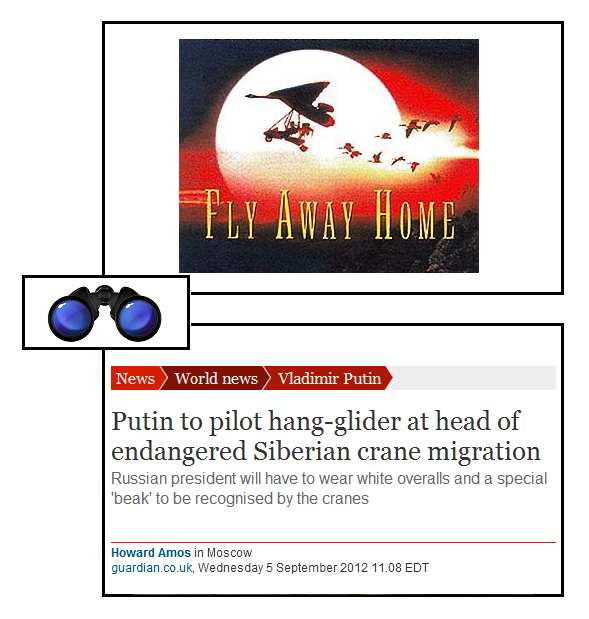
Fly away home, 007

Thursday, September 6th, 2012

[ by Charles Cameron — Putin the Magnificent and his gaggle of geese ]
.

--- upper image from the motion picture soundtrack album

In the film version, according to Wikipedia, there’s “an emergency landing at a U.S. Air Force base on Lake Ontario”

**

[ nothing too original here, the Guardian story mentioned the film ]

Inventing Grand Strategy and Teaching Command, The Classic Works of Alfred Thayer Mahan Reconsidered, a review

Tuesday, September 4th, 2012

[by J. Scott Shipman]

Inventing Grand Strategy and Teaching Command, by Jon Tetsuro Sumida

As of August 2012 this is the best non-fiction book I’ve read this year. Professor Sumida brings a potentially dry topic to life making Alfred Thayer Mahan relevant in the process; as indeed, he should. At a mere 117 pages of moderately footnoted text, Sumida provides the reader a grand tour of Mahan’s life work, not just The Influence of Sea Power 1660-1983. Sumida includes the major works of Alfred Thayer Mahan’s (ATM) father Dennis Hart Mahan, as he introduces ATM’s major works, lesser works, biographies, essays, and criticisms.

Sumida begins his chapters with quotes, and weaves his recounting of ATM’s work with musical performance, Zen enlightenment, and naval command; which is quite a combination, but convincing. Of ATM’s “approach to naval grand strategy” he writes:

Mahan believed the security of a large and expanding system of international trade in the twentieth century would depend upon the creation of a transnational consortium of naval power. His handling of the art and science of command, on the other hand, was difficult, complex, and elusive. It is helpful, therefore, to achieve an introductory sense of its liminal character by means of analogy.

This is where musical performance and Zen enlightenment become relevant and instructive. Sumida writes on musical performance:

Teaching musical performance…poses three challenges: improving art, developing technique, and attending to their interaction.

Sumida goes on to illustrate the parallels between learning musical performance and naval command/strategy and the common thread is performing or, “doing it.” He writes that most musical instruction is through the understudy watching demonstrations by the master, but the higher purpose of replicating the master’s work is “to gain a sense of the expressive nature of an act that represents authentically a human persona.” In other words, the development of relevant tacit knowledge, or as I have come to refer to this as “tacit insight.”

Sumida continues with six short chapters that pack a powerful punch and a good introduction to the trajectory of Mahan’s work from the beginning to end. My favorite was Chapter Six, The Uses of History and Theory. In this chapter Sumida deals with complexity, contingency, change, and contradiction, naval supremacy in the Twentieth Century, Jomini, Clausewitz, and command and history. Quite a line-up, but a convincing inventory of Mahan’s influences and how his work remains relevant today. Sumida writes:

Mahan’s role as a pioneer and extender of the work of others has been widely misunderstood and thus either ignored or misused. The general failure to engage his thought accurately is in large part attributable to the complexity of his exposition, the difficulties inherent in his methods of dealing with several forms of contingency, changes in his position on certain major issues, and his contradictory predictions about the future and application of strategic principles…His chief goal, however, was to address difficult questions that were not susceptible to convincing elucidation through simple reasoning by analogy. He thus viewed history less as a ready-made instructor than a medium that had to be worked by the appropriate intellectual tools.. Mahan’s analytical instruments of choice were five kinds of argument: political, political-economic, governmental, strategic, and professional.

The first three were used in grand naval strategy, the latter two with the “art and science of command.” The section of Command and History is particularly relevant given two recent posts, one at the USNI Blog, The Wisdom of a King, by CDR Salamander, and the other in a September 2012 Proceedings article by LCDR B.J.Armstrong, Leadership & Command. Here’s why: Sumida quotes Admiral Arleigh Burke, who latter became Chief of Naval Operations, during WWII. Of “Decentraliztion,” Burke wrote:

…means we offer officers the opportunity to rise to positions of responsibility, of decision, of identity and stature—if they want it, and as soon as they can take it.

We believe in command, not staff. We believe we have “real” things to do. The Navy believes in putting a man in a position with a job to do, and let him do it—give him hell if he does not perform—but be a man in his own name. We decentralize and capitalize on the capabilities of our individual people rather than centralize and make automatons of them. This builds that essential element of pride of service and sense of accomplishment.

The U.S. Navy could do worse than return to this “father” of naval strategy and give his ideas more attention; Professor Sumida’s little book would be a good place to start.

Strongest recommendation—particularly to active duty Navy personnel.

Cross-posted at To Be or To Do.

Recommended Reading & Viewing

Tuesday, September 4th, 2012

Top Billing! Information Dissemination (Chris Rawley) –Putting Major Naval Powers at Risk with Irregular Warfare 

Like the opening moves on a hundred million square kilometer chess board, great and smaller naval powers have once again begun to maneuver for Indian Ocean and Western Pacific naval infrastructure. The Southeast Asian underdogs in this match are outgunned and outspent so creativity is the order of the day. As various nations modernize and build up combat forces in the Pacific, it is worthwhile to examine alternatives to conventional naval power which could be used to thwart any real or perceived PRC threat. For an illustration of this creativity using irregular warfare, see this article penned by NWC Professor James R. Holmes analyzing an idea to establish a Vietnamese naval militia in order to defend the Paracels. Here, J. Noel Williams suggests another alternative to a new bilateral naval arms race. ….

Abu Muqawama (Dan Trombly) –Twilight of the Carriers?


…. Simply looking at carriers ability to dispense aerial firepower, however, is insufficient to understanding their value. Carriers project power, not just firepower. Bombers can support troops in contact in Afghanistan, sure, but Afghanistan isn’t exactly the height of the A2/AD challenge (and you can see plenty of F/A-18s providing airstrikes there too). Indeed, with the exception of landlocked countries, anywhere that the U.S. is providing close air support to American troops in contact, it will likely have a naval presence nearby. Indeed, if access to theater basing for tactical aircraft is diminishing, than projecting a ground presence into an area is more, not less, likely to necessitate a carrier. Carrier Battle Groups will likely need to integrate their operations more with strategic bombers and tactical aircraft, to confront A2/AD challenges, but for some kinds of crisis response, strategic bombers likely won’t cut it.

HNN (Daniel Lord Smail) –History Meets Neuroscience 

A neurohistory is a new kind of history, operating somewhere near the intersection of environmental history and global history. There are probably as many definitions of it as there are practitioners, but one important branch of the field centers on the form, distribution, and density of mood-altering mechanisms in historical societies. These can be foods and drugs like chocolate, peyote, alcohol, opium, and cocaine. But the list of mechanisms also includes things we do or endure: ritual, dance, reading, gossip, sport, and, in a more negative way, poverty and abuse. Every human society, past and present, arguably has its own unique complex of mood-altering mechanisms, in the same way that each society has distinctive family structures, religious forms, and other cultural attributes. Neurohistory is designed to explore those mechanisms and explain how and why they change over time. 

Seydlitz89 –My Conclusions on “Defining Literacy” 

My last post has been up for a while and I was very pleased with the comments that came from it. I’ve had a bit of time to consider the various points made so here are my conclusions:First, there seems to be a good bit of disagreement as to what “literacy” actually means. Is it being able to read labels on medicine bottles, or read and understand books, or is not reading/text required at all? From a Western perspective, I think we link literacy with reading/text/the written word. Other cultures may combine literacy with orality, but Western cultures do not, that is there is a distinction. To this I would add that this form of Western literacy was a requirement for much of our history since the invention of the printing press. Without this form of literacy, science and rational capitalism (as opposed to traditional capitalism) would never have changed the world the way they have. Without this literacy it would have been impossible for the modern world to exist as we know it.

Second, there seems to be a strong link between literacy, as in the ability to read and understand complex texts and the possibility of mass democracy. As I.F. Stone writes in his book, The Trial of Socrates….

Grand Blog Tarkin – The Tarkin Doctrine and the Sith Way of War 

You find someone in your organization with vision and strategic acumen. In Palpatine’s case, that person is Moff Milhuff Tarkin. Tarkin’s a man with a plan. He thinks that Palpatine should rule through fear of force rather than force itself. Tarkin understands deterrence. This is a man that recognizes that the Empire cannot kill its way to victory, but it can intimidate. This is counterinsurgency and stability through deterrence, based on a credible, overwhelming threat. That credible, overwhelming threat is the Death Star. Palpatine’s promotion of Moff Tarkin to Grand Moff, an entirely new rank, is evidence that 1) Palpatine recognized that Tarkin had a strategic vision and 2) the Empire heretofore lacked a military strategic vision. Palpatine rose to power through Machievellian politics and deception rather than military force. He didn’t defeat the Jedi clone army, he co-opted it. He defeated the Jedi through betrayal and deception, a skill set that may not work in the face of a galaxy-wide insurgency.

Palpatine, at some level, must recognize this as Tarkin, during the events of A New Hope, is the Stonewall Jackson to Papatine’s Robert E. Lee. Yes, Vader is present on the Death Star but he’s not in charge. Tarkin gives the order to destroy Alderaan after all. All Vader does is torture a prisoner and then reacts to the rebel assault by joining the fight himself. Both tactical level actions. ….  ( Hat tip Westphalian Post

Lexington Green –Creators Day 

Thomas PM Barnett –The irony: as America executes “strategic pivot” to contain Chinese military, the US economy continues to open up to Chinese FDI 

HG’s World –Let’s always speak softly people, and carry a “Big Stick.” 

Wikistrat Blog –Ask A Senior Analyst – Mr. Andrew Small

Paul Pillar-The Counterinsurgency Laboratory in Colombia 

Dave Schuler –Foundational Myths 

OTB (James Joyner)-John Nagl Next Haverford Headmaster 

WPR –With Market Forces Flowing, Mexico’s Cartels Consolidate 

Gene Expression-The cheating of the chosen and The waning of the nuclear family 

Ribbonfarm –The Varieties of Scientific Experience 

David Armano –Social Business for Complex Organizations

RECOMMENDED VIEWING:

John Cleese (yes, of Monty Python) on Creativity


Elvis, Bach, and their respective Bibles

Monday, September 3rd, 2012

[ by Charles Cameron — two books their owners have underlined and scribbled in, a practice I generally detest, and the issue of what music is suitable for worship ]
.
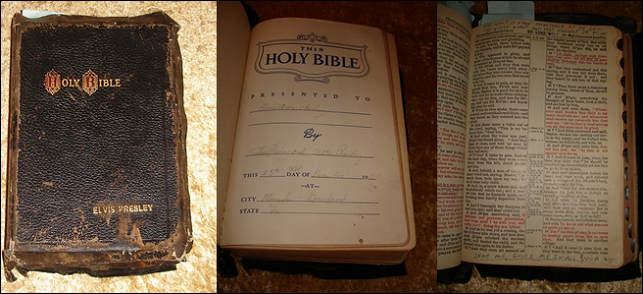
From the Omega Auctions catalogue of the Presley Collection:

Elvis Owned Holy Bible given to him in 1957 on his first Christmas at Graceland (estimate £20,000 – £25,000).

Elvis Presley’s personally owned and used Holy Bible 1957-1977 with Elvis’ handwriting, annotations and underlining throughout. This was Elvis Presley’s most precious book throughout his life from Christmas 1957 to that final day on 16th August 1977 and he read and wrote in this Holy Bible over many years. This sixteen hundred page bible with Elvis Presley and Holy Bible, embossed in gold on a leather cover was given to Elvis by his uncle Vester and Aunt Clettes Presley as a Christmas gift on December 25th, 1957 at Graceland. The bible contains Elvis’ personal annotations throughout its fragile pages. This bible was published by. The John A. Hertel Co., Chicago, IL ©1941.

I’d say that would be a steal at the price!

The auction starts at 3pm GMT on Saturday 8th September 2012 at Meadow Mill, Water St, Stockport, SK1 2BX, UK, but there are viewings on Friday 7th September from 11.00am – 6.00pm and on Saturday 8th September from 8.30am – 10.30am.

**

Tell you what I’d prefer myself, though — and I would’t even want to own it — just to know it’s there in the Concordia Seminary Library:
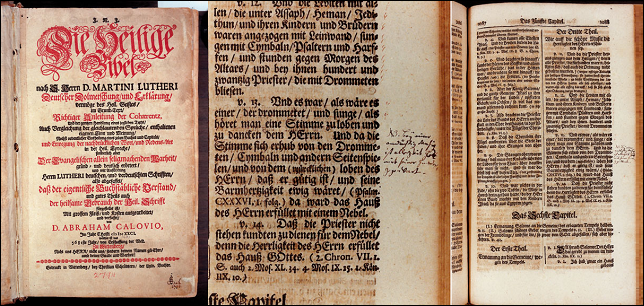
Images of Bach's Calov Bible Commentary courtesy of the Library at Concordia Seminary, St. Louis.

The 3-volume Bible commentary compiled by 17th-century Lutheran theologian, Abraham Calov, and once in the library of Johann Sebastian Bach has been in the Seminary Library collection since it was given to the Seminary by the Reichle family of Frankenmuth, MI, in the 1930s. The volumes are the only known, i.e., identified, books from the library of J. S. Bach. Calov is both editor and author of the commentary, using as he does both Martin Luther’s translation of the Bible and primarily Luther’s comments on the text, adding his own commentary when no material was available in Luther’s works. The work was printed in 1681-82. Some 25 marginal annotations of Bach, along with underlining and other marginal markings, are evidence of the composer’s use of the volumes. Careful analysis of the handwriting, as well as technical analysis of the ink done in the 1980s, established the authenticity of Bach’s ownership.

**

Is that your final choice?

That is my final choice.

**

Really what I’m getting at, though, is something that those two books can stand for: the debate now proceeding in the Catholic Church — and in Evangelical and Pentecostal Churches too — as to what kind of music is to be performed in the course of worship. The “battle lines” tend to be drawn between music that is intended to draw in the young, and music that is felt to be well-suited to the sacred.

Pope Benedict XVI is a strong proponent of the Western musical tradition:

An authentic updating of sacred music can take place only in the lineage of the great tradition of the past, of Gregorian Chant and Sacred Polyphony.

More personally, Benedict is an admirer of Mozart, whose music he plays daily on the piano — and of JS Bach, about whom he once said:

The encounter with the beautiful can become the wound of the arrow that strikes the heart and in this way opens our eyes, so that later, from this experience, we take the criteria for judgment and can correctly evaluate the arguments.

For me an unforgettable experience was the Bach concert that Leonard Bernstein conducted in Munich after the sudden death of Karl Richter. I was sitting next to the Lutheran Bishop Hanselmann. When the last note of one of the great Thomas-Kantor-Cantatas triumphantly faded away, we looked at each other spontaneously and right then we said: “Anyone who has heard this, knows that the faith is true.”

The music had such an extraordinary force of reality that we realized, no longer by deduction, but by the impact on our hearts, that it could not have originated from nothingness, but could only have come to be through the power of the Truth that became real in the composer’s inspiration.

Blogs like the Chant Cafe and colloquia like those of the Church Music Association of America are introducing a new generation of worshipers to this tradition.

**

Interestingly, though, something of the same sort is also discernible in the writings of the Australian Pentecostal preacher and author named (perhaps coincidentally, maybe by grace) Barry Chant.

Here in the early 21st century, Chant wrote in “Retuning the Church”:

an unhealthy number of new songs focus more on rhythm and harmony than melody … Whereas a half century ago, Christians sang songs in which there were disciplined rhythms and rhymes, and both melody and lyrics followed an obvious orderly pattern, today’s rhythms are more likely to be disruptive and disjointed… ‘feeling’ is what matters. So the pulsating rhythms throb through our beings, the compelling beat makes our bodies respond and the intellectual or biblical content only needs to be sufficient to justify calling what we are singing ‘Christian’

But hey, this discussion goes back a while… Back in the mid fourth century CE, St Basil the Great wrote:

The passions born of illiberality and baseness of spirit are naturally occasioned by this sort of music. But we must pursue that other kind, which is better and leads to the better, and which, as they say, was used by David that author of sacred songs, to soothe the king in his madness. And it is said that Pythagoras, upon encountering some drunken revelers, commanded the aulete who was leading their song to change the mode and to play the Dorian for them. They were so sobered by this music that tearing off their garlands they returned home ashamed. Others dance to the aulos in the manner of the Corybantes and Baccantes. Such is the difference in filling one’s ears with wholesome or wicked tunes! And since the latter type now prevails, you must have less to do with it than any utterly depraved thing.

And yet hey, hey — L’homme armé was a pop song in France around the time of the Renaissance — yet composers from Josquin to Benedict’s beloved Palestrina based settings to the Mass on its tune…

**

The single piece of recorded music that I play most often for myself is Sara Mingardo‘s rendering of the recitative O selger Tag in rehearsal with John Eliot Gardiner, which is mercifully available on DVD.

On that same DVD, just after Mingardo has concluded her luminous performance, Gardiner quotes Bach as saying “Nota Bene: Bey einer andächtigen Musique ist allezeit Gott mit seiner Gnadengegenwart” — and then comments:

Now I find that very, very significant. That he’s saying wherever there is devotional music, God with his grace is present. Which, from a strict theological point of view is probably heresy, heretical, because it’s saying that music has an equivalent potency to the word of God. And I think that in essence is why Bach is so attractive to us today because he is saying that the very act of music-making and of coming together is, in a sense, an act which invokes the latency, the potency, the potentiality of God’s grace, however you like to define God’s grace; but of a benediction that comes even in a dreadful, overheated studio like Abbey Road where far too many microphones and much too much stuff here in the studio itself, but if one, as a musician, puts oneself in the right frame of mind, then God’s grace can actually come and direct and influence the way we perform his music.

Aaaaaaah….


Switch to our mobile site