I wanted to offer my thoughts about Boyd & Beyond 2012, now that the dust has settled and the participants are recovering from two days of intense intellectual engagement by day and partying at night.
First, thanks are in order to those who made Boyd & Beyond 2012 a reality:
To the United States Marine Corps, for use of their facilities at the Command and Staff College, the Expeditionary Warfare School and the Al Gray Research Center.
To Colonel Stan Coerr, USMC – the principal organizer of the Boyd & Beyond Conferences. It is Colonel Coerr’s hard work during the year that makes these events possible.
To Major Marcus Mainz, USMC – whose dynamic style helped facilitate a very tight schedule of speakers and kept everyone well fed at lunch.
To J. Scott Shipman – my co-blogger, friend and the official host (with his lovely wife Kristen) of the annual Boyd & Beyond Party, where the conversation continued into the night ( they were also my most hospitable hosts as well).
To the archivists and staff of the Al Gray Research Center who made our examination of Colonel John Boyd’s private papers, briefs and personal library enjoyable and informative.
To the folks from Adaptive Leader, who provided the coffee, water and snacks, of which I had too much 🙂
And finally to Gahlord Dewald for creating a much better home for the conference’s twitter archive.
Now on to the conference itself……
Everyone had their favorite presenters and the number of questions often exceeded the time available, but we could loosely group featured individuals into clusters based on their role at the conference:
THEORISTS: Dr. Chet Richards, Dr. Venkat Rao, Dr. Terry Barnhart, Michael Moore, Matt Lungren
WARRIORS: Brigadier General Stacy Clardy, USMC, Captain Paul Tremblay, Gunnery Sergeant Nick Galvan and Damien O’Connell ( my apologies to Nick and Damien as I entered the case study after it had already begun and did not catch the intros, Nick might be a Master Gunnery Sergeant and I do not know Damien’s rank at all)
SCHOLARS: Dr. Katya Drozdova, Adam Elkus, Mike Miller
PRACTITIONERS: Greg Wilcox, Marshall Wallace, Pete Turner, Mike Grice, Gahlord Dewald, Chris Cox, Tom Hayden, William McNulty, Jonathan Brown
MASTERS of CEREMONIES: Colonel Stan Coerr, Major Marcus Mainz, Colonel G.I. Wilson
SPECIAL GUEST: Mary Ellen Boyd, daughter of Colonel John Boyd
Some of the highlights from my perspective:
Chet Richards was in the keynote speaker role, as befitting his status as the authorized briefer of Colonel Boyd’s work. Chet spoke for an hour on the intellectual evolution of John Boyd’s ideas, based on this paper ” John Boyd, the Conceptual Spiral and the Meaning of Life“ available for download at Fast Transients. I also recommend Chet’s essay “ The Origins of John Boyd’s A Discourse on Winning and Losing” in this slim volume and perusing the DNI archive at DNIPOGO.
I took the most notes on Chet’s lecture of any of the talks and was highly intrigued by what he termed “Boyd’s wonderful trinity”, the relationship of “Insight, Imagination and Initiative”, partly because it relates directly to a major research project I am currently undertaking at work; also, the application of Boyd’s “Theme for Vitality and Growth” being intended to scale from individuals to grand strategy and beyond (literally, the “theme” overarches grand strategy as a particularly attractive distillation of the civilizational narrative, at least as I interpret Boyd).
Dr. Venkatesh Rao, who has the excellent blog Ribbonfarm and the even better book Tempo, spoke on mental models, stating that “mental models are like addictions” and that situations or arguments that validated our mental models was akin to “an addict getting a hit”. Venkat shared lessons learned regarding common mental models, advising “training opponents using their unconscious model”; that the best strategy was not “faster [tempo] vs. getting inside [their Loop], but both” that we should get inside and then accelerate our tempo; that we should strive for “low tempo with richer moves that are natural to the system” which will beat a high tempo of artificial moves.
In both instances of Chet Richards and Venkat Rao, I felt the stringent ban on powerpoint maintained by Boyd & Beyond was something of a handicap to their excellent talks. While I fully understand and sympathize with the reluctance of military personnel who are bombarded daily with endless streams of junk powerpoint garbage to see more shape and arrow slideware at a conference, it would have been very helpful for the audience to have seen, for example, the figures from Boyd’s Conceptual Spiral that Chet was analyzing.
While I am familiar with Boyd’s briefs, 1) I don’t have them memorized and I can only imagine that 2) the first time participants would have benefited from the visual to an even greater degree. Likewise, Venkat could have used a slide for his mental models and lessons rather than the too small whiteboard on a tripod. Some moderation and common sense in enforcing “no powerpoint” should be considered in light of the nature of the presentation (particularly since John Boyd became well known from….well….briefing….with slides!).

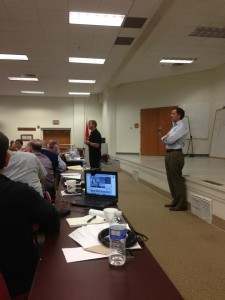

In the “Rise of the Marines” section, Brigadier General Clardy gave a forceful brief on his COIN operations in Anbar during the start of the “Anbar Awakening” that was covered by AOL Defense News:
QUANTICO, Va: Even though the administration’s strategic guidance swears off “large-scale, prolonged stability operations” while emphasizing air and naval forces, the lessons that ground troops learned in Afghanistan and Iraq will remain vitally relevant, both because we will still do stability operations in the future and because those skills apply to other kinds of conflicts as well, declared a senior advisor to the Marine Corps Commandant.
“We’re going to do more of this in the future, not necessarily less,” said Brig. Gen. H. Stacy Clardy, the Marines’ operations director. After 10 years of war, he said, “we’ve changed what we consider to be our core competencies.” Alongside the traditional Marine skills in attack, defense, and amphibious operations, “we’ve included now, as [has] the Army, stability operations.”
“It’d be nice to be able to say we’re going to go in, do the job, and get out,” said Clardy. “In reality, it may not work out that way.”
Even when future Marines can achieve their objective quickly — for example, a “non-combatant evacuation” (NEO) to get US diplomats and tourists out of a danger zone — they will still benefit from an appreciation of foreign cultures and the ability to interact with non-US civilians, officials, and security forces. So, said Clardy, the Marine Corps must give its troops “the tools to engage with populations, even if only for a limited period of time.”
Clardy was speaking at a conference at Marine Corps University, the hub of the service’s professional military education system, centered on the teachings of the late Col. John Boyd. Boyd was an Air Force fighter pilot whose research into Korean War dogfights led him to deemphasize high technology as a decisive factor. Instead Boyd ascribed fundamental importance to the human factors of how opposing combatants struggle to out-think each other, with victory going neither to the strong nor to the swift but to the most mentally agile. A fiery and confrontational prophet little honored in his own service, “Genghis John” had a lasting influence on the Marine Corps, and lately a Boyd-like fascination with human factors is rising also in the Army.
“Without what John Boyd proposed and what the Marine Corps absorbed,” said Clardy, “I’m not convinced we would have been successful in Iraq at all.”
Clardy and other attendees at the conference argued that Boyd’s emphasis on human factors — mind over matter, people over technology, skillful maneuver over raw power — holds true not just in a “hearts and minds” counterinsurgency campaign but even in no-holds-barred combat. After all, said Clardy, for a Marine or Army squad in Afghanistan that must defend its base, patrol, and react to ambushes, “the world for you on a daily basis looks a lot like any conventional op.”…..
In response to a question from me, General Clardy stated that a polycentric, decentralized, insurgency like the one in Iraq was tactically easier but a more difficult problem on a strategic level. The general was followed by Captain Paul Tremblay whose talk ended in his riveting account of how he and Bravo Company turned a feared Taliban ambush site into a shooting gallery for the Marines by using blitzkrieg tactics, killing 41 armed Taliban, routing the insurgents and pacifying the area.

A special mention should be made of the trip to the Al Gray Research Center which houses the papers and books of Col. John Boyd. Earlier, Colonel GI Wilson, had entertained us with the backstory of how the USMC, under the aegis of Lt. General Paul Van Riper, really acquired the Boyd collection for Quantico, with the added bonus of sticking it to the US Air Force. Mary Ellen Boyd also spoke movingly of that time, when her father was dying of cancer, when the Marines arrived at her parents small condo and carefully photographed and removed years of research, notes, briefing papers and books.
The archivist discussed the transfer, organization and presentation of the collection, John Boyd’s exhaustive marginalia and notations ( Boyd’s heavily marked up copy of On War was on display, which I picked up and perused) and the contents of the briefing files and papers. We dug in to all of these. The Al Gray Center, it must be said, is much larger than the Boyd archive and is a first rate facility with a professional staff ready to assist scholars and students in their research of military history. It is a must see if you visit Quantico.
The practitioners and scholars also gave some stimulating talks:
Marshall Wallace, a Quaker humanitarian NGO activist and Director of the Do No Harm Project. While a pacifist is seemingly an odd choice at a conference devoted to a military strategist, Marshall’s themes and ideas regarding decision dynamics in conflict zones were very warmly received by the audience and recognized as being strongly congruent as he illustrated how aid and aid workers, blindly inserted, can aggravate or extend conflicts ( an idea partly explored in The Five Percent: Finding Solutions to Seemingly Impossible Conflicts).
Wiliam McNulty, the co-founder of Team Rubicon gave a very inspiring talk about reintegrating veterans through “first-in” humanitarian missions to remote areas of current conflict zones, getting there long before the less nimble but heavyweight NGO’s can take over.

Pete Turner, a co-author of 29 Articles with 75 months of deployment in the field in Iraq and Afghanistan, in various capacities for the DoD and USG, gave a rapid-fire talk on transition operations being a different breed of animal from COIN. stressing “cultural acuity” and aggressively building up the role of the host nation partner. “Wasta is for the host nation [official]” Turner stated ” If you can’t talk transition, you can’t do COIN”. Turner dismissed our current efforts at cultural awareness and language programs as “Disneyland training” – a point that was strongly seconded (if not more robustly) by a later speaker, former intelligence officer and CORDS program official Tom Hayden, who compared American COIN efforts in Vietnam and Afghanistan.
Dr. Katya Drozdova: The former Hoover Institution Fellow gave a provocative talk about partitioning Afghanistan along ethnosectarian lines – or at least moving from a strong central government to a looser federation with autonomy for major Afghan demographic groups.
Gahlord Dewald, a social media expert and strategist, spoke on the theme of “dreadful efficiency” :
….Dreadful efficiency occurs whenever the path of energy or interest or attention is so straight and so clear that there is no room for the survival of anything else. It’s like the difference between a city water main and a stream. The water main may pass thousands of gallons of water for years before any significant life takes hold in the pipes. The stream would be supporting life within days.
Chris Cox, a British political consultant did an excellent analysis of strategic political dynamics – including recent American political history – something that I think rattled some of the audience members, much to my amusement. If I was ever running for political office, I’d hire Chris in a heartbeat.
Adam Elkus gave one of the best talks of the conference, on par with Chet Richards and Venkat Rao’s in terms of depth, speaking on “OODA and Robotic Weapons“. Leading with “The metaphor is not Terminator but Starcraft”, Elkus held the audience’s rapt attention as he dismantled a great deal of popular rubbish regarding drones and pointed to the larger, strategic implications of the deployment of autonomous systems within the larger operational context. I first met Adam at the Boyd Conference in 2007 and it has been a pleasure watching him mature into a first rate scholar and thinker on defense issues.

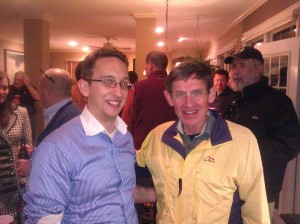
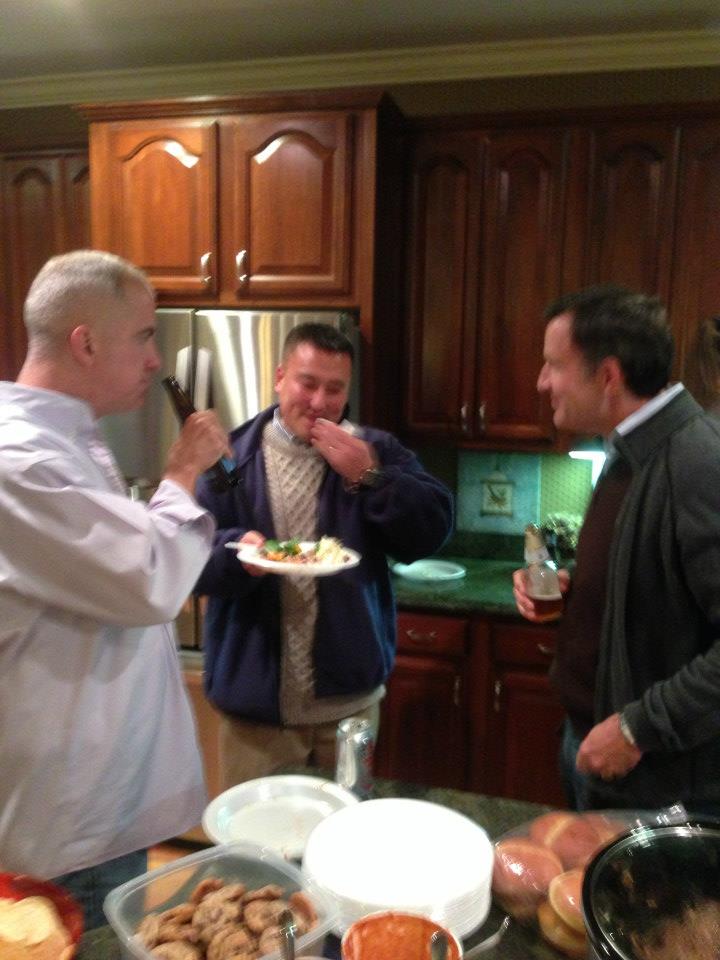
Afterwards, we closed Boyd & Beyond 2012 by enjoying great food and adult beverages at Scott Shipman’s. A wonderful time being had by all.
See you in 2013!