zenpundit.com » 2013

Archive for 2013

A hop, skip, and a leap of faith?

Friday, July 26th, 2013

[ by Charles Cameron — Joyner estimates 2.5 million, Zeynep proposed 27 million, NSA knows — but sealed lips, eh? ]
.

10 year old Lilly Allen was told by UK police recently that "playing hopscotch in front of her house could lead to criminal charges for drawing on the sidewalk" -- oops.

When you’re playing the kid’s game of hopscotch, three hops doesn’t get you very far. But Three hops create a data deluge is Zeynep Tufekci‘s short-form analysis of the adult version of the game as practiced by NSA, and it’s interesting to see how far three hops will take you.

Here are two estimates, from two very bright people:

Someone should really find out from an appropriate someone else what the grand total of US citizens swept up under first, second and third hops, skips and exponential leaps has been over the last couple of years.

**

Sources:

  • Little Girl Warned
  • James Joyner
  • Zeynep Tufekci
  • A Feast of Form II

    Friday, July 26th, 2013

    [ by Charles Cameron — exploring recursive form as a mode of pattern recognition ]
    .

    In this post, I’ll continue my collection of interesting examples of snake bites tail self-references in tweets and elsewhere, begun in A feast of form in my twitter-stream today.

    Does this tweet — today’s offering — qualify, for instance?

    As I compile more and more items that match my sense of what belongs in this category, I’m also becoming aware that it’s a very fuzzy and subjective category indeed — closer to Wittgenstein’s “family resemblance” than to a logically exact and exacting definitional set.

    Concerning two Lifebuoys

    Friday, July 26th, 2013

    [ by Charles Cameron — nothing strategic or serious, just dropping a little beauty your way ]
    .

    Here’s a DoubleQuote that doesn’t fit my usual graphic format, but that gives me enough delight that I thought I’d post it anyway.

    It all begins with a friend pointing me to this video — it’s quite beautiful, it’s a commercial, and it’s promoting a Lifebuoy campaign, in their words, “to help reduce the deaths of two million children before their fifth birthday” by means of their “handwashing behaviour change programmes”:

    Okay: so I like the video very much, but I know nothing about Lifebuoy, their politics, their labor practices, the things that might make me hesitate to be quite as delighted by the video as I might be if there wasn’t a massive “international” tied in with the short and moving narrative. So I googled “Lifebuoy”…

    **

    And found this poem, which has nothing to do with soap but a great deal to do with telling a short and beautiful story — albeit with the simplicity of words, of poetry:

    Tarantulas on the Lifebuoy
    –Thomas Lux
    .

    For some semitropical reason
    when the rains fall
    relentlessly they fall

    into swimming pools, these otherwise
    bright and scary
    arachnids. They can swim
    a little, but not for long

    and they can’t climb the ladder out.
    They usually drown—but
    if you want their favor,
    if you believe there is justice,
    a reward for not loving

    the death of ugly
    and even dangerous (the eel, hog snake,
    rats) creatures, if

    you believe these things, then
    you would leave a lifebuoy
    or two in your swimming pool at night.

    And in the morning
    you would haul ashore
    the huddled, hairy survivors

    and escort them
    back to the bush, and know,
    be assured that at least these saved,
    as individuals, would not turn up

    again someday
    in your hat, drawer,
    or the tangled underworld

    of your socks, and that even—
    when your belief in justice
    merges with your belief in dreams—
    they may tell the others

    in a sign language
    four times as subtle
    and complicated as man’s

    that you are good,
    that you love them,
    that you would save them again.

    **

    The video and the poem are very different — yet closely connected, coming to me as they did, hot on one another’s heels the other day. I celebrate them here as an informal DoubleQuote, with gratitude to Google.

    May I recommend, to myself when my ship comes in and to others: Thomas Lux, New and Selected Poems: 1975-1995.

    Of the arm, fist and rifle

    Thursday, July 25th, 2013

    [ by Charles Cameron — product from a neat, brief convo with Ibn Siqilli aka Chris Anzalone ]
    .

    I found the upper image in the same Visual References post from Chris Anzalone that I recommended recently in two comments here [figs 2, 3, 3B] and here. If you look closely — or is just my poor eyesight? — you’ll see the arm, fist and rifle to the left of the black banner in the upper half of the upper image.

    Black banner? Did I just say black banner?

    That upper image is the “logo of the Brigade of the Awaited Savior (Katibat al-Mahdi al-Muntazar)” according to Chris, and the text below reads, “O’ One Who Arises (al-Qa’im) [from] the family of Muhammad.”

    So there you have Mahdism (the titles al-Muntazar and al-Qa’im are both indicators of the same returning great one as the term al-Mahdi itself) along with the well-known banner…

    **

    What follows I have taken from a post on the Lebanese Expatriate blog, with some minor format changes to give the contents better graphical integration with the rest of the post:

    For those with the slightest knowledge about Hezbollah and the Middle East, I am not sharing with you something new, but for those who receive this information as a revelation, check out the resemblance between the emblem of Hezbollah and that of the Pasdaran, a.k.a Army of the Guardians of the Islamic Revolution.

    .
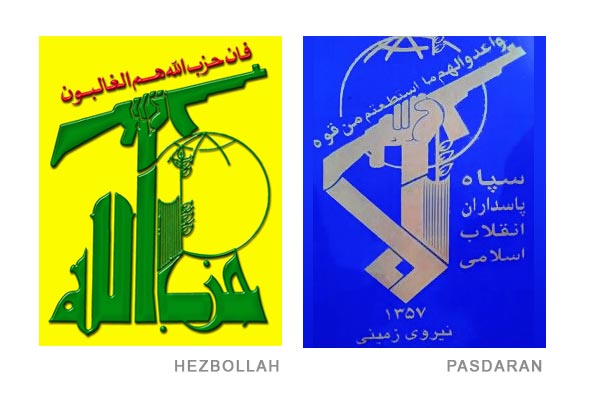
    — Hezbollah emblem to the left in yellow. Pasdaran emblem to the right in blue.
    .

    So what’s new? Why am I shedding light on what is already obvious? Why target Hezbollah today, out of all the parties that have been selling Lebanon?

    Today, more than ever, Hezbollah and Iran owe Lebanon an explanation. Take a look at the 10 Riyal postage stamp that is circulated in Iran.


    Iranian 10 Riyal postage stamp showing the emblem of Hezbollah covering the whole map of Lebanon. A clear symbol of the hidden intentions and a direct breach for the sovereignty of Lebanon’s independence as a nation.

    The stamp commemorates the martyrs of Hezbollah in Lebanon. Isn’t this an obvious breach of Lebanon’s sovereignty as a nation? I understand the bff relationship between Iran and Hezbollah, but why does Iran need to have Hezbollah’s emblem covering the Lebanese territories instead of the Lebanese flag? Why does Iran need to commemorate the Lebanese martyrs in the first place?

    What does Hezbollah have to say about this in the first place? How can Hezbollah justify such a demeaning document? What can its big-bellied, tie-less MPs and representatives say to logically justify this? Will they even attempt to justify it, or consider it normal and not even worth concealing with the whole world’s knowledge of its non-matrimonial marriage to Iran.

    As a Lebanese, I ask my government (which is controlled by Hezbollah) to question the Iranian ambassador about the motives of this stamp and ban its circulation.

    As a Lebanese, I ask Hezbollah to denounce the usage and circulation of this stamp in Iran and ask the Iranian state for an apology to the Lebanese people and its government.

    That’s taken from a post made in January, but I think it is no less relevant today, and adds to the general picture I’m painting.

    **

    I put this post together as the result of an exchange with Chris in which I asked him whether a raised arm with slanted rifle was now a characteristic motif across many or all Shi’a jihadist movements, to which he responded:

    Those groups influenced by Hizbullah &, by extension, Iranian Gov’t, seem to favor it, likely b/c it’s used by the Pasdaran.

    I then asked whether he’d say Hizbollah got the motif from the Pasdaran or vice versa, to which he replied:

    The former.

    I stumbled across the DoubleQuote image and accompanying Lebanese Expatriate post myself, searching for the best image of a Pasdaran flag or logo while following up on Chris’ pointer to the Pasdaran — and that gave me yet another use of DoubleQuotes in the wild!

    Hat-tip, #FF and thanks, Chris!

    **

    Quiet note to self: compare the arm, fist and rifle motif here with the name of the Covenant, Sword, and Arm of the Lord group in 1970s Arkansas. Most interesting, the way we display value systems in titles and images…

    From the Comments section: jihadist use of DoubleQuotes

    Thursday, July 25th, 2013

    [ by Charles Cameron — comments on two posts by Chris Anzalone aka Ibn Siqilli ]
    .

    I’m bringing across two comments of mine from DoubleQuotes in the wild and making a separate post out of them — to give them more exposure, to emphasize the importance / interest of the two posts by Chris Anzalone that they are based on — and to be able to reference them in a post I’m currently working on. Both graphics are drawn from Chris Anzalone‘s Visual References post from last month, which gives essential visual support to his article, Zaynab’s Guardians: The Emergence of Shi`a Militias in Syria in the CTC Sentinel, just out.

    Here’s the first, with Chris’ comment below:

    Nasrallah & Bashar with the Qur'an (Poster)
    .
    An Internet poster showing Hizbullah’s secretary-general Hasan Nasrallah (right) and Syrian president Bashar al-Asad. The photograph of Nasrallah was taken after the 2006 Hizbullah-Israel war and has clearly been edited to show light emanating from the book (presumably the Qur’an). The same is true of the posed image of al-Asad. Both are shown by the designer as pious (thus, presumably, deserving of support).

    This pair ties the piety of the politician with the piety of the cleric, making a conceptual bridge between both Lebanon & Syria on the one hand, and politics & religion on the other. Not terribly surprising, but still, cleverly done.

    **

    The use of “doubling” in the double cannibalism images presented below some from a little further into the same Visual References post, but serve a different function, making an association in time rather than one linking two contemporaries… They are designed to suggest that present Sunni brutalities have historical precedent — with tremendous spiritual and emotional resonance. Again, Chris’ own comment contextualizes the images:

    1, Hind & Abu Sakkar the Syrian Rebel Heart-eater
    .
    Internet poster comparing Abu Sakkar, commander of a Syrian rebel group, (right), who committed a politically symbolic act of cannibalism on video with an organ (said to have been the liver or heart) from a slain Syrian government soldier in May 2013, and Hind bint ‘Utba (left), one of the Prophet Muhammad’s most virulent enemies before his conquest of Mecca in 630 C.E. In some Islamic historical sources, she is said to have taken a bite of the liver of the Prophet’s uncle, Hamza bin ‘Abd al-Muttalib, who was also one of his greatest warriors, after the Muslims’ defeat at the Battle of Uhud near the city of Madina. The text at the bottom reads: “Some stick to their habits and traditions!!,” referring to Sunni Muslims. The image of Hind and Hamza is a still from Syrian film director Moustapha Akkad’s famous 1977 film The Message about the beginnings of the prophetic career of Muhammad, the founder of Islam. Akkad was one of those killed in a bombings of hotels in ‘Amman, Jordan carried out by Al-Qa’ida in the Land of the Two Rivers/Iraq, then led by Abu Mus’ab al-Zarqawi.

    Taken together, the two “doublets” linked to above can add rich spoils to our understanding of Shi’a contributions to what Chris calls “the increasing sectarianization of Syria’s civil war”.


    Switch to our mobile site

