zenpundit.com » 2013

Archive for 2013

Heavy breathing on the line: Uniform disbelief

Saturday, June 29th, 2013

[dots connected by Lynn C. Rees]

Sigh

Sigh

What did Lucius Aemilius Paullus know and when did he know it?

Once upon a time

During my first year’s encampment General Scott visited West Point, and reviewed the cadets. With his commanding figure, his quite colossal size and showy uniform, I thought him the finest specimen of manhood my eyes had ever beheld, and the most to be envied.

General Winfield Scott

I could never resemble him in appearance, but I believe I did have a presentiment for a moment that some day I should occupy his place on review—although I had no intention then of remaining in the army. My experience in a horse-trade ten years before, and the ridicule it caused me, were too fresh in my mind for me to communicate this presentiment to even my most intimate chum.

Flashback.

There was a Mr. Ralston living within a few miles of the village, who owned a colt which I very much wanted. My father had offered twenty dollars for it, but Ralston wanted twenty-five. I was so anxious to have the colt, that after the owner left, I begged to be allowed to take him at the price demanded. My father yielded, but said twenty dollars was all the horse was worth, and told me to offer that price; if it was not accepted I was to offer twenty-two and a half, and if that would not get him, to give the twenty-five.

I at once mounted a horse and went for the colt. When I got to Mr. Ralston’s house, I said to him: “Papa says I may offer you twenty dollars for the colt, but if you won’t take that, I am to offer twenty-two and a half, and if you won’t take that, to give you twenty-five.” 

It would not require a Connecticut man to guess the price finally agreed upon…

I could not have been over eight years old at the time. This transaction caused me great heart-burning. The story got out among the boys of the village, and it was a long time before I heard the last of it.

It was a setup.
(more…)

Geometry aka logic as an analytic tool

Friday, June 28th, 2013

[ by Charles Cameron — reflections on cognitive empowerment by selective noticing ]
.

.

I just realized that I take notice of details at the level of “geometry aka logic” which I would miss if I were more focused on content. In effect, I treat idiosyncracies and hiccups of expression — such as paradoxes — as indicative of condensed or distilled meaning.

What triggered this realization was the way my interest was aroused by this phrase:

The parallel universes may soon become perpendicular.

I found that today in an FP piece, Will June 30 be midnight for Morsi’s Cinderella story?

**

Paradox? Geometry? Contradiction? Figure of speech?

It’s the irregularity in the pattern used to describe the events in question that catches my eye here, however you care to name it. And something very similar is going on when I flag the weird juxtapositions of imagery and music in Taylor Swift, Sara Mingardo, JS Bach and a quiet WTF, or the koan-like tensions and reconciliations inherent in such inseparable pairs as war-and-peace in Of dualities, contradictions and the nonduality.

Here’s the full paragraph, discussing the increasing polarization of the Egyptian public, and some ways in which “the current situation differs more in degree than in kind from the recent past”:

Second, violence is on the table. The parallel universes may soon become perpendicular. Of course, Egyptian politics has had its victims over the past two and a half years, but violence has seemed episodic and almost self-limiting since those who have deployed it have paid a heavy political price. Nobody advocates violence now, but many expect it and it is not uncommon to hear from both sides that they will not shrink from self-defense. And the line between self-defense and offensive action can become thin for each camp for opposite reasons. The opposition is hardly centrally controlled and rogue elements have already been involved in attacks on Brotherhood offices as well as those of its political party. For the Brotherhood, its discipline has led it to prepare for what it sees as defensive action in a manner that understandably appears threatening to outsiders (especially after the events of December 2012 when Brotherhood cadres constituted themselves as a vigilante force to confront those demonstrating at the presidential palace).

Okay, so I’m already reading the article, ergo I must already have been interested enough in what’s going on in Egypt to click through to it. So why the fuss about paradox and geometry in what is, after all, only one turn of phrase in a piece whpose subject already interests me?

**

I’m still feeling my way towards and understanding of how my mind works, how I pick up on things, how I populate my mind with rich and interesting memories, how I make my small and large creative “leaps” — my means of collecting and connecting dots, if you will. Because there’s a cognitive skill there that I haven’t seen taught, and I believe it offers an “outside the box” alternative mode of monitoring topics of interest.

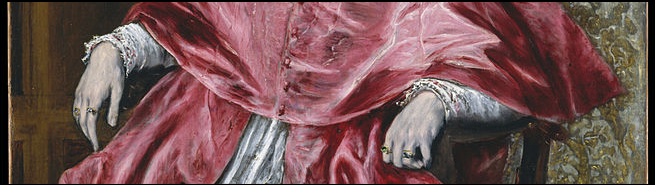
You know, of course, that most every time you read the words you know, of course, that it’s a dead giveaway that the speaker or writer is skimming quickly past a cherished assumption that he or she wouldn’t want you to examine too carefully? Of course you do. It’s one of those psychological “tells” that should alert you, like a facial tick, a hesitation, or that curious (and paradoxical) tight grip on one arm of the chair with one hand while the other rests almost disdainfully relaxed and gracious on the other, in El Greco’s masterful portrait of a Cardinal, now in the Metropolitan in New York:
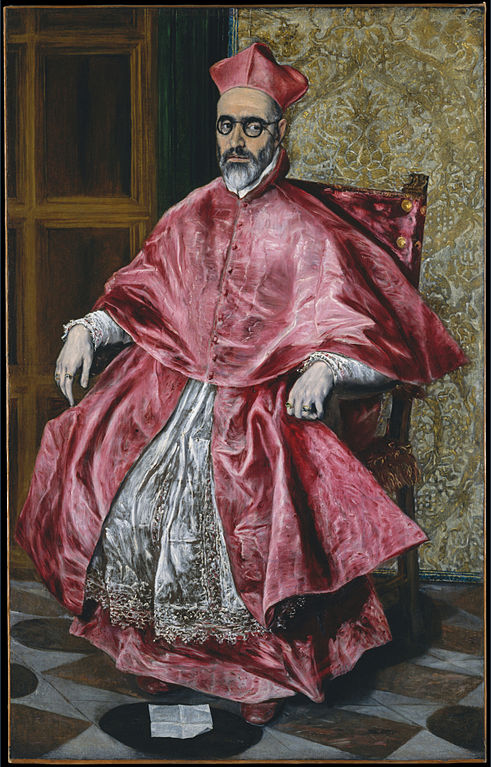
How very telling that sort of detail can be!

**

And intersections.

I talk quite a bit about juxtapositions and parallelisms, because they’re the elements of “creative leaps” (and Sembl / Hipbone moves) and I “practice” noting them for my DoubleQuotes. But one way to clear the xlutter from mind is to concentrate on places where two fields intersect. I’m interested in apocalyptic, for instance, so I take particular note when someone from a Christian apocalyptic POV (Joel Richardson, Joel Rosenberg, eg) writes about Islamic eschatology, or when someone from an Islamic apocalyptic POV (Sh. Safar al-Hawali, eg) writes about Christian eschatology. Reading wherever I notice this kind of overlap means that I learn in two contexts — effectively doubling my knowledge value — where most reading that’s not “targeted” this way only allows me to learn in one…

Again: parallelisms, overlaps, paradoxes, perpendiculars, contradictions — these are all “formal properties” of a given text rather than “contents” — that’s the level of abstraction at which you can make the details sing.

**

Hey, I’m not alone. As I was cleaning this post up, Adam Elkus tweeted a link to a post about the CTO of Intel, Intel Labs: Assuring Corporate Immortality by Rob Enderle, which contains this phrase:

This is very orthogonal thinking

There we go! The word orthogonal is so important to me, and is so often on the tip of my tongue but out of reach of immediate memory, that I have a file on my computer consisting solely of the words “opposite oblique orthogonal congruent incongruous antithetical obtuse parallel asymptotic perpendicular right angles” — so if I can remember any one of them, I can easily find “orthogonal”.

Very orthogonal thinking — terrific!

Of dualities, contradictions and the nonduality

Thursday, June 27th, 2013

[ by Charles Cameron — on the basis, the mathematics, the essence of conflict and resolution ]
.


.

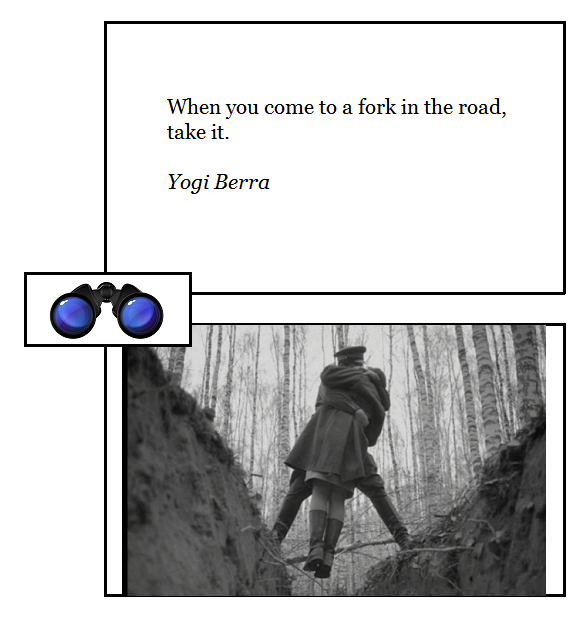
This DoubleQuote features two great masters on duality and the coincidentia oppositorum: the upper quote is Yogi Berra at his best, a koan worthy of a discourse by John Daido Loori, Roshi, while the lower image a still from Andrei Tarkovsky‘s first feature film, Ivan’s Childhood — which I stole from the ever-bountiful Gwarlingo.

Two is one and one is all and evermore shall be so.

**

Two into one won’t go, they told me in my schooldays — though not with nearly as much rigor as I presume is found in this article in Physics B

Questions of the two and the one are always of interest, because they are played out in the tensions we are faced with in daily life, and specifically in the tug of war with peace.

Thus, from my miscellaneous readings these past few days, they feature everywhere from a headline like Demonizing Edward Snowden: Which Side Are You On? in the New Yorker, who seem to feel that one should take a side, preferably the one with the least guns:

I’m with Snowden — not only for the reasons that Drake enumerated but also because of an old-fashioned and maybe naïve inkling that journalists are meant to stick up for the underdog and irritate the powerful. On its side, the Obama Administration has the courts, the intelligence services, Congress, the diplomatic service, much of the media, and most of the American public. Snowden’s got Greenwald, a woman from Wikileaks, and a dodgy travel document from Ecuador. Which side are you on?

to some relatively arcane areas of theological debate, in this case Fussing Over the 15th of Sha‘ban:

Question: Is marking out the 15th night of Sha’ban (laylat al-nisf min sha’ban) with extra prayers and devotion sanctioned by Islam, or is doing so judged to be a reprehensible innovation (bid’ah)?

Answer: Each year, a fair amount of fussing and fighting takes place over this issue. Yet the truth of the matter is that scholars have long-held this issue to be one over which there is a valid difference of opinion. The first group considered the night to have no specific virtues over and above any other night of the year, and believed that singling the night out for extra acts of worship is unsanctioned. Another group begged to differ and held that the middle night of Sha’ban does possess special merits and should be earmarked for extra prayers and devotion.

All those who hold the shari’ah to lack nuance and variety, incidentally, would do well to note (a) that it is far from exclusively devoted to the chopping off of hands or feet, and (b) combines within itself debates worthy of the Tannaim and Amoraim, or of the medieval scholastics of the Roman church…

**

By way of closure, here’s the koan from Alice in Wonderland that Loori Roshi studies in his discourse:

The caterpillar said, “One side will make you grow bigger, and the other side will make you grow smaller.” “One side of what? The other side of what?” thought Alice to herself. “Of the mushroom,” said the caterpillar. Alice looked at the mushroom, trying to make out which were the two sides of it, as it was perfectly round.

If you love your enemies [Matthew 5.44], Who’s side are you on?

And here’s what the great Cardinal Nicholas Cusanus had to say about dualities and opposites in his Of the Vision of God:

I have learned that the place wherein Thou art found unveiled is girt round with the coincidence of contradictories, and this is the wall of Paradise wherein Thou dost abide

Taylor Swift, Sara Mingardo, JS Bach and a quiet WTF

Thursday, June 27th, 2013

[ by Charles Cameron — some very beautiful music accompanied by unexpected visuals ]
.

I am in full agreement with this tweet today from our co-blogger here on Zenpundit, Scott Shipman:

Cantata 63, Christen ätzet diesen Tag, is indeed among the five or so works of Bach to which I find myself constantly turning, though not to this particular movement or performance. It is the work that John Eliot Gardiner performed so movingly, and that wonderfully caught for us on DVD — I’ve spoken of it before.

Today, though, Scott’s post brings us a mystery I’ve been pondering, and preparing to post about, for a few weeks now. It involves a series of videos, as you can see, and videos take time to watch, I know. I can only say that the music of Cantata 63 itself is wonderful, and the mystery really quite a puzzle. I hope you will find both worth your while.

**

Without further comment, then, here is Taylor Swift performing Love Story:

That seems simple enough.

Here, though, is the same footage used to present Cantata 63, directed by Karl Richter:

And here is what I take to be the same exact recording, presented with different visuals:

Remarkable.

To my mind, those three videos taken together raise all sorts of interesting questions about the sacred and the profane, eros and agape, aesthetics, mixology, you name it…

**

Here is Sara Mingardo singing the recitative O Selger Tag from the same Cantata — in the superlative rendering which I mentioned above — and only recently rediscovered on YouTube, and can thus bring you:

I have listened to a number of versions of this aria — and to my ear, mind, and heart, Mingardo brings a devotion to this “mere” recitative which far outdistances the others.

**

Now for the second part of my puzzle:

The second of those videos, with the glamorous Ms Swift’s imagery accompanying Herr Bach’s cantata, was posted by one “voiceofshariah” whose 117 videos include more Bach with Taylor Swift imagery:

— quite a glorious Bach organ piece with which I was not already familiar — but also, under the name “afghanistansomalia”, this version of the B Minor Mass, which I discussed here earlier in a post titled Osama and the flute of the devil:

— which you’ll note is posted after bin Laden‘s death, and — as if to confuse matters even further — this video, again with OBL visuals, of Maurice Jarre‘s soundtrack for the David Lean / Peter O’Toole film, Lawrence of Arabia!

Whoa! Osama bin Laden and Lawrence of Arabia?

What one is to make of all this, I can only guess. I desperately want to get back to the simple appreciation of beauty, however, and will do so, I hope, in an upcoming yet related post.

Recommended Reading – Cyber Edition II

Wednesday, June 26th, 2013

Top billing! Michael Tanji – 140+ Ed Snowden Edition 1.0Compare and ContrastPrepare for the Pendulum Swing 

I’m not going to belabor the tale of woe those trying to deal with Edward Snowden’s theft are dealing with right now. For a moment I want to opine on some of the secondary and tangential issues that I predict is going to make life in the IC more difficult because of his actions:

  1. Polygraphs. If it is true that he only took the job with BAH to gain access to specific data in order to reveal it, IC polygraph units are going to have to cancel leave through 2025. Moving from one agency to another? Get ready to get hooked up to the box (again). In a sys admin job? Pucker up. That old timer you used to get who realized that people were people and they had lives? He’s going to be replaced by a legion of whippersnappers who will all be gunning to catch the next leaker. Good people will be deep-sixed and those who survive will wonder if it’s worth the ***-pain.
  2. Investigations. When you can’t pick up on obvious problem-children, and when the bottom-line is more important than doing a good job, the bureaucracy will retrench and do what it does best: drop into low gear and distrust outsiders. There are only so many government investigators, and it’s not like there are fewer missions. Coverage will slip, tasks won’t get done, the risk of surprise (you know, what we’re supposed to try and avoid) goes up. 

Global Guerrillas  – Info Bomb,  Positive Control 

Here’s a framework that will allow you to put the stuff you read in the news into context.  

From hat bans to NSA leaks about surveillance programs.  

Problem:  Everybody on the planet IS a potential terrorist.

 Solution:  Put everybody on the planet under positive control.  

Positive control means the continuous monitoring.  

  • Location  GPS phone. Implied by utility use (smart grid).  Car GPS.  CCTV.  Facial recognition everywhere.  Social media data.
  • Network  Phone.  Social media connections.  Proximity.  Network analysis.  
  • Behavior  Economic activity.  Utility use.  Content use.  Usage monitoring.

In the case of positive control, any lack of activity or lapse in data flow is considered a dangerous act.  

Try to hide = something to hide.   

Any blocking of monitoring will be made illegal and a major crime.

Multiple systems with overlapping control will provide a complete cradle to grave blanket. 

There’s no way to avoid this.  It’s already here and nobody cares.  

Polizeros –Steve Gibson on NSA surveillance and PRISM. “Most important show ever”

Gibson’s point is that NSA taps into Tier 1 routers, and splits the data off, hence the name PRISM. They don’t have to tap your house or a server farm, just on the Tier 1 routers. Thus Apple, Facebook, and Google et al are correct in saying NSA didn’t have access to their servers. Forget server farms, the question we need to ask is, do they have access to routers near those companies by tapping the fiber optic lines. NSA targets the bandwidth provider of big high tech companies to tap the routers closest to them. All email is readable on the routers because it’s not encrypted (unless you use encryption software.) Semantic technology is used to analyze the data further. 

Joshua Foust – Can the NSA Search for Americans? Who Knows. and Three Guiding Principles for Reforming the NSA 

Lawfare BlogPhilip Bobbitt on the Snowden Affair and The Miminization and Targeting Procedures: An Analysis

Volokh Conspiracy –What is The “Real Story” About Edward Snowden and His Disclosure of NSA Activities? 

Abu Muqawama – Through a Murky PRISM 

Sic Semper Tyrannis – The Snowden Ruckus By Richard Sale and Clerks often have a lot of access 

Pundita – Out with Obama’s China Pivot; in with the Snowden Pivot, and  Obama’s Insider Threat program: Are you having a bad hair day? I might have to report you as a potential traitor to the United States. 

That’s It!


Switch to our mobile site