[ by Charles Cameron — here’s another post in my importance of form in intelligence series ]
.
Form is pattern, and pattern recognition is insight.
A while back, I started a series of posts [1, 2, 3, 4 and 5] in which I suggested that form is, from an intelligence point of view (and however you may parse “intelligence”) as important to humans as content. I’ll be saying more about this today, but wanted to complete this old and never quite completed post in that series right away, in response to a comment Grurray made today regarding Venn diagrams and the vesica piscis.
.
.
**
If you’ve seen a Venn diagram, you’ve seen overlap. And the simplest form of overlap — between two classes, ideas, or whatever — is the one that’s Venn diagrammed (below, left) as the overlapping of two equal circles — known to artists as the vesica piscis or eye of the fish.
MasterCard uses it for its logo (right) —
— as do Gucci and Chanel:
.
**
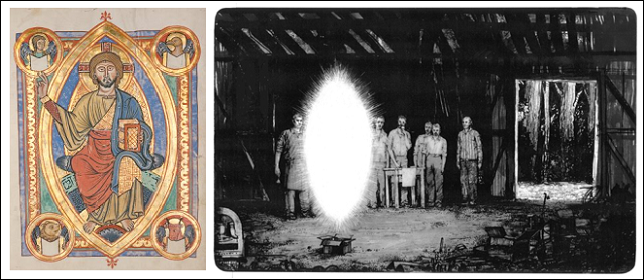
But let’s go back to that first pair of images:
.
Long before commerce took note of it, the vesica was a sacred image — back in the days when geometry, like nature herself, was sacred.
Like the illuminist of the Codex Bruchsal (ca 1220) with his Christ Pantocrator (above, left), Jan Valentine Saether makes sacred use of the vesica in his book The Viloshin Letters, which I hope to see published shortly — the exquisite suite of prints that accompany the text have already been exhibited to acclaim.
I was not sure. But a new wonder has been moving towards us. That which is… has a new presence. Entering here from elsewhere, the holy spirit manifested again in the vernacular last Wednesday, September 16th.
We were standing around, being together in our own fashion, when suddenly through our common imagination, right there on the floor in the old barn, the donna and the madonna, the loose one and the holy one, merged and became visible.
**
It seems to me there is more to the glory of God than there is to the glory of handbags and perfumes — but your mileage may vary, credit cards are handy little items, and then again, it’s all part of the glory in my opinion.
I have not read the first two books in Atkinson’s well-regarded Liberation Trilogy, but Guns at Last Light is a deeply researched work with over two hundred pages of end notes and selected bibliography, which feature a very substantial amount of primary source material. The campaign maps are richly detailed and photographs are ample. The author has aimed to satisfy academic critics, military history buffs and popular audience alike.
In vol. III Atkinson is telling the story of WWII from D-Day to the aftermath of Hitler’s suicide in defeated Berlin to overcome the savage but futile resistance of the Germans:
Although the National Redoubt in the Alps was a brown pipe dream, makeshift bastions here and there stoked SHAEF’s fear of a Germany bent on self-immolation. In Aschaffenberg, Bradley reported that ” women and children lined the rooftops to pelt our troops with hand grenades” while wounded veterans hobbled from their hospital beds into the firing line. In Heilbronn, on the Neckar River, already smashed by years of bombing, German officers shot down Hitler Youth detachments when they broke under American mortar fire
An anecdote that is the same spirit of what can be read in Ian Kershaw’s The End. The Third Reich was ruled to the last by fanatical Nazi bitter-enders who kept the war going long past the point of any hope of a moderate defeat, much less a victory.
[ by Charles Cameron — thinking more in terms of challenge than of threat, and skipping via Chicago Law, Everest, and Handel’s Messiah to a Venn diagram of the workings of conscience ]
.
Well, I don’t always read the Chicago Law Review cover to cover, or even at all to be honest — but I confess I did like this opening paragraph from George Loewenstein† & Ted O’Donoghue†† (love those daggers after your names, guys):
If you ever have the misfortune to be interrogated, and the experience resembles its depiction in movies, it is likely that your interrogator will inform you that “we can do this the easy way or the hard way.” The interrogator is telling you, with an economy of words, that you are going to spill the beans; the only question is whether you will also get tortured — which is the hard way. In this Essay, we argue that much consumption follows a similar pattern, except that the torturer is oneself.
**
Here’s the easy vs hard contrast I was thinking about as I googled my way to the Law Review — as you’ll see, it has nothing to do with interrogation:
**
So, a little background. Jason Burke has been covering Everest for The Guardian lately, since it has been almost exactly sixty years since Hillary and Tenzing were the first to “conquer” the highest peak on earth — and one of his reports caught my eye — Everest may have ladder installed to ease congestion on Hillary Step:
It was the final obstacle, the 40 feet of technical climbing up a near vertical rock face that pushed Sir Edmund Hillary to the limit. Once climbed, the way to the summit of Mount Everest lay open.
Now, almost exactly 60 years after the New Zealander and his rope-mate, Sherpa Tenzing Norgay, stood on the highest point in the planet, a new plan has been mooted to install a ladder on the famous Hillary Step, as the crucial pitch at nearly 29,000ft has been known since it was first ascended. The aim is to ease congestion.
That’s what the upper panel, above, is all about — and I think it contrasts nicely with the bottom panel, which shows a rurp. Should you need one, you can obtain your own Black Diamond rurp here.
**
Rurps are awesome. Here are two descriptions of them, both taken from the mountaineering literature, and neither one of them focusing in too closely on the poetry of the name…
Chouinard’s “rurp” was obviously something special. An acronym for “realized ultimate reality piton,” this ludicrously small fragment of heat-treated steel opened our eyes to untold possibilities.
It was about the size of a postage stamp. The business end was the thickness of a knife blade and penetrated only a quarter-inch into the rock. With several of these Realized Ultimate Reality Pitons, or rurps, Chouinard and Frost made the crux pitch on Kat Pinnacle (A4). It was the most difficult aid climb in North America.
Chouinard named this postage-stamp-sized thing the realized ultimate reality piton (RURP) because if you willingly and literally hang your life on that quarter-inch of steel, you’re liable to realize, well, ultimate reality.
Zen — yours for $15 and exemplary courage.
**
Here’s my question: should we make the hard way easier?
When is that a kindness, and when is it foolish?
**
In its own way, of course, a rurp is an assist — it makes the hard way a tad easier for the serious climber.
As indeed would the proposed “ladder” on Everest: here’s why it might be not-such-a-bad idea:
This year, 520 climbers have reached the summit of Everest. On 19 May, around 150 climbed the last 3,000ft of the peak from Camp IV within hours of each other, causing lengthy delays as mountaineers queued to descend or ascend harder sections.
“Most of the traffic jams are at the Hillary Step because only one person can go up or down. If you have people waiting two, three or even four hours that means lots of exposure [to risk]. To make the climbing easier, that would be wrong. But this is a safety feature,” said Sherpa…
Besides, the idea is to set it up as a one-way street…
Frits Vrijlandt, the president of the International Mountaineering and Climbing Federation (UIAA), said the ladder could be a solution to the increasing numbers of climbers on the mountain.
“It’s for the way down, so it won’t change the climb,” Vrijlandt told the Guardian.
Ah, but then there’s human nature to consider:
It is unlikely, however, that tired ascending climbers close to their ultimate goal will spurn such an obvious aid at such an altitude.
Bah!
**
Shouldn’t we just level the top off, as Handel and Isaiah 4.4 suggest, and as we’re doing in the Appalachians?
A little mountaintop removal mining, a helipad, and voilà — even I could make it to the summit!
**
But to return to Loewenstein† & O’Donoghue†† — their paper’s full title was “We Can Do This the Easy Way or the Hard Way”: Negative Emotions, Self-Regulation, and the Law — how can a theologian such as myself resist a diagram such as this?
Zenpundit is a blog dedicated to exploring the intersections of foreign policy, history, military theory, national security,strategic thinking, futurism, cognition and a number of other esoteric pursuits.