zenpundit.com » 2013 » September

Archive for September, 2013

Transparency: logic serpent puts foot in mouth

Tuesday, September 3rd, 2013

[ by Charles Cameron — and I didn’t know serpents even had feet, cf Genesis 3.14 ]
.

Unsealed, open source, unclassified, and for public release! — a great catch from Carol Rosenberg, whose reporting from Guantanamo is unsurpassed:

Zenpundit.com – One Million Strong

Tuesday, September 3rd, 2013

Today zenpundit.com had it’s one millionth vistor.

Thank you the readership for your continued patronage allowing us to reach this milestone!

Adding to the Book Pile

Tuesday, September 3rd, 2013


[by Mark Safranski a.k.a. “zen“]

Some “new” used books I picked up from Half-Price Books this holiday weekend….

War and Anti-War by Alvin and Heidi Toffler 

The Tofflers were among the most influential and prescient of the pop futurists of the 1970’s and in War and Anti-War they took a stab at how revolutions in information and science fields were going to change warfare and peace making. Or as Alvin Toffler said:

The thesis is very simple. The way you make war is the way you make wealth. If you change the way you make wealth, you inevitably change the way you make war. And if you change the way you make war, you ought to be thinking about changing the way you make peace.

War was initiated by the agrarian revolution, or in our terminology “the first wave of change.” With the coming of the industrial revolution, particularly the French Revolution and Napoleon, you begin to get mass production, you begin to get mass conscription. You begin to get machine guns for the machine society. With mass production, you get mass destruction – industrialized warfare. And if we are now in the process of transforming the way we create wealth, from the industrial to the informational, or call it whatever you wish, there is a parallel change taking place with warfare, of which the Gulf War gives only the palest, palest little hint. The transition actually started back in the late-1970s, early-1980s, to a new form of warfare based on information superiority. It mirrors the way the economy has become information-dependent.

An important part of this will be what we call “knowledge strategies” – social knowledge strategies, national knowledge strategies, and so on. In military terms there will be attempts to coordinate all the knowledge- intensive activities of the military from education and training to high- precision weaponry to espionage to everything that involves the mind – propaganda – into coherent strategies.

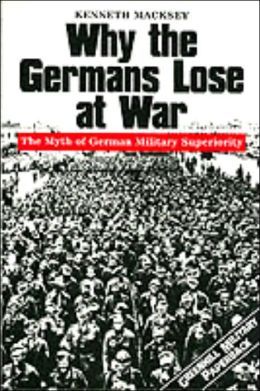
Why the Germans Lose at War: The Myth of German Military Superiority by Kenneth Macksey

The book is short and focused primarily upon the 20th century German grab for European hegemony and world power and, I expect, somewhat polemical as a counterweight to Germanomania common among military history buffs. Most of the Amazon reviewers panned it.

Hitlerland: American Eyewitnesses to the Nazi Rise to Power by Andrew Nagorski 

An account of American perceptions – reporters, diplomats, scholars and businessmen living in the Reich – of the Nazi movement and it’s coming to power and totalitarian rule over Germany. Useful in showing intelligent and well-informed people operating without benefit of hindsight as they attempted to assess the early stages of National Socialist Germany at a time when Fascism and Communism were popularly believed among Western intellectuals to represent the wave of the future.

Mike Royko: A Life in Print by Richard Ciccone

I grew up reading Mike Royko and the earlier part of my childhood was spent in the kind of gritty Chicago neighborhood of aspiring middle-class bungalows, dingy corner taverns and 16 inch softball leagues in Ed Kelly-run parks of the people who frequently populated Royko’s columns. I have read Boss several times and it is a classic tale of the world of big city Democratic Machine rough and tumble politics as much as  The Last Hurrah.

The Chicago Tribune, is a mere shadow of the great and independent newspaper that hired Mike Royko as a columnist after his career at the long defunct Chicago Daily News and The Chicago Sun-Times, which Royko quit the day it was purchased by Rupert Murdoch. Had Royko lived to see the Trib purchased by the exceedingly nasty Sam Zell, he’d have quit there as well.

Sent to Coventry and much else besides

Monday, September 2nd, 2013

[ by Charles Cameron — shall we say, not a great enthusiast for war? ]
.


.

This image of Winston Churchill in the bombed out ruins of Coventry Cathedral is almost a self-referential paradox in itself, if you still believe the canard that he knew the Germans were going to bomb Coventry that night, and did nothing about it to avoid divulging allied knowledge of the German ENIGMA code.

It it walks like a canard and quacks like a canard…

For a rebuttal of the suggestion that Churchill knew Coventry would be the target that night, see Sir Martin Gilbert, Coventry: What Really Happened [pdf, pp. 32-3] — the post-literate can listen to this Angry History podcast instead.

**

As an aside, I wonder what Churchill had in mind when he coined his celebrated mot about Russia:

It is a riddle wrapped in a mystery inside an enigma; but perhaps there is a key.

According to Wikipedia, the Poles had delivered their early Enigma-breaking theories, tools and sample cryptologic bombs to British military intelligence in Warsaw on 25 July 1939. Churchill’s broadcast, The Russian Enigma, was given on 1st October 1939.

*

And another aside, while we’re here — just to note that conspiracy theories are often among the gaseous components of a fog of war…

On the other hand, conspiracy theories can often be revealing of popular and or archetypal hopes and fears. In the present case, the anxiety revolves around situations such as that invoked by Caiaphas’ claim “It is expedient for us, that one man should die for the people“.

**

Coming at the destruction of Coventry Cathedral from another angle…

I have mourned before the losses at Bamiyan and Monte Cassino:
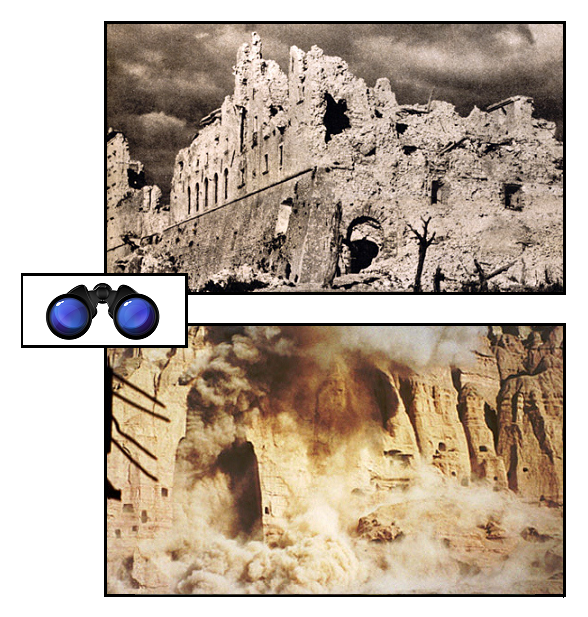
Here’s what’s happened to the Green Mosque or Mazjid Sabz, famous for its dome (upper panel only, lower panel h/t Bilal Sarwary), in the course of fighting in Afghanistan — the country whose oldest mosque it is:

**

And yet prayer continues:

FWIW, the lower panel image (above) is from a Christian Science Monitor article titled Israeli settlers respond to mosque burning allegations — the caption reads in part:

Palestinian men pray Monday near a burnt part of the carpet in a mosque that was damaged in the West Bank village of Beit Fajjar near Bethlehem. Palestinians accused Jewish settlers of setting fire to the West Bank mosque on Monday

The upper panel image, as far as I can determine, shows the continuing celebration of Mass in a German church after Allied bombardment in World War II.

**

It is at least worth pondering the words of these Trappist sisters in Azeir, Syria…

They came to Azeir to continue in spirit the work of the monks of Tibhirine, about whom I wrote, giving extensive background and the entire text of Fr. de Chergé‘s great, final testament here. The sisters write:

Today we have no words, except those of the Psalms that the liturgical prayer puts onto our lips in these days:

Rebuke the Beast of the Reeds, that herd of bulls, that people of calves…oh God, scatter the people who delight in war…Yahweh has leaned down from the heights of his sanctuary, has looked down from heaven to earth to listen to the sighing of the captive, and set free those condemned to death…Listen, God, to my voice as I plead, protect my life from fear of the enemy; hide me from the league of the wicked, from the gang of evil-doers. They sharpen their tongues like a sword, aim their arrow of poisonous abuse…They support each other in their evil designs, they discuss how to lay their snares. “Who will see us?” they say. He will do that, he who penetrates human nature to its depths, the depths of the heart…Break into song for my God, to the tambourine, sing in honor of the Lord, to the cymbal, let psalm and canticle mingle for him, extol his name, invoke it…For the Lord is a God who breaks battle-lines! … Lord, you are great, you are glorious, wonderfully strong, unconquerable.

We look at the people around us, our day workers who are all here as if suspended, stunned: “They’ve decided to attack us.” Today we went to Tartous…we felt the anger, the helplessness, the inability to formulate a sense to all this: the people trying their best to work and to live normally. You see the farmers watering their land, parents buying notebooks for the schools that are about to begin, unknowing children asking for a toy or an ice cream…you see the poor, so many of them, trying to scrape together a few coins. The streets are full of the “inner” refugees of Syria, who have come from all over to the only area left that is still relatively liveable…. You see the beauty of these hills, the smile on people’s faces, the good-natured gaze of a boy who is about to join the army and gives us the two or three peanuts he has in his pocket as a token of “togetherness”…. And then you remember that they have decided to bomb us tomorrow. … Just like that. Because “it’s time to do something,” as it is worded in the statements of the important men, who will be sipping their tea tomorrow as they watch TV to see how effective their humanitarian intervention will be….


Octavian Manea Interviews General David Petraeus

Monday, September 2nd, 2013

[by Mark Safranski a.k.a. “zen“]

Octavian Manea has had an excellent series of COIN  interviews at SWJ and this is one of the more important ones:

Reflections on the “Counterinsurgency Decade”: Small Wars Journal Interview with General David H. Petraeus

SWJ: In his recent op-ed published in the New York Times, “The Pipe Dream of Easy War”, General H.R. McMaster warned against the fantasy of “a new era of war”, and especially about the dangers in the blind faith in the transformative effects that technology promises to have on war. He argued that over the past counterinsurgency (COIN) decade we relearned a few lessons that we really should keep in mind as we head into the future: “American forces must cope with the political and human dynamics of war in complex, uncertain environments”. His warning reminds me of an article you wrote in 1986 with General John Galvin about “uncomfortable wars”. You warned to take into consideration “the societal dimension of warfare”. To what extent do you see that prophecy still holding true post Iraq and post Afghanistan?

General Petraeus: I think the essence of the article back in 1986 with General Galvin was frankly the importance of the human terrain in each particular situation, and the importance of understanding the terrain, having a very nuanced, detailed feel for the context of each situation, not just nationally, but sub-nationally and literally all the way down to each valley and each village. That kind of knowledge was achieved in Iraq and helped us enormously during the Surge. We had a greater understanding there, earlier than we did in Afghanistan, just because we had so many more forces on the ground, 165,000 American military alone at the height of the surge. In Afghanistan at the height of our deployment, we had 100,000 US troopers and about 50,000 coalitional forces, and we maintained that level for a relatively brief period of time. As I noted on a number of occasions, we never really got the inputs close to right in Afghanistan until late 2010.

So, noting the importance of human terrain, I believe, is a fundamental aspect of crafting a counterinsurgency campaign. In fact, it was the biggest of the big ideas when we launched the Surge in Iraq, and we knew that since the human terrain was the decisive terrain, we would had to secure it as our principal focus – and to do so by living with the people, locating forward operating bases/joint security stations in the neighborhoods and villages, and specifically right on the sectarian fault-lines across which the heaviest fighting was ongoing in the capital. We ultimately established 77 additional locations just in the Baghdad area of operations alone, and many dozens more elsewhere throughout the country. There were other big ideas to be sure:  e.g., that you can’t kill or capture your way out of an industrial strength insurgency, such as we faced, therefore you need to reconcile with as many of the insurgents as was possible, seeking to maximize the number of the reconcilables; correspondingly, we also needed to intensify our campaign of targeted operations against the irreconcilables. But I think, fundamentally, it comes back to this issue, that it is all about people, counterinsurgency operations are wars in, among, and, in essence, for the people. And the first task of any counterinsurgency campaign has to be to secure those people.

Read the rest here.


Switch to our mobile site