[ by Charles Cameron — concluding post in 3-part biblio series ]
.
I wanted to complete my series of posts, begun before the Boston conference, providing readings of use in understanding new religious movements, and “end times” movements in particular.
This, the third and last post in that series, contains additions to the first of the two posts above, as recommended by scholars on a relevant mailing list I subscribe to.
**
Here are the comments made by three scholars of new religious movements in response to my request:
Gordon Melton:
I feel some need to call attention to the vast literature on millennialisms that have no violence connected with them. I have been working for the past few years, for example, on Pentecostalism, an intensely millennial movement that spread globally in its first generation with no hint of violence. In fact the great majority of millennial groups have had no violence connected with them, while the majority of violent nrms have had no particular millennial orientation. In asking why a few millennial groups turned violent, and others had violence inflicted upon them, we must always deal with the issue of why so many, from the Millerites to the modern Catholic Marian groups, have no hint of violent tendencies in spite of vibrant millennial expectations.
John Hall:
I want to emphasize again that religious violence is not restricted to apocalyptic/millenarian groups, a point I developed at length in ‘Religion and violence from a sociological perspective,’ [in Jerryson, Juergensmeyer, and Kitts’s 2013 Oxford Handbook of Religion and Violence] which is not focused on religious movements per se, and thus, may have been missed by list members.
Jean Rosenfeld:
In How the Millennium Comes Violently, Cathy Wessinger has a chapter on the instructive case of Chen Tao, which I have used in class to demonstrate that even when the authorities are excited by the possibility of a group suicide, informed individuals from the group and outside can reassure everyone that nothing will happen. Even in the case of a very violent apocalyptic group, CSA, the collaboration of an insider (Noble) with the besieging authority (FBI HRT director Coulsen) averted a bloody denouement. In contrast, arguably peaceful groups, the Waco Davidians and the Rua Kenana group in North Island, NZ, were violently confronted by misguided (and frightened) authorities.
**
Further readings suggested by a variety of scholars:
[ by Charles Cameron — what hipbone thinking / gaming could and should bring to the natsec table ]
.
I have just been browsing the Institute for the Study of War‘s report on its ISIS wargame, and thought I’d wargame ISIS a bit myself, using my DoubleQuotes game.
**
The ISW report, in its 32 pages, barely mentions religious drivers, features one use of the word “apocalyptic” in a pretty non-specific sentence that implies nothing about what that word implies in terms of religious instensity — “ISIS intends to expand its Caliphate and eventually incite a global apocalyptic war” — and generally focuses on everything but “knowing” the enemy..
If they’d invited me and added a round or three of DoubleQuotes during a coffee break, I’d have been grateful for the coffee and the visit to DC, and very quickly played these two double-moves:
For wide context:
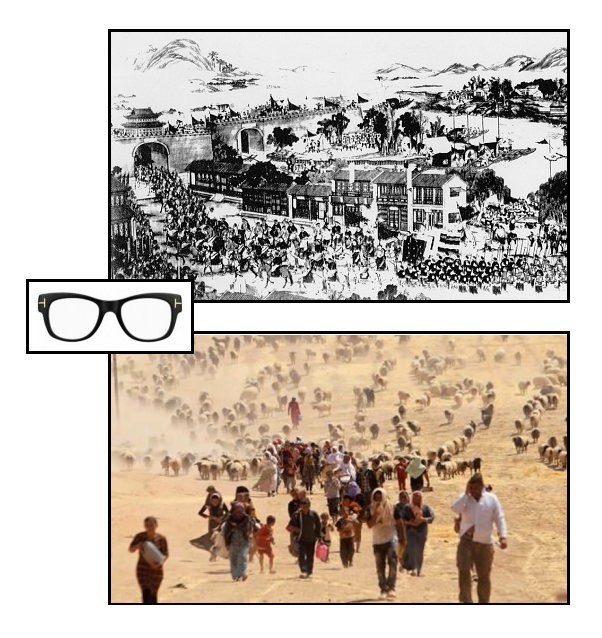
Upper panel: the Taiping Rebellion, an apocalyptic (in the true sense) movement in China, 1850 to 1864, with between 20 million and 30 million dead — as a reminder that apocalyptic movements can have, ahem, far-reaching consequences.
Lower panel: Refugees fleeing the Islamic State, a movement whose apocalyptic (in the true sense) strategy includes a focus on great end-times battle to be fought at Dabiq in Syria, Dabiq being the name of their English lnaguage magazine.
Read into the record in support of these two visuals:
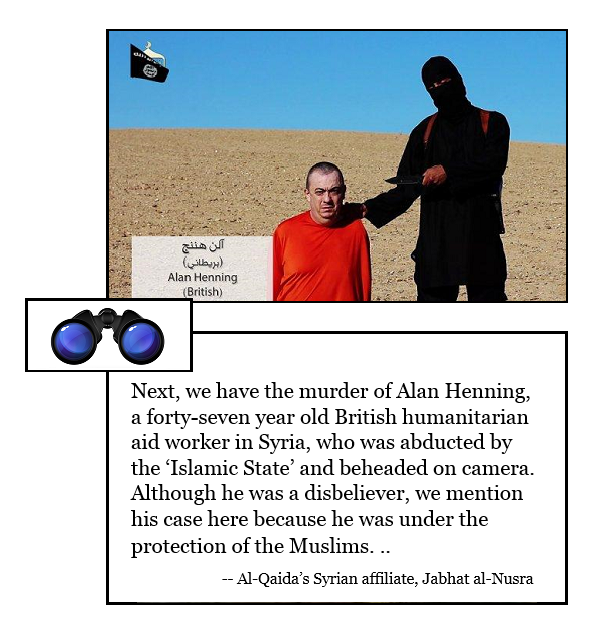
here, on the brutality levels permitted in two rival jihadist groups in Syria:
Upper panel: the Islamic State brutally executes British aid worker Alan Hemming
Lower panel: AQ affiliate Jabhat al-Nusra points out that he was under an offer of protection binding on all Muslims.
There would be background reading to explore and expand that DoubleQuote too. But the main point is: the contest of ideas, not simply that of troop movements and materiel, would have been part of the picture.
**
The Atlantic Council has also held two wargaming sessions on IS [1, 2], but again the insights to be gained into the Islamic State’s end-times motivations and their implications are almost nonexistent:
ISIS carries the seeds of its own destruction primarily because it has an extremely small constituency within Islamist populations around the world, an apocalyptic vision, an unsustainable strategy of us-against-theworld, and a failed governance project.
And that’s about it.
**
McCants’ presentation at the Boston conference, and his forthcoming book (above), both make it clear that the apocalyptic stress of today’s “caliphate” has morphed significantly from the more immediate apocaypticism in IS’ Zarqawi-era predecessor, Al Qaeda in Iraq.
[ by Charles Cameron — a highly interesting discussion, discussed ]
.
How to Write and Fight World War III:
This is the video of a terrific discussion of the future of warfare — peacemaking, too, if you see them as two sides of a coin — from the Art of Future Warfare project, to which I have contributed [two stories, 1, 2, a video appearance, 3, and even a DoubleQuotes reference 4]
**
I want to select certain phrases from the discussion above, and comment on them.
It’s a work of fiction, not prediction.
The thing is, a work isn’t just what its creators intend it to be, it can also be whatever its readers make of it. It’s my impression that the Hebrew prophets were not predicting so much as warning — that’s a distinction Wallace Black Elk made a point of mentioning when he was waxing prophetic — but todays “prophecy teachers” all too often read prophecy as a statement of future fact rather than as a warning of a dangerous path to be avoided.
So we’re dealing with this incredibly complex world – how do we grapple with it? How do we think about these problems?
There’s a class of answers to this question, ranging from complex mathematical models, sims and games to stocks and flows diagrams to Dialogue Mapping and my own HipBone Games. Most if not all of the items in this class are graph-based (node and link) networks.
My own vector is away from high tech and “big” data, towards “rich” data and human-sized graphs — ie graphs with few enough nodes that the human mind can fairly easily envision them, and nodes and links rich enough in anecdotal, visual, statistical, aphoristic, quotatiuonal and other forms of data to elicit full-spectrum human responses, emotional, cultural, mental, heart and mind in conjunction.
we hunger for creativity and intellectual agility in our national security leaders, and our military leaders
The usual routes to leadership significantly fail to provide such agility, although occasional good apples to manage to survive among the rotten throng.. That’s why it takes so long to go from John Boyd being a voice in the wilderness to his being lauded by SecDef.
how do we actually cultivate that kind of thinking, that creative, lateral thinking?
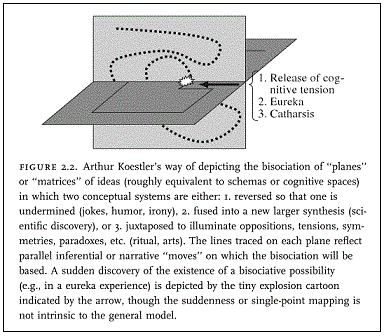
Again, my own practice draws explicitly on Arthur Koestler‘s insight that it is at the intersection of “planes of thought” — silos, anyone? — that creative insights arise.
My games accordingly, simply and elegantly make all moves consist, at some level, of such intersections. The HipBone move is a conceptual leap, regular practice of HipBone Games is the most focused way to train the mind in creative leaping, on or off the gameboard, in play or in life.
fiction, literature and the arts are a critical and often overlooked vehicle for exactly that
I fully agree, and indeed it turns out that the style of “creative leaping” I am talking about is richly found within the complex weavings of the arts — and indeed, my games were directly inspired by a Nobel-winning novel by Hermann Hesse.
I lack the competence to build a web-playable version myself, but a museum-oriented adaptation of my game ideas by Cath Styles can be played on iPads in the Australian National Museum, and its web implementation, also focused on visual artefacts rather than concepts, can serve as a proof of concept for the wider uses I envision — intelligence analysis included.
Paul Callaghan, a writer, game developer, and university lecturer who has played Cath’s Sembl game commented:
Sembl incredibly succesfully mixes competitive and collaborative play, creativity and expression, and exploration and inspiration. It’s the sort of game you think about when you’re not playing it, and it’s the sort of game that helps you see the world in new ways.
That’s very precisely what any HipBone derived game aims to do, and if we want creative leadership, getting the HipBone Games up and running online and using them in analytic and decision-making training would be a pretty useful step to take.
it was basically this Army / Marine Corps answer to a zen koan, right
and
a theological and religious scholar
It may seem strange to find zen buddhism, theology, and religious scholarship mentioned in a discussion on the future of warfare, but they’re areas of the human conceptual spectrum with a great deal to teach us about insight. And fwiw, I read Theology at Oxford, and have recently been “sitting zen” with koans after a brief but brilliant afternoon with the zen roshi John Tarrant.
Playing a HipBone move and “solving” (resolving, dissolving?) a zen koan have a great deal in common. Haiku, likkewise.
But that’s enough for one post.
**
Here are the selections I’ve been responding too, at greater length:
Peter W Singer
We have been very clear. It’s a work of fiction, not prediction. That’s the opening line of it. It is based on real world trends and technologies, but it is not a prediction – but hopefully it can be something that maybe ends up being preventative, by identifying certain issues, trends, even mistakes we are making right now, it helps us to avoid those from happening so that the scenario actually doesn’t come to pass. ..
Kathleen McInnis:
We’re grappling with an increasingly complex and interdependent world: globalization, climate change, urbanization, population migration, resource scarcity, all of these are trends that are intersecting with the re-emergence of geopolitics on the one hand, and the erosion of what we’ve known as the sovereign state on the other. So we’re dealing with this incredibly complex world – how do we grapple with it? How do we think about these problems? How do we advance US and global security in a world plagued by wicked problems and unintended consequences?
As Dan mentioned earlier, we hunger for creativity and intellectual agility in our national security leaders, and our military leaders—but how do we actually cultivate that kind of thinking, that creative, lateral thinking? And crucially, how do we communicate how we are thinking about these problems and what we think we should be doing about them – how do we communicate that to our public in a way that resonates.
And I submit to you that fiction, literature and the arts are a critical and often overlooked vehicle for exactly that, the creative contemplation of matters of statecraft and national security.
One of the interesting things about that manual [Field Manual 3-24, Counterinsurgency] was that it actually proposed these intellectual puzzles, these constructs, like, “the more you secure your environment, the less safe you can be” – when you’re operating in a local tactical environment. Instead of having a tactical check-list of, you know, this is what we need to do in these particular operations and this is the logic flow for how you do x, y or z in these environments, it was basically this Army / Marine Corps answer to a zen koan, right – like how does this non-logical, really intuitive way to creatively grapple …
This is no accident. The point of a zen koan is to inspire a deeper, non-logical level of contemplation. But we haven’t always used koans to access that part of our psyches, and that way of thinking about things.
Karen Armstrong, who is a theological and religious scholar, who wrote a book that I just love, it’s called A Short History of Myth – she argues that ever since we were cavemen, sitting round camp fires, we have been using stories and myths as ways to communicate truths to each other, ways to communicate meaning. Myths were not an expression of religious beliefs per se, rather they were an imaginative, non-logical way to understand who we are and how we fit in the world. ..
And then you get to the ancient Greeks, who had two very different, equally important ways of looking at the world, Mythos and Logos.
WTG, Kathleen!
**
Possible koans from the COIN Manual, p 1.27:
Sometimes, the More You Protect Your Force, the Less Secure You May Be
Sometimes, the More Force Is Used, the Less Effective It Is
[ by Charles Cameron — requesting suggestions re “second order nuclear effects” from Israel & the Saudis ]
.
I’ve been watching one aspect of developing current events closely — Islamic apocalyptic jihad, for short — and claim no special expertise in many other realms, but on the contrary, consider myself too inexpert even to hazard much in the way of commentary. Knowing what I know about what I know, and having seen how often the media and punditry get it wrong, I am deeply suspicious of anything I might tend to think on the basis of media readings in other areas.
So: I am ignorant about the Iranian nuclear deal.
I tend to read Cheryl Rofer for insight into the tecnhical nuclear issues, and Tim Furnish on Iranian Mahdism as it might or might not intersect with the desire for nukes. But that’s about the limit for me.
So: here’s what nags away at me, in the words of a commenter at ChicagoBoyz:
the end result might not be nuclear weapons [for Iran] .. It might be a nuclear preemptive strike by Israel and Saudi Arabia
I’m ignorant. Does the deal, or any other diplomatic venture, address the issue of consequences other than those the deal itself provides for Iran and for her co-signers? What will the Israelis, what will the Saudis in fact do?
With Putin already rattling implicitly nuclear sabres, do we now have a second potential nuclear front, a threat coming not “from” Iran but “at” it?
Please set me straight, from left, from right, from military and intelligence perspectives, any which way you can.
**
Second order effects are always important and often overlooked. When they’re nuclear, that could be highly problematic, not to say volcanic.
The Haunted Wood was once groundbreaking and provocative and is now a classic of Cold War studies. Allen Weinstein, the former Archivist of the United States, died a month ago but he was better known as one of the historians who exposed thatAlger Hisswas indeed the Soviet spy, traitor and secret Communist inside the Roosevelt administration State Department that Whittaker Chambers and Richard Nixon said he was, an achievement that did not endear Weinstein to the dwindling band of hardcore leftist Hiss apologists at The Nation magazine.
Milovan Djilas was a man who epitomized the same conflict as the Hiss-Chambers trial. The right hand to Titoin the Yugoslav Communist Party, Djilas was the highest ranking Communist official to become a dissident and critic, moving politically from convinced Stalinist to an advocate of free elections and liberal democracy. Djilas shrewdly analyzed the Communist nomenklaturaas an oppressive and parasitic oligarchy in The New Class.
Zenpundit is a blog dedicated to exploring the intersections of foreign policy, history, military theory, national security,strategic thinking, futurism, cognition and a number of other esoteric pursuits.