zenpundit.com » 2016

Archive for 2016

Thucydides Roundtable, Book I: How Group Dynamics Brought Sparta and Athens to War

Thursday, October 20th, 2016

1GR-12-E1-B -------------------- D: -------------------- Das Zeitalter des Perikles / Foltz Perikles, athen. Politiker, um 500 v. Chr. - 429 v.Chr. - "Das Zeitalter des Perikles". - (Versammlung der bedeutendsten Kuenstler, Dichter und Philosophen der Zeit). Druck, spaetere Kolorierung, nach dem Gemaelde, 1852 ff., von Philipp von Foltz (1805-1877). -------------------- F: -------------------- L'epoque de Pericles / Foltz Pericles, homme politique athenien, vers 500 av. J.-C. - 429 av. J.-C. - "Das Zeitalter des Perikles" (L'epoque de Pericles). - (Rassemblement des artistes, poetes et philosophes les plus connus de l'epoque). Impr., coloriee post., d'ap. le tableau, 1852, de Philipp von Foltz (1805-1877).

[By Joe Byerly]

In Book 1 of The Landmark Thucydides the council of citizens in Sparta gather to hear the Corinthians, the Athenians, King Archidamus, and one of the ephors debate whether or not Sparta should go to war with Athens. It is within this scene that we witness a psychological phenomenon called “Group Think”; ultimately ending in a declaration of war.

After several of the sides had spoken their piece, the ephor, Sthenelaidas rose to address the group. He quickly dismissed the logical arguments of Archidamus, who thought that the decision to go to war should be deliberate and made only after the Spartans were better prepared to face the Athenians. Instead, Sthenelaidis appealed to the assembly’s emotions, calling for them to “Vote therefore, Spartans for war, as the honor of Sparta demands, and neither allow for further aggrandizement of Athens, nor betray our allies to ruin, but with the gods let us advance against the aggressors.”

To understand the significance of what happened next, we must first understand how the Spartans traditionally voted. In J.E. Lendon’s Song of Wrath: The Peloponnesian War Begins the author writes:

“For decisions on matters such as war and peace, Lycurgus had given the Spartan also an assembly of citizens, which voted not by show of hands as at Athens, but by shouting, and the presiding ephor decided which shout was louder.”

Instead of allowing the vote to take place in accordance with Spartan tradition, the ephor asked the crowd to divide. He pointed to a place in the assembly hall and asked all Spartans in favor of war to move to that spot. He then pointed out another location in the assembly hall, and asked those in favor of peace to move to that spot. Here is where the group gains power over the individual and in this instance drove the Spartans to war.

Research has shown that groups can impact individual decision-making when anonymity is reduced; which is what happened when the method of voting switched from yelling within a crowd to having the voters physically divide themselves. Thucydides believed that Sthenelaidas understood this because he writes that he switched the method of voting because, “he wished to make them declare their opinion openly and thus to increase their ardor for war.”

How could Spartans have potentially avoided the pitfalls of group think? In a 2014 Harvard Business Review article, authors Sunstein and Hastie recommend the Delphi Method:

“This approach, developed at the RAND Corporation during the cold war, mixes the virtues of individual decision making with social learning. Individuals offer first-round estimates (or votes) in complete anonymity. Then a cycle of re-estimations (or repeated voting) occurs, with a requirement that second-round estimates have to fall within the middle quartiles (25%–75%) of the first round. This process is repeated—often interspersed with group discussion—until the participants converge on an estimate. A simple (and more easily administered) alternative is a system in which ultimate judgments or votes are given anonymously but only after deliberation. Anonymity insulates group members from reputational pressures and thus reduces the problem of self-silencing.”

One is left to wonder what might have happened if the ephor did not manipulate the voting method to push the Spartans toward war. Could the Peloponnesian War have been avoided? Or could the Spartans have bought more time and better prepared for the conflict with Athens? This vignette from Book 1 serves as a warning for leaders who attempt to make critical decisions based on the consensus of groups. Understanding these dynamics is the best way for leaders to safe guard against the pitfalls of group think.

Thucydides Roundtable, Book I: THE BROKEN REED

Wednesday, October 19th, 2016

[Jim Lacey]

As this roundtable moves forward I may not say as much as many, but I am going to try and focus on ideas or concepts that are rarely hear discussed.

As my first item I would like everyone to think a bit about Corcyra.

As most of you know, Thucydides gives many reasons for the Peloponnesian War before boiling them all down to Spartan fear of Athens’ growing power.  But, if one requires a proximate cause for the conflict it was Athens joining Corcyra in its quarrel with Corinth.

But why did Athens care about the fate of Corcyra?  Thucydides answers:

For it began now to be felt that the coming of the Peloponnesian War was only a question of time, and no one was willing to see a naval power of such magnitude as Corcyra sacrificed to Corinth… At the same time the island seemed to be conveniently on the coasting path to Sicily. (1.44)

The Corcyraeans themselves had made this argument when they begged Athens for aid:

Remember that there are but three considerable naval powers in Hellas, Athens, Corinth and Corcyra, and that if you allow two of these three to become one, and Corinth to secure for herself, you will have to hold the sea against the united fleets of Corcyra and the Peloponnesus.  But if you receive us, you will have our ships to reinforce you in the struggle.  (1.36)

Indeed!  This is truly a tremendous strategic incentive.

By allying with Corcyra, Athens could add 120 ships to her fleet.  This addition, coupled with Corcyra’s strategic position along the shipping lanes between Greece and Sicily-Italy, meant the Delian League would dominate the western seas, as it did the Aegean.  Corinth, the Peloponnesus’s great trading power, could be easily blockaded, Sparta and its allies would be cut off from Sicily’s and Italy’s wheat, and Corcyra could be counted on to joint Athens in raids along the enemy coast.

But war, as Thucydides informs us, is an “affair of chances.”  Chances from which neither side is exempt, and who’s events are “risked in the dark.” (1.78).

But, Athens was so sure of Corcyra’s power that they sent a mere 10 ships (later reinforced by 20 more), out of over 300 that could easily have been outfitted.  It is worth noting that with the exception of the Syracuse expedition, this was a typical Athenian failure – sending a boy-sized force for a man-sized job (See the Battle of Mantinea in Book 5).  In this case, they sent a fleet large enough to greatly anger the Peloponnesians, but too puny to attain any strategic effect.

In the event, Athens’ strategic rationale for joining themselves to Corcyra was swept away in the conflict’s first engagement (1.49-52).  In just one day’s battle Corcyra lost almost 70 ships – better than half the fleet. (1.54).  Even if they had the wealth to replace the lost ships, they could never replace the thousands of skilled sailors drowned, struck down, or captured that day.  They would have found themselves in a similar situation to that of the Ottomans after the Battle of Lepanto, where the lost ships were replaced in a single year, but the crippling loss of 50,000 professional seamen was never made good.

But Corcyra never even replaced the ships.  Instead the city soon fell into a period of instability, anarchy, and eventually, civil war (Book 3).  In a single and mostly forgotten battle (Sybota) Athens saw its strongest ally removed from the board.  An ally, that if it had maintained its power and internal stability, would have greatly eased the burden of attacking Sicily, or possibly even have made that expedition unnecessary.

Instead, Athens, at the very onset of the struggle, had bonded itself to a “broken reed” whose only later contribution to the war-effort was to have their city act as an assembly point for the Syracuse expedition (6.42).  Even then, Corcyra’s only material contribution to the expedition were a few sailors who were likely “compelled” to join the Athenian fleet.  (7.26).

DISCUSS: Allying with Corcyra was Athens first strategic mistake of the war… one that it never recovered from.

Thucydides Roundtable, Book I: Fear, honor, and Ophelia

Wednesday, October 19th, 2016

[by Lynn C. Rees]

“Fear, honor, and interest” is common shorthand for the political realism blamed on Thucydides. It appears twice in Book I, first at 1.75.3 (in Attic and Crawley’s English)…

ex autou de tou ergou catênancasthêmen to prôton proagagin autên es t?de, malista men hypo deous, epita cae timês, hysteron cae ôphelias..

And the nature of the case first compelled us to advance our empire to its present height; fear being our principal motive, though honor and interest afterwards came in.

…and second at 1.76.2

houtôs oud? hêmis thaumaston ouden pepoeêcamen oud? apo tou anthrôpiou tr?pou, i archên te didomenên edexametha cae tautên mê animen hypo triôn tôn megistôn nicêthentes, timês cae deous cae ôphelias, oud? au prôtoe tou toeoutou hyparxantes, all? aei cathestôtos ton hêssô hypo tou dynatôterou catirgesthae, axioe te hama nomizontes inae cae hymin docountes mechri hou ta xympheronta logiz?menoe tôi dicaeôi l?gôi nyn chrêsthe, hon oudis pô paratychon ischui ti ctêsasthae prothis tou mê pleon echin apetrapeto.

It follows that it was not a very wonderful action, or contrary to the common practice of mankind, if we did accept an empire that was offered to us, and refused to give it up under the pressure of three of the strongest motives, fear, honor, and interest. And it was not we who set the example, for it has always been the law that the weaker should be subject to the stronger. Besides, we believed ourselves to be worthy of our position, and so you thought us till now, when calculations of interest have made you take up the cry of justice—a consideration which no one ever yet brought forward to hinder his ambition when he had a chance of gaining anything by might.

There’s a trick found in the distance between 1.75.3 and 1.76.2. E. C. Marchant’s note on 1.75.3 hints at its identity:

28. déous—fear of the Persians. times—the honor enjoyed by Athens when she had once accepted the hegemonía. óphelos —interest.

In 1.75.3, “fear, honor, and interest” is not an unchanging trinity of human neuroses outside of time but an all too historically grounded sequence of:

  1. fear: (déous) of the Persian threat triggered by Athens renouncing its 508 BC submission to Persia, heightened by Athenian participation in the sack of Sardis in 498 BC, frustrated in 490 BC at Marathon, and realized in Xerxes481 BC sack of Athens.
  2. honor: (times) from abandoning Attica to Xerxes in 480 BC for the common defense, their role in winning at Salamis, re-abandoning Attica in 479 BC just before Plataea, their victory at Mycale that same year, and their later leadership (hegemoníaof resistance to Persia after Sparta went home, a role formalized in the Delian League.
  3. interest: (óphelos) won by the gradual shift of the Delian League from a voluntary league of military contingents led by Athens to a prison of disarmed and discontented assets owned by Athens.


In 1.76.2, use of the catchphrase is closer in spirit to the use proposed by some users (and even readers) of the History of the Peloponnesian Wars: a fearsome threesome, forever hiding behind every good intent of the heart.

Internet sleuthing of the most amateur kind uncovers other English variations on the catchphrase:

So that at first we were forced to advance our dominion to what it is, out of the nature of the thing itself; as chiefly for fear, next for honor, and lastly for profit.

…and 1.76.2 as…

So that, though overcome by three the greatest things, honor, fear, and profit, we have both accepted the dominion delivered us and refuse again to surrender it, we have therein done nothing to be wondered at nor beside the manner of men. Nor have we been the first in this kind, but it hath been ever a thing fixed, for the weaker to be kept under by the stronger. Besides, we took the government upon us as esteeming ourselves worthy of the same; and of you also so esteemed, till having computed the commodity, you now fall to allegation of equity; a thing which no man that had the occasion to achieve anything by strength, ever so far preferred as to divert him from his profit

The Attic translated as “interest” by Crawley and “profit” by Hobbes, óphelos, can be read in ways both interesting and profitable. Perseus translates óphelos as “help, aid, succor”. Perseus’s online Greek-English Lexicon (published in 1940) lists a few possible meanings of óphelos:

A. help, aid, succor, esp[ecially]. in war
II. profit, advantage
2. source of gain or profit, service
3. esp. gain made in war, spoil, booty

Paul’s koine uses óphelos in Romans 3:1:

1 1 Tí o?n tò perissòn to? Ioudaíou, ? tís h? ophéleia t?s peritom?s?

Thirty-one years before Hobbes, the King James Version (1611) translated Paul as this:

What advantage then hath the Jew? or what profit is there of circumcision

NASB translates Romans 3:1 as:

Then what advantage has the Jew? Or what is the benefit of circumcision?

Jerome translated Paul into Latin as:

quid ergo amplius est Iudaeo aut quae utilitas circumcisionis

óphelos is also used in Jude 1:16:

ho?toí eisin gongustaí, mempsímoiroi, katà tàs epithumías heautõn poreu?menoi, kaì tò st?ma autõn lale? hupéronka, thaumázontes pr?s?pa ?pheleías khárin.

Jude 1:16 in the KJV:

These are murmurers, complainers, walking after their own lusts; and their mouth speaketh great swelling words, having men’s persons in admiration because of advantage.

Jude 1:16 in the NASB:

These are grumblers, finding fault, following after their own lusts; they speak arrogantly, flattering people for the sake of gaining an advantage.

Jude 1:16 in the Latin of the Vulgate:

hii sunt murmuratores querellosi secundum desideria sua ambulantes et os illorum loquitur superba mirantes personas quaestus causa

óphelos originates in the Attic Greek ophelos. It dates back to Proto-Indo European:

From Proto-Indo-European *ob?elos, from *h?b?el- (whence also opheíl? (opheíl?)).

In modern Greek, óphelos becomes:

óphelos (ófelos) n, plural ophél?

  1. (finance) profit
  2. benefit

óphelos Anglicizes as ópheleia. Its descendent óphelos may be the root of the name Ophelia, most famously held by a character in an unprofitable relationship with William Shakespeare’s Hamlet.

The fear, honor, and profit of heroic cherrypicking.

[Greek characters preserved at The Committee of Public Safety]

Trolleys come to Terror

Tuesday, October 18th, 2016

[ by Charles Cameron — a western koan makes it onto German TV? ]
.

What Hala Jaber calls a supermarket trolley in this tweet is not what this post is about — but it sure does connect trolley and terror!

**

Here’s the terror side of things, in a tweet from John Horgan:

The BBC halls it an “interactive courtroom drama interactive courtroom drama centred on a fictional act of terror” and notes:

The public was asked to judge whether a military pilot who downs a hijacked passenger jet due to be crashed into a football stadium is guilty of murder.

Viewers in Germany, Switzerland and Austria gave their verdict online or by phone. The programme was also aired in Slovakia and the Czech Republic.

The vast majority called for the pilot, Lars Koch, to be acquitted.

Here’s the setup:

In the fictional plot, militants from an al-Qaeda offshoot hijack a Lufthansa Airbus A320 with 164 people on board and aim to crash it into a stadium packed with 70,000 people during a football match between Germany and England.

“If I don’t shoot, tens of thousands will die,” German air force Major Lars Koch says as he flouts the orders of his superiors and takes aim at an engine of the plane.

The jet crashes into a field, killing everyone on board.

So, is the pilot guilty, or not guilty?

**

At the very least, he has our sympathy — but how does that play out in legal proceedings?

What’s so fascinating here is the pilot’s dilemma, which resembles nothing so much as a zen koan.

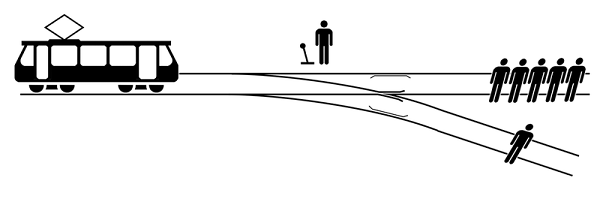
Except for the Trolley Problem:

trolley_problem
Image from Wikimedia by McGeddon under license CC-BY-SA-4.0

**

Substitute an Airbus for the trolley, 164 people for the lone individual on the trolley line, and 70,000 people for the cluster of five — and the pilot for the guy who can make a decision and switch the tracks.

There you have it: terror plot and trolley problem running in parallel.

To be honest, I think the full hour-plus movie is far more immersive, to use a term from game design, than the Trolley Problem stated verbally as a problem in logic — meaning that the viewer is in some sense projected, catapulted into the fighter-pilot’s hot seat — in his cockpit, facing a high speed, high risk emergency, and in court, on trial for murder.

It’s my guess that more people would vote for the deaths of 164 under this scenario than for the death of one in the case of the trolley — but that’s a guess.

**

The German film scenario — adapted from a play by Ferdinand von Schirach — is indeed a courtroom drama, a “case” in the sense of “case law”. And it’s suggestive that koans, too, are considered “cases” in a similar vein. Here, for instance, is a classic definition of koans :

Kung-an may be compared to the case records of the public law court. Kung, or “public”, is the single track followed by all sages and worthy men alike, the highest principle which serves as a road for the whole world. An, or “records”, are the orthodox writings which record what the sages and worthy men regard as principles [..]

This principle accords with the spiritual source, tallies with the mysterious meaning, destroys birth-and-death, and transcends the passions. It cannot be understood by logic; it cannot be transmitted in words; it cannot be explained in writing; it cannot be measured by reason. It is like a poisoned drum that kills all who hear it, or like a great fire that consumes all who come near it. [..]

The so-called venerable masters of Zen are the chief officials of the public law courts of the monastic community, as it were, and their collections of sayings are the case records of points that have been vigorously advocated.

**

Relevant texts:

  • John Daido Loori, Sitting with Koans
  • John Daido Loori, The True Dharma Eye
  • Thucydides Roundtable, Book I: An introduction

    Monday, October 17th, 2016

    [by T. Greer]

    On a summer night, nearly three thousand years ago, three hundred men of Thebes, wet and mud soaked, snuck into the town of Plataea with murder on their minds. Their attempt to launch revolution in Plataea was futile: most would die before the night was over. If their aim was political change, they failed, and failed utterly. But if their aim was undying fame, they succeeded. Perhaps they did not know that their deeds would echo through time, but they have. These were the men who began the Peloponnesian War. What they did is still read and written about thousands of years later.

    Why is this?

    Why is this war so well remembered?

    Thucydides answers these questions in terms of scale:

    This was the greatest movement yet known in history…there was nothing on a greater scale, either in war or other matters (1.1).

    Perhaps this was true in Thucydides’ day, but to moderns who have witnessed millions perish in global wars, the scale of the Peloponnesian War is minuscule. Even by classical standards, it can claim no special title in size or extent.

    Thebes and Plataea were separated by only seven miles. That is barely a shadow on the frontier of the greater ancient empires. Even the fabled Sicilian campaign, whose distance robbed Athens of her empire, was only half as far away as Caesar wandered from Rome, and only a fourth of the distance Han warriors traveled from their capitals at Chang’an or Luoyang to the farthest frontier of their empire.

    A bit less than three hundred Thebans died that day. This was a fairly normal casualty count for the war. Even Athens at her greatest could only put ten thousand hoplites into the field. In contrast, in one day of fighting at Cannae, Rome lost more than 50,000 men. Emperor Ashoka lamented that he killed more than 100,000 enemy soldiers in the conquest of Kalinga.

    Seen in this perspective, the Peloponnesian War was a tiny conflict, fought between the small towns of a fractious, tribalistic, and self-absorbed people. Despite this, it is not only remembered, but earnestly studied and carefully reconstructed. Many wars of far greater scale languish unremembered.

    Perhaps the key to the war’s hold on our minds is its complexity? This was a war that involved dozens of polities. It pitted land powers against sea powers, oligarchs against democracies, coalition against empire. Culture and ideology played their part in this war; so did domestic strife and civil conflict. This war spawned great contests for food, for wealth, and for power; it witnessed both plague and starvation. No matter what angle you wish to take, the Peloponnesian War has something for you.

    Yet the Peloponnesian War’s complexity is hardly unique. American history began, after all, with a war that stretched across land and sea, entangling enemies both domestic and foreign, flinging diverse cultures, ideologies, and political regimes into one violent contest. This sort of multi-sided warfare, one-part wheeling-and-dealing on the international stage, another part grandstanding on the domestic one, is the historical norm. It describes all great wars found in our records—and its shadows haunt the legends and ruins of wars who had no historian to record them. To parse through the tales of the Iroquois oral tradition, or piece together inscriptions from Mayan steles and tombs, is to be struck with wonder. It is wonder at the intricacy of their wars, the complexity of their alliances, and the drama of their betrayals.

    Above all, it is to wonder what classics these events might have produced if these peoples and places had a Thucydides to write about them. Alas! They had no Thucydides. There has been only one of him. That is all that truly sets the Peloponnesian War apart from the other wars of human history: this was the war witnessed by Thucydides.

    It is difficult to peg this Thucydides. Political scientists, historians, and military theorists all claim him as the father of their craft. Whenever one of these disciplines is infected with a new “path breaking” paradigm, a blizzard of articles are written to graft the latest fashion onto his work. This literature is enormous. Forgive me for quoting none of it. So many of yesteryear’s intellectual fads have died. They are forgotten. Thucydides and his history live with us still. He will outlast them all.

    In any case, their purpose for consulting Thucydides differs from mine. They approach his work like miners on the mountainside, drilling narrow shafts down through hardrock until they find something marketable. The results are predictable: Thucydides’ book is more often referenced than read, and when read, more often in part than in full. The quote is what matters.

    There is nothing entirely wrong with this. Analogies to Thucydidean events can be revealing; pithy Thucydidean one-liners add punch to all essays in need of it. But those who limit their acquaintance with Thucydides to a few snapshots miss a great opportunity. There is more to Thucydides than a frantic search to find another model for all time. If they look hard enough, the seeker of evergreen political models or eternal laws of war will find what they are looking for in Thucydides, though it is hard for me to believe that any thinker as subtle as he would smile on this quest. What I value in Thucydides is something different altogether. I do not turn to him for templates “for all time,” but for an escape from my time.

    We all live in the moment. A cacophony of words and sounds follow us wherever we go, broadcast into our cars, our workplaces, our homes, and our pockets. We live in an unescapable echo chamber—an echo chamber relentlessly focused on the now.

    Not so with Thucydides! His history is about many things, but 2016 is not one of them. Here then is a chance to put the present to the side. Cast away that dreadful election! Muffle the droning of the news reports. Close the Twitter stream. Before us is a world that has never heard of the twenty-first century nor imagined its problems. Your guide to this world will be a man from an alien past; his values and assumptions will be starkly different than your own. Wrestle with him—let your beliefs and assumptions be tested. What better chance to assay the building blocks of your politics than by exploring the politics of a different age, removed from the passions of the moment? Thucydides does not spell out his lessons for you. Instead he invites you to follow along with him and find what lessons history allows by yourself.

    This is a long process, for Thucydides’ history is a long book. But it does not go on forever. When you come out the other end, you will be ready to face the present again, hopefully more thoughtful, wise, and penetrating than when you began. My hope is that I will carry a little of what I have learned with me wherever else I go. In reading Thucydides, I aim for what Joseph Sobran once described as the real purpose behind reading ‘old books’:

    To know a single old book well, even if it hasn’t been canonized as a “classic,” is to have a certain anchorage you can’t get from most contemporary writing…you should find a few meritorious old writers you find absorbing and not only read them, but live with them, until they become voices in your mind — a sort of internal council you can consult at any time.

    When you internalize an author whose vision or philosophy is both rich and out of fashion, you gain a certain immunity from the pressures of the contemporary. The modern world, with its fads, propaganda, and advertising, is forever trying to herd us into conformity. Great literature can help us remain fad-proof…

    When confronted with a new topic or political issue, I often ask myself what Shakespeare, Samuel Johnson, Edmund Burke, or James Madison — or, among more recent authors, George Orwell, C.S. Lewis, or Michael Oakeshott — would have thought of it. Not that these men were always right: that would be impossible, since they often disagree with each other. The great authors have no specific “message.”

    But at least they had minds of their own. They weren’t mere products of the thought-factory we call public opinion, which might be defined as what everyone thinks everyone else thinks. They provide independent, poll-proof standards of judgment, when the government, its schools, and the media, using all the modern techniques of manipulation, try to breed mass uniformity in order to make us more manageable.1

    Thucydides earned a place at my “internal council” table. A spot has been saved for him near the doorway, between the seats given to Xunzi and Ibn Khaldun. One day he might sit opposite to Tocqueville; the next he will debate with Madison. In all cases I will be glad to hear his voice. But Thucydides is a wily one, and I am not quite ready to let him in yet. I have too many questions that must first be answered. So I invite him instead (or, at least, so I imagine) to a cozy side room, warmed by a great fire place and graced with two old armchairs. I ask him to sit down and bear kindly the interrogation that is to follow.

    • “How should I read your book?”
    • “Should it be understood as a work of what we call history, or literature, or social science?”
    • “How can I distinguish between your narrative of events and the events themselves?”
    • “Could your explanations be wrong? How would I know?”
    • “And why, for heaven’s sake, did you not tell us when and how the Athenians passed the sanctions on Megara?”

    Thucydides smiles, pulls out his manuscript, and begins his reply. I listen carefully, questioning here, prodding there, occasionally crying out, “You rascal, you almost fooled me!” and then arguing furiously against what I hear. I know these questions will not all be resolved in one sitting. It will go on for weeks, I think, and even then some queries will remain unanswered. But by then the old Hellene will be ready to take his seat place at my table. I, in turn, will have learned a great deal about the world and its workings that I’d never considered before.

    Luckily for you, Thucydides no longer lives in flesh and blood. I cannot secret him off to my study for weeks on end to prevent others from stealing his company. Everyone reading this has an equal claim to the historian; all can spend their evenings considering his words. I invite you to do so. Question him about his work, argue with him about war and power, badger him about what he might think of the wars in Vietnam or Iraq. Ask away! Just remember to write down what you have learned. Share with us what you have gained by wrestling with Thucydides.

    I will have more to say about Book I later this week. For now, welcome to the Thucydides Roundtable.

    —————————————————————————

    Joseph Sobran, “Reading Old Books,” The Imaginative Conservative (8 July 2013).


    Switch to our mobile site