zenpundit.com » 2016

Archive for 2016

New York Times correction ouroboros

Friday, September 9th, 2016

[ by Charles Cameron — irresistible but sad, sad, sad ]
.

Gary Johnson, Libertarian Party presidential candidate, flubbed a question about Aleppo in an interview:

That’s not great.

The New York Times then corrected him:

Gary Johnson, the former New Mexico governor and Libertarian Party presidential nominee, revealed a surprising lack of foreign policy knowledge on Thursday that could rock his insurgent candidacy when he could not answer a basic question about the crisis in Aleppo, Syria.

“What is Aleppo?” Mr. Johnson said when asked on MSNBC how, as president, he would address the refugee crisis in the Syrian city that is the de facto capital of the Islamic State.

That’s not great either.

The Times then had to correct its correction of Mr Johnson:

Correction: September 8, 2016

An earlier version of this article misidentified the de facto capital of the Islamic State. It is Raqqa, in northern Syria, not Aleppo.

That’s having to eat your words.

The Times then had to correct its correction of its correction of Mr Johnson:

Correction: September 8, 2016

An earlier version of the above correction misidentified the Syrian capital as Aleppo. It is Damascus.

That’s having to admit that when you had to eat your own words, you didn’t even chew them properly.

Ouroboros!

**

For the record, everyone concerned has my sympathy. Eating one’s own words, eating one’s hat, eating humble pie is seldom pleasant — or in the case of the serpent, eating one’s own tail!

dragon-eats-self-reference-bd

Full disclosure: I too have blind spots, am vastly ignorant, and am prone to error. Plus I’m terrible at geography.

Sectarian geopolitics in two easy tweets just yesterday

Wednesday, September 7th, 2016

[ by Charles Cameron — you could start from this polarity and build out to cover the tensions of the world ]
.

This:

is an instance of this:

**

And if these two don’t suffice, there’s always Charles Mortimer:

And so it’s all explained at last,
There’s nothing more to know.
Chameleons are pink and fast
Because they’re green and slow.

Quick notes on intelligent intelligence, 2

Wednesday, September 7th, 2016

[ by Charles Cameron — on a quote from my fellow whacky Brit, Geoffrey Pyke ]
.

the-ingenious-mr-pyke-cover-smaller

Whacky? From a short description of the man by his biographer, Henry Hemming:

Geoffrey Pyke, an inventor, war reporter, escaped prisoner, campaigner, father, educator–and all-around misunderstood genius. In his day, he was described as one of the world’s great minds, to rank alongside Einstein, yet he remains virtually unknown today. Pyke was an unlikely hero of both world wars and, among many other things, is seen today as the father of the U.S. Special Forces. He changed the landscape of British pre-school education, earned a fortune on the stock market, wrote a bestseller and in 1942 convinced Winston Churchill to build an aircraft carrier out of reinforced ice. He escaped from a German WWI prison camp, devised an ingenious plan to help the Republicans in the Spanish Civil War, and launched a private attempt to avert the outbreak of the Second World War by sending into Nazi Germany a group of pollsters disguised as golfers.

Whacky!

And for good measure, here’s Jami Miscik on oddballs:

To truly nurture creativity, you have to cherish your contrarians and give them opportunities to run free. Leaders in the analytic community must avoid trying to make everyone meet a preconceived notion of the intelligence community’s equivalent of the “man in the gray flannel suit.”

and Reuel Marc Gerecht:

And the service can ill-afford to lose creative personnel with a high tolerance for risk.

It’s a sad fact that the folks who are in government, especially in the “elite” services of the CIA and the State Department, aren’t what they used to be. They are, to be blunt, less interesting. There are vastly fewer “characters” -— the unconventional, often infuriating, types who give institutions color and competence.

**

Okay, here’s Geoffrey Pyke in his own capital letters:

EVERYTHING IS IRRELEVANT TILL CORRELATED WITH SOMETHING ELSE

And why does that interest me?

Well first, today it corroborates my comment just now on David Barno and Nora Bensahel and the importance of their suggestion that “The Army should also reinstate the requirement for every career officer to develop skills in two specialties.”

And then second, because I have been saying for a while that:

Two is the first number

and quoting along the way Aristotle, Jung, and the tenth-century Rasa’il Ikhwan al-Safa’..

**

For these reasons, and with a hat-tip to Bryan Alexander, I cherish the contrarian intelligence of Mr Pyke.

Quick notes on intelligent intelligence, 1

Wednesday, September 7th, 2016

[ by Charles Cameron — I do believe this will be a new series ]
.

brain-ic

**

Intelligence, obviously, can mean something along the lines of bright thinking, but also that which is gathered, usually from the extremities of empire or the most hidden of an opponent’s or ally’s secret secrets — but for my purposes here it means the frst of these (the “intelligent” of my title) as applied in the mind of military, analytic or civilian leadership to the second (my title’s “intelligence” by which I mean “intel”).

**

David Barno and Nora Bensahel, Six Ways to Fix the Army’s Culture:

The Army should also reinstate the requirement for every career officer to develop skills in two specialties, rather than to focus narrowly on one. This would produce officers with a much broader range of talents, who would be educated and then employed effectively across more than one skill to support the Army’s disparate needs. These measures would help rising Army leaders think more creatively about the wide range of challenges facing the Army and contribute more effectively at the strategic level within the Department of Defense or the wider interagency arena.

I’d like to make this more explicit. Not only does the development of skills in two specialties mean that an officer can handle two dofferent kinds of problem set with greater assurance, it also and specfically opens the possibility of cross-fertilization between the two disciplines, in those places where they overlap not on the surface level but at the level of analogy and pattern.

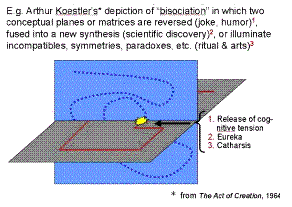
When Barno and Bensahel say the development of skills in two specialties “would help rising Army leaders think more creatively” it’s not just that they’d be better informed and brighter than they would be with only one such skill, and it’s not just that they could handle issues involving the overlap between specialties (and I actually don’t just mean military specialties like “Transportation officer (88A)” and “Chemical, Biological, Radiological and Nuclear officer (74A)” but also realms like cutural anthropology, topology, systems dynamics, art history), it’s that analogies would leap to mind showing that allow insights from one realm, discipline, silo or specialty to illuminate another. As shown in Arthur Koestler‘s image in The Act of Creation, which I never tire of posting:

**

Hey, I’ll follow up immediately with related commentary — on a quote from the eccentric, brilliant mind of a British fellow, Geoffrey Pyke, recently memorialized in Henry Hemming‘s book, The Ingenious Mr. Pyke: Inventor, Fugitive, Spy.

My Latest on Lapido — Mother Teresa

Wednesday, September 7th, 2016

[ by Charles Cameron — writing about Mother Teresa as a balancing act ]
.

My latest post on LapidoMedia, Mother Teresa: the making of a saint, opens thus:

‘MOST blessed Father, Holy Mother Church, beseeches your Holiness to enroll the Blessed Teresa of Calcutta among the saints, that she may be invoked as such by all the Christian faithful.’

With these words, Cardinal Angelo Amato, the Prefect of the Congregation for the Causes of Saints petitioned Pope Francis to declare Mother Teresa of Calcutta a saint.

There are five stages in the Catholic Church’s ‘canonization’ – the declaration that a saint is in heaven, and that their name may be included in the roll of the names of saints.

In my article I write, “As with many people considered especially holy, Teresa’s life has often been discussed in terms of hushed veneration – and also harshly criticised by the unimpressed.” I’m not too convinced either by the hagiography with which the Church tends to surround her, nor with the vituperatuve criticism with which Christopher Hitchens, her chief detractor, attacks her.

I have tried to write Teresa up in a way which balances the two. In my own quiet way, and reading it somewhat between the lines, my article attempts to bridge the two by suggesting that her specific “charism” or gift — the “wavelength” of love of which she is, for the Church, the examplar — was explicitly to bring spiritual, not medical, love to the dying, and that she accomplished this task, while her failure to accompany it with sound, even basic medical care — her clinics, for instance, commonly reused needles without sterilizing them — was the cause of much of Hitchens’ criticism, and has indeed been remedied by her order of nuns since her death.

Christian theological discussion often distinguishes between the Historical Jesus and the Christ of Faith. It may well be that the historical Teresa will stand as a warning to missionaries to be adequately prepared for the proper medical treatment of those to whom they minister, while the Teresa of faith can be a beacon of hope and love in the lives of many. We can hope that the order of nuns she founded, the Missionaries of Charity, will take note of her work at both levels.

Read the whole piece here on the Lapido site.


Switch to our mobile site