zenpundit.com » 2016 » October

Archive for October, 2016

Thucydides Roundtable, Book I: reflections in a beginner’s mind

Sunday, October 23rd, 2016

[ by Charles Cameron ]
.

I’m entirely new to Thucydides, having received my copy of the book only on Friday, so I’ll keep this brief. I hope to have caught up a bit more by this time next week.

Meanwhile, my mind works associatively, so..

**

rich-vs-poor-in-rio
Riches and poverty in Rio

The goodness of the land favored the enrichment of particular individuals, and thus created faction which proved a fertile source of ruin. It also invited invasion.

trump-border-wall
Donald Trump

**

In Spencer-Brown’s inimitable and enigmatic fashion, the Mark symbolizes the root of cognition, i.e., the dualistic Mark indicates the capability of differentiating a “this” from “everything else but this.”

He does not even use the term barbarian, probably because the Hellenes had not yet been marked off from the rest of the world by one distinctive name.

Turkish President Recep Tayyip Erdogan, in a speech after a suicide bomb explosion in Istanbul on January 12, 2016, said: “Pick a side. You are either on the side of the Turkish government, or you’re on the side of the terrorists.”

**

The iconic 'Rumble in the Jungle' belt of late boxing champion Muhammad Ali is displayed for auction at Heritage Auctions house in Manhattan, New York, U.S., August 19, 2016. REUTERS/Eduardo Munoz

The iconic ‘Rumble in the Jungle’ belt of late boxing champion Muhammad Ali is displayed for auction at Heritage Auctions house in Manhattan, New York, U.S., August 19, 2016. REUTERS/Eduardo Munoz

To this day among some of the barbarians, especially in Asia, where prizes for boxing and wrestling are offered, belts are worn by the contestants..

Koki Kameda of Japan, center, donning the newly-captured champion belt, green, in addition to the two he already has, poses with his younger brothers Daiki, left, and Kazuki after Koki's victory over Alexander Munoz of Venezuela in their 12-round WBA bantamweight world title boxing bout in Saitama, Japan, Sunday, Dec. 26, 2010. Koki Kameda won a unanimous decision over Munoz to take the vacant title. (AP Photo/Shizuo Kambayashi)

Koki Kameda of Japan, center, donning the newly-captured champion belt, green, in addition to the two he already has, poses with his younger brothers Daiki, left, and Kazuki after Koki’s victory over Alexander Munoz of Venezuela in their 12-round WBA bantamweight world title boxing bout in Saitama, Japan, Sunday, Dec. 26, 2010. Koki Kameda won a unanimous decision over Munoz to take the vacant title. (AP Photo/Shizuo Kambayashi)

On targeting as a mood this electoral season, 1

Sunday, October 23rd, 2016

[ by Charles Cameron — the only virtue I can see in this darkness is that the light contrasts with it ]
.

I find this frankly horrifying:

This, at a supposedly Christian university?

Feh.

**

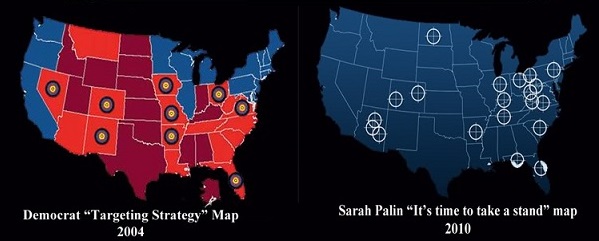
Mark you, I think targeting an individual — any individual –in this way is very different from targeting contested seats in an election. I can understand both Democrats and Republicans using the imagery of targets or cross-hairs to suggest where they’d like their supporters to get active, get out the vote and win seats..

acceptable-or-not

I said as much in On sneers, smears, and mutual sniping:

Neither “targetting” political adversaries nor “having them in your crosshairs” equates to killing or there would have been a whole lot more attempted assassinations — just the one was bad enough.

Have some proportion, people.

**

However, as an inveterate DoubleTweeter I have to say that pinning targets or cross-hairs on individual leaders in highly charged political disputes speaks a wholly different language, and presents a far higher threat level, than targeting districts on an electoral map:

**

For the record, I find this no less offensive:

trump-target

Thucydides, Book I: Failed Visions of Strategic Restraint

Saturday, October 22nd, 2016

Image result for shattered greek helm

[Mark Safranski / “zen“]

“…for me alone my strong-greaved companions excepted the ram when the sheep were sheared, and I sacrificed him on the sands to Zeus, dark-clouded son of Kronos, lord over all, and burned him the thighs; but he was not moved by my offerings, but still was pondering on a way how all my strong-benched ships should be destroyed and all my eager companions.”

                                                        – Odysseus

As to what happened next, it is possible to maintain that the hand of heaven was involved, and also possible to say that when men are desperate no one can stand up to them.”

                                                         -Xenophon

“The degree of force that must be used against the enemy depends on the scale of political demands on either side”

                                                         – Carl von Clausewitz

The Peloponnesian War was the first, great “civil war of Western civilization”—fought long before that embryonic civilization would fully cohere to endure; but it would not be the last. Far from it.

Like most conflicts of this kind, the nominal pretext for the Spartans and Athenians and their respective allies to go to war was a small thing, but the costs for the belligerents would prove to be very great. Nor was this unforeseen, another truism of such terrible wars. Sir Edward Grey, for example, was no outlier among the well informed classes, if not the people, on the eve of the First World War when he declared “The lamps are going out all over Europe, we shall not see them lit again in our life-time“. Europe’s elites, like Jean de Bloch had been saying such things to each other with every crisis since Fashoda and the gruesome slaughter of the Russo-Japanese War confirmed the consequences of modern battle between even third rate industrial powers. Yet in August 1914, the Entente and the Triple Alliance enthusiastically took the plunge into the abyss anyway just as the Spartans and the Athenians had done 2300 years earlier.

Why? When a polity dances on the edge of ruin why does it not come to its senses back away? Or at least wager lesser stakes upon a throw of the iron dice? Cheryl Rofer has discussed the effects of Pericles’ “motivated reasoning” in smoothing the path of Athens to war; Joe Byerly identified the increased power of “groupthink” in the Spartan Assembly under the direction of Sthenelaidas the Ephor while Dr. Kaurin established the importance of rhetoric in the cadence of classical Greek thought. Finally, Dr. Lacey illuminated the Athenian strategic miscalculation of Corcyra’s true strength. These points all have resonance, but I think another element is in play; one which Thucydides was at great pains in his history to draw as a lesson about the political deficiencies of the radical democracy that flourished in Athens after the death of Pericles: the failure to pursue a war policy of strategic restraint.

The truth is that the strategic value of restraint is often perceived by statesmen as Thucydides recorded, but the will to stay that course is seldom unwavering and this folly applied just as much to oligarchic Sparta as democratic Athens. Among the Greek leaders, both Pericles of Athens and his guest-friend Archidamus, king of Sparta, foresaw the dangers were war to break out and counseled after their own fashion, caution and restraint to their impetuous countrymen. Neither were successful.

Addressing the Assembly and the Gerousia, Archidamus gave not only a realistic political assessment but good strategic advice to be slow to take up arms against Athens and prepare carefully to fight the war on future terms more favorable to Sparta’s strengths and resources:

This, the war on which you are now debating, would be one of the greatest magnitude, on a sober consideration of the matter. In a struggle with Peloponnesians and neighbours our strength is of the same character, and it is possible to move swiftly on the different points. But a struggle with a people who live in a distant land, who have also an extraordinary familiarity with the sea, and who are in the highest state of preparation in every other department; with wealth private and public, with ships, and horses, and heavy infantry, and a population such as no one other Hellenic place can equal, and lastly a number of tributary allies—what can justify us in rashly beginning such a struggle? wherein is our trust that we should rush on it unprepared? Is it in our ships? There we are inferior; while if we are to practise and become a match for them, time must intervene. Is it in our money? There we have a far greater deficiency. We neither have it in our treasury, nor are we ready to contribute it from our private funds. Confidence might possibly be felt in our superiority in heavy infantry and population, which will enable us to invade and devastate their lands. But the Athenians have plenty of other land in their empire, and can import what they want by sea. Again, if we are to attempt an insurrection of their allies, these will have to be supported with a fleet, most of them being islanders. What then is to be our war? For unless we can either beat them at sea, or deprive them of the revenues which feed their navy, we shall meet with little but disaster. Meanwhile our honour will be pledged to keeping on, particularly if it be the opinion that we began the quarrel. For let us never be elated by the fatal hope of the war being quickly ended by the devastation of their lands. I fear rather that we may leave it as a legacy to our children; so improbable is it that the Athenian spirit will be the slave of their land, or Athenian experience be cowed by war.

This was eminently practical advice for a land power whose strengths were optimized by short conflicts of a few day’s march away and that were based on traditional Greek hoplite phalanx warfare where battles were swiftly won or lost by the breaking of the enemy formation. The ability of Sparta to sustain a war of any duration depended heavily on the uncertain loyalty and continued agricultural productivity of a resentful and rebellious Helot population; a fact that made distant operations by the Spartan army either risky or required them to leave ample military forces at home. Fighting against walled and fortified cities in an era when the arts of siege warfare were extremely primitive eroded most of Sparta’s qualitative edge in heavy infantry and fighting a war primarily upon the seas could not even be executed at the time of the Assembly vote. Sparta’s triremes were few and in poor condition and no Spartan Themistocles was on hand to fill the office of Navarch or supervise the construction of a seaworthy battle-fleet, even if such a thing could be afforded. Facing Athens, the greatest maritime empire of the day and secured by its Long Walls, Sparta’s strategic position could only have improved with time diligently spent on diplomatic, fiscal and naval preparations.

As other participants have already discussed, the Spartan Assembly failed to heed Archidamus and proceeded on the assurances of Sthenelaidas the Ephor, that while empty, fit the “laconic” rhetorical style much favored by the Lacedaemonians. While Sthenelaidas may have carried the day, it was Archidamus who was proved correct when the Spartan invasion and devastation of Attica failed to yield any strategic benefits. The Athenians remained behind their walls, their fleet ruled the wine-dark seas and harried the Peloponnesians at will. More to the point, by a stratagem of Cleon, the naval power of Athens later compelled the Spartans to come to terms (at least for a time) or see an irreplaceable part of their army trapped on an islet perish of starvation. The plague struck Athens a far greater blow than any Spartan phalanx marching uselessly back and forth to Attica. Without the decimation of Athens by the plague and the extreme folly of the Athenians in undertaking the Sicilian Expedition, it is difficult to see how cash-poor Sparta could have prevailed.

As other panelists have correctly noted, Pericles approached the prospect of war with greater elan vital than did Archidamus. This is true. Pericles oratory typically radiated confidence in all things Athenian. But to stop there would be to shortchange the difficulty of Pericles’ real accomplishment. Stopping motions for unwise or humiliating concessions to Sparta was not difficult. It was highly unlikely the Athenians would have voted to re-accept ancient Spartan hegemony or abandon their new empire simply to avoid war. In Athenian eyes, the Spartans were oathbreakers for refusing arbitration as their treaty demanded and arrogant and insulting blusterers whose power in Hellas no longer matched their words.

No, what Pericles managed to persuade the Athenians to abandon their instinctive rush to a decisive battle of traditional phalanx warfare for a novel strategy of limited warfare in a long war that played to the very Athenian strengths that Archidamus most feared. As Pericles concluded:

…This, I think, is a tolerably fair account of the position of the Peloponnesians; that of Athens is free from the defects that I have criticized in them, and has other advantages of its own, which they can show nothing to equal. If they march against our country we will sail against theirs, and it will then be found that the desolation of the whole of Attica is not the same as that of even a fraction of Peloponnese; for they will not be able to supply the deficiency except by a battle, while we have plenty of land both on the islands and the continent. The rule of the sea is indeed a great matter. Consider for a moment. Suppose that we were islanders; can you conceive a more impregnable position? Well, this in future should, as far as possible, be our conception of our position. Dismissing all thought of our land and houses, we must vigilantly guard the sea and the city. No irritation that we may feel for the former must provoke us to a battle with the numerical superiority of the Peloponnesians. A victory would only be succeeded by another battle against the same superiority: a reverse involves the loss of our allies, the source of our strength, who will not remain quiet a day after we become unable to march against them. We must cry not over the loss of houses and land but of men’s lives; since houses and land do not gain men, but men them. And if I had thought that I could persuade you, I would have bid you go out and lay them waste with your own hands, and show the Peloponnesians that this at any rate will not make you submit.

I have many other reasons to hope for a favourable issue, if you can consent not to combine schemes of fresh conquest with the conduct of the war, and will abstain from wilfully involving yourselves in other dangers; indeed, I am more afraid of our own blunders than of the enemy’s devices.

Pericles, it must be said, offered at best an incomplete strategy of exhaustion—to stretch the economic resources of poorer Sparta and its political will to the breaking point from attrition and frustration. There was no method for Athens to “compel Sparta to do its will” in the vision of Pericles and bring the war to a favorable political conclusion; instead, it relied on Spartan leaders realizing the futility of the efforts and giving up the war. Pericles might have suggested investing Athenian resources in aiding another helot revolt to further increase pressure on Sparta but he did not. Overall, Pericles imposed an extremely conservative strategy of pursuing war with great restraint and calculated force; a plan designed to wisely husband Athenian resources and fighting capacity—but a politically unsatisfying one as it flouted Greek conceptions of heroism and honor. For this reason, among others including the untimely death of its author, the Athenian strategy failed.

It was however more of a strategy than what the Spartans could bring to bear.

Mosquitoes of the mind

Saturday, October 22nd, 2016

[ by Charles Cameron — or should that be Uber über alles?]
.

uber-drones
Forget billboards — motorists now have ads buzzing a few feet above their windshields — MIT Technology Review

**

There is an endless variety of possible starting points for a critique of oneself and the world. One might start from:

  • the message in a fortune cookie
  • whatever one’s parents imparted
  • whatever one rejected of what they imparted
  • Israel from the Nile to the Euphrates
  • a return to the Green Line
  • Palestine from the river to the sea
  • the sweet humility of the Magnificat
  • the fierce doctrine of Original Sin
  • the Cloud of Unknowing
  • the uncontaminated Unity of Godhead
  • the Buddha’s Noble Truth of suffering
  • the shining suchness of the Tathagata
  • something Karl Marx said, or Darwin
  • a tall tale from Chuang-Tzu
  • Lao Tzu’s unspeakable truth, unmappable path..
  • or the way someone reacted when one trod on their foot in the subway
  • Myself, I tend to go from either:

  • the Bene Gesserit adage, Fear is the mind-killer
  • or its obverse in Patanjali’s Yoga Sutras, Yoga is the cessation of waves in the mind.
  • **

    Which brings me to advertising.

  • Yoga is the cessation of waves in the mind.
  • Advertising is the paid attempt to capture my attention regardless of my wishes in the matter.

    In terms of the Yoga Sutras‘s goal of an unruffled mind, advertising attempts to stir up trouble — not in Syria or Afghanistan, or even in my kitchen, but within my consciousness.

    And I’m not alone in detesting this invasive behavior. “Nearly 90% of people watching timeshifted shows fast-forward the ads,” the Guardian reported in a piece titled TV advertising skipped by 86% of viewers, and while Victoria may have a secret ingredient which makes her ads memorable — I’m referring here, of course, to a recent Nobel Prizewinner — most ads are simply irritants.

    The benefit of advertising, to those whom it speaks, is that it acts as a road-sign to what we may want. It’s adverse effect is to clutter up our lives with road-signs to irrelevant and possibly offensive destinations. Apples don’t need little stickers on them proclaiming “apples by the Creator” but a discreet mention of “All purpose disinfecting cleaner by Bright Green” was quite helpful to me the other day, as I was wandering the aisles of Safeway in search of a brand they no longer carry..

    And yes. Advertising drives sales drives manufacturing drives employment drives a roof over the head for many who might otherwise find themselves in the rain. Granted.

    **

    But here come the mosquitoes.

    The image at the head of this post comes from an article titled Uber’s Ad-Toting Drones Are Heckling Drivers Stuck in Traffic.

    The unfortunate drivers in traffic jams in Mexico City are close to ground zero of an epidemic; Beelzebub, remember, is Lord of the Flies.

    Thucydides Roundtable, Book I: Political Rhetoric in Book I: Truth or Action?

    Friday, October 21st, 2016

    aristotle

    [by Pauline Kaurin]

    In reading and discussing Book I with my students, they were fascinated by the role of speeches and the ways in which the speeches seemed to drive action. This seemed counter-intuitive to my students who – amidst the general election season of 2016 – saw speeches, political rhetoric more generally as empty and meaningless exercises in candidate ego or manipulation by appeal to fear and other negative emotions.  I found this interesting because it demonstrates important differences between how the Greeks viewed and used political rhetoric and how we might view and use it today.

                    To begin, the crisis caused by the Corcyareans and Corinthians results in a typical assembly being called and then the two sides make their respective cases by giving speeches.  (433/1) The Corcyareans  go first, and then the Corinthians make their case, largely by counter-arguing the previous case.  Thucydides then describes the actions taken by the Athenians in the aftermath of the speeches, making it clear that deliberation on the speeches (taking into account various factors including a change in public feeling) produced certain actions.

    After the siege of Potidea, we have another round of accusations and fussing, then followed by more speeches, “ Last of all the Corinthians came forward, and having let those who preceded them inflame the Spartans, now followed…”  (1.67)  Athens weighs in as well, and then Sparta decides for war, and articulates the reasoning with a speech laying out what we might think of as Just Cause in the Just War Tradition.  One of the issues at stake is whether to go to war now, or whether they will be “men of action” or if the Spartans are stalling.  Book I, in fact, concludes with a speech from Perikles where he makes the case that ‘war is a necessity’ (1.144) and Thucydides notes that the Athenians were persuaded by his speech and voted and acted as he had suggested.

    These highlights are designed to show that there is a pattern here: speeches and rhetoric are embedded within a larger process of reflection and deliberation that is oriented towards making a collective decision and then implementing it into action.  This is, I would argue, very characteristic of the classical Greek mind. We find this exact process laid out in Book III of Aristotle’s Nicomachean Ethics, and it is reflected in many Platonic dialogues (like Meno, Crito, Phaedo and the Republic) where the occasion for the conversation about virtue, justice or death is some kind of decision or action that is being contemplated.

    We should also recall the role of the Sophists in Athens and particularly in the development of Western philosophical traditions. They are frequently Socrates’ interlocutors and opponents, and their relativistic worldview is what Plato and Aristotle are positing their accounts of objective knowledge over and against. The Sophists were well known figures, traveling teachers who tutored the young Athenians in the art of rhetoric.  Rhetoric was an absolutely critical career skill for the young, free (and often wealthy) men of Athens to master, as their success in life (political and otherwise) was tied to it.  So rhetoric occupies a critical and prominent space in Greek (and especially Athenian) culture, as it was necessary for the political processes and as Thucydides points out, had a clear impact on what happened and how it happened.

    So these observations are all very interesting but what of it? 

                  The reason that I bring up the role of rhetoric here, especially in the context of the development of the Western philosophical traditions, is that I think my students’ reactions show a stark difference in how we view rhetoric today and Socrates helps us understand why.  It is not the case that speech and political rhetoric has no impact in our lives. We might think of the Gettysburg Address, JFK’s Inaugural speech. Reagan’s ‘Tear Down This Wall’ speech, George Bush’s ‘A Thousand Points of Light’ speech, Barack Obama’s speech on race during the 2012 election or Michelle Obama’s convention speech from this summer.  Political rhetoric is alive and well, but I would argue serves a different function now.

    For Plato especially, dialogue contra the Sophists, became not about deliberation to make a decision (his dialogues often frustratingly have no closure in that respect) , but as a mode of self-reflection in the pursuit of knowledge and truth.   With the exception of Reagan’s speech, the other speeches that we remember as a part of our political or personal life, those that resonate still, are not speeches that necessarily are aimed at action – except indirectly.  They are speeches that ask us to reflect on our sense of self (both individual and communal), that ask us to think about who we are and we want to be, very often in moral terms.  Most of these timeless speeches (judgement reserved for Michelle Obama as it is too soon) still have resonance because they connect to some aspect of the human condition, to our political life both in this moment and across time and are aspirational in some way.  They ask or challenge us to look beyond the current moment and decision/action cycle to something else – to truth and knowledge.

    As we continue through Thucydides, I ask you to watch for this dynamic in the speeches.  What is the intent and effect of the speeches?


    Switch to our mobile site