zenpundit.com » 2016 » October

Archive for October, 2016

DoubleQuoting Blake on Guinea and Sun

Thursday, October 20th, 2016

[ by Charles Cameron — an appendix to The importance of Albrecht Dürer ]
.

On two separate occasions Blake compares a guinea (a coin worth one pound and one shilling) and the sun:

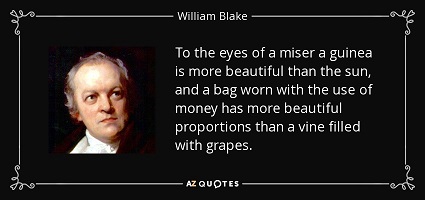
blaketo-the-eyes-of-a-miser

In the quote above, we see things as they appear “to the eyes of a miser”, while in that below, we see them through the eyes of the Poet:

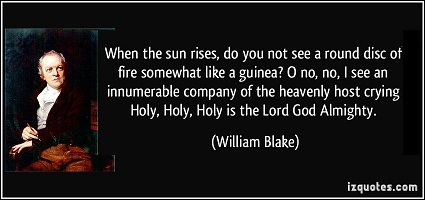
blake-when-the-sun-rises

Blake continues that second quote, by saying “I question not my Corporeal or Vegetative Eye any more than I would Question a Window concerning a Sight: I look thro it & not with it.” Hence my distinguishing between “as they appear” in the miser’s eyes and “through” the poet’s eyes..

**

The two quotes, taken together, freshly demonstrate the gulf between the two views so forcefully expressed in the second — the topic of my earlier post, The importance of Albrecht Dürer

The importance of Albrecht Dürer in grokking ISIS

Thursday, October 20th, 2016

[ by Charles Cameron — because the world of the jihadists resembles Dürer’s more than it does our own? ]
.

It’s extraordinary the insight that an appreciative acquaintance with Albrecht Dürer provides, in attempting to understand ISIS not just theoretically but imaginatively, and thus viscerally.

Under the title ISIL Boasts: America will go down to defeat in the Streets of Mosul Juan Cole blogs [emphasis mine]:

AFP is reporting that a news agency linked to Daesh (ISIS, ISIL), “A`maq,” is carrying a video of a Daesh fighter who swears that he and his colleagues will inflict a decisive defeat on the US in Iraq, as the guerrillas spread through the streets of the city. He addresses the camera saying, “As for you, America, we promise you that which our honored elders promised you, God bless them, such as Abu Mus`ab (al-Zarqawi) and Abu `Umar and Abu Hamza [etc.].”

The threats don’t make any sense. The US does not have infantry combat troops at the front lines, and is mainly intervening with fighter jets and bombers. If you are a small guerrilla group, you really cannot match that firepower. There is no obvious way in which Daesh could inflict harm on the US in Mosul.

How about a non-obvious way?

**

For the apocalyptic true believers of ISIS, these verses (ayat, which also refers to “signs”) from the Qur’an ring true today:

When thou saidst to the believers, ‘Is it not enough for you that your Lord should reinforce you with three thousand angels sent down upon you? Yea; if you are patient and godfearing, and the foe come against you instantly, your Lord will reinforce you with five thousand swooping angels.’

Qur’an 3.124-25

We may have lost sight of the angels, and for that matter the dragon, the horsemen, the “woman clothed with the sun, and the moon under her feet, and upon her head a crown of twelve stars” and the “Lamb which is in the midst of the throne” — in our western mostly post-Christian tradition, but John of Patmos and Albrecht Durer saw them, in what we now think of as “the sky”, familiarly known in their days as “the heavens”.

But is that our clarity or our blindness?

**

If we are to understand ISIS, we need an analytic framework which doesn’t automatically exclude angels from its purview — as I argued somewhat more broadly in my essay The Dark Sacred: The Significance of Sacramental Analysis in Robert Bunker‘s Blood Sacrifices [Kindle, $3.99].

We are dealing with a subset of that culture wherein poetry is as highly valued as it is lowly valued in our own — as Shahab Ahmad tells us in What is Islam, “the poetical discourses of Muslim societies” are “the form of speech regarded as the highest register of human self-expression and social communication.”

And we are easily blind to such things. Thomas Hegghammer, in his Paul Wilkinson Memorial Lecture at the University of St. Andrews, Why Terrorists Weep: The Socio-Cultural Practices of Jihadi Militants, writes:

It took me a long time to even notice these things. I’ve studied jihadi groups for almost fifteen years, and for the first ten, I was addressing standard questions, like, how did group A evolve, what has ideologue B written, who joins movement C, etc. The thing is, when you study one type of group for a while, you take certain things for granted. I knew that these groups were weeping and reading poetry, but it didn’t really register – it was background noise to me, stuff I needed to shove aside to get to the hard information about people and events.

Hegghammer goes on to comment that “soft” activities — he names weeping, reading and reciting poetry, dreaming — “pose a big social science puzzle, in that they defy expectations of utility-maximising behaviour.”

We tend to the “utility-maximizing” end of a philosophical spectrum (running, as per my example above, from “heaven” to “sky”) but they do not.

Oh, no. They do not.

**

To understand the poetics of jihad, and thus the passions it arouses, we must first glimpse the visionary faculty that is implicit in our own so easily disregarded poetry.

Thus William Blake, in his A Vision of the Last Judgment:

“What,” it will be Questioned, “When the Sun rises, do you not see a round Disk of fire somewhat like a Guinea?” O no no, I see an Innumerable company of the Heavenly host crying “Holy Holy Holy is the Lord God Almighty.” I question not my Corporeal or Vegetative Eye any more than I would Question a Window concerning a Sight: I look thro it & not with it.

Thucydides Roundtable, Book I: How Group Dynamics Brought Sparta and Athens to War

Thursday, October 20th, 2016

1GR-12-E1-B -------------------- D: -------------------- Das Zeitalter des Perikles / Foltz Perikles, athen. Politiker, um 500 v. Chr. - 429 v.Chr. - "Das Zeitalter des Perikles". - (Versammlung der bedeutendsten Kuenstler, Dichter und Philosophen der Zeit). Druck, spaetere Kolorierung, nach dem Gemaelde, 1852 ff., von Philipp von Foltz (1805-1877). -------------------- F: -------------------- L'epoque de Pericles / Foltz Pericles, homme politique athenien, vers 500 av. J.-C. - 429 av. J.-C. - "Das Zeitalter des Perikles" (L'epoque de Pericles). - (Rassemblement des artistes, poetes et philosophes les plus connus de l'epoque). Impr., coloriee post., d'ap. le tableau, 1852, de Philipp von Foltz (1805-1877).

[By Joe Byerly]

In Book 1 of The Landmark Thucydides the council of citizens in Sparta gather to hear the Corinthians, the Athenians, King Archidamus, and one of the ephors debate whether or not Sparta should go to war with Athens. It is within this scene that we witness a psychological phenomenon called “Group Think”; ultimately ending in a declaration of war.

After several of the sides had spoken their piece, the ephor, Sthenelaidas rose to address the group. He quickly dismissed the logical arguments of Archidamus, who thought that the decision to go to war should be deliberate and made only after the Spartans were better prepared to face the Athenians. Instead, Sthenelaidis appealed to the assembly’s emotions, calling for them to “Vote therefore, Spartans for war, as the honor of Sparta demands, and neither allow for further aggrandizement of Athens, nor betray our allies to ruin, but with the gods let us advance against the aggressors.”

To understand the significance of what happened next, we must first understand how the Spartans traditionally voted. In J.E. Lendon’s Song of Wrath: The Peloponnesian War Begins the author writes:

“For decisions on matters such as war and peace, Lycurgus had given the Spartan also an assembly of citizens, which voted not by show of hands as at Athens, but by shouting, and the presiding ephor decided which shout was louder.”

Instead of allowing the vote to take place in accordance with Spartan tradition, the ephor asked the crowd to divide. He pointed to a place in the assembly hall and asked all Spartans in favor of war to move to that spot. He then pointed out another location in the assembly hall, and asked those in favor of peace to move to that spot. Here is where the group gains power over the individual and in this instance drove the Spartans to war.

Research has shown that groups can impact individual decision-making when anonymity is reduced; which is what happened when the method of voting switched from yelling within a crowd to having the voters physically divide themselves. Thucydides believed that Sthenelaidas understood this because he writes that he switched the method of voting because, “he wished to make them declare their opinion openly and thus to increase their ardor for war.”

How could Spartans have potentially avoided the pitfalls of group think? In a 2014 Harvard Business Review article, authors Sunstein and Hastie recommend the Delphi Method:

“This approach, developed at the RAND Corporation during the cold war, mixes the virtues of individual decision making with social learning. Individuals offer first-round estimates (or votes) in complete anonymity. Then a cycle of re-estimations (or repeated voting) occurs, with a requirement that second-round estimates have to fall within the middle quartiles (25%–75%) of the first round. This process is repeated—often interspersed with group discussion—until the participants converge on an estimate. A simple (and more easily administered) alternative is a system in which ultimate judgments or votes are given anonymously but only after deliberation. Anonymity insulates group members from reputational pressures and thus reduces the problem of self-silencing.”

One is left to wonder what might have happened if the ephor did not manipulate the voting method to push the Spartans toward war. Could the Peloponnesian War have been avoided? Or could the Spartans have bought more time and better prepared for the conflict with Athens? This vignette from Book 1 serves as a warning for leaders who attempt to make critical decisions based on the consensus of groups. Understanding these dynamics is the best way for leaders to safe guard against the pitfalls of group think.

Thucydides Roundtable, Book I: THE BROKEN REED

Wednesday, October 19th, 2016

[Jim Lacey]

As this roundtable moves forward I may not say as much as many, but I am going to try and focus on ideas or concepts that are rarely hear discussed.

As my first item I would like everyone to think a bit about Corcyra.

As most of you know, Thucydides gives many reasons for the Peloponnesian War before boiling them all down to Spartan fear of Athens’ growing power.  But, if one requires a proximate cause for the conflict it was Athens joining Corcyra in its quarrel with Corinth.

But why did Athens care about the fate of Corcyra?  Thucydides answers:

For it began now to be felt that the coming of the Peloponnesian War was only a question of time, and no one was willing to see a naval power of such magnitude as Corcyra sacrificed to Corinth… At the same time the island seemed to be conveniently on the coasting path to Sicily. (1.44)

The Corcyraeans themselves had made this argument when they begged Athens for aid:

Remember that there are but three considerable naval powers in Hellas, Athens, Corinth and Corcyra, and that if you allow two of these three to become one, and Corinth to secure for herself, you will have to hold the sea against the united fleets of Corcyra and the Peloponnesus.  But if you receive us, you will have our ships to reinforce you in the struggle.  (1.36)

Indeed!  This is truly a tremendous strategic incentive.

By allying with Corcyra, Athens could add 120 ships to her fleet.  This addition, coupled with Corcyra’s strategic position along the shipping lanes between Greece and Sicily-Italy, meant the Delian League would dominate the western seas, as it did the Aegean.  Corinth, the Peloponnesus’s great trading power, could be easily blockaded, Sparta and its allies would be cut off from Sicily’s and Italy’s wheat, and Corcyra could be counted on to joint Athens in raids along the enemy coast.

But war, as Thucydides informs us, is an “affair of chances.”  Chances from which neither side is exempt, and who’s events are “risked in the dark.” (1.78).

But, Athens was so sure of Corcyra’s power that they sent a mere 10 ships (later reinforced by 20 more), out of over 300 that could easily have been outfitted.  It is worth noting that with the exception of the Syracuse expedition, this was a typical Athenian failure – sending a boy-sized force for a man-sized job (See the Battle of Mantinea in Book 5).  In this case, they sent a fleet large enough to greatly anger the Peloponnesians, but too puny to attain any strategic effect.

In the event, Athens’ strategic rationale for joining themselves to Corcyra was swept away in the conflict’s first engagement (1.49-52).  In just one day’s battle Corcyra lost almost 70 ships – better than half the fleet. (1.54).  Even if they had the wealth to replace the lost ships, they could never replace the thousands of skilled sailors drowned, struck down, or captured that day.  They would have found themselves in a similar situation to that of the Ottomans after the Battle of Lepanto, where the lost ships were replaced in a single year, but the crippling loss of 50,000 professional seamen was never made good.

But Corcyra never even replaced the ships.  Instead the city soon fell into a period of instability, anarchy, and eventually, civil war (Book 3).  In a single and mostly forgotten battle (Sybota) Athens saw its strongest ally removed from the board.  An ally, that if it had maintained its power and internal stability, would have greatly eased the burden of attacking Sicily, or possibly even have made that expedition unnecessary.

Instead, Athens, at the very onset of the struggle, had bonded itself to a “broken reed” whose only later contribution to the war-effort was to have their city act as an assembly point for the Syracuse expedition (6.42).  Even then, Corcyra’s only material contribution to the expedition were a few sailors who were likely “compelled” to join the Athenian fleet.  (7.26).

DISCUSS: Allying with Corcyra was Athens first strategic mistake of the war… one that it never recovered from.

Thucydides Roundtable, Book I: Fear, honor, and Ophelia

Wednesday, October 19th, 2016

[by Lynn C. Rees]

“Fear, honor, and interest” is common shorthand for the political realism blamed on Thucydides. It appears twice in Book I, first at 1.75.3 (in Attic and Crawley’s English)…

ex autou de tou ergou catênancasthêmen to prôton proagagin autên es t?de, malista men hypo deous, epita cae timês, hysteron cae ôphelias..

And the nature of the case first compelled us to advance our empire to its present height; fear being our principal motive, though honor and interest afterwards came in.

…and second at 1.76.2

houtôs oud? hêmis thaumaston ouden pepoeêcamen oud? apo tou anthrôpiou tr?pou, i archên te didomenên edexametha cae tautên mê animen hypo triôn tôn megistôn nicêthentes, timês cae deous cae ôphelias, oud? au prôtoe tou toeoutou hyparxantes, all? aei cathestôtos ton hêssô hypo tou dynatôterou catirgesthae, axioe te hama nomizontes inae cae hymin docountes mechri hou ta xympheronta logiz?menoe tôi dicaeôi l?gôi nyn chrêsthe, hon oudis pô paratychon ischui ti ctêsasthae prothis tou mê pleon echin apetrapeto.

It follows that it was not a very wonderful action, or contrary to the common practice of mankind, if we did accept an empire that was offered to us, and refused to give it up under the pressure of three of the strongest motives, fear, honor, and interest. And it was not we who set the example, for it has always been the law that the weaker should be subject to the stronger. Besides, we believed ourselves to be worthy of our position, and so you thought us till now, when calculations of interest have made you take up the cry of justice—a consideration which no one ever yet brought forward to hinder his ambition when he had a chance of gaining anything by might.

There’s a trick found in the distance between 1.75.3 and 1.76.2. E. C. Marchant’s note on 1.75.3 hints at its identity:

28. déous—fear of the Persians. times—the honor enjoyed by Athens when she had once accepted the hegemonía. óphelos —interest.

In 1.75.3, “fear, honor, and interest” is not an unchanging trinity of human neuroses outside of time but an all too historically grounded sequence of:

  1. fear: (déous) of the Persian threat triggered by Athens renouncing its 508 BC submission to Persia, heightened by Athenian participation in the sack of Sardis in 498 BC, frustrated in 490 BC at Marathon, and realized in Xerxes481 BC sack of Athens.
  2. honor: (times) from abandoning Attica to Xerxes in 480 BC for the common defense, their role in winning at Salamis, re-abandoning Attica in 479 BC just before Plataea, their victory at Mycale that same year, and their later leadership (hegemoníaof resistance to Persia after Sparta went home, a role formalized in the Delian League.
  3. interest: (óphelos) won by the gradual shift of the Delian League from a voluntary league of military contingents led by Athens to a prison of disarmed and discontented assets owned by Athens.


In 1.76.2, use of the catchphrase is closer in spirit to the use proposed by some users (and even readers) of the History of the Peloponnesian Wars: a fearsome threesome, forever hiding behind every good intent of the heart.

Internet sleuthing of the most amateur kind uncovers other English variations on the catchphrase:

So that at first we were forced to advance our dominion to what it is, out of the nature of the thing itself; as chiefly for fear, next for honor, and lastly for profit.

…and 1.76.2 as…

So that, though overcome by three the greatest things, honor, fear, and profit, we have both accepted the dominion delivered us and refuse again to surrender it, we have therein done nothing to be wondered at nor beside the manner of men. Nor have we been the first in this kind, but it hath been ever a thing fixed, for the weaker to be kept under by the stronger. Besides, we took the government upon us as esteeming ourselves worthy of the same; and of you also so esteemed, till having computed the commodity, you now fall to allegation of equity; a thing which no man that had the occasion to achieve anything by strength, ever so far preferred as to divert him from his profit

The Attic translated as “interest” by Crawley and “profit” by Hobbes, óphelos, can be read in ways both interesting and profitable. Perseus translates óphelos as “help, aid, succor”. Perseus’s online Greek-English Lexicon (published in 1940) lists a few possible meanings of óphelos:

A. help, aid, succor, esp[ecially]. in war
II. profit, advantage
2. source of gain or profit, service
3. esp. gain made in war, spoil, booty

Paul’s koine uses óphelos in Romans 3:1:

1 1 Tí o?n tò perissòn to? Ioudaíou, ? tís h? ophéleia t?s peritom?s?

Thirty-one years before Hobbes, the King James Version (1611) translated Paul as this:

What advantage then hath the Jew? or what profit is there of circumcision

NASB translates Romans 3:1 as:

Then what advantage has the Jew? Or what is the benefit of circumcision?

Jerome translated Paul into Latin as:

quid ergo amplius est Iudaeo aut quae utilitas circumcisionis

óphelos is also used in Jude 1:16:

ho?toí eisin gongustaí, mempsímoiroi, katà tàs epithumías heautõn poreu?menoi, kaì tò st?ma autõn lale? hupéronka, thaumázontes pr?s?pa ?pheleías khárin.

Jude 1:16 in the KJV:

These are murmurers, complainers, walking after their own lusts; and their mouth speaketh great swelling words, having men’s persons in admiration because of advantage.

Jude 1:16 in the NASB:

These are grumblers, finding fault, following after their own lusts; they speak arrogantly, flattering people for the sake of gaining an advantage.

Jude 1:16 in the Latin of the Vulgate:

hii sunt murmuratores querellosi secundum desideria sua ambulantes et os illorum loquitur superba mirantes personas quaestus causa

óphelos originates in the Attic Greek ophelos. It dates back to Proto-Indo European:

From Proto-Indo-European *ob?elos, from *h?b?el- (whence also opheíl? (opheíl?)).

In modern Greek, óphelos becomes:

óphelos (ófelos) n, plural ophél?

  1. (finance) profit
  2. benefit

óphelos Anglicizes as ópheleia. Its descendent óphelos may be the root of the name Ophelia, most famously held by a character in an unprofitable relationship with William Shakespeare’s Hamlet.

The fear, honor, and profit of heroic cherrypicking.

[Greek characters preserved at The Committee of Public Safety]

Switch to our mobile site