[by Mark Safranski, a.k.a. “zen“]
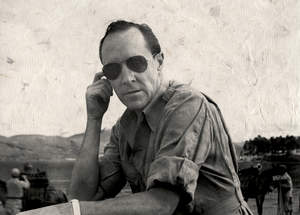
“China Hand” John Paton Davies
Our newest ZP team member, T. Greer of Scholar’s Stage blog has reposted two very thoughtful essays on the Chinese strategic tradition and its interpretation that can be found in modern Sinology. They are excellent and I encourage you to read them in full.
.
In his second post, T. Greer raises many questions regarding the state of Sinology, as well as topics for future investigation yet unexplored that would represent in equivalent fields, the fundamentals. Given that China represents not just a nation-state and a potential near-peer competitor of the U.S. but thousands of years of a great civilization, it is remarkable that the professional community of Western Sinologists is so small. The number of USG employees with the highest level of conversational fluency in Chinese who are neither native speakers nor children of immigrants would probably not fill a greyhound bus.
.
Why is the state of Sinology relatively parlous?
I think the poor state of Sinology is traceable primarily, albeit far from exclusively, to the Cold War for two reasons:
.
First, Mao’s
tumultuous,
totalitarian rule cut off access to Chinese sources and China to Western scholars for roughly a generation and a half. This in itself, coming on the heels of almost forty years of revolution, warlordism, foreign invasion and civil war, was enough to cripple the field. Without access to in-country experience, archival sources and foreign counterparts, an academic field begins to die. Furthermore, Mao’s tyrannical isolation of mainland China was far more severe than the limited access for Western scholars of Russian history and journalists imposed by the
Soviet Union.
Josef Stalin, in contrast to Mao, was partially a great Russian chauvinist and the Soviet dictator demanded certain aspects of Russian history, culture and the reigns of particular Tsars be celebrated alongside the Marxist pantheon . Mao’s feelings towards traditional Chinese culture were
much more hostile and ideologically extreme. Stalin’s worst abuses of Russian history in demolishing
a historic Tsarist cathedral for a never-built, gigantic Soviet labyrinthe pale next to the
mad vandalism of the
Cultural Revolution .
.
Secondly, the fate of “
the China hands” like
John Paton Davies and the “
Who Lost China” debate during McCarthyism rendered Sinology politically radioactive in America. It is true that many of the China hands like Davies combined a realistic strategic assessment of
Kuomintang/Chiang Kai-shek shortcomings with politically naive or wishful thinking about Mao and the Communists, but the field was dealt a blow from which it never recovered in American universities. Davies was not a Communist or even a leftist (though some China Hands were fellow travelers) but that nuance was lost on the public in a period that saw in swift succession
Alger Hiss, the Berlin blockade, the the Fall of China, the Soviet A-Bomb, Klaus Fuchs, the Rosenbergs and the
Korean War. It seemed at the time that the
Roosevelt administration had been infiltrated with Soviet spies and fellow travelers (largely because
it had been) and in that atmosphere of Red-baiting, Davies was subsequently scapegoated, smeared and fired. This McCarthyite political cloud over Sinology was curiously juxtaposed with the simultaneous robust funding of studies of the USSR, Russian culture and the training of Slavic linguists in the 1950’s to 1991 by the USG. For academics, going into Sinology could become a professional dead end and carried (at least in the early fifties) an odor of disloyalty.
.
There are certainly other and more contemporary reasons for American Sinology being more of an esoteric field than it deserves, to which someone else with expertise can address but all fields need to attract talent and funding and until Nixon’s “China opening”, American Sinologists struggled against the political current.
This entry was posted
on Monday, June 8th, 2015 at 2:39 am and is filed under 20th century, America, chiang kai-shek, china, cold war, Communism, Confucianism, cultural intelligence, foreign policy, government, history, intellectuals, national security, politics.
You can follow any responses to this entry through the RSS 2.0 feed.
Both comments and pings are currently closed.



June 8th, 2015 at 2:08 pm
I think the disparity in the number of English speakers in China vs. the number of Chinese speakers in the US will be a very great disadvantage in the event of a shooting war breaking out between the two countries. The consequences of their being immediately able to read and understand most of what we say and write vs. our being unable to read or understand most of what they say and write will be quite great at all levels even down to the tactical I think. It will be much worse than the WWII with Japan and Japanese because Red China is rather bigger and their tech is basically on a par with ours. Perhaps it is sort of like Navajo code talkers in reverse.
June 8th, 2015 at 7:53 pm
We have enough Mandarin speakers to be ok. More of those now than we had Japanese speakers in 1940.
It wouldn’t be hard for them to Navajo code in reverse though. Take this list of Chinese dialects as an example: http://en.m.wikipedia.org/wiki/List_of_Chinese_dialects
.
Each of the big subheadings-Mandarin, Yue, Hokkien, etc. Are mutually unintelligible–sometimes as different as Polish and Portuguese. The Mandarin, Yue (through Cantonese), and Hokkien/Amoy (through Taiwanese) language families have a substantial number of Americans with fluency, and I’ve seen textbooks for all three. I haven’t seen textbooks for Wu, but seeing as Shanghaiese is part of that group I imagine that more than a few Westerners have picked it up. The problem is dialect families like Gan or Xiu, which have tens of millions of speakers each, but (if you take away ABCs) prob somewhere between ten and twenty Americans who know any of it.
.
And then there are small ethnic minorities equivalent to our Navajo. China officially has 54 ethnic groups. Each has its own language, as do many of the groups not counted on the official lists. Many of these groups don’t have a single Westerner who has yet learned their language.
June 8th, 2015 at 9:00 pm
Referring to Mandarin, Yue, Hokkien, etc. as “dialects” is actually a misnomer. Chinese is actually language family and the “dialects” are member languages. As you say, the “dialects” are not mutually intelligible.
.
And then there’s the literary language. Reading historic documents requires knowledge of the literary language. That’s one of the reasons that the “dialects” were classified the way they were–speakers of the various “dialects” all wrote using the literary language.
June 9th, 2015 at 1:42 am
The problem is not the number of Mandarin speakers in the U.S. Population. The problem is the number at the highest levels of fluency who can pass a security clearance. That bongs native speakers, most of their children, native born Americans with Chinese citizen spouses and Americans who have extensive time residing in China. During a Sino-American War we would no doubt relax these rules ( many of which are Cold War legacies, albeit with some logic to them) but our current lack of depth and breadth on Chinese affairs is contributing to such a war being blundered into.
.
The points on minority languages are excellent
June 9th, 2015 at 10:57 am
It occurred to me that we needed Navajo code talkers because the Japanese had English speakers available even down to very low levels. The Red Chinese may have even more English speakers available now. But how many Navajo speakers are available to us now vs then? I don’t know but I think I remember reading that minority languages like that are fast fading in the US.
.
It’s a double whammy.
June 9th, 2015 at 9:31 pm
There’s no danger of that. There are about 170,000 English-Diné bizaad (the language of the Diné people) speakers.
June 10th, 2015 at 2:08 am
Has anyone read anything on the US handled this challenge vis a vis Japan in WW2?
June 12th, 2015 at 4:47 am
We had broken Japanese codes, which helped tremendously at the strategic and operational levels. Not sure what we did at the tactical level. We didn’t seem to take prisoners in significant numbers (which I am sure-cough-was due entirely-couch- to Japanese fanaticism -cough)or permit the use Nisei as interpreters
June 12th, 2015 at 2:50 pm
Most of you are probably aware of this WWII USMC document but for those of you who are not.
.
http://forum.axishistory.com/viewtopic.php?t=104610
.
It is completely fascinating and somewhat related to the discussion.
June 14th, 2015 at 10:52 pm
Mark, the insanity during WWII went beyond not permitting Nisei to be interpreters. When the war broke out a family friend of ours (not of Japanese descent) was one of the few American PhDs in Japanese. When he volunteered for service he expected to be put to work translating. Wrong. He carried a searchlight for most of the war. Apparently, the War Department needed tall guys who could carry a searchlight more than they needed fluent speakers of Japanese.
June 14th, 2015 at 11:46 pm
Gordon Prange earned his Ph.D in history and specialized in German history. He even studied in Berlin 1935-1936.
Where did the Navy send Prange in 1945?
Tokyo.
It turned out fortuitously. It let Prange become one of the more influential historians of the attack where Cousin Glenn got hit by a wood splinter (also known as Pearl Harbor).