….Mrs. Thatcher, 87, was Britain’s first female prime minister, serving for 11 years beginning in 1979. She was known as the Iron Lady, a stern Conservative who transformed Britain’s way of thinking about its economic and political life, broke union power and opened the way to far greater private ownership.
The daughter of a grocer, she was leader of Britain through its 1982 war in the Falklands and stamped her skepticism about European integration onto her country’s political landscape for decades.
Though Mrs. Thatcher had been in poor health for months, the news of her death still overwhelmed many. Within moments of the announcement by Lord Bell, Queen Elizabeth II and Prime Minister David Cameron offered tributes to what Mr. Cameron called “a great leader, a great prime minister, a great Briton.”
North Korea’s shopworn game of bluster, threaten, bully, violate international norms and eventually be rewarded with concessions and bribes has stopped working, which is why there now is a crisis. With the suckers (ROK, USA and Japan) refusing to play three card monty and with even Pyongyang’s confederate China wearying of the scam when they have their own fish to fry,Kim Jong Eunhas few options to save face except to double down on painting himself into a smaller and tighter corner. There are some who would like to play the game of appeasement for a temporary respite but both Seoul and Washington are taking a harder line on North Korean antics.
Here is a round up of more intelligently thought out (or at least interesting) articles and posts about the Nut of the North and possible war with North Korea:
Let me try my hand at reading the tea leaves. I don’t know that much, relatively speaking, about the “sovietology” of analyzing North Korean nuances which I will leave for experts like Colonel Maxwell to concentrate on other angles. Some points i no particular order:
First, any hope of an internal coup against Eun is probably nonexistent. Not only for the the consistent ruthlessness and lavish bribery which the Kim Family regime has treated it’s military, but the fact that coups of this nature have a poor track record in Communist states, even weird ones like the DPRK. From the inception of Communist power in the USSR, Soviet leaders fretted about “Bonapartism” by counterrevolutionary generals on white horses from Kornilov to Tukhachevskii to Zhukov. That these plots were mostly imaginary did not matter and Communist rulers neutralized this threat by binding the military leadership into the Party leadership at a level subordinate to the Politburo and periodically shooting likely upstarts. The political space for successful military coups do not exist in Communist regimes even for the key insiders, just ask Lin Bao. The North Korean military does not have the will to do this except in conjunction with massive Chinese intervention. Perhaps not even then.
For all the talk of irrationality, North Korea has been been playing this game as a survival strategy for sixty years and only miscalculated once, with the original invasion of South Korea in 1950 – which only happened, after Kim Il-Sung received the blessing of Stalin and promise of massive support from Mao ZeDong – and it was an unmitigated disaster for North Korea and China. Pointedly, the North has not initiated a war since and their subsequent violent provocations, while infuriating, have been quixotic and weird rather than existential threats that would guarantee a crushing military response.
The “win” for the US and ROK here is in frustrating the regime’s grasp for status, however self-deluded, in extorting more material concessions by acting like the international community’s equivalent of a crazy, menacing, homeless person ranting on a street corner. We need to make this charade appear to be a diplomatic sure-fire loser this time in the eyes of Pyongyang’s elite with an endgame where the North emerges empty handed and Eun feels that pressing further risks a greater loss of face. We do this by making moves where the spillover costs of North Korean intransigence and public lunacy drift in China’s direction; a tightly constrained North Korea out of diplomatic and economic options is really Beijing’s problem.
The strategic equation for “victory” from the North’s perspective depends heavily upon the reaction of the US and ROK governments to get drawn into tiresome negotiations before the North ceases it’s behavior, something they ultimately cannot control. Washington and Seoul cold hold firm or even (conceivably) take a harder line. If frustrated in their quest for concessions, the regime could exercise several options a) shift gears to a different propaganda campaign to distract internal audience b) engage in an act of terrorism elsewhere in the world, such as against a ROK embassy c) engage in a military demonstration that while provocative, like ballistic missile test, is not a casus belli d) all of the above e) undertake a military strike under the mistaken impression the ROK will not retaliate.
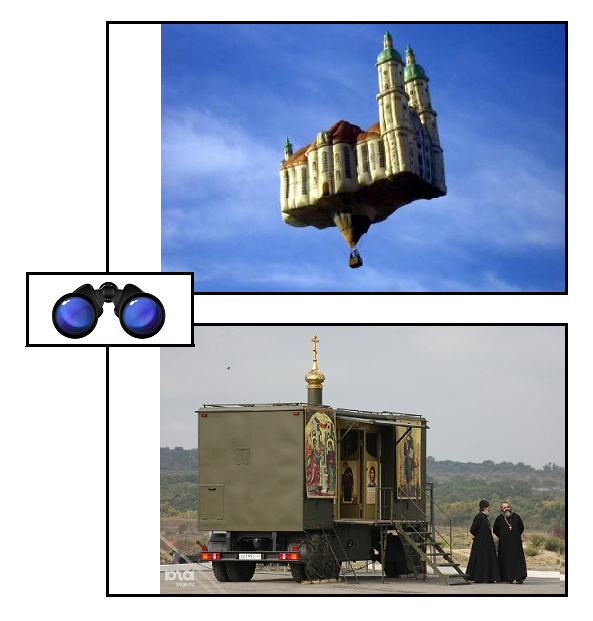
I suppose you could think of this double image as representing “the ideal” (above) and “the real” (below). In actuality, the upper image is of “Cathedral Balloon @ Balloon Fiesta ’08” — while the lower image is of an actual Russian army chapel, of which the Guardian notes:
The latest addition to the Russian military arsenal takes the form of an airborne church complete with parachuting priests.
**
Fr John Peck over at The Orthodox Church of Tomorrow gleefully tosses us this image from the Russian Airborne Force Press-Service:
**
Not until that rather boxy parachuting chapel equals and indeed surpasses the great mediaeval cathedrals in splendor will we begin to be on our way to Revelation 21.21:
And I John saw the holy city, new Jerusalem, coming down from God out of heaven, prepared as a bride adorned for her husband.
**
Hat-tip to Michael Robinson, my “go to” source (what an abysmal phrase, but language is never static. eh?) for all things antiquarian, aesthetic and ecclesial…
….By using this power in addition to examine human history, we can gain insights into the origin and nature of aesthetic judgment. For example, neurobiological monitoring, in particular measurements of the damping of alpha waves during perceptions of abstract designs, have shown that the brain is most aroused by patterns in which there is about a 20 percent redundancy of elements or, put roughly, the amount of complexity found in a simple maze, or two turns of a logarithmic spiral, or an asymmetric cross. It may be coincidence (although I think not) that about the same degree of complexity is shared by a great deal of the art in friezes, grillwork, colophons, logographs, and flag designs. It crops up again in the glyphs of the ancient Middle East and Mesoamerica, as well in the pictographs and letters of modern Asian languages. The same level of complexity characterizes part of what is considered attractive in primitive art and modern abstract art and design. The source of the principle may be that this amount of complexity is the most that the brain can process in a single glance, in the same way that seven is the highest number of objects that can be counted at a single glance. When a picture is more complex, the eye grasps its content by the eye’s saccade or consciously reflective travel from one sector to the next. A quality of great art is its ability to guide attention from one of its parts to another in a manner that pleases, informs, and provokes
This is fascinating. My first question would be how we could determine if the pattern of degree of complexity is the result of cognitive structural limits (a cap on our thinking) or if it represents a sufficient visual sensory catalyst in terms of numbers of elements to cause an excitory response (neurons firing, release of dopamine, acetylcholine etc. ) and a subsequent feedback loop. Great art, or just sometimes interesting designs exhibiting novelty can hold us with a mysterious, absorbing fascination
Later, Wilson writes:
….If ever there was a reason for bringing the humanities and science closer together, it is the need to understand the true nature of the human sensory world, as contrasted with that seen by the rest of life. But there is another, even more important reason to move toward consilience among the great branches of learning. Substantial evidence now exists that human social behavior arose genetically by multilevel evolution. If this interpretation is correct, and a growing number of evolutionary biologists and anthropologists believe it is, we can expect a continuing conflict between components of behavior favored by individual selection and those favored by group selection. Selection at the individual level tends to create competitiveness and selfish behavior among group members—in status, mating, and the securing of resources. In opposition, selection between groups tends to create selfless behavior, expressed in greater generosity and altruism, which in turn promote stronger cohesion and strength of the group as a whole
Very interesting.
First, while I am in no way qualified to argue evolution with E.O. Wilson, I am dimly aware that some biological scientists might be apt to take issue with Wilson’s primacy of multilevel evolution. As a matter of common sense, it seems likely to me that biological systems might have a point where they experience emergent evolutionary effects – the system itself has to be able to adapt to the larger environmental context – how do we know what level of “multilevel” will be the significant driver of natural selection and under what conditions? Or does one level have a rough sort of “hegemony” over the evolutionary process with the rest as “tweaking” influences? Or is there more randomness here than process?
That part is way beyond my ken and readers are welcome to weigh in here.
The second part, given Wilson’s assumptions are more graspable. Creativity often is a matter of individual insights becoming elaborated and exploited, but also has strong collaborative and social aspects. That kind of cooperation may not even be purposeful or ends-driven by both parties, it may simply be behaviors that incidentally help create an environment or social space where creative innovation becomes more likely to flourish – such as the advent of writing and the spread of literacy giving birth to a literary cultural explosion of ideas and invention – and battles over credit and more tangible rewards.
Mr. Lewis Shepherd of Microsoft came to Purdue to give a talk for CERIAS awhile back and he talked about how equating the Manhattan Project to the world of cyber security is completely wrong. I liked his talk quite a bit, and it aligned closely with something I’ve been talking to people about for awhile. Talking to people is important. I know my impact on the world is going to be negligible but I’ve dedicated my life to infecting the youth of the world with a few stray ideas. They call it teaching, and it doesn’t pay much. I think Mr. Shepherd was making a good case that scope, and cause and effect, and process of one program might no align realistically with another program. The secrecy, single mindedness, and type of problem that was the Manhattan project has almost nothing to do with the quite different project of cyber security. Much like I’ll never be able to equate my teaching to Socrates, the cyber security community shouldn’t really think “Manhattan Project”.
….Everything you likely think about defense in depth is wrong. All of the audit and compliance stuff is wrong. The firewall and intrusion detection and prevention technologies are wrong. The autocratic and dictatorial policies of information security are wrong. The underlying theories of robust and resilient programming are wrong. There is nothing about the current information technology infrastructure that is security oriented. The foundations of the technologies are fundamentally at odds with creation of an information secure culture. Now to be honest I didn’t say this. Neumann, Saltzer, Cerf, Bernack, and so many other people said this long before I did. But, maybe you haven’t read their stuff before.
How can I possibly support that they are all wrong and don’t work? Pretty simple. They don’t. Though we can secure systems to some point we are almost always talking about a security absent some failure in the system. There is nothing really secure. This is a huge problem that breaks most peoples “common sense” way of thinking about security. Simply put the way we do things will never be secure and we should stop trying to fix things the way we know doesn’t work.
In a world of growing uncertainty and mounting performance pressure, it’s understandable that resilience has become a very hot topic. Everyone is talking about it and writing about it. We all seem to want to develop more resilience. But I’m going to take a contrarian position and suggest that resilience, at least as conventionally defined, is a distraction and perhaps even dangerous.
….In this context, the conventional view of “bounce back” resilience for enterprises is profoundly dangerous. It simply increases the ability of the institutional status quo to survive when conditions demand a fundamental transformation. It increases the gap between what we are doing and what we need to do. We already face a growing mismatch between the institutions and practices that dominate in business and the needs of the markets and societies that are being re-shaped by the global forces outlined earlier. As long as this mismatch persists, we will face increasing disruptions and stress as struggle to maintain institutions and practices that are no longer viable. We don’t need to bounce back; we desperately need to move forward.
J.M. Berger, author of Jihad Joe (reviewed here by Charles) frequently tackles Islamist militants and various kinds of terrorism at Intelwire but the focus in the above paper is on far Right, white nationalist and radical racist strands of violent extremism
A new Texas Department of Public Safety Threat Assessment report states that criminal cartels are operating in Texas and are the No. 1 threat to the Lone Star State. Narcobloqueos (narco-blockades) are now being seen north of the border.
Zenpundit is a blog dedicated to exploring the intersections of foreign policy, history, military theory, national security,strategic thinking, futurism, cognition and a number of other esoteric pursuits.