[ by Charles Cameron — Hugo Chavez was not only a friend of the Twelfth Imam to Ahmadinejad, but a disincarnate great spirit to Spiritualists & a near-savior to many Catholics ]
.
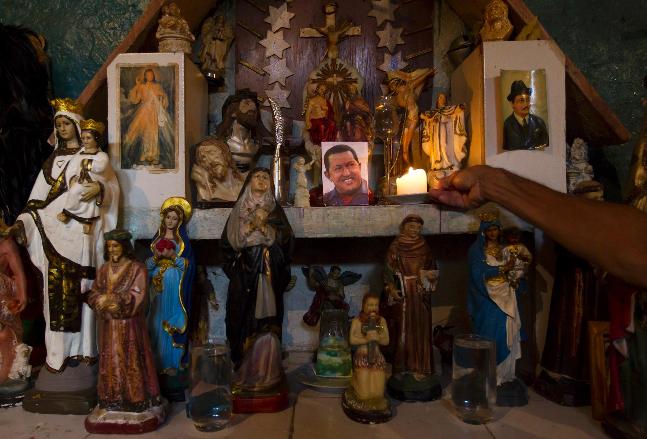
altares de santos with Hugo Chavez, image credit likely Reuters
.
A short while back in Chavez and the Second Coming? I reported on Iranian President Ahmadinejad’s fulsome tribute to the late president of Venezuela Argentina, Hugo Chavez, of whom he said, “I have no doubt that he will return alongside Jesus Christ and the Mahdi to establish peace and justice in the world.”
The central personality of this mystical congress was the former president of Venezuela, Hugo Chavez. “He is a great spiritualist who has disincarnated,” Enrique Alemany, president of the Spiritualist Federation of Havana, said.
Okay, that’s Shiite Islam and global spiritualism taken care of. How about Catholicism, South American style, with an intriguing mention of the recent papal election?
Chavez’s die-hard followers considered him a living legend on a par with independence-era hero Simon Bolivar well before his March 5 death from cancer. In the mere three weeks since, however, Chavez has ascended to divine status in this deeply Catholic country as the government and Chavistas build a religious mythology around him ahead of April 14 elections to pick a new leader.
Chavez’s hand-picked successor, Nicolas Maduro, has led the way, repeatedly calling the late president “the redeemer Christ of the Americas” and describing Chavistas, including himself, as “apostles.”
Maduro went even further after Argentine Cardinal Jorge Mario Bergoglio became Pope Francis earlier this month. Maduro said Chavez had advised Jesus Christ in heaven that it was time for a South American pope.
That comes as Maduro’s government loops ads on state TV comparing Chavez to sainted heroes such as Bolivar and puts up countless banners around the capital emblazoned with Chavez’s image and the message “From his hands sprouts the rain of life.”
“President Chavez is in heaven,” Maduro told a March 16 rally in the poor Caracas neighborhood of Catia. “I don’t have any doubt that if any man who walked this earth did what was needed so that Christ the redeemer would give him a seat at his side, it was our redeemer liberator of the 21st century, the comandante Hugo Chavez.”
Chavistas such as Munoz have filled Venezuela with murals, posters and other artwork showing Chavez in holy poses surrounded by crosses, rosary beads and other religious symbolism.
One poster on sale in downtown Caracas depicts Chavez holding a shining gold cross in his hands beside a quote from the Book of Joshua: “Comrade, be not afraid. Neither be dismayed, for I Will be with you each instant.” The original scripture says “Lord thy God,” and not “I,” will accompany humanity each instant.
And if Ahmadinejad expected that Chavez would return with Christ at the Second Coming, it’s worth noting that Chavez was also present — at least in a crèche from Caracas last year — at Christ’s nativity.
**
With hat-tips to Ben Zeller, Jean-Francois Mayer and the crew at the New Religious Movements mailing list.
[ by Charles Cameron — remembering that there are two calendars, two times, the secular and the sacred, and that there’s more poetry, more depth of heart and thus intellect too, in the sacred calendar — a truth made known also to popes and monarchs ]
.
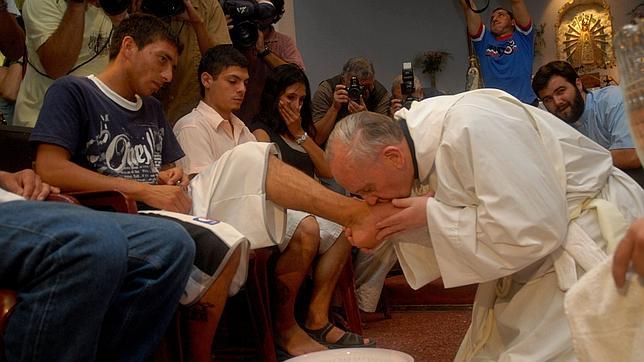
Cardinal Bergoglio, now Pope Francis, washes & kisses the feet of residents of a shelter for drug users, Maundy Thursday, 2008
.
It’s an extraordinary day, today, for myself as it happens, and more significantly for the world. Specifically, it is significant for poor and powerful alike, for it sets them in a proper relation to one another.
Today is Maundy Thursday, the day on which Christ’s Last Supper, which became and remains the prototype of the Catholic Mass, is remembered. His Last Supper would be closely followed by his crucifixion the next day, Good Friday, and resurrection on Easter Sunday.
After that final supper, Christ made a gesture which initially disturbed his close followers — he washed their feet, then instructed them to do the same.
His gesture repeats itself to this day.
**
Pope Francis, who as an archbishop had followed this practice by washing and kissing the feet of young people in drug shelters (image above) and AIDS clinics, is breaking with Vatican tradition — the pope washing the feet of priests in some major basilica in Rome — this year, by going to a youth prison today for the ceremony:
The Mass of the Lord’s Supper that Pope Francis will celebrate on Holy Thursday in the chapel of the Casal del Marmo Penitential Institute for Minors will be, by his express desire, very simple. Concelebrating with the Holy Father will be Cardinal Agostino Vallini, vicar general of the Diocese of Rome, and Fr. Gaetano Greco, chaplain of the Institute.
Around 10 girls and 40 boys will take part in the Mass. The Pope will wash the feet of 12 of them, who will be chosen from different nationalities and diverse religious confessions. The youth will also say the readings and the prayers of the faithful. Given the intimate nature of the pastoral visit, journalists will be restricted to the area outside the building and no live coverage will be transmitted.
That’s a slightly formal Vatican announcement of the occasion: “diverse religious confessions” in this case almost certainly includes Muslims and atheists or agnostics. Father Greco, the prison chaplain, is quoted as saying:
Only eight of our residents are Italian: six boys and two girls … The others are all foreigners. And most of them are Muslim. Then there are some who have no religious belief at all. Therefore many of them don’t even know who the Pope is. For this reason too, it was far from easy to explain to them the importance of the Pope’s visit.
A young Neapolitan who has been here for a while came to my help. He gathered them all together, to try to make them understand above all what the Pope’s act, which is an act of love for them, actually meant. I was upset for a moment by the first looks, that were either blank or only faintly curious about my enthusiasm. Then our friend broke the silence with that most classic of Neapolitan expressions: “Maronna mia, o Papa accà!” [good heavens! The Pope here!] and he ran his hand through his hair, his face betraying emotions mingled with happiness. At that very instant all the others, seeing his amazement, realized that it must really be something very special and began to question me. Little by little, I saw their enthusiasm growing.
Father Greco said of his young charges that the Pope’s visit “will make them see that their lives are not bound by a mistake, that forgiveness exists and that they can begin to build their lives again.”
**
This symbolic gesture, this washing of the feet, does indeed have enormous imaginative power, if we will allow it, to touch the heart and transform our behavior.
I’ve quoted this before, I know: it’s the account given by the man I know who, more than any other, prayed, lived, worked, and saw his great dream and hope accomplished in his lifetime — the overturning of the apartheid regime in S. Africa. For myself, it’s the heart of what he taught me: here, in his own words, Fr Trevor Huddleston CR describes how his own role in that drama began:
On Maundy Thursday, in the Liturgy of the Catholic Church, when the Mass of the day is ended, the priest takes a towel and girds himself with it; he takes a basin in his hands, and kneeling in front of those who have been chosen, he washes their feet and wipes them, kissing them also one by one. So he takes, momentarily, the place of his Master. The centuries are swept away, the Upper Room in the stillness of the night is all around him: “If I, your Lord and Master, have washed your feet, ye ought also to wash one another’s feet.” I have knelt in the sanctuary of our lovely church in Rosettenville and washed the feet of African students, stooping to kiss them. In this also I have known the meaning of identification. The difficulty is to carry the truth out into Johannesberg, into South Africa, into the world.
**
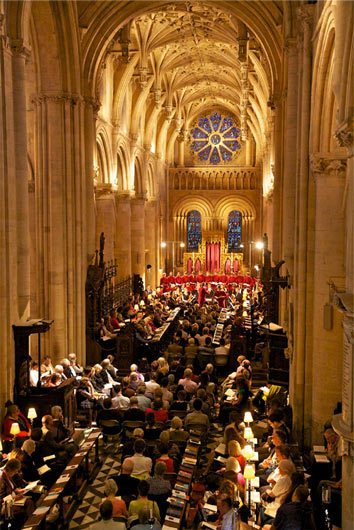
Earlier today, Queen Elizabeth II will have celebrated “the Royal Maundy” in the chapel of my old College and that of my mentor, Trevor Huddleston, at Oxford, Christ Church — our college chapel is also the cathedral of that great city.
The current Dean Of Christ Church, the Very Reverend Christopher Lewis, gave the BBC this historical detail:
The last time it happened here was in 1644 when Charles I was thrown out of London and welcomed in Oxford.
Here’s the glorious building where the ceremony will have taken place:
**
The Royal Maundy is celebrated by the monarch giving two purses to local pensioners — 83 men and 83 women this year since HM is 83 years old — a white purse containing sterling silver 1p, 2p, 3p and 4p pieces, and a red purse contained a £5 and a 50p coin commemorating the 60th anniversary of the Queen’s coronation in 1953.
Maundy Thursday commemorates the day of the Last Supper of Jesus Christ with the Apostles. The word ‘Maundy’ comes from the command or ‘mandatum’ by Christ at the Last Supper, to love one another.
The tradition of the Sovereign giving money to the poor dates from the thirteenth century. The Sovereign also used to give food and clothing, and even washed the recipients’ feet. The last monarch to do so was James II.
It’s a curious survival, the Royal Maundy, but a touching one, looking back to the days when the monarch really was expected to be a bit like a priest for the nation – acting out the great symbols of faith on behalf of everyone. …
And that’s very much what the Royal Maundy is about. What we see today is only a shadow of what used to be done hundreds of years ago, when the monarch would actually do what Jesus did at the Last Supper and wash the feet of a number of poor people. Back in the Middle Ages, this meant that the King was just doing what priests and bishops often did, not only on Maundy Thursday but on many other occasions.
They didn’t all do it because they were lovely humble people – some were, and some definitely weren’t – but because they accepted one great truth that needed repeating over and over again, the one big thing that Christianity had brought into the world of human imagination.
And that was – and is – the truth that power constantly needs to be reminded of what it’s for. Power exists, in the Church or the state or anywhere else, so that ordinary people may be treasured and looked after, especially those who don’t have the resources to look after themselves. The Bible is crystal clear that this is the standard by which the gospel of Jesus judges the powerful of this world.
Power exists, in the Church or the state or anywhere else, so that ordinary people may be treasured and looked after, especially those who don’t have the resources to look after themselves.
**
Here is the text from St John’s gospel — the gospel that focuses its attention at the symbolic level — describing the original event [John 13.1-15]:
He riseth from supper, and laid aside his garments; and took a towel, and girded himself. After that he poureth water into a bason, and began to wash the disciples’ feet, and to wipe them with the towel wherewith he was girded.
Then cometh he to Simon Peter: and Peter saith unto him, Lord, dost thou wash my feet?
Jesus answered and said unto him, What I do thou knowest not now; but thou shalt know hereafter.
Peter saith unto him, Thou shalt never wash my feet.
Jesus answered him, If I wash thee not, thou hast no part with me.
Simon Peter saith unto him, Lord, not my feet only, but also my hands and my head.
Jesus saith to him, He that is washed needeth not save to wash his feet, but is clean every whit: and ye are clean, but not all. For he knew who should betray him; therefore said he, Ye are not all clean.
So after he had washed their feet, and had taken his garments, and was set down again, he said unto them, Know ye what I have done to you? Ye call me Master and Lord: and ye say well; for so I am. If I then, your Lord and Master, have washed your feet; ye also ought to wash one another’s feet. For I have given you an example, that ye should do as I have done to you.
**
Here finally, for sheer beauty, is the great 16th century Spanish composer Tomás Luis de Victoria‘s First Lamentation for Maundy Thursday, sung by the Tallis Scholars in the chapel of Merton College, Oxford — just around the corner from Christ Church:
Taking a break for a bit from .mil topics in order to refresh my perspective on strategy and policy with new learning elsewhere. Reading a lot on creativity of late and a comprehensive post or paper may be the ultimate result.
Taleb’s book has been the focus of some interesting online exchanges elsewhere. Previously I wrote of Antifragile:
One of the ”must read” books for 2013. I watched Taleb kick around some of the concepts in Antifragile on his Facebook page and then observed friends like co-blogger Scott Shipman and Dr. Terry Barnhart comment as they started reading shortly after the book’s release. There are many things in Antifragile (including, it seems, a fair piece on the epistemic deficiencies of Socrates) and this is a book to read with care – not least because I intuitively agree with a number of Taleb’s arguments which means reading with a critical eye will require more effort.
I like the “antifragile” concept. It’s useful. So I have my sharpie in hand as I read.
Stewart Brand, well known activist, futurist and creator of theWhole Earth Catalog and The Long Now Foundation, speaks here on the realities of “de-extinction” the bringing back of extinct species and (local) ecosystems through genetic engineering and radical hybridization.
The greatest divergence between Johnson and Stone is on the matter of Socrates and religion. This is is some importance because one of the charges leveled at Socrates by his accusers Anytus and Meletus was not believing in “the gods of city”and introducing new ones.
The sincerity of this specific charge is an interesting question. As both authors indicated, the century of pre-Socratic philosophers in Athens laid the cornerstone of empirical and rational thought about nature that were the forerunners of both materialism as well as science in the form of natural philosophy. This coincided with the rise of Athens to greatness and empire and a possible change in Athenian civic culture, not so much a secularization but an emphasis on humanism over mysticism in political affairs. This point Johnson was at pains to emphasize as the core nature of “the cultural revolution” wrought by “the Periclean regime” , where Protogoras was prominent sophist. Stone regards the transition to one where religion was “demoted…reduced to venerable fables and metaphorical personifications of natural forces and abstract ideas” which renders the religious question at Socrates’ trial a “distraction”. The primitive awe in which the Greek gods were held during archaic times, gave way to a more ritualistic and cultural reverence in the classical period, or so this line of argument goes.
I am not certain this interpretation is correct to that exaggerated degree. It strikes me far more likely as a representation of the beliefs of educated elite Athenians at the time than those of the middle classes or the thetes, or of Greeks from other cities. Pagan folk religion probably retained the same influence over public and private life in Athens as Christianity does in America in our own times. That is to say there were likely differences in religiosity between the aristocratic elite and the masses in democratic Athens and between political factions (democratic, moderate and extreme oligarchic).
Some contrasting examples: Nicias, whose political reputation with the Assembly was anchored in trust of his admirable piety, brought final disaster upon the Sicilian Expedition and himself with his obstinate, superstitious, deference to religious signs and soothsayers when the path of escape still remained open. Xenophon, in delicately rebuffing calls to accept rulership over the 10,000 in The Anabasis of Cyrus used pious arguments with the soldiers that he himself probably viewed with some degree of cynicism because they were an effective excuse to pass the leadership to a Spartan. Speaking of the Spartans, they were known in this time as “the craftsmen of war” not because of battle art but because of their zealous adherence to military religious ceremonials and divination of sacrificial animals to discern the will of the gods.
That does not sound much like a people for whom Zeus and Apollo were merely enjoyable campfire fables for children, figures of comic sport in the theater or convenient metaphors for chance or the weather.
Stone argued that Athenian religion had been “demoted” but did so for purposes of rebutting the claim of Socrates that decades of comic poets lampooning him in their plays (like The Clouds, by Aristophanes) had prejudiced the jury against him. Stone was also writing The Trial of Socrates after the time when standards of “traditional morality” had been challenged culturally and theologically during the sixties and seventies and were rejected by a significant part of the Baby Boom generation:
….As for not believing in gods, the Athenians were accustomed to hearing the gods treated disrespectfully in both the comic and the tragic theater. For two centuries before Socrates, the philosophers had been laying the foundations of natural science and metaphysical inquiry. Their gigantic pioneering in free thought still awes us as we pore over the fragments of these so-called pre-Socratics. Almost all the basic concepts of science and philosophy may be found there in embryo. They first spoke of evolution and conceived the atom. In the process the gods were not so much dethroned as demoted and bypassed. They were reduced to venerable fables or metaphorical personifications of natural forces and abstract ideas.
These philosophers were rationalists and rarely bothered with what we call “theology”. The very term was unknown to them. Indeed it does not appear in Greek until the century after Socrates. The word theologia – talk about gods – turns up for the first time in the Republic when Plato is explaining what the poets in utopia will not be allowed to say about the divine powers. In his ideal society a Socrates would have indeed been punishable for deviating from the state-sanctioned theologia, but not in Athens.
….Polytheism was, by it’s pluralistic nature, roomy and tolerant, open to new gods and new views of old ones. It’s mythology personified by natural forces and could be adapted easily, by allegory, to metaphysical concepts. These were the old gods in a new guise, and commanded a similar but fresh reverence.
Atheism was little known and difficult for a pagan to grasp because he saw divinity all about him, not just on Olympus but in the hearth and boundary stone, which were also divinities though of a humbler sort…..
….It was the political, not the philosophical or theological views which finally got Socrates into trouble. The discussion of religious views diverts attention from the real issues.
Stone develops this theme further in his explanation of how Socrates might have won acquittal, had the old philosopher not been determined to antagonize his jury:
The indictment’s two counts are equally vague. No specific acts against the city are alleged. The complaints are against the teaching and beliefs of Socrates. Neither in the indictment – nor at the trial – was there any mention of any overt act of sacrilege or disrespect to the city’s gods or any overt attempt or conspiracy against it’s democratic institutions. Socrates was prosecuted for what he said, not for anything he did.
In other words, the charges against Socrates were of a very different character than the ones which had been made during the Expedition to Syracuse against the close associate and student of Socrates, the ambitious demagogue Alcibiades. The latter had been charged with sacrilege, specifically defaming and vandalizing the Eleusinian Mysteries, forcing his recall as joint strategos over the expedition and summoning him back to Athens for trial. This ill-fated and poorly timed indictment may or may not have been false, but it had certainly been politically motivated and was the catalyst for the subsequent treason of Alcibiades and the military disaster in Sicily, both so damaging to Athens. That charge, unlike the one against Socrates however, was based upon real acts that had taken place, whether Alcibiades had been the culprit or not.
….on the impiety charge, Socrates is as vague as the indictment. He never discusses the accusation that he did not respect or believe in – the Greek verb used, nomizein, has both meanings – the gods of the city. Instead, he traps the the rather dim-witted Meletus into accusing him of Atheism, a charge he easily refutes. But there was no law against atheism in ancient Athens either before or after the trial. Indeed, the only place we find such a law proposed is in Plato’s Laws. In this respect, Plato was the exception to the tolerance that paganism showed to diverse cults and philosophic speculation about the gods.
….it was monotheism that brought religious intolerance into the world. When the Jews and Christians denied divinity to any god but their own, they were attacked as atheos or “godless”. This explains how – to borrow Novalis’s characterization of Spinoza – a “God-intoxicated” Jew and Christian like St. Paul could be called an “atheist” by pious and indignant pagans.”
We will see later that Johnson takes a normatively very different, but logically complementary view to Stone on “Socratic monotheism”, who concludes:
By trapping Meletus into calling him an atheist, Socrates evaded the actual charge in the indictment. It did not accuse him of disbelief in Zeus and the Olympian divinities, or in gods generally. It charged disbelief in ‘the gods of the city”.
This was in the ancient Greek sense, a political crime, a crime against the gods of the Athenian polis. This is a crucial point often overlooked.
In Athens, Democracy was itself deified and personified, at least to the extent of having it’s own ritual priest in the annual theater of Dionysus – and what was old Socrates in the view of Stone but the teacher of antidemocratic and antipolitical doctrines in a city where the Democracy had been overthrown by the Thirty?
Zenpundit is a blog dedicated to exploring the intersections of foreign policy, history, military theory, national security,strategic thinking, futurism, cognition and a number of other esoteric pursuits.