[ by Charles Cameron — more on the upcoming papal election from a “comparative” perspective ]
.
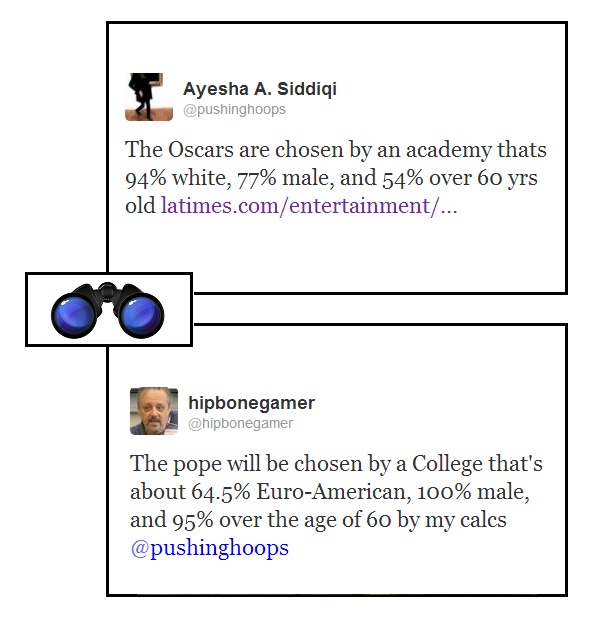
As you know, I noodle around with parallelisms and oppositions quite a bit. Here are two recent pairings that caught my attenion — one of them just in time for the Oscars:
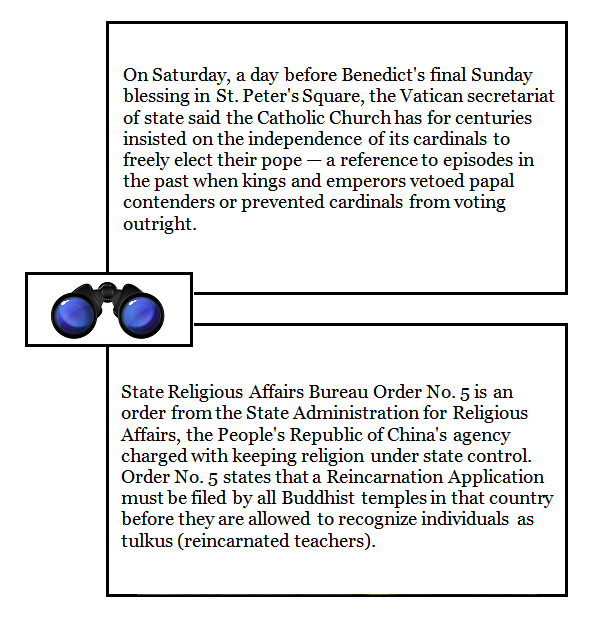
The other concerns political influence on spiritual appointments…
I had the good fortune to meet and befriend a “tulku” while I was at Oxford, so the whole business of the identification and recognition of reincarnated Tibetan lamas has long been an interest of mine.
[ by Charles Cameron — three ways to get a fix on the present status and future needs of the Catholic Church ]
.
Perugino, The Entrusting of the Keys to Peter, Sistine Chapel
.
I want to make this brief. It seems to me that the most powerful statement of the present situation of the Church was that delivered by John Colet at Convocation in 1512:
You are come together today, fathers and right wise men, to hold a council. In which what you will do and what matters you will handle, I do not yet know, but I wish that, at length, mindful of your name and profession, you would consider of the reformation of ecclesiastical affairs; for never was there more necessity and never did the state of the Church more need endeavors. For the Church – the spouse of Christ – which He wished to be without spot or wrinkle, is become foul and deformed. As saith Isaias, “The faithful city is become a harlot”; and as Jeremias speaks, “She hath committed fornication with many lover,” whereby she has conceived many seeds of iniquity and daily bringeth forth the foulest offspring. Wherefore I have come here today, fathers, to admonish you with all your minds to deliberate, in this your Council, concerning the reformation of the Church.
By way of comparison, here’s a snippet from this week’s Time report, Bitter Pill: Why Medical Bills Are Killing Us, on the status of another large entity whose purported focus is the common good:
By the time Steven D. died at his home in Northern California the following November, he had lived for an additional 11 months. And Alice had collected bills totaling $902,452. The family’s first bill — for $348,000 — which arrived when Steven got home from the Seton Medical Center in Daly City, Calif., was full of all the usual chargemaster profit grabs: $18 each for 88 diabetes-test strips that Amazon sells in boxes of 50 for $27.85; $24 each for 19 niacin pills that are sold in drugstores for about a nickel apiece. There were also four boxes of sterile gauze pads for $77 each. None of that was considered part of what was provided in return for Seton’s facility charge for the intensive-care unit for two days at $13,225 a day, 12 days in the critical unit at $7,315 a day and one day in a standard room (all of which totaled $120,116 over 15 days). There was also $20,886 for CT scans and $24,251 for lab work.
**
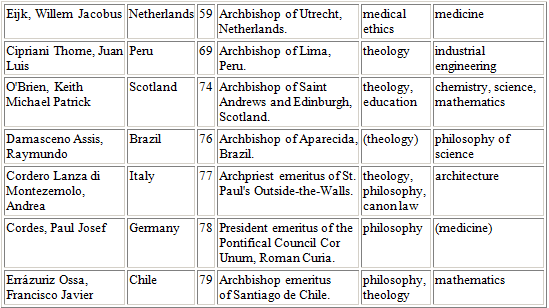
And for a third angle on the upcoming conclave, I would like to offer a brief cull from Anthony Judge‘s tabular listing of cardinals aged 80 and below, in which he identifies those who have some indication of competence in the “social” and “natural” sciences in their Wikipedia biographies.
I have omitted those who had no listing in the natural sciences — mathematics included — and those aged 80, since I understand they will be too old to vote. Of the 116 cardinals that remain, these seven apparently have some acquaintance with what Judge terms the natural sciences, as detailed in the final column:
Of these, Cardinal O’Brien, who appears to have the widest range of scientific disciplines in his background, has recently been the target of accusations of impropriety.
As those who read me regularly are aware, I “come from” the arts rather than the sciences myself. But I cannot help but agree with Anthony Judge’s comment, particularly insofar as it relates to mathematics and the sciences:
It is striking how few disciplines are represented in what amounts to a table of cognitive competence of those from whom guidance in world governance is expected.
**
I’m tossing you these three quotes not so much for themselves as for the ripples of thought, the further questions they may raise. Colet’s sermon, for instance, was delivered only five years before Martin Luther “nailed his theses to the door” — or at least sent them to his bishop — thus starting the Protestant Reformation in 1517.
The aptness of Colet’s sermon to today should give us considerable pause.
[ by Charles Cameron — on the exclusion of worldviews not consonant with grey suits and security clearances ]
.
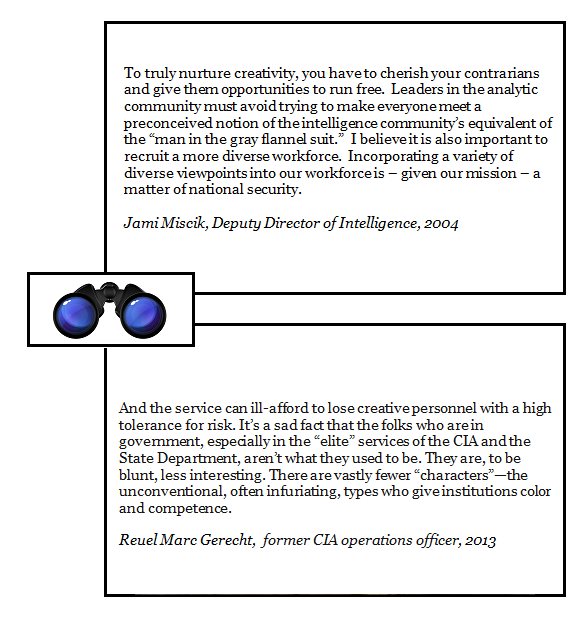
These two persons are likely being polite.
**
I’m wondering how any people at State or in the Agency or wherever know what it feels like to be one of the flagellants in Iran during Muharram, in Qom or Masshad perhaps… or at the Jamkaran mosque, and to believe the Mahdi is waiting close by in the wings… or to be in Afghanistan, Sunni, and expecting his army with black banners will sweep down on Jerusalem from Khorasan in accordance with hadith… or in Palestine, reliant on the hadith of the rocks and the trees, certain that Israel will soon fall… in Pakistan, listening to Syed Zaid Zaman Hamid and mentally preparing for the Ghazwa-e-Hind?
**
I suppose I’ve been struggling to say this for years:
The sanction for extremist violence, even to the point of death, is that the cause is just and right. The sanction for messianic violence is that the cause is not only humanly just and right but divinely so — and final, for the entirety of the cosmos, for all Creation.
[ by Charles Cameron — a poet’s rant against the hubris of scientists and the poverty of so much of what passes for art ]
.
Gorgeous. And fascinating.
**
I’d like to begin by saying beauty is not the same as prettiness any more than joy is the same as fun or truth than popular opinion. In fact I have an aphorism:
if you shoot for beauty, you’re liable to hit prettiness; if you want to achieve beauty, shoot for truth.
Okay? The beautiful can be grotesque, utterly normal, joyously peaceful, extremely violent, or simply gorgeous — and be beautiful in each case.
Having said that, I’d also like to say that the world, the universe in all it immense scope and scale and variety and possibility, isn’t “science” or “art” — we find science in exploring it one way, find art in exploring it another.
And when scientists want to impress, they often do it by choosing elements of beauty in what science has recorded of a universe that is neither science nor art but seamlessly filled to the brim with both — by appealing to our aesthetic taste, to the “art” side of our being, while claiming the result is science.
**
Case in point:
The graphic above, from the I fucking love science photo timeline on FaceBook, which comes with the caption:
Caddisfly larvae build protective cases using materials found in their environment. Artist Hubert Duprat supplied them with gold leaf and precious stones. This is what they created.
Did you get that? It’s from a site that bills itself I fucking love science that specializes in presenting, how can I make this simple, nature’s art. It’s the recognition of beauty that makes this site so wonderful — and in this particular case, the work of Artist Hubert Duprat.
**
I’ve been working with jewelry recently, and as you can see from this image of a Hematite “Tricubi” necklace by Bernd Wolf, the influence goes both ways.
**
What is beauty? And why does science as an institution so often want to claim what properly belongs in the realm of art? Or is science, perhaps, an art or cluster of arts? I’m tired of these ceaseless wranglings between two supposedly opposing cultures.
Paul Dirac:
I think that there is a moral to this story, namely that it is more important to have beauty in one’s equations that to have them fit experiment.
As art, the jewel-like protective cases those caddisfly larvae make are simply beautiful. The fact that they make them is fascinating.
[ by Charles Cameron — Zero Dark Thirty & Manhunt, fact and fiction, that old saw about who it is that gets to write history, thence onwards to theology & the arts, von Balthasar & Tolkien, winding up watching UK & US versions of House of Cards with son David ]
.
How’s this for stereoscopy?
**
You may know I’m preoccupied with the notion of extending the stereo concept — using twin sources to add a depth dimension to one’s perception — from stereophonic audition and stereoscopic vision to stereocognition more generally.
Nada Bakos‘ image above shows a cinema in which documentary and fictional versions of the story of the hunt for bin Laden are playing simultaneously. The fiction, Kathryn Bigelow‘s Zero Dark Thirty, I saw a couple of days ago, and neither I nor son Emlyn, 17, were terribly enthused: the Camp Chapman scene was the one that touched me most deeply.
I’ll no doubt want to see both films, but it’s Greg Barker’s documentary, Manhunter, that will interest me the most, the more factual of the two. And yet that’s curious in and of itself, because as a poet I’m usually interested in the mythic and imaginative as much as or more than the “merely” factual, and I tend to think of the movies as providing a mythology for our times.
Okay, let me give you the two quotes that get to the heart of my sensibilities about fact and fiction at the movies.
What, after all, happens in a movie theater after the lights dim and the curtain rises? F Scott Fitzgerald tells us what happens in the mogul’s screening room, but it’s the same with us peons, isn’t it?
Dreams hung in fragments at the far end of the room, suffered analysis, passed — to be dreamed in crowds or else discarded.
And I’m also with the poet Kathleen Raine, who said:
Myth, when a real event may be the enactment of a myth, is the truth of the fact and not the other way around…
So where does that leave me?
Right now, it leaves me feeling that in the case of these two filmic treatments of the same “true story” — and no doubt many others — history will likely be “written” by the entertainment makers, not the documentarists. Paradoxically, a sad thought.
But let’s go beyond that.
**
I said I’m preoccupied with the notion of using twin sources to add a depth dimension to perception — from stereophonic audition and stereoscopic vision to stereocognition more generally. Another way to say that is that I’m interested in figuring out how to think contrapuntally, and how to score contrapuntal thought — thought which holds two or more potentially conflicting concepts in mind simultaneously, so as to arrive at a deeper understanding than one perspective alone can provide…
In his revelation, God performs a symphony, and it is impossible to say which is richer: the seamless genius of his composition or the polyphonous orchestra of Creation that he has prepared to play it
and states that “Even eternal Truth itself is symphonic.” The only stronger statement I know of concerning the contrapuntal nature of the world from within the Catholic tradition is JRR Tolkien‘s extraordinary short masterpiece of a creation myth, The Music of the Ainur [scroll down at link], with which he begins the Silmarillion.
So the contrapuntal idea is present in theology, as well as the arts…
**
Stereoscopy, counterpoint.
I’ve been watching the TV series, House of Cards, with my fourteen-year old, David — we’ve now seen the whole first series of the UK version together, and the beginning of the US version, and it’s fascinating to notice the differences.
Frank Underwood (Kevin Spacey):
Francis Urquhart (Ian Richardson):
See both shows, form your own conclusions…
And their source?
Now I shall have to watch Richard III with David, too.
Zenpundit is a blog dedicated to exploring the intersections of foreign policy, history, military theory, national security,strategic thinking, futurism, cognition and a number of other esoteric pursuits.