January 29th, 2009
My belated contribution to The Clausewitz Roundtable on Book II.
Clausewitz, On War, Book 2: War is an Act of Human Intercourse
Nation-states are superorganisms and warfare constitutes a form of collective bargaining, a market of blood. Lyndon Johnson in the basement of the White House, pouring over maps of North Vietnam, picking out bombing targets was attempting to bargain with Hanoi through the martial gestures of escalation. Even amidst the total war of WWII, the belligerents made calculated gestures in the intransigence of Stalingrad, the reckless dash for Cairo or through the Ardennes, in the step by step horror that was Okinawa, to signal to the enemy “the price” for continuing the war. Hiroshima and Nagasaki cleared the table of all but the most dangerous of gamblers
Read the rest here.
Posted in chicago boyz, Clausewitz Roundtable | Comments Off on Clausewitz Roundtable – War as Social Interaction
January 27th, 2009
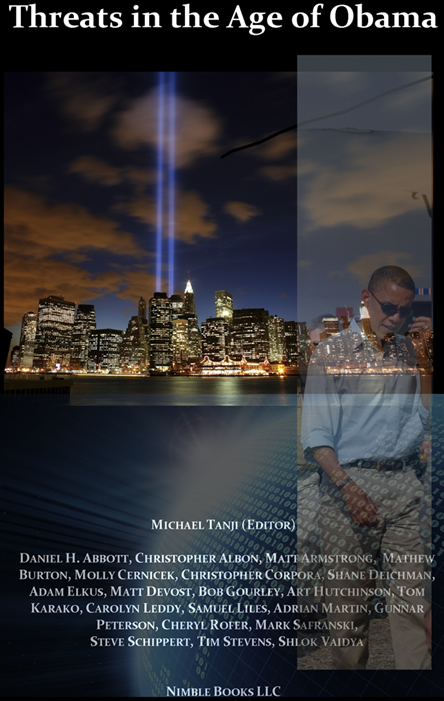
I am both excited and very pleased to announce the release of Threats in the Age of Obama by Nimble Books.
Edited by my friend Michael Tanji, a former senior member of the intelligence community, the volume is a 224 page A-Z anthology on the cutting edge security challenges faced by the United States in the 21st century and the strategic thinking required to deal with them. Tanji recruited an impressive stable of experts, many with high level USG and private sector experience, in intelligence, cyberwarfare, terrorism, pandemics, nuclear proliferation, human terrain, information operations, public diplomacy, foreign policy and national security. It was a high honor for me to be included among the authors, who are:
Dan tdaxp, Christopher Albon, Matt Armstrong, Matthew Burton, Molly Cernicek, Christopher Corpora, Shane Deichman, Adam Elkus, Matt Devost, Bob Gourley, Art Hutchinson, Tom Karako, Carolyn Leddy, Samuel Liles, Adrian Martin, Gunnar Peterson, Cheryl Rofer, Mark Safranski, Steve Schippert, Tim Stevens, and Shlok Vaidya. And last, but really first, editor, contributor and chief cat-herder, Michael Tanji.
“….If you are on a mission to change the way government works, particularly in the national security arena, this is one a place where some independent and intellectually diverse thinking is to be found. In these essays, we offer our view of some of the more pressing threats the Obama administration will have to deal with in these early days of the 21st century.”
If support the idea that the national security establishment needs to embrace change, then this is the book for you.
Posted in 21st century, authors, book, national security, Nimble Books, strategy | 3 Comments »
January 24th, 2009

I am sometimes asked ” What is the point of twitter?” by people who sign up and are bewildered by the flurry of seemingly disconnected “tweets”. Even Dave Davison, a longtime investor in and enthusiast of media platforms has asked what is the “Return on Attention” with twitter ?
All social networking is not created equal. My usual answer based upon my own usage has been that twitter will make sense for you if  you have an established network of people with whom you have a reason to be in frequent contact and a common set of interests. I have that on twitter with a sizable national security/mil/foreign policy/4GW/IC informal “twittersphere”. If you don’t have that kind of network at least in latent form when you sign up on twitter, its going to be very hard to build one from scratch by following strangers based on random tweets.
As it turns out, research has begun to validate my empirical observation. In social networking platforms there is your formal network but inside it is the real, “hidden” network with which you actually interact:
From Complexity Digest – “Social networks that matter: Twitter under the microscope” (PDF) by Bernardo A. Huberman, Daniel M. Romero and Fang Wu
“….This implies the existence of two different networks: a very dense one made up of followers and followees, and a sparser and simpler network of actual friends. The latter proves to be a more inuential network in driving Twitter usage since users with many actual friends tend to post more updates than users with few actual friends. On the other hand, users with many followers or followees post updates more infrequently than those with few followers or followees.”
What does this mean ?
First, it means that if the IC or military or law enforcement are worried about terrorists or criminals using twitter or Facebook for nefarious purposes, the bad guys will not be able to conceal their cells amidst a large list of nominal “friends” because their manic activity stands out like neon lights against the passivity of the non-members of the network.
Secondly, I’m not certain if this research scales with “celebrity” figures on a platform with huge numbers of followers like Robert Scoble ( Scobleizer 50, 362) or the designer Guy Kawasaki ( guykawasaki 52, 506). These people are deep influencers well outside any realistic circle of actual friends and are followed in part because of their pre-existing status earned in other domains or media.
That said, it’s an interesting concept to think of social media networks having a surface and a hidden or inner network where the real action takes place and what causes transactional movement to occur between the two.
UPDATE:
A related post by Drew – Enabling the Power of Social Networks in the IC
Posted in academia, analytic, network theory, networks, social networks, tech, theory, twitter, web 2.0 | 10 Comments »
January 22nd, 2009

Last week’s Book I. commentary was so extensive that our Book II. of On War discussion is just beginning to heat up at the links below:
Lexington Green – courtesy of Curzon of Coming Anarchy – “U.S. Army Lt. Col. Clausewitz”
Lexington Green – Adam Elkus posts on “Clausewitz, The Rage of the People, and Strategies of Positive Ends”
Lexington Green – Clausewitz, On War, Book 2: The “theory” of war is purely a means of professional formation.
Kotare – Clausewitz, “On War”, Book 2: the fog of war
Cheryl Rofer – Clausewitz, On War, Book 2: Clausewitz’s Science
[UPDATE] Capt. Nathaniel T. Lauterbach – Clausewitz, On War, Book II: The Intellectual Style of the Military Genius
I had left Nate’s post off accidentally earlier today because there are some Book I. posts in between his and Cheryl’s at CB and I was posting in a hurry. Sorry Nate!
The Clausewitz Roundtable Archive
Posted in Clausewitz Roundtable | 1 Comment »



