zenpundit.com

When Old Government Intersects with New Media

January 22nd, 2009

Galrahn at Information Dissemination:

Admiral, Do You Tweet Sir?

….In no small part due to a comment in the article by John Nagl, the Small Wars Journal gets an honorable mention in this article as an example where new media is having influence in the national security debate. While it is possible other areas of new media are having a similar effect, I would argue the Small Wars Journal is the exception, not the rule, and is the only place this is happening. What makes the Small Wars Journal unique?Because it is where active and retired members of the military want to debate their ideas, want their opinions in the open source on any given topic, and Dave has tapped into a community that has become comfortable with their ideas debated in an open forum. The Small Wars Journal has the capacity to “help shape the public debate about national security policy” primarily because those involved in the debate have found value participating in the public debate.

As I have noted in the past, each military service has taken a unique approach to new media. The article highlights unique examples where our military leadership has found utility within new media to introduce and discuss their message. I follow all of these discussions, and they have all met the same challenge: the discussion is still one way and while there is a network, it is yet to become a truly interactive network of idea sharing, or just as relevant, idea shaping.

….What is the role of new media in the national security debate? I have asked this question on the blog since I began blogging, and have seen some brilliant answers in my email and in the comments. This CSM article added another slide to a brief I am building that answers this question. I think it is a really good brief, but the question I still haven’t answered is whether the better audience for the brief is the military services, or the think tanks. That John Nagl hasn’t suggested CNAS buy the Small Wars Journal from Dave suggests to me that the think tanks somehow believe the Web 1.0 model they all currently use will somehow stay relevant in the rapidly evolving information age.

Read the rest here.

Very interesting thoughts by Galrahn and I agree with his assessment of the value of SWJ as it evolved under the stewardship of Dave Dilegge and Bill Nagle though I’m not certain SWJ is unique so much as it is  a succcessful “first” because Dave and Bill did everything right. They allowed a community to form from the ground-up without trying to ramrod an ideological agenda. Sure, SWJ is primarily about COIN but opposing views are invited, welcomed, heard and debated because the moderators are honest brokers and that imparts credibility to the entire enterprise. Intellectual integrity begets quality as well as quantity in terms of readership and submissions.

Tradtional think tanks are not set up to do what SWJ does because they come with either ideological baggage (Heritage, Brookings Carnegie) or institutional affiliations (SSI, CNA, Hoover) that preemptively circumscribe membership, discussion and research interests for fear of drying up the revenue stream. Few large donors, be they Uncle Sam, Richard Mellon Scaife or George Soros, are motivated to open their checkbook by the idea of unfettered inquiry and unlimited time horizons or providing a platform to their professional or political opponents. Attempts by official orgs to imitate SWJ will result in costly but sterile echo chambers. Genuine Web 2.0 interactivity is not desired because it is spontaneous and unpredictable but without that interactivity there’s no spark, no insight and no intellectual productivity.

The Obama White House just started a “blog” but despite the sleek visual design, “The Briefing Room” is a very Web 1.0 format. Media expert Jay Rosen of Press Think  on Twitter described it as “press releases” and scanning the posts leads me to agree with him. It’s very hard for established legacy entities – even one now filled with techies – to embrace the risk of uncontrolled discussion. Perhaps the blog should be farmed out to whatever Obama is calling his private political action group; lacking comments or an authentic, personal, voice The Briefing Room is likely to become a tepid EOB version of Dipnote – except even less interesting.

The SWJ Model can be replicated for other fields but the requirements of independence, community-building, intellectual diversity, relative transparency, openness to membership and free debate appear to be non-negotiable elements. Features, not bugs. 
Tsuen Takk !

January 21st, 2009

boydbook.jpg

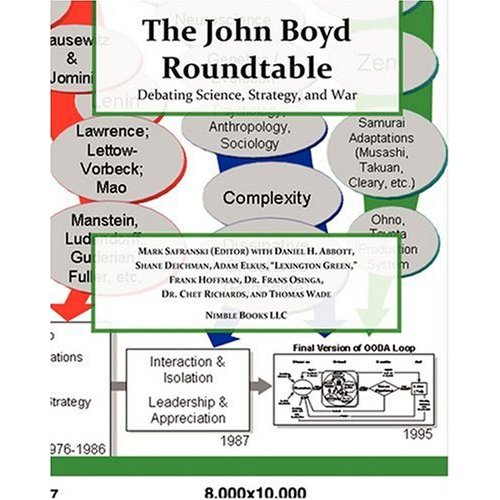
 I would like to say “thanks” to whomever is associated with the Royal Norwegian Navy that placed a bulk order for copies of The John Boyd Roundtable: Debating Science, Strategy, and War through The Norwegian Library House. Much appreciated!

Mr. President

January 20th, 2009

For the 44th time in the history of our Republic, a sacred oath has been taken and history steps forward.

I have not been a supporter of President Obama but today is a day on which he is to be congratulated and welcomed as the new chief executive and commander-in-chief. His supporters will celebrate, as they well should as it is their time. Hopefully, in tackling the many problems the nation faces, the President will opt for the long view rather than the expedient one. Hopefully, the Republican leadership will use their position as the opposition party wisely in a way that limits the worst excesses of one party government to the benefit of our nation.

Good luck Mr. President, you will need it.

UPDATE:

In office for two hours, the new administration has begun blogging ( Hat tip Dr. Jay Rosen):

Change has come to WhiteHouse.gov

Welcome to the new WhiteHouse.gov. I’m Macon Phillips, the Director of New Media for the White House and one of the people who will be contributing to the blog.

New Book on Hugo Chavez

January 19th, 2009

slide1.JPG

The Threat Closer to Home: Hugo Chavez and the War Against America by Douglas E. Schoen and Michael Rowan

I just received a review copy of The Threat Closer to Home courtesy of FSB Associates ( hat tip to Julie H. ) and the two authors have done some spadework on the “Bolivarian” regime of crypto-Communist, plebiscitary strongman, President Hugo Chavez. Dr. Schoen is a biographer and a longtime political and communication consultant to the Democratic Party as well as a former adviser to President Bill Clinton and is a member of the Board of Trustees for the International Crisis Group. Mr. Rowan is a a regular columnist for El Universal and Veneconomia of Venezuela and is also a political consultant for the Democratic Party and an array of overseas clients ranging from politicians to economic development programs. This is Rowan’s second book on Hugo Chavez and he is currently researching political economy issues in Latin America.

I have not read the book yet but thumbing through the pages I see numerous topics of interest, including Chavez support for FARC, alliance building with rogue states, ties to Hezbollah and known terrorists on the Treasury Department’s list of figures banned from conducting business within the United States. The authors have keyed into Chavez’s autarkic strategy of state managed commodity exports (oil) to both fund his regime and leverage foreign policy advantages – a historic  economic policy for aggressive, authoritarian, regimes. The book jacket carries blurbs by heavyweights in the foreign policy establishment including Congressmen Connie Mack ( R- Florida) and Ike Skelton (D-Missouri) as well as Richard Holbrooke and CFR’s Leslie Gelb.

I’m going to give this a close read and then perhaps try to schedule a short interview with Rowan and Schoen for Pajamas Media or another platform.

Recommended Reading ( and Viewing)

January 18th, 2009

Top Billing!: John HagelPareto Power and Leveraged Growth and Pareto Paring – Achieving Strategic Cost Reduction

The “Pareto Curve” of Italian economist Vilfredo Pareto is bettern known in the blogosphere as “The Long Tail” due to Chris Anderson of WIRED who wrote the recent bestseller The Long Tail, (Revised and Updated) and Nassim Nicolas Taleb‘s  The Black Swan: The Impact of the Highly Improbable which expounded on “Black Swan” events occuring on the “Extremistan” end of Pareto’s distribution curve.  The Pareto Curve has powerful applications, particularly well in a globalized, information economy, environment and John Hagel is, for me, always an educational read.

Scientific AmericanEvolution of the Mind: 4 Fallacies of Psychology and The Future of Man–How Will Evolution Change Humans?

“…Harpending and Hawks’s team estimated that over the past 10,000 years humans have evolved as much as 100 times faster than at any other time since the split of the earliest hominid from the ancestors of modern chimpanzees. The team attributed the quickening pace to the variety of environments humans moved into and the changes in living conditions brought about by agriculture and cities”

Lexington GreenClausewitz, On War, Book I: The Enduring Value of Clausewitz’s Articulation of the Nature of War

Also courtesy of Lex….

John Robb – Fewer Teachers more Automation

I want to tackle this post in detail later.

Fabius Maximus“Some people just want to see the world burn”

I agree with FM. Mr. Bowman does not understand the psychology of the warlord, or those who would sign up with them. From my view, the world contains no shortage of armed bohemians.

JosephfoucheThe First Rule of 5GW is, You Do Not Talk About 5GW

Heh. Dan of TDAXP meets his match in the smooth, original, Open Office, color graphics for war theory department.

SWJ BlogA Proposal for a Unifying Strategic Doctrine for National Security

A discussion starter.

The Claremont InstituteBennett and Cribb on Post-Racial Politics

There appears to be an interesting – though warily executed by both parties – reachng out going on between the conservative intellectual establishment and the incoming administration of Barack Obama. Sort of a political detente in progress for a possible strategic triangulation on issues where common ground can be discerned. 

John Seely Brown on “Creativity”:

That’s it !


Switch to our mobile site

