Dr. van Hulst was among more than 26,500 gentiles — 5,595 from the Netherlands — recognized by Yad Vashem for risking their lives to save Jews during the Holocaust.
A while back, I received a copy of Commander of the Faithful from friend of ZP, Major Jim Gant who had been impressed with the book and urged me to read it. My antilibrary pile of books is substantial and it took a while to work my way towards it. I knew a little about Algerian colonial history from reading about the French Third Republic, the Foreign Legion and counterinsurgency literature but the name of Abd el-Kader was obscure to me. The author, John W. Kiser, had also written a book on the martyred Monks of Tibhirine, a topic that had previouslycaught the eye of Charles Cameron and made a significant impression. Therefore, I settled in to read a biography of a long forgotten desert Arab chieftain.
What a marvelous book!
Kiser’s fast-moving tale is of a man who attempted to forge from unwieldy tribes and two unwilling empires, a new nation grounded in an enlightened Islam that transcended tribal customs ad corrupt legacies of Ottoman misrule while resisting encroachments of French imperial power. A Sufi maraboutwho was the son of a marabout, el Kader was the scholar who picked up the sword and whose call to jihad eschewed cruelty and held that piety and modernity were compatible aspirations for the feuding tribes of the Mahgreb. There are a number of themes or conflicts in Commander of the Faithful that will interest ZP readers;
el-Kader’s political effort to build a durable, modernizing, Islamic state and Mahgreb nation from feuding desert tribes and clans
Abd el-Kader struggled to unify disparate Arab tribes and subtribes through piety, generosity and coercion while integrating Turco-Arabs and Algerian Jews who had a place under the old Ottoman regime into his new order. Jews like the diplomat Judas Ben Duran and Christian French former military officers and priests became el-Kader’s trusted advisers and intermediaries alongside Arab chieftains and Sufi marabouts.
el-Kader the insurgent strategist and battlefield tactician
As a military leader, Abd el-Kader demonstrated both a natural talent for cavalry tactics as well as the organizational skill to build a small, but well-disciplined regular infantry with modern rifles on the European model. It is noteworthy, that while Abd el-Kader suffered the occasional reverse (the worst at the hands of a wily Arab warlord loyal to the French) the French generals fighting him all came to grudgingly respect his bravery, honor and skill. Never defeated, Abd el-Kader made peace with the French and surrendered voluntarily; all of his former enemies, Generals Lamoriciere, Damaus, Bugeaud and Changarnier interceded on al-Kader’s behalf to prod the French government to keep its promises to the Amir, who had become a celebrity POW in a series of French chateaus.
el-Kader the Islamic modernizer and moral figure
The 19th century was a time of intellectual ferment in the Islamic world from Morocco to British India with the prime question being the repeated failures of Islamic authorities in the face of European imperialism of the modern West. El-Kader found different answers than did the Deobandis of India, the Wahhabis of Arabia, the later Mahdists of the Sudan, the followers of al-Afghani or the Young Turks who began turning toward secularism. Educated in the Sufi tradition, el-Kader’s vision of Islam, while devout and at times strict, encompassed a benevolent tolerance and respect for “the People of the Book” and general humanitarianism far in advance of the times that is absent in modern jihadism.
It was Abd el-Kader, in retirement in Damascus, who rallied his men to protect thousands of Christians from being massacred in a bloody pogrom (the 1860 Riots) organized by the Ottoman governor, Ahmed Pasha, using as his instrument two local Druze warlords who were angry about their conflict with the Maronite Christians of Mount Lebanon and Sunni Arabs and Kurds enraged about the Ottoman reforms that had ended the dhimmi status of the Maronite Christians. It was the Emir who faced down and chastised a howling mob as bad Muslims and evildoers and by his actions thousands of lives were spared. Already honored for his chivalrous treatment of prisoners and his banning of customary decapitation as barbarous, the 1860 Riots cemented Abd El-Kader’s reputation for humanitarianism and made him an international figure known from the cornfields of Iowa to the canals of St. Petersburg.
Kiser, who it must be said keeps the story moving throughout, is at pains to emphasize the exemplary moral character of Abd el-Kader. As Emir, he “walked the walk” and understood the connection between his personal asceticism, probity and generosity to his enemies and the poor and his political authority as Emir. When some Arab tribes betrayed Abd El-Kader in a battle against the French, consequently they were deeply shamed and ended up begging the Emir to be allowed to return to his service. On the occasions when harsh punishments had to be dealt out, Abd el-Kader meted them not as examples of his cruelty to be feared but as examples of justice to deter unacceptable crimes that he would swiftly punish. This is operating at what the late strategist John Boyd called “the moral level of war”, allowing Abd el-Kader to attract the uncommitted, win over observers, rally his people and demoralize his opponents. Even in defeat, realizing the hopelessness of his position against the might of an industrializing great imperial power that was France. el-Kader retained the initiative, ending the war while he was still undefeated and on honorable terms.
In Commander of the Faithful, Kiser paints el-Kader in a romantic light, one that fits the mid 19th century when concepts of honor and chivalry still retained their currency on the battlefield and society, among the Europeans as much as the Emir’s doughty desert tribesmen (if there is any group that comes off poorly, it is the Turks, the dying Ottoman regime’s pashas and beys providing a corrupt and decadent contrast to el-Kader’s nascent Islamic state). The nobility of Abd el-Kader shines from Kiser’s text, both humble and heroic in a manner that rarely sees a 21st century analogue. It is both refreshing and at times, moving to read of men who could strive for the highest ethical standards while engaged in the hardest and most dangerous enterprise.
Shortly after Christmas 1831, an audacious rebellion broke out in Jamaica. Some 60,000 enslaved people went on strike. They burned the sugar cane in the fields and used their tools to smash up sugar mills. The rebels also showed remarkable discipline, imprisoning slave owners on their estates without physically harming them.
Tea:
The second just begs to be read alongside the first, especially if like so many Brits you like two cubes of sugar in your tea..
I saw a bumper sticker that said “Make tea, not war”, and what a wild ride they are in for when they learn literally any fact about tea.
The second leaves you hanging, yeah, needing to comb your memory for the back-story of tea.. which is why, in addition to the fact that I read it after I’d read the entry on sugar and the sugar riots, I have put it second here.
It requires mental work!
But then the first one — with the rebellious slaves treating their imprisoned previous slave-owners civilly..
May I find there an early precedent for the nonviolence of MLK and the civil rights movemnt — in Jamaica, 1831?
**
This is the sort of intellectual stimulation I live for!
Lattes for two, if you please. Do you take yours with Splenda?
[ by Charles Cameron — honoring the Civil Rights movement ]
.
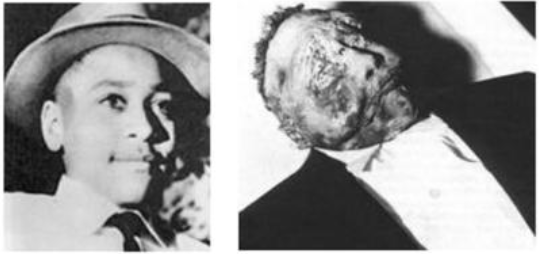
I’m truly sorry, but these two photos tell a mother’s tale — Emmett Till as his mother knew and loved him, and Emmett Till as she found him, when she ordered his coffin opened…
There’s a documentary now released — Hope and Fury: MLK, the Movement and the Media — which features Emmett Till‘s image as revealed in photographs taken when his coffin was opened, and exploring how that image radicalized Americas’s awareness of the lynching mentality, sending a shock wave amplifying the emergent Civil Rights movement.
America is remembering — and I as a Brit have two Emmett Tills to remember: Hugh Masekela, — and Medgar Evers.
**
Hugh Masekela:
Hugh Masekela, the great jazz trumpeter whom my own mentor, Fr Trevor Huddleston mentored and gifted:
**
Medgar Evers:
Medgar Evers, first, because Bob Dylan recorded Only a Pawn in their Game:
which acquainted me, forcibly, with Medgar Evers’ name — and next because I knew his son, Darrell, for a few years:
That’s a pretty extraordinary interview, and the video itself wound up on the Eyes on the Prize cutting room floor.
Darrell’s description of his father’s pooled blood — Darrell being an artist — was seared into my mind by association with the painter’s term crimson lake.. a private association, surely, but no less forceful for that.
**
In those two names, their holders themselves both now deceased, I honor the civil rights movement in the US — our equivalent in the UK was the anti-apartheid movement, of which Fr Trevor was for many years the president.
Miller appeared in an interview with Chris Matthews on the MSNBC show Hardball. After Miller expressed irritation at Matthews’ line of questioning, Matthews pressed Miller with the question, “Do you believe now – do you believe, Senator, truthfully, that John Kerry wants to defend the country with spitballs?” Miller angrily told Matthews to “get out of my face,” and declared, “I wish we lived in the day where you could challenge a person to a duel.”
GOLDBERG: And so we here in this dystopian situation where John Bolton, the last person in the world who should be anywhere near the national security bureaucracy. This President has – he has dubious legitimacy at best, he doesn`t have popular support in the country. And we are stumbling toward an apocalyptic war that will kill millions of people, turn America into a pariah and our way of life. There is almost no way to talk about what a dangerous spot we are in without sounding insane.
[..]
MATTHEWS: Where does that lead to? What does that lead to if Israel does that against an Islamic country?
CORN: Well, I would say one easy term is apocalypse. I mean, this is where they`re at.
I’m a pretty good poker player. We’re going to see how this plays out. We have a piece of litigation and we’re going to handle it diligently and surgically.
You don’t go and tell a wwitness who is possibly going to testify against you, Oh, well I’ll give you a pardon, don’t worry about it. You know, criminal lawyers, one of the first things any smart lawyer would do to any one of their ckients is to say, Don’t talk to any witnesses, don’t even say hello to them on the street, let alone something like offering up a pardon, a massive get out of jail free card
“He’s really not in a punch-back mode,” said one friend who has discussed the matter with the president in recent days and requested anonymity to be candid. “Everyone is telling him, look, you can’t win here, so just do nothing.”
counterpuncher, punch-back mode
**
Jay Sekulow?
he’s a really good shortstop who has been asked to pitch in the world series
Zenpundit is a blog dedicated to exploring the intersections of foreign policy, history, military theory, national security,strategic thinking, futurism, cognition and a number of other esoteric pursuits.