zenpundit.com » theory

Archive for the ‘theory’ Category

Round-up from The Clausewitz Roundtable

Tuesday, February 17th, 2009

Thought I would catch-up to the excellent work of my fellow participants at The Clausewitz Roundtable at Chicago BoyzFirst though, I’d like to say “thank you” to Ron Coleman for linking to my most recent post at the roundtable at Dean’s World and at his own blog, Likelihood of Success. Much appreciated!

The Roundtable continues….

Book III

Sam LilesClausewitz, On War Book 3: A consideration of cyber strategy

Matthew BortonClausewitz, On War, Book 3: The Shape of a Strategic Force.

seydlitz89 Carl von Clausewitz, Book III, General Comments

josephfoucheClausewitz, On War, Book III: Painting by Numbers

Shane DeichmanClausewitz, On War, Book III: The Substance of Strategy

Lexington GreenClausewitz, On War, Book III: Factors to Be Considered in Making and Executing Strategy

Cheryl RoferClausewitz, On War: Book 3: Boldness

Kotare Clausewitz, “On War”, Book 3: the Prussian as prophet

ZenpunditCarl von Clausewitz, On War, Book III: Calculation

Book IV.

Matthew Borton – Clausewitz Book IV: Still Relevant.

seydlitz89 – Carl von Clausewitz, On War, Book IV (and VI): Contingency  and Carl von Clausewitz: Book IV, Some Comments

Lexington GreenClausewitz, On War, Book IV: The Rise and Fall of Battle

Shane DeichmanClausewitz, On War, Book IV: Attrition Writ Large

KotareClausewitz, “On War”, Book 4: keep it simple stupid

Book V.

Shane Deichman – Clausewitz, On War, Book V: Jointness à la Carl

josephfouche Clausewitz, On War, Book V: Freedom is Worth the Mass

Lexington GreenClausewitz, Book V: Military Forces (Circa 1830)

Book VI.

Shane DeichmanClausewitz, On War, Book VI: The Best Defense is a Good Offense

Israel’s Half-Mad Genius of Mil-Theory

Saturday, February 14th, 2009

Just read this profile of Dr. (Gen.) Shimon Naveh, via Soob via Ubiwar.

….Naveh describes his last and perhaps most important military-academic project, OTRI, as a chronicle of failure. “It was a failure of the group and also my personal failure, but in a far deeper sense it was the IDF’s failure. The IDF has not recovered because it doesn’t have the ability, unless it undergoes a revolution.”Naveh, who established OTRI together with Brigadier General (res.) Dov Tamari, draws on imagery from the world of construction to explain the project. “We wanted to create an intermediate level between the master craftsman, the tiling artisan or the electrician, who is the equivalent of the battalion or brigade commander, and the entrepreneur or the strategist, the counterpart of the high commander, who wants to change the world, but lacks knowledge in construction.”Between the two levels, he continues, is the architect/commander-in-chief, whose role is “to enable the system to understand what the problem is, define it and interpret it through engineers.” In the absence of this link, he maintains, armies find themselves unable to implement their strategic planning by tactical means. “Entrepreneurs and master craftsmen cannot communicate,” he says.Already in his first book, “The Operational Art,” published in 2001 and based on his doctoral dissertation, he described the level of the military architect: “The intermediate level is the great invention of the Russians. [The military architects] occupy the middle, and make it possible for the other fields, from politics to the killers, to understand, plan and learn.”

An interesting and to me well constructed analogy by General Naveh that rings true to me from what I know of the Soviet history. Naveh perfectly describes the peculair adaptive requirements forced on the Red Army by the nature of the Soviet political system, especially as it existed under Stalin from the time of the Great Terror forward ( 1936 -1953). Stalin wiped out much of his senior military leadership of the Red Army during the Yezhovschina in 1937 and decimated the junior officer corps to boot, leaving it thoroughly demoralized and rigidly shackled to political comissars who were, like the military commanders, completely paralyzed with fear ( the Red Navy officer corps was basically exterminated en masse).

When Operation Barbarossa commenced in June, 1941, the dramatic Soviet collapse in the face of the Nazi onslaught was due in part to Stalin’s maniacal insistence that Germany was not going to attack and that assertions to the contrary were evidence of “wrecking” and “provocation” – crimes liable to get one immediately shot. Even a high ranking NKVD official, Dekanazov, whom Stalin made ambassador to Berlin, was personally threatened by Stalin for daring to warn the Soviet dictator about Hitler’s imminent attack.
That being said, Stalin quickly realized during the 1941 retreat that he had debilitated his own army by decapitating it and his own judgment as supreme warlord was no substitute at the front lines for what Naveh terms “operational art”. Stalin the entrepreneur-grand strategist needed competent military architects like Zhukov and Rossokovsky to plug the gap with the craftsmen and Stalin not only promoted and protected them, he tolerated their dissent from his own military judgment and sometimes yielded to their concerns. Very much unlike Hitler who could seldom abide criticism or deviation from his general officers or learn from them. Stalin improved as a war leader from interaction with his generals; Hitler did not and if anything grew worse over time – as did the Wehrmacht’s tactical-strategic disconnect.

The above anecdote represents the rich level of depth behind Naveh’s offhand and seemingly disjointed references. There’s a lot of meat there behind the dots Naveh is connecting but the uninitiated will have to be willing to dig deep. I’m cool toward Naveh’s reliance upon French postmodernism but I admire the breadth of his capability as a horizontal thinker and theorist. However, Naveh needs an “architect” of his own to translate for him and make his complex ideas more readily comprehensible to the mainstream. I will wager that few Majors or Lt. Colonels, be they U.S. Army, IDF or Russian, read much Focault these days.

ADDENDUM:

The SWJ had an interview with Dr. Naveh on his theory of Systematic Operational Design in 2007

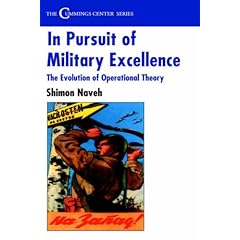
Dr. Naveh’s book is In Pursuit of Military Excellence: The Evolution of Operational Theory (Cummings Center Series)

Joint Force Quarterly (via Findarticle) -“Operational art

Jerusalem Post – “Column One: Halutz’s Stalinist moment

SWJ: My Interview with Tom Barnett

Thursday, February 5th, 2009

The Small Wars Journal has published an interview I conducted with Dr. Thomas Barnett regarding his new book Great Powers: America and the World After Bush.

Ten Questions with Thomas P.M. Barnett

…. 4. In Great Powers, you delve deeply into American history. What lessons did you find in our nation’s past that the diplomat overseas, the Army colonel in Afghanistan or the U.S. Aid worker in Africa should know to navigate their mission today?

This is all about frontier integration. Globalization is like America’s rapid and aggressive push Westward across the 19th century: a lot of the same bad actors and a lot of the same tools applied. So don’t be surprised when the Pinkertons show up, or when the covered wagons are attacked, or when the Injuns head to the Badlands for sanctuary. Thus, the goals of our frontline players are fairly straightforward: create the baseline security to allow the connectivity to grow. Focus on social trust and institutions as much as possible, but co-opt existing structures whenever and wherever you can. It doesn’t have to be perfect and it sure as hell doesn’t have to measure up to America’s mature standards. This is a frontier setting within globalization-treat it as such. The good news is, the settlers are already there, with more uncredentialed wealth than we realize (see Hernando DeSoto), if you respect their existing rule-sets and realize they will change only when the locals see the need themselves, so no instant rule-set packages applied by outsiders, please. Finally, acknowledge that with growing connectivity with the outside world, you will see more nationalism, more ethnic tensions, and more religious identity. These are all natural reactions, and not signs of your failure, so patience is the key.

Read the whole thing here.

Special thanks to Dave Dilegge for providing the forum and to Sean Meade and Lexington Green with editorial assistance and astute advice.

Hoffman -What is Irregular Warfare?

Sunday, February 1st, 2009

I saw this fantastic “ask the basic question” thread at SWJ this morning due to a comment by SWC member Ken White:

 Frank HoffmanAn IW “Bottle of Scotch” Challenge

I loved the paper by a team of guys trying to tackle a thorny issue – Irregular Warfare: Everything yet Nothing by Lieutenant Colonel (P) William Stevenson, Major Marshall Ecklund, Major Hun Soo Kim and Major Robert Billings.

In over a year of effort, and two separate meetings of OSD’s most senior officers; we failed to come up with a good solid definition for Irregular Warfare (IW). It’s like porn, we know IW when we see it. I do take exception to the unfounded statement made about historical research. The IW JOC (Irregular Warfare Joint Operating Concept) may not show it, but there is a lot of good history referenced by both the IW team and counterinsurgency guys, with lots of cross fertilization and common members. We may not have gotten it right, but it wasn’t due to a lack of intellectualism. I’ll be a bit blunter, people who live in glass houses, need to be careful where they throw their rocks. That said, I agree with the conclusion that we could use a better definition.

….All in all – the beginnings of a good debate. Yes, we need a definition better than what we have. Yes, concur with the point about populations (very COIN centric). But out of a dozen or so definitions that exist in the foreign literature, and the six or so developed by OSD, Army, Booze Allen etc, this is not an improvement. Sorry about that – so it’s back to the white board. I will put up a bottle of scotch to the best definition.

Great comments in this thread – read the whole thing here.

Irregular warfare historically coexists with conventional warfare to varying degrees whether we are discussing the Civil War, Vietnam War or even WWII where, for example, the Ukranian Nationalist partisans of Stepan Bandera could field reasonably large semi-regular units with light artillery or fight in classic guerilla syle. WWI is of course, famous for COIN patron saint Lawrence of Arabia’s campaign against the Ottoman Turks in his advisory capacity to the forces of the Sherif of Mecca and his allied Bedouin tribes of the Nejd.

The Hidden Networks of Twitter

Saturday, January 24th, 2009


I am sometimes asked ” What is the point of twitter?” by people who sign up and are bewildered by the flurry of seemingly disconnected “tweets”.  Even Dave Davison, a longtime investor in and enthusiast of media platforms has asked what is the “Return on Attention” with twitter ?

All social networking is not created equal. My usual answer based upon my own usage has been that twitter will make sense for you if you have an established network of people with whom you have a reason to be in frequent contact and a common set of interests. I have that on twitter with a sizable national security/mil/foreign policy/4GW/IC informal “twittersphere”. If you don’t have that kind of network at least in latent form when you sign up on twitter, its going to be very hard to build one from scratch by following strangers based on random tweets.

As it turns out, research has begun to validate my empirical observation. In social networking platforms there is your formal network but inside it is the real, “hidden” network with which you actually interact:

From Complexity Digest – “Social networks that matter: Twitter under the microscope” (PDF) by Bernardo A. Huberman, Daniel M. Romero and Fang Wu

“….This implies the existence of two different networks: a very dense one made up of followers and followees, and a sparser and simpler network of actual friends. The latter proves to be a more inuential network in driving Twitter usage since users with many actual friends tend to post more updates than users with few actual friends. On the other hand, users with many followers or followees post updates more infrequently than those with few followers or followees.”

What does this mean ? 

First, it means that if the IC or military or law enforcement are worried about terrorists or criminals using twitter or Facebook for nefarious purposes, the bad guys will not be able to conceal their cells amidst a large list of nominal “friends” because their manic activity stands out like neon lights against the passivity of the non-members of the network.

Secondly, I’m not certain if this research scales with “celebrity” figures on a platform with huge numbers of followers like Robert Scoble ( Scobleizer  50, 362) or the designer Guy Kawasaki ( guykawasaki  52, 506). These people are deep influencers well outside any realistic circle of actual friends and are followed in part because of their pre-existing status earned in other domains or media.

That said, it’s an interesting concept to think of social media networks having a surface and a hidden or inner network where the real action takes place and what causes transactional movement to occur between the two.

UPDATE:

A related post by Drew – Enabling the Power of Social Networks in the IC


Switch to our mobile site
