zenpundit.com » china

Archive for the ‘china’ Category

Rules of the Game(s)

Tuesday, December 18th, 2018

[ by Charles Cameron — a quick, deep (or high altitude) look into various ways to play ]
.

I learned quite a bit on a topic of huge interest to me — playing games — in short order over the last couple of hours.

To wit, from Pine Gap, the Aussie espionage series on Netflix, which is how I take my naps — Pine Gap (Netflix) s 1 e 4:

There are three ways to play any game:

A: Plan your moves so far in advance your opponent can’t predict them,

B: Make your opponent watch what you’re doing with one hand while your other is busy with your real game plan., or

C: Play your cards very, very close to your chest..

Sometimes all you can do is wait.. until your opponent makes the next move.

Another game rule, this one from MTP Daily (MSNBC) 12/18/2018, which obviously obviated the nap:

Whatever comes of this, both sides have got to save face.

.
And back to Pine Gap s1 e 5:

Good game ..
.
A loss is always a bad game.

**

That covers quite a decent bit of ground: strategies in competitive games; games of negotiation, quasi-competitive, quasi-collaborative; games as play, pretend-competitive, non-competitive, playful — “For when the One Great Scorer comes to mark against your name, He writes – not that you won or lost – but how you played the Game” — and game as victory or defeat, period.

**

Now, get this, with an associative geopol link below, from Pine Gap s1 e6:

We’re on the same side really, aren’t we? I mean, we all just want to be safe and happy, and our leaders want to be rich and powerful.

Sure, but there are differences, too. See, uh, Americans play Chess, right? Where the object of the game is to kill the other king. A fest attack, a total victory. But we play Go, where the object of the game is to gradually own the most territory, slowly acquire a .. a winning position, which is a completely different approach — to, uh, life, business — even relationships ..

Read that, which ties up many strands in the plot of Pine Gap, and also applies interestingly to events in the South China Sea: “to gradually own the most territory, slowly acquire a .. a winning position”.

It’s been a good afternoon for picking up game quotes.

**

And holy moly, there’s more:

It’s not about winning, Kath, it’s about maintaining dominance. [..]

We keep everybody in check. [..]

You played a good long game, Paul..

We both played a pretty good long game, mate. I’ll be watching to see how yours plays out.

And the coup de grace, quietly yet quite viciously delivered, wrt a divorce & who gets to keep the cat — with high irony:

Shake hands, well played. Moving on, that’s me. No thoughts of revenge whatsoever.

ICYMI, Geopol: South China Sea

Saturday, December 8th, 2018

[ by Charles Cameron — this caught my eye, not an area i often think about, but important, important ]
.

Commander Robert Brodie, U.S. Navy, Winning the Joint Fight

The most likely high-end fight in the near future would be the Peoples’ Republic of China (PRC) attempting to annex the South China Sea, coerce the nations in and around it into a dependent relationship, and push the boundary with the free world into the Pacific. This is in addition to the perpetual problem of North Korea invading South Korea. These scenarios present many opportunities for the Marine Corps to help the joint fight. It is time for the Corps to reestablish its expeditionary and amphibious assault capabilities. Expeditionary long-range artillery, antisurface and antiair teams could turn the tables on PRC antiaccess/area denial efforts by holding their man-made bases, ships, and aircraft at risk and imposing significant cost in a wartime scenario. The threat of an amphibious assault that would trap North Korean leaders and bring about regime collapse if the North invaded the South is as good a deterrent as any. While these skill sets have been traditional Marine Corps strong points, the collapse of the Soviet Union, the hope that prosperity would cure the PRC of communism, and the Global War on Terror have distracted the Corps from staying ahead of the requirements to fight and win high-end battles against forces that may locally outnumber us.

All is not lost. As a free people, the United States is better able to innovate, communicate, and fight jointly for the common good. In the case of the Marine Corps, everything it needs to threaten PRC land, sea, and air assets has been fielded and only needs to be organized, transported, supported, and integrated into the joint fight. The Marine Corps needs to take charge of the expeditionary fight, even if that means co-opting capabilities or units from other services and working with other countries. If it fails to take the lead, the Army’s Multi-Domain Task Force experiment[1] that envisions deployable long-range artillery, antiship, antiair, and space and cyber units as the building blocks of its capabilities will compete against the Marine Corps expeditionary role instead of complementing it.

Sunday surprise — mourning, a global view

Sunday, September 23rd, 2018

[ by Charles Cameron — starts with an anthro DoubleQuote inspired by this morning’s readings & a Steve Martin tweet — though in sensitive times it might be best not to chuckle, let alone guffaw, at strangers’ strange ways ]
.

One: The tearless eye of a NASA camera on the occasion of the Challenger blow-up:

One of our reporters, who happened to be at a distant nasa base at the time, tells us that afterward a television monitor for nasa’s own internal satellite service kept on its screen a view from a camera on the beach at Cape Canaveral which had been following the spacecraft’s ascent. Now that camera simply stared searchingly out over the blue-gray sea to where it met the blue-gray sky, like a sailor’s widow gazing endlessly at the horizon. Twenty-eight years into the space age, the sea is as much a symbol of eternity as the sky. Both have swallowed up the Challenger and its crew, leaving behind a double emptiness of sea and space.

Two: The professional Ghanaian substitute for tearless eyes:

Here’s an account in the news:

Ami Dokli is the leader of one of the several groups of professional mourners in Ghana. In a recent interview with BBC Africa, she said that some people cannot cry at their relatives’ funerals, so they rely on her and her team to do the wailing. Dokli and the other women in her team are all widows who, after their husbands died, decided to come together to help others give their loved-ones a proper send-off to the afterlife. But crying for strangers is not the easiest thing in the world, so professional mourners charge a fee for their services, the size of which is in direct relation to the size of the funeral. If it’s a big funeral, their tears cost more.

And here’s an American FB version of the ad Steve Martin’s tweet captured:

Do you want to boost your funeral? Hire me….the professional mourner to come and cry at the funeral. Below are the “Summer Special” prices:
.
1. Normal crying $50,
2. Bahamian hollering $100,
3. Crying and rolling on the ground $150,
4. Crying and threatening to jump into the grave $200,
5. Crying and actually jumping in the grave $1000

That’s my DoubleQuote for the day.

**

A clutch of videos:

Ghanaian Professional Wailing mourners:

Promotional — funerala with a white lady mourner, extra:

Ghanaian troupe of Dancing Pallbarers:

Chinese professional mourning performer:

N’Orleans Second Line:

A Modest Proposal

Wednesday, May 23rd, 2018

by J. Scott Shipman

Our Navy has not experienced war against a peer competitor since 1945. War at sea differs significantly from what our Marine Corps and Army brothers have learned over the last 17 years. Naval warfare is attrition warfare, for at sea there is no place to hide. To quote the late strategist Herbert Rosinski: “At sea there is no halfway house between victory and defeat, because there is no difference between what is needed for defense and what for attack. One side only can gain security at the cost of the other—or neither.”

The United States Navy doesn’t have enough submarines (or surface ships, for that matter). Our highly capable fleet of SSNs is the best in the world, but we’re retiring the old LOS ANGELES Class boats faster than we’re replacing them with the VIRGINIA Class. These new submarines are expensive (~$2.5B USD) and the high costs are translating into fewer platforms with the number of attack boats shrinking from 50 today to as low as 42 by 2030—with only about 25 projected to operate in the Pacific—while China is building both SSKs and SSNs at a pretty aggressive rate with up to 70 attack boats on the horizon.

Under current forces structure plans and budgets the USN cannot afford the number of platforms needed to meet existing security threat requirements. Given our top-heavy force of large multipurpose warships, most are too expensive to send in harm’s way—but that does not change the need for presence. As William Beasley wisely suggested in the November 2015 issue of Proceedings, the US Navy needs to “close the presence gap.” Beasley “steals” a line from former Naval War College Dean CAPT Barney Rubel and defines “presence” — “it means being there.” Costs are limiting our numbers, thus our presence. As marvelous as the VA Class is (and it is a true marvel), it can’t be in two places at once.

The USN attack submarine force is all nuclear. These ships are complex and take years to construct—and only two shipyards are currently certified to build them. If many predictions are correct, in a future great power war we cannot assume the sanctuary of CONUS and these shipyards would make irresistible targets.

Our ally Japan may hold a potential subsurface solution which could be an almost “turn-key” solution to the USN’s presence crisis and the growing threat of China. The Japanese Soryu class submarine (pictured above) is the most advanced conventional submarine in the world and the first to transition to ultra-quiet lithium batteries for submerged operations. Further, these boat could be built for at least half the price of a VA Class.

Japan faces a common adversary in China, though without a Pacific Ocean buffer. What if we made a deal with the Japanese government to license the Soryu class design? Further, as part of the deal, construct boats for their navy in our shipyards. We would gain needed numbers and our ally would gain an “extra” production yard. This seems a great way to reassure our allies, increase our subsurface numbers, and send a message to the world that our bonds as allies are deep and resolute. This line of thought is not unprecedented, as we are building the next generation of SSBN (the COLUMBIA Class) in collaboration with the UK.

Whatever the USN decides (and doing nothing is a decision), time is growing short for alternatives and more of the same isn’t affordable.

Sunday surprise — Li Bai and the Song of Songs

Sunday, March 11th, 2018

[ by Charles Cameron — it’s all about a scarlet thread and some corks in a current ]
.

I have plenty of idle time between naps, and was binge watching The Churchmen on Netflix. Plus it’s a Sunday..

**

As you know, I track “twins” in events and quotations, mainly for sheer aesthetic pleasure, but also partly as an analytic tool — believing as I do that “two is the first number” and often a leading-edge clue to pattern, meaning, significance.

I’m used to finding others who have noted these twins or “DoubleQuotes” as I call them — “DoubleQuotes in the Wild” — but I’m not sure I’ve ever run across a clear description of someone else noting them, let alone in a scholarly manner that bridges the secular west and spiritual east — but lookee here!

**

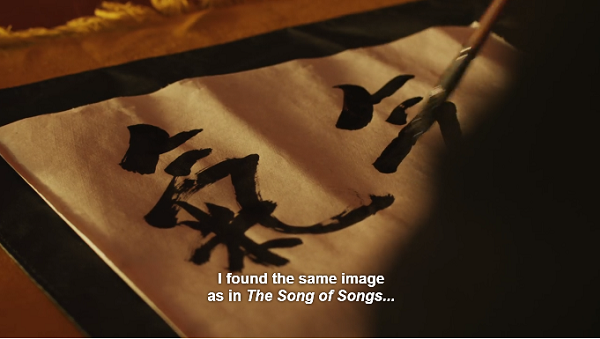
Amazing indeed! And what a line! Your lips are like a thread of scarlet! worthy of Li Po, worthy indeed of the Song of Songs!

I’d have been very chuffed if I’d run across the same doublet between Li Bai – better known to me as Li Po — and the Song of Songs — which, by the way, is Solomon’s.

**

Li Po, who, drunk and out in a shallow boat, saw the moon reflected in the Yellow River, leaned over to kiss it, and drowned..

Solomon — but you know the story — seated in judgement, ordered a child be cut in two when two women claimed to be its mother — then commanded it be given to the one whose shocked pure love begged him to deliver it to the other.. wisdom as the test of love!

**

The discoverer of the binary “Your lips are like a thread of scarlet!” is a brilliant, generous-hearted, flawed founder and leader of a seminary in France who displeases ambitious Vaticanisti, is offered a choice of disgrace (on account off his flaws) or (as an “out”) a posting to an obscure but copacetic position in Shanghai..

A conversation ensues, in which he discusses his options with the nun who serves as his assistant:

The nun ancourages him to consider the Shanghai option..

That option has a certain seductive charm — following that scarlet thread.. but it represents being “bought off” rather than sticking by one’s guns come what may, and somehow weathering the consequences.

**

Our nun reflects:

And that’s an interesting idea.

At first glace it seems fatalistic — but that current moving the corks — the seminarians, the nun herself, the priest she serves, an ambitious president of the Franch bishops, various monsignori and a pope – maybe Christ, too? — has its own flows and undertows — a priest’s flaws included. It’s a complex system.

The corks are afloat in a complex system. A scarlet thread traces its curve in the complex system, from contemporary France to eighth- century China.

**

And when you’re afloat in a complex system — as we all are — “go with the flow” may be sound advice. That’s why the “corks in a current” idea seems so interesting to me. Sunday surprise!


Switch to our mobile site