Two years ago, Dr. Chet Richards released Neither Shall the Sword: Conflict in the Years Ahead , a radical treatise on global trends toward the privatization of military capabilities and the erosion of the efficacy of state armed forces. If We Can Keep It: A National Security Manifesto for the Next Administration
 is not a sequel to Neither Shall the Sword but rather a logical extension of that
 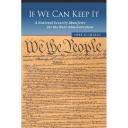 book’s premises upon which Richards builds a stinging critique of American grand strategy and a profligate United States government that Richards argues wins enemies and alienates allies while squandering hundreds of billions of dollars on weapons systems of dubious usefulness against what genuine threats to our security still exist. It is a provocative thesis that leaves few of the Defense Department’s sacred cows grazing unmolested.
Dr. Richards has a trademark style as a writer: economical clarity of thought. One can agree or disagree with his analysis or dispute his normative preferences but within his parameters, Chet will give his audience an argument that is internally consistent and logically sound, without much in the way of redundancy or wasted words. As a result, If We Can Keep It is about as lean a book as Richards would like the U.S. military to be while giving the reader no shortage of things to think about as he hammers away at conventional wisdom regarding defense policy, national security and the war on terror.
A number of intellectual influences resonate within If We Can Keep It. Unsurprisingly, given Richards’ history as a military thinker, these include the ideas of Colonel John Boyd, Martin van Creveld, Thomas X. Hammes and 4GW Theory advocated by William Lind. Also present as a strategic subtext is Sun Tzu along with elements of Eastern philosophy and the recent work of British military strategist General Sir Rupert Smith, whose book, The Utility of Force , shares a similar title with one of Richards’ chapters. Finally, Richards is channeling, in his call for a grand strategy of Shi and for America to focus on ” being the best United States that we can be “, a very traditional strand of foreign policy in American history. One that diplomatic historian Walter McDougall has termed “Promised Land” but which may be most accurately described as “Pre-Wilsonian“; not “Isolationist” in the mold of the 1930’s but rather a hardheaded realism with very skeptical view of the efficacy of military intervention beyond purely punitive expeditions against violent ideological networks like al Qaida.
In enunciating this case, Richards argues that the “war on terror” conducted since 9/11 by the Bush administration does not qualify as a “war” and that “terrorists” is an empty label slapped on to many types of problems, most of which are best handled by law enforcement and intelligence agencies ( Richards recommends giving the IC the lead and budget for fighting al Qaida, not the DoD); the “war” model is costly in terms of treasure and civil liberty without yielding positive strategic results; While COIN is ” a piece of the puzzle” for fighting “true insurgencies” it is not a strategic magic bullet and COIN is historically ineffectual against “wars of national liberation”; that given the lack of serious external threats from foreign states or justification to intervene abroad militarily in most instances (aside from raids and strikes against violent non-state networks) the American defense establishment can be drastically scaled back to roughly $ 150 billion a year to support a superempowered US Marine Corps with Special Forces and tactical Air power.
(Dr. Richard’s last bit should be enough to kill off most of America’s general officer corps from heart attacks and take a fair number of the House of Representatives with them)
Chet Richards makes a strong argument for the declining utility of military force and the consequent budgetary implications before calling for a radical shift in American foreign and strategic policy. Much of his criticism of the strategic status quo is praiseworthy, bold, incisive and insightful and could serve as the basis for commonsense discussion of possible reforms. However, Richards’ argument can also be contested; in part from what Richards has said in If We Can Keep It, which will mostly attract the attention from specialists in military affairs, but most importantly from what has been left unsaid. It is the consequences of the latter with which the public and politicians must seriously consider in entertaining the recommendations of Dr. Richards.
In terms of what was “said”, I am dissatisfied with the sections dealing with the differentiation between “true insurgencies” and “wars of national liberation which suffers from some degree of contextual ahistoricality. For example, the Malayan Emergency ( which is listed in tables IV and V as being in both categories) has a result of ” UK declares victory and leaves”. True enough, but in the process of doing so, an ethnic Chinese Communist insurgency with ties to Beijing was crushed and the population reconciled to a legitimate, pro-Western state. That’s a victory, not a declaration. Communist Vietnam may have ” withdrawn” from Cambodia but their puppet ruler, the ex-Khmer Rouge Hun Sen, is still Prime Minister today. That’s a victory, even if Hun Sen’s power has been trimmed back somewhat by a UN brokered parliamentary-constitutional monarchy system. The case of the Portuguese colonies of Angola and Mozambique have as much to do with the utter collapse of the decrepit, semi-fascist, Salazar regime in Lisbon a brief Communist coup as the military prowess of the insurgencies.
Reaching for a dogmatic rule, which the 4GW school is currently doing with “foreign COIN is doomed”, is an error because the more heterodox and fractured the military situation in a country happens to be, the more relative the concepts of “foreigner” and “legitimacy” are going to become to the locals. Rather than binary state vs. insurgents scenarios, historical case studies in military complexity like China 1911-1949, the Spanish Civil War, South Vietnam 1949 -1962, Lebanon 1980’s, West Afrca 1990’s and Iraq, Afghanistan, Colombia and Central Africa the 2000’s should be pursued to better understand 4GW and COIN dynamics.
In terms of what has been left “unsaid” in If We Can Keep It, would be the downstream global implications of a radical shift in America’s strategic posture. Richards is no isolationist but his smoothly laconic style belies the magnitude of proposals which entail a top to bottom reevaluation of all of the alliances and military relationships maintained by the United States ( itself not a bad thing) – most likely with the result of terminating most and renegotiating the rest. The extent to which American securrity guarantees originating in the aftermath of WWII, have interdependently facilitated peaceful economic liberalization and integration is a factor ignored in If We Can Keep It and frankly, I’m not sure how we can abruptly or unilaterally exit our security role in the short term without creating a riptide in the global economy.
If We Can Keep It is a fascinating and thought-provoking book as well as an absolutely brutal critique of the numerous shortcomings and strategic mismatches we suffer from as a result of ponderous, Cold War era, legacy bureaucracies and weapons systems and ill-considered foreign interventions. It is also, a pleasure to read. I highly recommend it to any serious student of defense policy, military strategy or foreign affairs.
ADDENDUM – Other Reviews of If We Can Keep It:
William Lind
TDAXP
Like Mark Twain’s “death” in 1897 (he died in 1910), reports of AFRICOM’s demise may be exaggerated. Concerns that AFRICOM hasn’t been thought out or is unnecessary aren’t supported by the actions and statements of those charged with building this entity. However, based on the poor marketing of AFRICOM, these concerns are not surprising.

 ficial state once built upon the polyglot ruins of European empires and Muslim sultanates. This particular geographic node, Kosovo, has a quality that all of it’s larger forerunners lacked – the cultural unity of identity that will make the nation the primary loyalty of the overwhelming majority of it’s citizens. A fact on the ground that trumps diplomatic protests over the finer points of international law or the mythic appeal of seven hundred year old Lost Causes.
 lengthy, grand historical ( and overly deterministic) narrative of relative American decline and a coming age of superstate multipolarity with a critical “swing vote” being held by New Core/Seam states like Russia and Brazil.

