zenpundit.com » islamist

Archive for the ‘islamist’ Category

Bomb Syria?

Thursday, August 29th, 2013


[by Mark Safranski a.k.a. “zen“]

There is much ado about a prospective Western (i.e. American) aerial campaign to bomb the Iranian allied Alawite-Baathist dictatorship Syria over use of chemical weapons against primarily al Qaida allied Sunni Islamist extremist rebels.

To what end or how that end will be brought about by a surgical use of American air power, aided by token French and British contributions, well, no one is quite sure.

The driving insider force behind this astrategic call to arms are Susan Rice, Samantha Power and Anne-Marie Slaughter, the three Furies of R2P.  Slaughter writes on military intervention in Syria with her usual combination of moral certainty and operational magical thinking here. Rice angrily pontificates here while an unusually muted UN Ambassador Samantha Power just tweeted about it while on vacation from the emergency UN Security Council meeting on, uh, Syria.

The strategic argument about Syria is not about the normative qualities of the Assad regime, which is anti-American, brutal, terrorist supporting and fascistic. Or that the regime is committing atrocities. It is. It is about what political objective, if any, the use of military force against Syria can accomplish at what cost and with what probable outcomes. At a grand strategic level, there are also questions about how military intervention in Syria will impact great power relations and the shaping of international law.

I suspect many R2P advocates like Slaughter, Rice and Power are attracted to the idea of bombing Syria partly to garner a precedent to support doing similar things in the future, whether or not it has any positive effect on the Syrian civil war. That however, if true, is an extremely poor reason for military intervention anywhere. If bombing had some hope of changing the behavior of the Syrian regime or replacing it with something better, I would warm to the prospect but where is the evidence that is a likely outcome? Consider:

The Syrian rebels include armed groups as violent, lawless and squalid as the Assad regime. You know, the Beheading community of the third jihad international, with fringe support from the occasional cannibal commandos. If these Islamist lunatics come to power in Damascus they will cheerfully engage in ghastly pogroms of mass murder and torture that will make Assad’s goons look like the British Raj at tea time.

The Assad regime and the Alawite minority from whence it originates have their backs to the wall in a conflict that determines if they continue to rule Syria or are exterminated. Having no margin for maneuver or concession, America bombing them is irrelevant to whether in their calculus they can stop fighting their local enemies. The whole point of combining the threat of force with diplomacy – allegedly the reason given for bombing Syria – is to be able to make Assad an offer that he can’t refuse and not a threat that the Alawites can’t accept. Then, while blustering loudly and ominously we undercut our own bellicose posturing and announce that regime change was off the table. WTF?  Really?

The President should fire this unholy crew of incompetents and intellectual poseurs and hire some real foreign policy advisers with at least an undergraduate level grasp of how diplomacy, strategy and war have worked for the past 2000 years.

Failing that, a few poker players who can bluff without showing the entire table their cards.

Blip: algo’s got rhythm at last!

Tuesday, August 27th, 2013

[ by Charles Cameron — a qualit with little time for quants making another graceful retraction ]
.

I haven’t been too convinced that algorithms were good at understanding my interests — remember that ad for “bold” Christian shirts (and babe) some fool code placed on Islamic Awakening — a site I was visiting to read up on Awlaqi?

Well, those algos are improving… Here’s what YouTube thinks I might want to listen to next, hot from the digital presses…

**

Turing Test: check!

I’d say YouTube’s algorithm has finally figured out — at least momentarily — the basics of who I am.

On understanding Hijra

Friday, August 16th, 2013

[ by Charles Cameron — the lure of exile, of hijra, in the context of western jihadists going abroad ]
.

Whereas the Prophet’s first visionary reception of the Quran dates to 609-610 CE, and the Prophet himself was born some 40 years earlier, the Islamic reckoning of time (AH, Anno Hegirae) begins with his hijra or migration from Mecca, his home, to Medina — an event of huge Islamic consequence, with echoes in our own times.

One of the questions I have been pondering recently has to do with those echoes. I have been asking myself how strong a part in the decisions of westerners to migrate to Syria and elsewhere to participate in jihad might be played by the concept of hijra — either in the minds of recruits, or in the rhetoric of recruiters.

When I came across the quote from Czeslaw Milosz (above, upper panel), I recognized that I had stumbled upon the expression of a secular equivalent of that yearning — and thus perhaps an opening into our own deeper understanding of hijra (lower panel) — a sacralization and hence an intensification of the same yearning.

**

It is therefore instructive to note conversely that Thomas Hegghammer, in his paper Should I Stay or Should I Go? Explaining Variation in Western Jihadists’ Choice between Domestic and Foreign Fighting, p 7, quotes Anwar al-Awlaki as advising a correspondent:

[Hearing] that you intend on making hijrah [emigration], I immediately wanted to contact you to tell you that my advice to you was to remainin your current position.

Here, strategic rationalism attempts to prevail over romantic yearning…

**

Sources:

  • Czeslaw Milosz, On Exile, quoted in Paris Review
  • Al-Shabab video: The Path to Paradise: from the Twin Cities to the Land of the Two Migrations, at 08.23-08.36
  • Redux: I’d like to game an idea entering a mind

    Tuesday, July 9th, 2013

    [ by Charles Cameron — another angle on the whole idea of qualitative node-&-edge graphs for concept mapping ]
    .

    Image of a virus letting its DNA loose in a cell, from the Bjork app-game-song

    The other day I found myself re-reading a comment I’d made on Zen’s post The Games People Play back in January 2008, which I’d been searching for in the back of my mind for months — too attic-like and cobwebbed, probably not the best place to look for it. In any case, now I’ve found it I’ve dusted it off and offer it here for your consideration:

    **

    Ideas can be infectious.  We know this, and thus we can explore the spread of ideas using models drawn from epidemiology, an approach which Malcolm Gladwell takes in his book Tipping Point. Ideas can also be viewed as existing in an ecosystem, and thus what we know of genetics can be applied to them, as Dawkins suggested in coining the term "meme". Having said that, I’d still like to game an idea entering a mind.

    Specifically, I would like to game the way in which the idea that constitutes "martyrdom" (shahada) in an al-Qaida mind enters a mind that’s primed with the ideas of Tablighi Jamaat, for instance, and once it’s "in," conforms the idea of "obligation" (fard) that’s already present in TJ’s non-violent and apolitical version into the al-Q sense of the word — that "to kill the Americans and their allies — civilians and military — is an individual duty (fard ‘ayn) for every Muslim who can do it in any country in which it is possible to do it"… I’m thinking of something along the lines of the kind of research that allows someone to write, describing the John Cunningham virus (JCV):

    the JC virus enters the central nervous system by fastening itself to the 5HT2AR receptor for serotonin, which is found on the surface of glial cells.  When this receptor for serotonin is triggered, it opens the pathway that allows the virus to enter the cell.

    The thing is, we can manage a very brief verbal sketch of how an idea enters a mind and becomes part of a person’s "thinking" — and we can model in some detail the way that an idea spreads through a population — but we’re not very good at modeling, or gaming, thought processes.  And from my POV, that’s the most fascinating challenge of all.

    My question is: what kind of game should this be, how do we set up the board, what markers shall we have for ideas or parts of ideas and for views or congregations of ideas, what rules do we need to use in combining them, etc — how do we get as close to a mental conversation as humanly possible?

    I happen to think that meditators will have quite a bit to teach us here, that the Tibetans may have a better vantage point than we as a culture do… because they’ve been watching the mind, and in particular watching its various coiled springs uncoil, and putting the process into words, for longer than we have. But it will take a whole new series of aha!s to really figure this out.

    **

    The result wouldn’t look like the image at the top of this post — it might look more like a PERT chart, but with sequences of ideas rather than actions. And it would be based on narratives, not theories. Above all, it would be multi-voiced, polyphonic, fluid — like that diagram from Edward Tufte about the Ocean of Stories:

    That’s it — what say you all?

    The Bjork Virus video can be found here, the Virus app-game-song can apparently be downloaded here.

    Mostly it’s religion, now and then it’s sports

    Sunday, July 7th, 2013

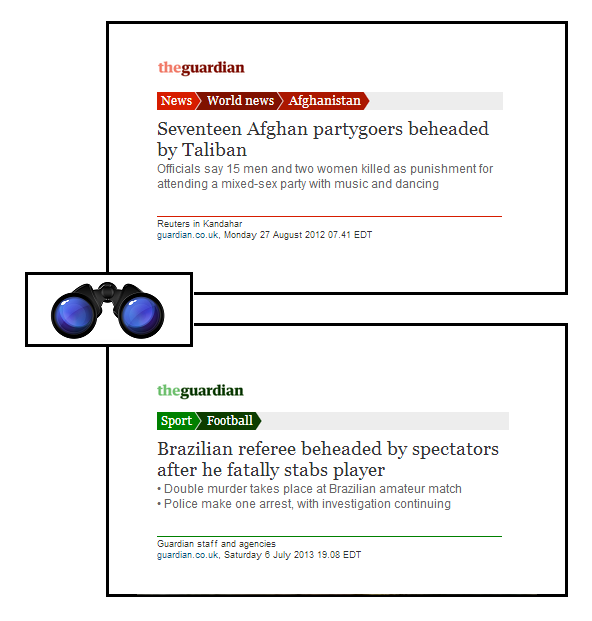
    [ by Charles Cameron — beheadings and the questions they raise ]
    .

    **

    Tim Furnish, friend of this blog, had a piece titled Beheading in the Name of Islam in the Middle East Quarterly back in 2005, in which he wrote:

    The February 2002 decapitation of Wall Street Journal reporter Daniel Pearl, true to its intention, horrified the Western audience. Chechen rebels, egged on by Islamist benefactors, had adopted the practice four years earlier, but the absence of widely broadcast videos limited the psychological impact of hostage decapitation. The Pearl murder and video catalyzed the resurgence of this historical Islamic practice. In Iraq, terrorists filmed the beheadings of Americans Nicholas Berg, Jack Hensley, and Eugene Armstrong. Other victims include Turks, an Egyptian, a Korean, Bulgarians, a British businessman, and a Nepalese. Scores of Iraqis, both Kurds and Arabs, have also fallen victim to Islamist terrorists’ knives. The new fad in terrorist brutality has extended to Saudi Arabia where Islamist terrorists murdered American businessman Paul Johnson, whose head was later discovered in a freezer in an Al-Qaeda hideout.

    For myself, convinced as I am that perceived, preached or proclaimed divine endorsement for such killings plays a major role in facilitating them, the existence of what are overtly at least non-religious examples of the same brutal behavior are valuable, albeit humanly distressing, for the questions they raise:

  • is the brutal behavior in question a bestial aspect of human nature in general, and religion merely a thin veneer with which it sometimes conveniently clothes itself?
  • or are sports in some way alternative modalities of group transcendence — and thus effectively religious in their essence?
  • **

    Bryan Alexander, another friend, comments today on a related story at his gothic-themed blog, Infocult, under the heading When sports fans attack, Russian remix.

    DoubleQuote Sources:

  • Seventeen Afghan partygoers beheaded
  • Brazilian referee beheaded

  • Switch to our mobile site