zenpundit.com » philosophy

Archive for the ‘philosophy’ Category

Serpent logics: a ramble

Sunday, November 24th, 2013

[ by Charles Cameron — continuing my exploration of a pattern language of thoughts, both verbal and imagistic ]
.

One of my favorite patterns derives from the nesting of Russian dolls inside Russian dolls, so it’s only appropriate to start with an example of what I can only call.. Matrioshka shipping!

**

It’s my habit, as you may have seen, to collect certain “ways of thinking” in the miniature format provided by my Twitterstream. Whether you think of them as logical forms, patterns in a pattern language, or amuse-bouches for the mind, they are here to delight and instruct — and when you pile a whole lot of them up together, they can make you just a touch dizzy.

Today I’ll be bringing my collection up to date with two posts, Serpent logics: a ramble, and Serpent logics: the marathon. If you want a quick look at some of the neat patterns I’ve seen since I last posted on these topics, this post — Serpent logics: a ramble — is the one for you. If, after reading it, you want a gruelling, hilarious, insightful, insane, devious, extended course in this kind of pattern recognition — try Serpent logics: the marathon.

**

Here’s one from today, tweeted as I was prepping this post — in a category I’ll simply call…

Counter-intuitive?

Admit it, that’s just a trifle mind-blowing, no? C’mon!

**

Serpent Bites Tail:

Here’s a light-and-dark-hearted example of the ourobouros or serpent-bites-tail recursive patterm, with a hat tip to Allan Stairs:

Follow Kim Kierkegaardashian (@KimKierkegaard) on Twitter if you like mashups between the deepest of theologians and the shallowest of celebrities…

**

I have no idea what category this one belongs in, so I’ll slip it in here. It’s from the Electronic Frontier Foundation, protecting our digital private parts:

Oh my! A Clash of Classifications!

The EFF even has it’s own playful-serious version of the NSA logo —

— as the DoubleQuote above — juxtaposing how the Agency views itself with how the EFF sees it — illustrates…

**

DoubleQuotes in the Wild

DoubleQuotes in the Wild is my on-going collection of paired juxtapositions that say more together than they do apart. It’s a beginning training in what F Scott Fitzgerald claimed was the “test of a first-rate intelligence” — “the ability to hold two opposed ideas in mind at the same time and still retain the ability to function”.

The example above comes from Parecidos Razonables, a blog that takes off from the Separated at Birth concept and specializes in double-takes of this sort, often satirical. One of their more celebrated examples:

I’d have juxtaposed Vladimir Putin with Daniel Craig as James Bond myself, but that idea has already been taken — a Bond fan apparently photoshopped Putin’s face onto a poster of Bond in Casino Royale, and then “plastered” Moscow with his handiwork.

Apparently the Apparat, like Queen Victoria, was not amused. I’d have been flattered…

**

While we’re on the subject of President Putin, here’s another category to consider…

Mixed games:

The op eds by Presidents Putin and Rouhani to which Soufan refers are Putin’s A Plea for Caution From Russia and Rouhani’s Why Iran seeks constructive engagement.

Ali Soufan, the author of Black Banners, is always worth paying attention to — and his tweet, above, clearly belongs with that Alasdair MacIntyre quote I’m so fond of [1, 2]:

Not one game is being played, but several, and, if the game metaphor may be stretched further, the problem about real life is that moving one’s knight to QB3 may always be replied to by a lob over the net

**

Let’s close with some examples from the arts, the first with just a touch of Tibetan Buddhist flavor…

One of mine:


For further details, see Death and hallucination color new work by Chinese artist Zhang Huan after life-altering Tibet trip.

And the second, a pair of images — each in itself a sort of DoubleQuote in the Wild comparing the forms of birds and mechanical objects in a single photo — posted together today by Wm. Benzon under the title Conjunctions:

Birds and cranes, New Jersey and Lower Manhattan.

IMGP3517rd - Five ducks and freedom tower

Birds and cranes, Brooklyn and Governors Island.

birds of a feather.jpg

Magnificent — what a generous eye he has — many thanks, good Sir!

**

Patterns? You might think of them as Jungian archetypes, Platonic ideas, Hofstadterian analogies — or Ayat, the same word used to describe the verses of the Qur’an, signs in the calligraphy of God:

Qur’an 41 (Fussilat), 53

We shall show them Our signs in the horizons and in themselves

**

And now, consider your options. Have you had enough of these damn patterns of mine — or would you like to try out for the marathon version?
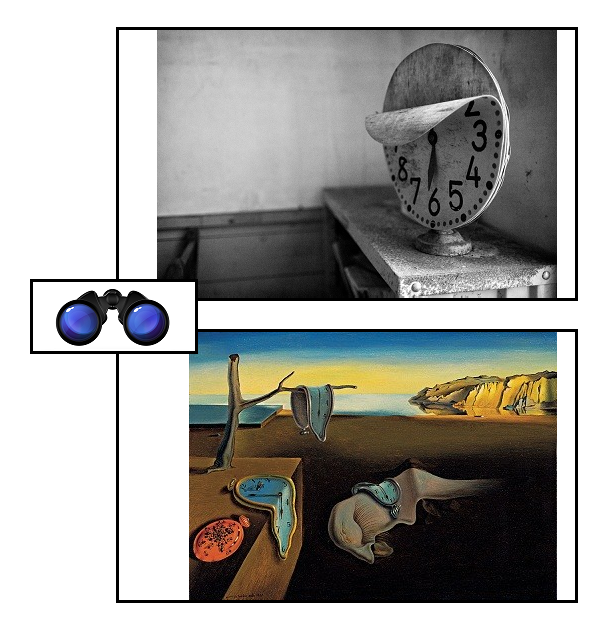
Sunday surprise 9: surreal art imitates real life?

Sunday, October 20th, 2013

[ by Charles Cameron — my semi-official idiocy to cap the week ]
.

Here, surreal art imitates real life — ahead of time, and or much later.

**

Sources:

  • Tokyo Times, An abandoned and atmospheric Japanese school in the mountains
  • Salvador Dali, The Persistence of Memory

  • A tip of the hat to Bryan Alexander of Infcult
  • **

    Footnote:

    Time itself is a curious business, and the question of its “reality” comes up from time to time. Physicist Sean Carroll talked about it a while back on the pompously named Closer to Truth series, and makes some interesting points. I have to say, though, that I wasn’t overwhelmed — Carroll may be the equivalent of Hawking when it comes to physics, but the equivalent of Wittgenstein when it comes to philosophy he has yet to prove himself.

    But then of course we have never seen Wittgenstein talking off the cuff on YouTube: my sense is that this was a wise decision on his part — although many of the slips of paper on which he typed the aphorisms that go to make up his Zettel might well have been Tweeted, give or take a century.

    Twitter’s immense fan-base does include thousands — and likely hundreds of thousands — of folks who would follow a Witty Wittgenstein twitter-feed among it’s half-billion (2012 estimate) users if wittgenstein were alive and tweeting… Indeed, the entirely posthumous Wittgenstein Tweets feed has more than 4,000 followers, and you might care to join them — although the quotes in the tweets are more than 60 years old at time of tweeting. My own preference for a philosophical feed, btw, runs to Kim Kierkegaardashian.

    But it’s Sunday, we were talking surrealism, and I digress.

    Echevarria and the Irrational in Strategy

    Tuesday, September 17th, 2013

    Adam Elkus alerted me to an insightful op-ed by Dr. Antulio Echevarria of SSI:

    Op-Ed: Is Strategy Really A Lost Art?

    …. Instead, we need to rediscover the value of strategizing relative to the outcome, the product, an individual strategy. The hard truth is that policy does not always need strategy to get what it wants. We have used military force plenty of times in our history without the guiding logic of strategy, and—though critics do not like to admit it—we have made it work often enough for it to be taken seriously. Sometimes what policy wants most is not to be tied to something inflexible, particularly something as inflexible as our strategic process. It is the proverbial machine that goes of itself, and it takes, or almost does, the preparation for and direction of war out of policy’s hands. The question modern-day Clausewitzians really have to answer is whether war has its own logic after all, a logic provided by the dictates, the processes, and the dynamics of making strategy.

          In all the online debates and blog sites concerning strategy, one theme is constant: we call strategy an art, but approach it as a science. We praise creative thinking, but assess our strategies with formulae: strategy = ends + ways + means (the ends we want to achieve + the ways or concepts + the availablemeans). This formula is as recognizable to modern strategists as Einstein’s equation E=mcis to physicists. Each defines its respective field. Like all good math, good strategies consist of balanced equations. As our variables change, we merely rebalance our strategy: scale down the ends, increase the means, or introduce new ways. Like any good equation, our strategy remains valid so long as we keep one half equal to the other. This is a far cry from when military strategy meant the “art of the general” and, by extension, grand strategy meant the “art of the head of state.”

    .    If the art of strategy is truly lost, perhaps it is because—despite our rhetoric to the contrary—we really wanted it to be a science all along.

    Several comments….
    .
    First, Echevarria is correct that it is certainly possible to win ugly, win lucky, win through the other side imploding for internal reasons that have nothing to do with us or to win by unimaginatively, but steadily bludgeoning a much weaker opponent to death while employing a bad strategy or no strategy at all. Finland’s Marshal Mannerheim, for example, repeatedly humiliated Stalin’s immensely larger but poorly led Red Army in the Winter War but the end was never in doubt if Stalin chose to press the issue.  An effective strategy and a Red Army officer corps that were more than lackeys and thoroughly terrorized purge survivors would have markedly improved the USSR’s abysmal military performance, but it would not have changed the longitudinal equation that Stalin had thousands of tanks and planes and potentially millions of soldiers and the Finns did not. The asymmetry between the Soviet Union and Finland was too great; Mannerheim played a weak hand with great skill against an enemy leader whose basic foreign policy outlook was opportunistic yet risk averse ( as Stalin understood the situation at least. He was also a great miscalculator).
    .
    When  however that Echevarria writes “Sometimes what policy wants most is not to be tied to something inflexible” he is certainly correct, but the real crux is that it is politicians who want and policy that bends to their desires. Flexibility can be a virtue when a situation is new, has not yet risen to open hostilities or a hedge is required against many dangers. Raised to systemic practice, “flexibility” -meaning a conscious avoidance of the “strategic process – really means that we have embraced an astrategic culture and accepted not just greater political behavior, but elevated the minutia of domestic politics and cynical careerism to displace strategy as the primary calculus for making decisions of war with unsurprisingly poor results.
    .
    Lastly, I see merit in Echevarria’s criticism of the tendency to view strategy in algebraic or scientific terms. He’s right that this is an arid reification of strategy from which all chance, passion, genius, stratagems, deception, novelty and coup d’oeil have evaporated. Sometimes, the Czarina dies, the unsinkable ship sinks,  the “rules” get broken and certain victory turns into utter defeat because leaders, with the intuitive mind that Einstein called ” a sacred gift”, seize the moment and do what should have been by rational calculation, impossible. We fail to look for such qualities in ourselves or allow room for their expression and worse, fail to discern them in the enemy.
    .
    Strategy is rational, but people doing strategy and the circumstances in which strategy is done often are not.

    Serpent logic and related

    Saturday, September 14th, 2013

    [ by Charles Cameron — where paradox begets form in phrasing, redux ]
    .

    Here for your entertainment and entrainment are some further instances where the tweet doubles back on itself, bites its tail, or otherwise embodies some form of “form” that’s noteworthy in its own right, and possibly indicative of the heart of a problem — think of these tweets as eddies in the flow of things, knots in the wood…

    Two arms crossed as in that MC Escher hand-draws-hand piece:

    And a net version of the same, aka “tit for tat”:

    Speaking of economics, here’s a bit of spiral logic — the economics of spiralling out of control?

    And here’s an example of “endless” recursion, as featured in two tweets about “end” times from Barth’s Notes:

    and its 2013 equivalent:

    **

    Okay, here are some simple sample opposites. First, the weather forecast for Syria:

    — spelled our explicitly by Andrew Stroehlein, who tweeted “Sunny with a chance of cluster bombs…” in response.

    That one seems fairly fair, but click on the links yourself to see the nuances in King‘s actual statements.

    **

    Now for some regular serpents’ tails, from the reasonably light-hearted to the heavier end of the scales:

    Okay, here are two from Mikko Hypponen, the first of which is frankly outdated, but still fun:

    Angela Watercutter caught the tide at just the right moment with her Wired piece, Skynet Becomes Self-Aware: How to Welcome Our AI Overlords:

    The time has come. According to the Terminator clock, at 8:11 p.m. Tuesday, Skynet will become self-aware. And humanity will be screwed. Going by canon set out in the Terminator: The Sarah Connor Chronicles TV series, Judgment Day should hit Thursday.

    Never mind Mikko, this one’s funny too — if and only if one’s also familiar with Wikipedia, which seems plausible in all cases for those who follow twitter — it wins double-honors in fact, hitting it out of the self-reference ball-park and into parallelism as satire:

    **

    Namarupa, or “name and form”, has to do with parallelisms between a name and its referent — or what zen might call the “finger pointing” and the moon — always fun:

    The next one depends on your knowing that the Greek mythological creature known as a Naiad refers to “any of the nymphs in classical mythology living in and giving life to lakes, rivers, springs, and fountains”:

    — aptly named indeed.

    **

    We’re almost done — here’s one with a built in time-factor:

    It it still there? Aha!

    **

    Finally, this isn’t a serpent eating its tail by itself:

    — but it becomes one, I’d suggest, when Husain Haqqani, Pakistan’s Ambassador to the US from 2008 to 2011, retweets it!

    **

    Until next time…

    Serpentine logic: enantiodromia, or a sudden turn of events

    Saturday, September 14th, 2013

    [ by Charles Cameron — an intriguing example of enantiodromia aka reversal or the hairpin bend ]
    .

    Let’s start with this tweet from Glenn Greenwald on September 11th 2013, a dozen years on from that tragic day:

    Click on Greenwald’s link, and you’ll find it leads to an article by Mike Riggs, and refers specifically to this image of an ad in a DC metro station:

    Riggs, who had written his article Oath Keepers Group Places Massive Pro-Snowden Ad Inside Pentagon Metro Station a couple of months eariler on July 24 2013, clearly thought that OathKeepers’ ad was strange enough to comment:

    Last Thursday as I was rolling into the Pentagon Metro station I noticed from the train window a giant sign that read, “Snowden Honored His Oath. Honor Yours! Stop Big Brother!”

    Before I could snap a picture or see who’d sponsored the sign, the train was rolling out. For the rest of the weekend I wondered who had the chutzpah (and the inventiveness) to praise Snowden at the Pentagon stop, where it’s far more common to see ads from lobbyists praising the merits of some piece of military tech.

    Turns out it was the Oath Keepers, “a coalition of current and former military, police, and other public officials [who] have pledged not to obey unconstitutional commands.”

    Following hot on the heels of Greenwald’s tweet of September 11, Charles Johnson wrote a piece on LGF titled Why Is Glenn Greenwald Promoting an Extreme Right Wing Militia?

    And that in turn led to friend JM Berger’s tweet, also on Sept 11th:

    And the enantiodromia here, the sudden switcheroo? That’s to do with Greenwald suddenly tweeting an appreciation of the OathKeepers — not his usual allies by any stretch of the imagination. So this one might equally be filed under “strange bedfellows”.

    Or a “one two combo” perhaps? Left jab right cross, to be specific?

    **
    So where does the word come from? Carl Jung more or less borrowed the word from Heraclitus, as quoted by Diogenes Laërtius (ix. 7) in a passage that defies easy translation. Fortunately, as Wikipedia helpfully notes:

    Plato in the Phaedo will articulate the principle clearly: “Everything arises in this way, opposites from their opposites.” (sect. 71a).

    Jung explains Heraclitus’ meaning as he understands it:

    In the philosophy of Heraclitus it is used to designate the play of opposites in the course of events — the view that everything that exists turns into its opposite…

    and as he himself uses the term:

    I use the term enantiodromia for the emergence of the unconscious opposite in the course of time.

    Would you prefer a more contemporary reference? John Perry Barlow even gave a TED talk about it:

    **

    Enantiodromia turns out to be one of the classic forms of paradox in history — t’s a form I’ve written about before on Zenpundit, in my post Jung in Tehran, aka “enantiodromia”, and also referred to in a comment on Pamela Geller.

    Here are two notable examples. The first comes from Reinhold Niebuhr‘s The Irony of American History:

    Everybody understands the obvious meaning of the world struggle in which we are engaged. We are defending freedom against tyranny and are trying to preserve justice against a system which has, demonically, distilled injustice and cruelty out of its original promise of a higher justice.

    The second is from UK’s Labour MP, Sir Gerald Kaufman, who once said:

    My grandmother was ill in bed when the Nazis came to her home town a German soldier shot her dead in her bed. … My grandmother did not die to provide cover for Israeli soldiers murdering Palestinian grandmothers in Gaza.

    Right or wrong, Kaufman was in effect asserting the danger of enantiodromia

    **

    Note well that enantiodromia is mostly used to refer to a single switchback: iterative enantiodromia would be a form of boustropehdon.

    Note also that David Myatt, whose comment on enantiodromia in Heraclitus I linked to above, is an interesting fellow in his own right, having been a leading UK neonazi for decades, then converting to Islam and preaching jihad and praise of bin Laden — now finally settling into his (hopefully, final) role as an English country gentleman and proponent of moderation in all things — an ex-twice-extremist anti-extremist, itself quite an enantiodromic turn of events…

    Hurrumph! Enough for one post…


    Switch to our mobile site

