zenpundit.com » insight

Archive for the ‘insight’ Category

Klimt under the microscope, then on to bigger things

Saturday, March 17th, 2012

[ by Charles Cameron – the “internal” complexity from which we relate to both the simplest and most complex issues and problems in the “external” world ]
.

The painting is by Gustav Klimt: your eye sees it, you know it’s a painting, reproduced here in pixels, you can read the text that accompanies it — a Nobel laureate wrote it — which describes just one chemical level of the complexity in you that responds to the painting, reproduction, pixels, blog post..

Viewing the painting, reading the accompanying text — they’re complex activities. You notice the woman’s head, “detached” for her body by that golden necklace, might see the beheaded head she’s holding almost out of the picture frame, lower right — might or might not know the story of Judith and Holofernes, which gives the painting a cultural intensity of particular interest to Israel under threat — Alexander Kafka sketched the background thus in the Chronicle article that brought all this to my attention today:

In 590 BC, to protect her besieged city of Bethulia, the alluring Jewish widow Judith drank with and seduced the attacking Assyrian general Holofernes. When he fell into a drunken, sated heap, she decapitated him with his own sword and displayed his head as trophy, rallying her fellow citizens to rout the Babylonians.

And if the writer hadn’t forewarned you, you might well have missed that echo effect of the beheaded Holophernes and the necklaced head of his beheader.

All of which touches on meaning, while Nobel laureate (and long-time Klimt collector) Eric Kandel‘s commentary deals in neurotransmitters: dopamine, oxytocin, vasopressin, norepinephrine, serotonin, acetylcholine

*

Gilles Fauconnier and Mark Turner have a fine book out called The Way We Think: Comceptual Blending and the Mind’s Hidden Complexities in which they lay out some fascinating aspects of how the brain builds for us the “blend” of different impulses, correspondences and perceptions that we consider to be “the world we live in”…

They quote Sir Charles Sherrington‘s celebrated description of the mind waking from sleep as an enchanted loom in his Man on his Nature:

The brain is waking and with it the mind is returning. It is as if the Milky Way entered upon some cosmic dance. Swiftly the head mass becomes an enchanted loom where millions of flashing shuttles weave a dissolving pattern, always a meaningful pattern though never an abiding one; a shifting harmony of subpatterns.

And it’s with that “shifting harmony of subpatterns” within us that we meet and attend to the shifting patterns of the world around us — a world that features its own “complex, n-dimensional and constantly shifting” problems, which we seek to understand and resolve via insights and solutions %i(that would also make good tight soundbites) for the TV.

*

Indeed — are those two weaves of complex shifting patterns, within us and around us, distinct — or one and the same?

Eh?

One quick illustrated quote from Secretary Clinton

Wednesday, March 14th, 2012

[ by Charles Cameron — sometimes i post things so obvious they might actually be useful ]
.

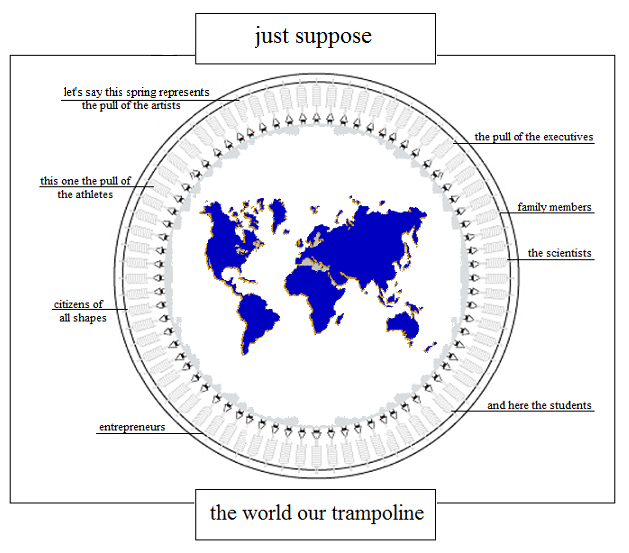
One quick annotated quote from Sec. Clinton‘s speech at the U.S. Institute of Peace China Conference, March 7th:

Now when I say “we,” I do not mean only our governments, as important as they are. Every day, across both of our countries, executives and entrepreneurs, scientists and scholars, artists and athletes, students and teachers, family members and citizens of all kinds shape and pull and add to this relationship. Together, they represent a vast range of priorities, concerns, and points of view. And they are all stakeholders in how we build toward a shared future.

It’s really that list I’m after…

There are seven billion individuals bouncing up and down on our trampoline, some of them holding hands, some of them in gangs that want to trip up rival gangs, or make a clearing for themselves and themselves alone, some too weak to bounce much at all…

and each time each one of us lands, we impact the trampoline from a different angle, stretch it a different way – tugging it to the will of the artist, the entrepreneur, the child, the retiree, the curious, the aggressive, the meek…

As we know, the earth is round, which is to say three-dimensional – but the tugs on it, the tensions, are more complicated than that, in fact they’re complex, n-dimensional – and constantly shifting.

Hilary Clinton wants to wake up in the morning, have coffee – and model that! – along with, and in balance with, her counterpart in another huge mass of population, half a globe and at least six philosophies away…

The coffee’s good, but it’s not enough — what we all could use is a new mode of thinking.

*

Maps courtesy of www.theodora.com/maps used with permission

Iran is a classic wicked problem

Saturday, March 10th, 2012

[ by Charles Cameron — Iran, unknown unknowns, Madhyamika philosophy and a blessed unknowing ]
.


.
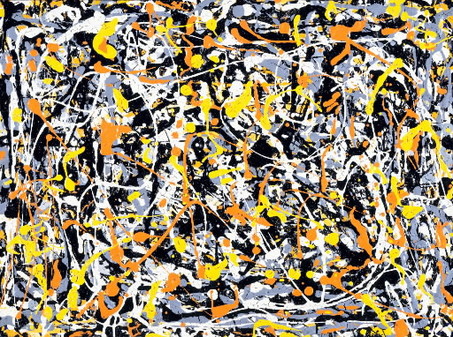
image from Jackson Pollock / AustinKids
an artist’s representation of a wicked problem to be untangled?

1.

Dr. TX Hammes, who will need no introduction to most ZP readers, wrote a few days back in On Bombing Iran, A False Choice:

While there has been some discussion of Iran closing the Straits of Hormuz, there has been no consideration of other Iranian actions – mining harbors overseas (using merchant ships), major attacks on oil production chokepoints globally or major terror attacks using the nuclear equivalent explosive power inherent in many industrial practices. In short, bombing proponents assume Iran will be an essentially supine enemy and not attempt to expand the conflict geographically or chronographically.

Iran is a classic wicked problem. Any “solution” brings a new set of problems. Lacking a solution, the strategist’s job is to think through how to manage such a problem.

My train of thought now departing the National Defense University on Dr Hammes’ platform will make its way with stops at Hans Morgenthau, Jeff Conklin and Richard Feynman to a final destination deep in the heartland of Buddhist Madhyamika philosophy with Elizabeth Mattis-Namgyel.

2.

Drs. Francis J. Gavin and James B. Steinberg‘s recent Foreign Policy piece The Unknown Unknowns carried the subtitle:

If the past half-century of American political history has taught us anything, it’s that we can’t possibly know the consequences of bombing — or not bombing — Iran

and opined:

Based on our experiences — one of us a former senior policymaker, the other a historian of U.S. foreign policy — we are convinced that the “right” answer, but the one you will never read on blogs or hear on any cable news network, is that we simply cannot know ahead of time, with any degree of certainty, what the optimal policy will turn out to be. Why? Even if forecasters could provide probabilities about the likelihood of a narrow, specific event, it is simply beyond the capacity of human foresight to make confident predictions about the short- and long-term global consequences of a military strike against Iran.

3.

It appears that this sense of unknowing has application beyond the specific question of whether or not to bomb Iran. Blog-friend Peter J Munson just the other day quoted Hans Morgenthau in a short SWJ piece titled Gentile: Realities of a Syrian Intervention — using a Morgenthau quote that he also features as an epigraph to his book, Iraq in Transition: The Legacy of Dictatorship and the Prospects for Democracy.

So that’s Iran, Iraq and Syria — but the Morgenthau quote itself, from his Politics among Nations, is even more general in application:

The first lesson the student of international politics must learn and never forget is that the complexities of international affairs make simple solutions and trustworthy prophecies impossible.

Okay?

4.

And it goes further. Love that quote from Laurence J Peters that Jeff Conklin uses as the epigraph to his seminal paper on Wicked Problems:

Some problems are so complex that you have to be highly intelligent and well informed just to be undecided about them

Next up, here’s the Nobel physicist Richard Feynman speaking in The Pleasure of Finding Things Out, a Horizon / Nova interview, illustrating the approach Morgenthau takes to international relations as applicable to the grand issues of philosophy, religion and science:

I can live with doubt and uncertainty and not knowing. I think it’s much more interesting to live not knowing than to have answers which might be wrong. I have approximate answers and possible beliefs and different degrees of certainty about different things, but I’m not absolutely sure of anything and there are many things I don’t know anything about, such as whether it means anything to ask why we’re here, and what the question might mean.

5.

And how far is that from Elizabeth Mattis-Namgyel, student and wife of the lama Dzigar Kongtrul Rinpoche, writing in her book on Madhyamika, The Power of an Open Question (p. 58):

Maybe experiencing complexity brings us closer to reality than does thinking we’ve actually figured things out. False certainty doesn’t finalize anything. Things keep moving and changing. They are influenced by countless variables, twists and turns … never for a moment settling into thingness. So maybe we should question the accuracy or limitations of this kind of false certainty. Conflicting information confuses us only when we’re trying to reach a definite conclusion. But if we’re not trying to reach a conclusion in the first place — if we just observe and pay attention — we may actually have a fuller, more accurate reading of whatever we encounter.

6.

Zen, too, welcomes this “open ended” approach in its working with koans, those mysterious and / or paradoxical riddles and / or poetic statements and / or legal cases for which such teachers as Dogen Zenji had such affection. In the words of Shozan Jack Haubner:

The searching, open-ended nature of koan work yields the kind of answer, however, that frustrates easy analysis, not to mention that most exquisite of all human pleasures: being “right.” For, ultimately, koan practice teaches that as long as a question is alive in the world around us, it should not — indeed, cannot — be settled once and for all within us. Koan practice does not put life’s deepest issues “to bed.” It wakes these issues up within us, waking us up in the process.

or consider this, from Lin Jensen, An Ear to the Ground: Uncovering the living source of Zen ethics:

Judgments on right and wrong are a nearly irresistible enticement to pick sides. And that’s exactly why the old Zen masters warned against becoming a person of right and wrong. It isn’t that the masters were indifferent to questions of ethics, but for them ethical conduct went beyond simply taking the prescribed right side. For these masters, the source of ethical conduct is found in the way things are, circumstance itself: unfiltered immediate reality reveals what is needed.

Policy-makers, of course, can’t suspend judgment indefinitely — but maybe a contemplative approach in general would make them better prepared for snap judgments and sound intuitions when such are called for. Clausewitz [grinning, with an h/t to Zen here]:

When all is said and done, it really is the commander’s coup d’œil, his ability to see things simply, to identify the whole business of war completely with himself, that is the essence of good generalship. Only if the mind works in this comprehensive fashion can it achieve the freedom it needs to dominate events and not be dominated by them.

7.

And let’s go the distance…

Here’s Elizabeth Mattis-Namgyel again, from an online retreat she gave last year for subscribers to Tricycle magazine:

We need to ask, what is love or beauty or pain before we objectify it? what happens when we can abide without conclusions? you know, these are questions for the practitioner, practitioners questions… and I wanted to use one word in Tibetan that I’ve found very useful for myself… and this is the word zöpa.. this translates usually as patience or endurance or tolerance, but there’s this very subtle translation of zöpa, which is the ability to tolerate emptiness basically, which is another ways of saying the ability to tolerate that things don’t exist in one way, that things are so full and infinite and leave you so speechless, and so undefinably grand – and these are just descriptive words, but you have to use some words to communicate, I guess — the ability to bear that, that fullness, like we’ve been talking about, not turning away, not turning away.

On fire: issues in theology and politics – ii

Tuesday, February 28th, 2012

[ by Charles Cameron — burning and blasphemy ]
.

The question here is a simple one: which is the more blasphemous? burning holy scripture — or burning oneself, a human being?

Now I imagine you think the answer to that’s quite obvious, and I do too. But there are people with the opposite opinion to mine — and when we burn their scriptures, even by mistake, even making apologies afterwards, they get enraged, and kill people. There may be many other factors that contribute to their rage, but this is the trigger, the religious sanction, the thing that pushes them over the top.

Someone tweeted the other day:

Souls are being burned alive in Homs & others riot over ink & paper. Where’s the logic?!

It is not my purpose to attack or defend anyone’s beliefs or opinions here — what I would like to do instead is to see through the rage and glimpse that logic: I would like us to avoid needlessly triggering it.

I want to bring what may at first seem utterly incomprehensible to us, a little closer to our comprehension.

1.

In the Quran 5.32, we read:

We ordained for the Children of Israel that if any one slew a person – unless it be for murder or for spreading mischief in the land – it would be as if he slew the whole people: and if any one saved a life, it would be as if he saved the life of the whole people.

On the one hand, that sets an extremely high value on human life — the Jewish equivalent is found in the Talmud, Tractate Sanhedrin 37a — and on the other hand, it can be claimed that that high value is set not by humans but by their Creator in his revealed Word, the Qur’an.

2.

What metaphor or analogy would allow me to understand that logic in terms of my own culture? Not the rage itself, not the killings — but the logic that potentiates them?

3.

If you think, as the melancholy Jaques has it in As You Like It, that all the world’s a stage, and all the men and women merely players – and as Hamlet might think, pondering what more things might be in heaven and earth than are dreamt of in philosophy – why then —

How does one weigh the value of the life of a Jaques, or Hamlet, of one of us, one single human being – of whom Shakespeare, again through his Hamlet, said:

how noble in reason! how infinite in faculty! in form and moving how express and admirable! in action how like an angel! in apprehension how like a god! the beauty of the world! the paragon of animals! ..

against the value of a single copy of the Works of one William Shakespeare – who then continued on, through that same Hamlet’s voice, to ask:

And yet, to me, what is this quintessence of dust?

4.

Shakespeare, the First Folio, Hamlet?
God, the Scripture, you or me?

5.

It is said the imperishable Quran is writ in heaven before time was, and there is a hadith of Tirmidhi that describes Allah reciting Suras 20 and 36, Taha and Ya Sin, upon hearing which the angels responded “Happy are the people to whom this comes down, happy are the minds which carry this, and happy are the tongues which utter this”.

I am not a literalist, I am a poet — so that makes poetic sense to me, the way Shakespeare’s “all the world’s a stage” makes sense.

In reading these words, I see for a moment the beauty, the devotion that is possible towards this book, the fervent dedication.

I am not about to kill people in the name of Shakespeare or the Gospels — yet I can understand a reverence for that which is greater than I, for that which is more than we dream of, and for that which “comes down” from thence.

6.

Suppose the body is a perishable scaffolding, and the book an eternal transcript written in the immortal soul…

And now recall what that eternal transcript says:

We ordained for the Children of Israel that if any one slew a person – unless it be for murder or for spreading mischief in the land – it would be as if he slew the whole people: and if any one saved a life, it would be as if he saved the life of the whole people.

The paradox here, surely, is that we are each of us the quintessence of dust – each of us more than is dreamt of in philosophy.

7.

May the soul of Mohamed Bouazizi rest at last.

The speeds of thought, complexities of problems

Wednesday, February 1st, 2012

[ by Charles Cameron — instinct, rationality, creativity, complexity and intelligence ]
.

Guy Claxton, Hare Brain, Tortoise Mind
Daniel Kahneman, Thinking, Fast and Slow

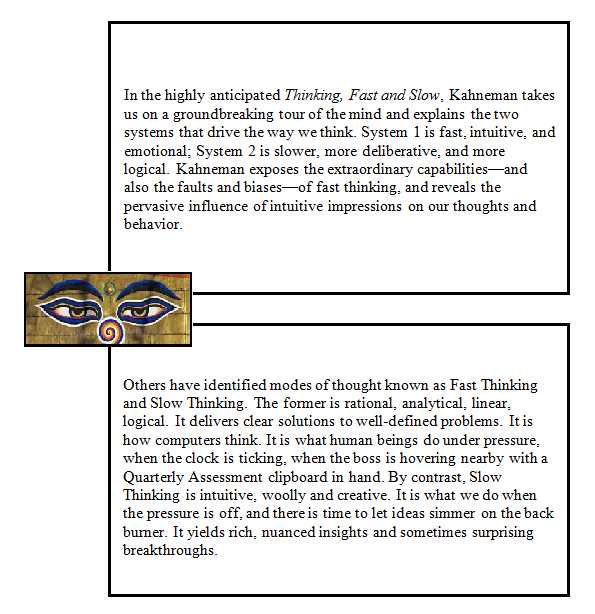
You might think, taking a quick glance at their titles, that these two books would be in substantial agreement with one another about the speeds of thought. But consider these two comments, in one of which the deliberative, logical mind is “slower” than the intuitive and emotional — while in the other, it is the rational mind that is “faster” and the intuitive mind which is “slower”. Brought together, the two quotes are amazing — it would seem that either one or the other must be wrong:

\

Happily, I don’t believe either one is wrong — I think it’s more a matter of there being three speeds of thought, and the two books in question using different terminologies to emphasize different distinctions between them.

Here’s a more extended version of Guy Claxton’s position:

Roughly speaking, the mind possesses three different processing speeds. The first is faster than thought. Some situations demand an unselfconscious, instantaneous reaction. … Neither a concert pianist nor an Olympic fencer has time to figure out what to do next. There is a kind of ‘intelligence’ that works more rapidly than thinking. This mode of fast, physical intelligence could be called our ‘wits’. (The five senses were originally known as ‘the five wits’.)

Then there is thought itself — the sort of intelligence which does involve figuring matters out, weighing up the pros and cons, constructing arguments and solving problems. A mechanic working out why an engine will not fire, a family arguing over the brochures about where to go for next summer’s holiday, a scientist trying to interpret an intriguing experimental result, a student wrestling with an examination question: all are employing a way of knowing that relies on reason and logic, on deliberate conscious thinking. … Someone who is good at solving these sorts of problems we call ‘bright’ or ‘clever’.

But below this, there is another mental register that proceeds more slowly still. It is often less purposeful and clear-cut, more playful, leisurely or dreamy. In this mode we are ruminating or mulling things over, being contemplative or meditative. We may be pondering a problem, rather than earnestly trying to solve it, or just idly watching the world go by. What is going on in the mind may be quite fragmentary. What we are dunking may not make sense. We may even not be aware of much at all. As the English yokel is reported to have said: ‘sometimes I sits and thinks, but mostly I just sits’. […]

That third mode of thinking is the one Claxton identifies with “wisdom” — which is interesting enough. Just as interesting, though, is his identification of this slowest mode of thought with “wicked problems”:

Recent scientific evidence shows convincingly that the more patient, less deliberate modes of mind are particularly suited to making sense of situations that are intricate, shadowy or ill defined. Deliberate thinking, d-mode, works well when the problem it is facing is easily conceptualised. When we are trying to decide where to spend our holidays, it may well be perfectly obvious what the parameters are: how much we can afford, when we can get away, what kinds of things we enjoy doing, and so on. But when we are not sure what needs to be taken into account, or even which questions to pose — or when the issue is too subtle to be captured by the familiar categories of conscious thought — we need recourse to the tortoise mind.

I haven’t read either book, and I’d hope that Kahneman as well as Claxton actually addresses all three speeds of thought. But my immediate point is that the slowest of the three forms of thought is the one that’s best suited to understanding complex, wicked and emergent problems.

And that’s the one that can’t be hurried — the one where the Medici Effect takes effect — and the one which provides Claxton with one of his finest lines, with which he opens his book, a western koan if ever I saw one:

There is an old Polish saying, ‘Sleep faster; we need the pillows’, which reminds us that there are some activities which just will not be rushed. They take the time that they take.

More on that front shortly, insha’Allah and the creek don’t rise.


Switch to our mobile site