zenpundit.com » science

Archive for the ‘science’ Category

DoubleQuoting Rubio and Obama

Friday, November 23rd, 2012

[ by Charles Cameron — one fault-line in current American political tectonics runs through the age of the planet ]
.

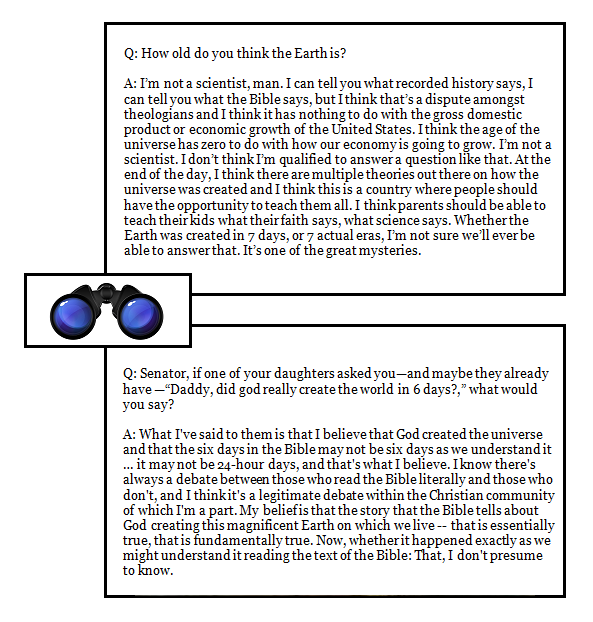
I thought Daniel Engber‘s piece in Slate doublequoted Rubio and Obama very nicely the other day:

The top quote is from Sen. Rubio, the second from then-Sen. Obama, and indeed, they both hedge their bets, as Engber goes on to suggest:

1) Both senators refuse to give an honest answer to the question. Neither deigns to mention that the Earth is 4.54 billion years old.

2) They both go so far as to disqualify themselves from even pronouncing an opinion. I’m not a scientist, says Rubio. I don’t presume to know, says Obama.

3) That’s because they both agree that the question is a tough one, and subject to vigorous debate. I think there are multiple theories out there on how this universe was created, says Rubio. I think it’s a legitimate debate within the Christian community of which I’m a part, says Obama.

4) Finally they both profess confusion over whether the Bible should be taken literally. Maybe the “days” in Genesis were actual eras, says Rubio. They might not have been standard 24-hour days, says Obama.

In light of these concordances, to call Rubio a liar or a fool would be to call our nation’s president the same …

**

I don’t however think Engber is right in saying of Sen. Rubio — and by implication of Pres. Obama too:

By arguing that every viewpoint has a claim to truth — that the geologists and theologians are each entitled to their own opinions — the senator gave up on dealing with reality at all.

This runs deeper than the “age of the earth” question, it seems to me, and the two sides currently facing off on a whole slate of issues seem to articulate, respectively, these two questions

  • Doesn’t anyone recognize the truth of Revelation when they see it?
  • Doesn’t anyone recognize the truth of Science when they see it?
  • My own question — which I think has the capacity to reconcile the two — would be along the lines of:

  • Doesn’t anyone recognize the truth of Poetry when they see it?
  • **

    An afterthought:

    Current American political tectonics: an issue of homeland security?

    Cross-grain thinking, 3: ASP’s Report on Climate Security

    Wednesday, November 21st, 2012

    [ by Charles Cameron — as Dylan sang, a change in the weather is known to be extreme ]
    .

    People sit at a flooded table in Piazza San Marco, Venice -- photo: Luigi Costantini / AP

    .
    Right at the top of Part I of the recent three-part Report on Climate Security from the American Security Project, we read this paragraph:

    Climate change is real: we see its impacts every day, around the world. A melting Arctic, unprecedented droughts across the world, extreme examples of flooding, and uncontrollable wildfires are all examples of the changing climate.

    That’s right, that’s right and important, that’s right, important and timely.

    But you know, at heart I’m a poet. And although I’m concerned about the issues the report addresses, I can’t help thinking of climate and weather, atmosphere and wind, in a manner that crisscrosses the “interior” vs “exterior” divide.

    If you lean to the scientific more than the poetic, you might want to consider what I’m talking about as an instatiation of the insight Gregory Bateson expressed in the title of his seminal book, Mind and Nature: A Necessary Unity.

    **

    Let me lean to the poetry-side for a paragraph or so, then we’ll come back to security issues the report raises.

    I probably caught this particular “weather and weather” disease from Dylan Thomas’ great and celebrated poem, A Process in the Weather of the Heart:

    A process in the weather of the heart
    Turns damp to dry; the golden shot
    Storms in the freezing tomb.
    A weather in the quarter of the veins
    Turns night to day; blood in their suns
    Lights up the living worm.

    Writing about this poem in his Reader’s Guide to Dylan Thomas, William York Tindall notes “Thomas’ obsessive concern with the natural process that, linking man and world, inner and outer, turns upon the axis of life and death” and specifies that “applying ‘weather,’ a word for outer climate, to inner climate joins two worlds.”

    Thomas is concerned in that extraordinary poem to join, likewise, life with death, night with day, womb with tomb, seeing eye with blind bone and more – or not so much to join them as to see them as inseparable, as parts of the single unfolding that is the world.

    There is much more to the poem than the central obsessive theme of the “process in the weather of the heart” with which the poem opens and the “process in the weather of the world” with which it closes. It is their conjunction, their inseparability which interests me here – the poet’s perception that there is no inner without the outer, no outer without the inner – that in each there is weather, which Tyndall also calls climate, that weather is in both…

    **

    Back to meteorology and national security..

    Look, I’m not exactly an enemy of thinking about climate change and national — or global — security. I admire ASP for today’s piece by Catherine Foley, Climate Change: The Missing Link in Tackling the Mali Crisis. We need more considerations of that kind, they’re rare and extremely valuable.

    Mecca is one of the hottest cities in the world, and the Kaaba the central pivot around which all Islam revolves — potentially a double hot-spot. What are the implications of climate change for the Saudis, for Mecca, for Islam?

    **

    When I think about weather, I think about storms in the world, storms in the heart and mind, almost in the same breath. Specifically, when I think of global warming, I can’t help but see the problem as being one of double-awareness – rising temperatures and rising tempers, rising sea-levels and rising levels of anxiety and / or denial, the climate of meteorology and the climate of opinion…

    Seen from my bifocal perspective, the report is notably focused on externals. Take another sentence from the brief bullet points on the first page;

    The climate influences people’s everyday lives, from what they eat to where they live.

    We eat food, food that can be weighed and measured, and analyzed for its nutrient elements and health properties. We live in cities, towns and villages, in houses, or developments, which can located on maps…

    With my bifocals on, it would be more accurate, more encompassing to say:

    The climate influences people’s everyday lives, from what they eat to how they feel, and from where they live to what they think and how they behave.

    Because in my view, the situation is as much about “mind change” as it is “climate change” — in my view, the “fulcrum that can move the world” is to be found in the geography of mind and heart.

    **

    Okay, let’s back up a bit.

    The “first page” I quoted is the first page of the First Part of the Report, but there’s also an Introduction, and I want to pick up the thread there now, because the Introduction is written with human thought — specifically “honest dialogue” — in mind, and opens with what seems at first glance like one of those obvious truths that serve as the jumping off points for more detailed considerations:

    The American Security Project is organized around the belief that honest, public discussion of national security requires open, non-biased, non-partisan discourse about the dangers and opportunities of the 21st Century.

    There’s just one problem here, though — a single paragraph later, we read:

    Climate change poses a clear and present danger to the United States

    I’d give my assent happily enough to either of these two propositions, if they weren’t both talking about the same situation. Because when someone sees a “clear and present” hungry tiger coming at them and doesn’t take rapid action to avoid being eaten, it’s not “open” and “unbiased” — it’s “in denial”.

    Which in turn means there’s a swathe of the population that may not be willing to hear “open, non-biased, non-partisan discourse” nor able to contribute to it. “I don’t believe my eyes, they’re deceiving me with all this hogwash about tigers”…

    And those people have loved ones, bring foods to community pot-lucks, and teach class, and vote…

    **

    Some time ago, I was working on a transposition of the Gospel narratives of Luke and John into the Troubles in Northern Ireland, with Britain playing the part of Rome and so forth, and adding some commentary along the way. Here’s a slightly revised version of my comment on John 3.8:

    There is one particular word that John uses which has what we today might call a triple (rather than a double) meaning. When Christ in this verse says, “The wind bloweth where it listeth, and thou hearest the sound thereof, but canst not tell whence it cometh, and whither it goeth: so is every one that is born of Spirit,” it is the Greek word pneuma that can be translated both as wind and spirit. It also means breath.

    Christ is saying here that those who are born of spirit are like the wind, like breath, and like inspiration: each of which can be noticed but not predicted, because each moves of its own accord — yet in the Greek these are not three separate concepts as they are for us today. As CS Lewis says in another context, we must always remember “that the various senses we take out of an ancient word by analysis existed in it as a unity.”

    In telling us this, St John is saying at one and the same time that nobody knows where the first breath comes from or when the last breath will leave us, nobody knows how to forecast exactly which path a hurricane will take, and nobody knows how to make an assembly line for inspiration – if we did, Beethoven could have written another three symphonies as great as his Ninth to order, stat!

    One of the reasons we don’t know how the heart and mind work is that we’ve separated “meteorological” weather from “the weather of the heart” — and there’s a storm brewing, inextricably, on both fronts.

    If the ASP report is anything to judge by, we’re only looking at one of them.

    **

    Oh, and here by way of confirmation is an old friend from my Oxford days, the late Chogyam Trungpa Rinpoche, quoted in a piece for the November issue of Shambhala Sun:

    No matter where we are in the world, there is a need for enlightened society, wherever natural disasters hit. In this case, “natural disaster” refers to aggression, passion, and ignorance. These kinds of natural disasters occur in the minds of people.

    Trungpa’s sense of “natural disaster”, I humbly submit to the folks at the American Security Project, either needs to run like a woof through the warp of their report on climate change — which it doesn’t — or it deserves a fourth section of its own.
    Numbers by the numbers: Twone?

    Saturday, November 10th, 2012

    [ by Charles Cameron — parallels and opposites, with a pinch of Shakespeare and a digression into philosophical theology ]
    .

    My friend Peter Feltham steered me towards an intriguing Telegraph piece about something called the Rolling Jubilee project. The accompanying image caught my eye —

    because it reminded me of another image I’d seen years ago, when I took a class in movie directing at UCLA extension.

    The upper image (above) illustrates the Telegraph piece, which depicts the Rolling Jubilee thus:

    The Rolling Jubilee project is seeking donations to help it buy-up distressed debts, including student loans and outstanding medical bills, and then wipe the slate clean by writing them off.

    The lower image is from Jean-Luc Godard‘s film, La Chinoise, which is apparently about a bunch of French Maoist radicals in the 1960s — the “wall” in the image is made of countless copies of Chairman Mao‘s Little Red Book.

    And bundles of twenty dollar bills are pretty much the intellectual opposite of stacks of Little Red Books, no?

    **

    So what? Where do we go from here? Is there anything actionable about those two images?

    Does the lower one mean the Rolling Jubilee project is Maoist? Or that capitalism has triumphed over Marxism in the 45 years since Godard’s film was produced? In China? Or in the world at large? Or (ironically?) that capitalism, like communism, is a failed system? That there’s a Hole in the Wall?

    Should we be thinking of Pyramus and Thisbe, the play within a play in Shakespeare‘s Midsummer Night’s Dream?

    This man, with lime and rough-cast, doth present
    Wall, that vile Wall which did these lovers sunder;
    And through Wall’s chink, poor souls, they are content
    To whisper.

    Is there idea that there’s a chink in Wall Street?

    **

    I’m asking all this because we can take all manner of conclusions from a juxtaposition — it naturally lends the mind to associative thinking, extrapolation, the derivation of one or more meanings. And I surely want to emphasize the “or more” here.

    But also because it brings up, with force, the issue of parallels and oppositions.

    We don’t say Oxford is the opposite of a Fouquieria columnaris cactus in the Huntington Gardens — they’re too disparate to be opposite. No, we think of Cambridge as the opposite of Oxford because they’re so similar, they’re almost the same — as I’ve said elsewhere on ZP, there’s even a single word for both: Oxbridge.

    Opposites are similars with difference, while parallels are differents with similarities — and is that one insight, or two?

    We talk about a “two-way street” — in city traffic terms, that’s just one street, but the traffic flows in two directions — and it’s probably best to keep ’em separate.

    **

    Zoom in, and you’ll see differences, zoom out, and you’ll see samenesses — is that true? true when applied to concepts, debates, arguments, elections, partisanship, wars? day and night? sun and moon? war and peace? life and death?

    Apples and oranges?

    I don’t think we’re terribly good at thinking about this sort of thing — and I also think binary thinking is both a primary and a frequently divisive factor in the human condition, so we’d best get better at it.

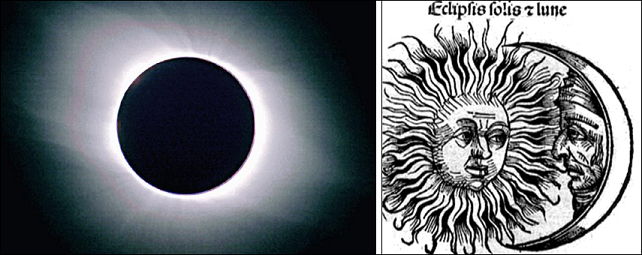
    Sun and moon are an interesting pair, because even though they are vastly different both in size and distance from our planet, they each subtend almost exactly the same angle on the eye — thus allowing for the brilliant halo effects of full eclipses of the sun.

    Alchemists see in that sameness a marriage of opposites or coincidentia oppositorum. But here’s my pair of questions for you:

  • is that similarity a matter of entirely random coincidence, or is it evidence of immaculate care and design?
  • and how different would the entire history of human belief be, if the moon and sun were not even close to the same as each other in (apparent) size?
  • For one thing, if the moon seemed smaller than the sun, we’d have no total solar eclipses — the impact of that alone would be interesting to consider.

    A Handy intro to Networks

    Monday, October 22nd, 2012

    Blogfriend Rob Paterson has two concise posts up on understanding networks and network theory. If this is a subject you want to know more about, they are must-reads.

    My Network Revealed – Now what can you learn about yours?


    ….Here is my social network as created by the Mapping tool on Linkedin. It’s not the 100% true picture but it looks like 90% to me. You can use their mapping tool by going here.

    If I am right and we are moving to an economy that depends on our networks, then it is essential that we learn what each of our networks means and what we can do to make them healthier. So, with that in mind, let’s look at mine and I will share some lessons with you.

    Next week, I will post a podcast that I recorded yesterday with the Master of Networks, Valdis Krebs. Anything I know is because of him. He will go much deeper than I – so this is an introduction.

    Diversity – In nature diversity is a good thing – so it is with our social networks. You can see that I am connected to a series of worlds. PEI , Public Media, Network Thinkers, Family and I have 2 outside nets of New Military Thinkers and my legacy Corporate connections.

    I think that this does not look too bad – I have good links into many fields. How does your world look? 

    Our networks are like gardens, we can always make them better. We can always add and remove. We can always pay attention. ….

    Read the rest here.

    Human Networks – A masterclass by the Master Valdis Krebs – Podcast #networks

    This is Valdis Krebs – The Galileo of human Social Networks – ie the person who shows us what they look like, when before they were invisible, and who shows us the simple rules that drive them. 

    The few nations that were early into navigation and exploration in the 16th century, did very well. As we ourselves move into a world where all the advantages will accrue to those that understand Networks, I think it is vital that we understand how to navigate in the Network world. 

    The problem that many of us have is that when we hear the work “Network” we think of TV networks or Telephone networks that are driven by the old rules of engineering. What Valdis talks about mainly are Natural Networks, of which human social networks are a part. These are driven by the rules of Emergence and Nature and NOT by the rules of the CEO.

    The good news is that the Rules of Nature in this regard are simple to understand and to operate. 

    Network copy
    This is the “Map” that we are now going to explore.

    Read the rest here.

    Valdis Krebs is indeed the master of network-mapping and leveraging social networks


    Form is insight: the bow to arrow paradox

    Monday, October 8th, 2012

    [ by Charles Cameron — a post in my importance of form in intelligence series — ]
    .

    Ben Turner‘s tweet today —

    neatly encapsulates the “counterintuitive” paradox by which bow and arrows — and catapults too, for that matter — work. You pull back to send forwards.

    **

    The Chicago Tribune report which Turner links to contains the following paragraphs:

    Gurdon spoke of his own unlikely career as a young man who loved science but was steered away from it at school, only to take it up again at university.

    He still keeps an old school report in a frame on his desk: “I believe he has ideas about becoming a scientist… This is quite ridiculous,” his teacher wrote. “It would be a sheer waste of time, both on his part and of those who have to teach him.”

    What’s funny here is that our new-minted Nobelist liked this comment well enough to frame it. He has shown the teacher in question to be wrong, no doubt about it, and perhaps given others who have received similarly negative advice some encouragement along the way.

    But here’s my question: did that unflattering report somehow propel him to greater effort?

    **

    For your thinking pleasure in the matter of the bow to arrow paradox:

    reverse psychology
    blowback
    reculer pour mieux sauter
    counterintuitive
    unintended consequences

    It’s really quite a party for the party-going mind. Does your mind party?

    **

    There will be more posts in this “form is insight” series, as time and tide permit.


    Switch to our mobile site