zenpundit.com » society

Archive for the ‘society’ Category

Get Smarter Futurism

Sunday, July 5th, 2009

Jamais Cascio of Open the Future has a piece on possible extrinsic, pharmaceutical and evolutionary modifications to human intelligence in The Atlantic Monthly ( I read it on my Kindle):

Get Smarter

….Our present century may not be quite as perilous for the human race as an ice age in the aftermath of a super-volcano eruption, but the next few decades will pose enormous hurdles that go beyond the climate crisis. The end of the fossil-fuel era, the fragility of the global food web, growing population density, and the spread of pandemics, as well as the emergence of radically transformative bio- and nano­technologies-each of these threatens us with broad disruption or even devastation. And as good as our brains have become at planning ahead, we’re still biased toward looking for near-term, simple threats. Subtle, long-term risks, particularly those involving complex, global processes, remain devilishly hard for us to manage.

But here’s an optimistic scenario for you: if the next several decades are as bad as some of us fear they could be, we can respond, and survive, the way our species has done time and again: by getting smarter. But this time, we don’t have to rely solely on natural evolutionary processes to boost our intelligence. We can do it ourselves.

….Yet in one sense, the age of the cyborg and the super-genius has already arrived. It just involves external information and communication devices instead of implants and genetic modification. The bioethicist James Hughes of Trinity College refers to all of this as “exo­cortical technology,” but you can just think of it as “stuff you already own.” Increasingly, we buttress our cognitive functions with our computing systems, no matter that the connections are mediated by simple typing and pointing. These tools enable our brains to do things that would once have been almost unimaginable:

  • powerful simulations and massive data sets allow physicists to visualize, understand, and debate models of an 11?dimension universe;
  • real-time data from satellites, global environmental databases, and high-resolution models allow geophysicists to recognize the subtle signs of long-term changes to the planet;
  • cross-connected scheduling systems allow anyone to assemble, with a few clicks, a complex, multimodal travel itinerary that would have taken a human travel agent days to create.

If that last example sounds prosaic, it simply reflects how embedded these kinds of augmentation have become. Not much more than a decade ago, such a tool was outrageously impressive-and it destroyed the travel-agent industry.

That industry won’t be the last one to go. Any occupation requiring pattern-matching and the ability to find obscure connections will quickly morph from the domain of experts to that of ordinary people whose intelligence has been augmented by cheap digital tools. Humans won’t be taken out of the loop-in fact, many, many more humans will have the capacity to do something that was once limited to a hermetic priesthood. Intelligence augmentation decreases the need for specialization and increases participatory complexity.

Newspapers: Putting the “Dead” into Dead Tree

Thursday, May 7th, 2009


The MSM has bumped up against the internet – and lost. 

Clay Shirky called it a while ago in Here Comes Everybody: The Power of Organizing Without Organizations
but big media, if they wish to make the leap to to Web 2.0 life, have to leverage the one thing they do better than everyone else, original investigative reporting, that’s where they create value. Instead they are looking for government protection, subsidies or both.

Rupert Murdoch envisions a walled garden strategy but news has a brief shelf life. A high price on all content is a barrier to entry for older news items that just interest a few people. A flat rate drives down their market share for attention, their traffic and in turn, the market value of all the content they own. A sliding scale would be needed that rapidly discounts toward free as public attention on a news item waned.

Right now the media are like a brontosaurus that has just realized it waded into a tar pit.

Excess Complexity is the Route to Extinction

Friday, April 10th, 2009


Nassim Nicholas Taleb, author of The Black Swan: The Impact of the Highly Improbable and Fooled by Randomness: The Hidden Role of Chance in Life and in the Markets, had an op-ed in FT.com entitled “Ten principles for a Black Swan-proof world” (Hat tip to John Robb and Pundita). Taleb was addressing the global economic crisis, but I was particularly drawn to Taleb’s fifth principle, which has a more general implication:

5. Counter-balance complexity with simplicity. Complexity from globalisation and highly networked economic life needs to be countered by simplicity in financial products. The complex economy is already a form of leverage: the leverage of efficiency. Such systems survive thanks to slack and redundancy; adding debt produces wild and dangerous gyrations and leaves no room for error. Capitalism cannot avoid fads and bubbles: equity bubbles (as in 2000) have proved to be mild; debt bubbles are vicious.

Taleb has encapsulated many important concepts very well here. Up to a certain point, increasing complexity represents a advantage for an evolving system (biological, financial, physical etc.) by increasing efficiency through adding specialization, interconnection, diversification, redundancy and checks for mitigation of risks. Complexity, in the earlier part of a development curve can add to a system’s overall resiliency – to a point.

Superfluous complexity, that which goes beyond the minimum required for additional gains in systemic efficiency or productivity, is a net drag on the system, an economic waste, a source of friction, a cancer,  a useless eater of resources and the earliest sign of the system’s inevitable decay. Worse, excess complexity represents an increasing probability of systemic failure by multiplying the number of variables involved in the normal process of the system. There are more things that can go wrong and more choke points where a catastrophic failure can occur. Increasing the degree of complexity moves the system away from simplicity and reliability and toward chaos and the creativity of emergent properties, but like an ice skater seeking ever greater range, go too far and the ice will crack under one’s feet.

This is an effect familiar to engineers and scientists but one that appears to escape the majority of politicians, corporate executives and economists. My co-blogger at Chicago Boyz, Shannon Love,  took GE to task for trying to get on the Federal dole by advocating needlessly complicating the nation’s power grid:

If Your Grid Had a Brain

GE is advertising to build political support for Obama’s plan to purchase billions of dollars of GE tech in order to make the power grid “smart”.  After all, who would want a “dumb” anything when they could have a “smart” something? 

The reason we should keep things dumb is that in engineering the word “dumb” has a different connotation. In engineering, “dumb” means simple and reliable. 

Increasing complexity in any networked system increases possible points of failure. Worse, the more interconnected the system, i.e., the more any single component affects any other randomly selected component in the system, the faster point-failures spread to the entire system. Power grids are massively interconnected. Every blackout starts with a seemingly trivial problem that, like a pebble failing on a mountain side, triggers an avalanche of failure. 

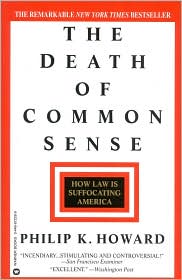
In the social and political domain, back in the 1990’s Philip K. Howard wrote a book called The Death of Common Sense: How Law is Suffocating America in which he detailed example after example of how the overlawyering of regulatory systems in America by an emerging and hyper-aggressive legal class was producing neither restraint on government abuses nor fine-tuned social outcomes but instead created a state of paralyzed rigidity, risk aversion, perverse incentives and general dysfunction; in other words, chaos instead of order.

The Obama-ites in the White House are not “socialists” ( at least not most of them) but there is a great love of liberal-minded technocracy there, and a seemingly boundless self-confidence in the ability of high-minded, upper-middle class, progressive, wonks and lawyers from the “good schools” (or investment houses – in some cases, both) to micromanage not just our lives for us, or even the United States of America but the global economy itself. Sort of a Superempowered Oligarchy of Good Feelings.

The ancient Greeks had a word for that: hubris. More importantly, the Obama-ites are wrong here – adding endless amounts of regulatory complexity is not going to give them the kind of granular control or positive returns that they seek to obtain from the system. Counterintuitively, they should be radically simplifying where and to the degree they safely can instead.

On Tribes

Tuesday, March 10th, 2009


John Robb has been thinking about tribes. So has David Ronfeldt. So has Seth Godin.

Why?

John Robb  writes:

If you are like most people in the ‘developed world,’ you don’t have any experience in a true tribal organization.  Tribal organizations were crushed in the last couple of Centuries due to pressures from the nation-state that saw them as competitors and the marketplace that saw them as impediments.  All we have now it is a moderately strong nuclear family (weakened via modern economics that forces familial diasporas), a weak extended family, a loose collection of friends (a social circle), a tenuous corporate affiliation, and a tangential relationship with a remote nation-state.  That, for many of us, is proving to be insufficient as a means of withstanding the pressures of the chaotic and harsh modern environment.

The advantage of tribal structures in my view, compared to hierarchies, markets and networks discussed by Ronfeldt revolves around the certainty of mutual trust as a psychological motivator, especially vis-a-vis “outsiders”.  Loyalty to all members of the tribe ( primary loyalty) is paramount which is not the case in hierarchies ( loyalty flows upward, downward not so much), markets ( nonexistent) or networks (potentially  non-reciprocal loyalty to hub). As such, tribes function very well at the base of Maslow’s Hierarchy of Needs which means they are good insurance for physical survival. It does not matter if the tribe is one of blood or cultural heritage or artificial political, religious or military brotherhood. Militiaman, monk or gang member is irrelevant; what matters is the establishment of unreserved mutual trust as a core of personal identity.

The implicit trust present within the tribe and the flexible sense of authority gives individual tribesmen room for individual initiative to react, knowing “the tribe has their back”. They are a more centralized unit of power than a network but more fluid and mobile than a hierarchy. A tribe is a safety net or a bodyguard. Great enterprises require something else as an organizational form but behind a great enterprise should be at least some kind of life preserver.

Addendum:

Col. Pat Lang – “ How to Work With Tribesmen

Intersecting Emerging Tech and Society – Juan Enriquez

Tuesday, March 3rd, 2009

This is good, once you get past the pedestrian observations about the economic crisis:


Switch to our mobile site