zenpundit.com » iraq

Archive for the ‘iraq’ Category

There Will Be Blood…..

Thursday, January 19th, 2012

All In: The Education of General David Petraeus by Paula Broadwell, with Vernon Loeb

The official biography of CIA Director General David Petraeus, by Harvard researcher Paula Broadwell, has long been anticipated in the .mil/COIN/NatSec/Foreign Policy communities and blogosphere.  I can hear pencils scrawling furiously away in the margins even as I type this post. 🙂

Broadwell,  herself a reserve Army officer, West Pointer, Harvard grad, doctoral student at King’s College War Studies Department , and by all accounts, an impressive up and coming individual,  had very extensive access to her subject – allegedly, far more than the official Army historian assigned to General Petraeus’ last command. Given the subject is General Petraeus, the precarious state of American policy in Afghanistan and 2012 as a circus of political excess, All In will be one of the few “must read” books this year.

And, I must commend Miss Mrs. Broadwell highly here, she will be donating 20 % of her net proceeds to help wounded veterans.

That said, in terms of reaction to this book, there will be blood.

Reviews of All In will afford the opportunity to tear the scabs off of the well-worn COINdinista/COINtra debate and rub salt in the exposed wounds – I for one am especially looking forward to reading future back to back reviews by Carl Prine and Thomas Ricks and Abu Muqawama vs. Colonel Gian Gentile. In the mainstream press, the opportunity for newspaper columnists to get in gratuitous potshots against figures like Presidents Bush and Obama, Dick Cheney, Don Rumsfeld, Robert Gates, Joe Biden, Hillary Clinton, Stan McChrystal and numerous others or grind partisan axes will be too tempting to resist, regardless of how relevant these remarks are to Broadwell’s biography of Petraeus. The looming specter of draconian cuts to defense budgets will also add to the rancor of the discussion of the book within the defense community.

Somewhere in that debate will be the book Broadwell actually wrote and within the book, perhaps, we will come to see David Petraeus. Or not.

Get your popcorn ready!

Right now, I am deep into reading the superb George Kennan biography by eminent diplomatic historian John Lewis Gaddis but All In is definitely next on my list.

And it will be reviewed.

Iconic: compare and contrast III

Saturday, December 24th, 2011

[ by Charles Cameron – Iraq war, beginning and ending, analytic power of similarity ]

.

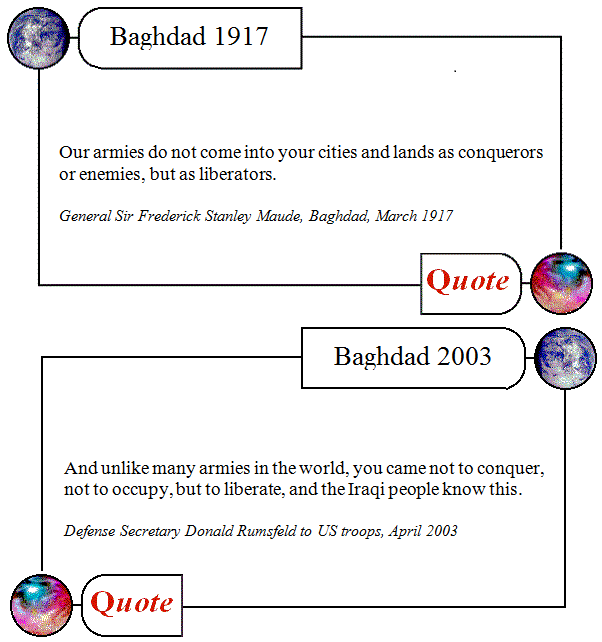
I’ve thanked Zen for his Iconic Compare and Contrast post already, but I’d like to run with his juxtaposition of images from the end of the Iraq war, and book-end it with an early DoubleQuote of mine from the beginning, thus:

That’s the beginning of the war, as I saw it “binocularly” — and here’s its ending, as Zen captured it:

Different though they are — one verbal, one visual — I think they go well together. I think they belong together.

But that’s essentially an aesthetic intuition.

*

And — apart from thanking Zen — that’s the thing I want to talk about.

The two quotes, eighty-six years apart, about an (anglophone) army in Baghdad coming there to liberate, not to conquer, are similar enough that they should give us pause for thought. They challenge us to think long and hard about the similarities between the two situations — and they challenge us to think no less hard and long about their differences.

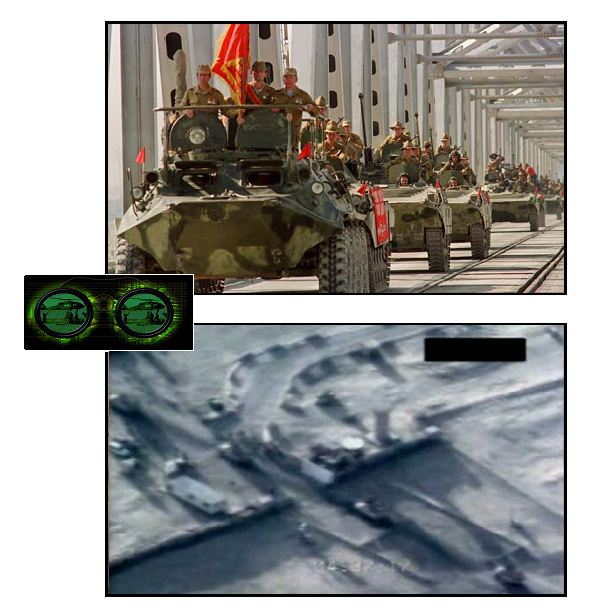
Likewise, it’s the similarities between the two images Zen chose — of the Soviet withdrawal from Afghanistan and the US exit from Iraq — that give that juxtaposition its power.  And Zen has chosen very carefully:

Not only are there two lines of vehicles stretching back from the foreground away into the distance in each image, but the angle from which the two columns are seen is about the same — and there are even two “tracks” in each photo reinforcing the vanishing point — two tracks to the right of the vehicles in the Afghan photo, the edge of the road and a what looks like the shadow of an overhead cable in the photo from Iraq.

*

But let’s take this a bit further. The following juxtaposition is every bit as much a juxtaposition of the Soviet and American withdrawals as the pair of images Zen picked, but this time we have an aerial view of the US convoy — so the visual “rhyme” between the two images is no longer there — and even though the aerial shot is an intriguing one, what a difference that makes!

There’s nothing in that juxtaposition to make you go, yes!

On the level of what’s being referred to, the troop withdrawals from Afghanistan and Iraq,  this pair of images has the same properties as the two images that Zen selected.  But it doesn’t capture our attention in nearly the same way.

And the same would have been true if I’d picked a different sentence from Rumsfeld‘s speech to juxtapose with General Maude‘s “not as conquerors or enemies but as liberators” — such as, “You’ve unleashed events that will unquestionably shape the course of this country, the fate of the people, and very likely affect the future of this entire region.” I’d still be comparing and contrasting two speeches from the beginnings of two occupations of Baghdad.  But there’d be no oomph to the comparison.

*

Because — and this is what I am trying to get at, the basic principle of HipBone analysis and what distinguishes it from otherwise similar modes of brainstorming and mind-mapping — the recognition of pattern, of salient sameness, of close parallelism or opposition is the criterion for success or failure in a HipBone-style juxtaposition.

Zen’s graphic example has that closeness — even down to those two parallel tracks beside and to the right of the vehicles.  My two quotes from Maude and Rumsfeld have that.  And it’s that closeness of match that makes a juxtaposition powerful.

Analogy works this way, rhyme works this way, fugue works this way, graphic match (in cinematography) works this way — it’s basic to the arts, basic to rhetoric, and basic to the way our analogically-disposed minds think.

It is not a method for arriving at conclusions, it’s a method for posing questions. And it sits right at the juncture where analysis admits it is not a science but an art.

Zen’s Iconic Compare and Contrast: Nine Years

Saturday, December 24th, 2011

I would like to depart from my usual style and take a leaf out of Charles Cameron’s playbook – notably his last post. Consider this a “Part II”.

Here are my selections:

Friendship Bridge, Afghanistan – February 16, 1989

….Many troops wondered how the Iraqis, whom they had worked closely with and trained over the past year, would react when they awakened on Sunday to find that the remaining American troops on the base had left without saying anything.

“The Iraqis are going to wake up in the morning, and nobody will be there,” said a soldier who identified himself only as Specialist Joseph. He said he had emigrated to the United States from Iraq in 2009 and enlisted a year later, and refused to give his full name because he worried for his family’s safety…..

Tampa Highway, Iraq – December 18, 2011

War without a strategy is like driving without a map – and in both cases you may not like your destination.

On bananas, cucumbers, tomatos and piano legs: an aside

Saturday, December 10th, 2011

[ by Charles Cameron, h/t Mike Few — bananas, cucumbers, tomatos and piano legs as sexual objects, reading the world as a book, Iraq recently, Shakespeare a while back, Robert Hooke ]
.

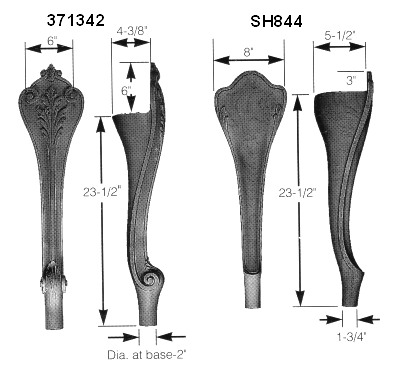
Louis XV grand piano legs, hard maple. Image credit: http://www.balaams-ass.com/grandlegs.htm

MikeF in a comment on my post, Let me put my banana in your fruitbasket, pointed us to his Small Wars Journal article The Break Point: AQIZ Establishes the ISI in Zaganiayh, in which he reports that the Mujahedeen Shura Council in Iraq passed out propaganda pamphlets providing “instruction on the proper actions of good Muslims” in preparation for the establishment of an Islamic State of Iraq. One example of “proper actions” given was as follows:

One cannot eat tomatoes and cucumbers together because one is male and the other is female. This action is immoral. Failure to comply will result in death.

Think long and hard on that one!

*

By way of light relief:

Frederick Marryat‘s 1839 book A Diary in America, in which he describes (as his title stipulates) American, not British, customs, seems to be the source of the idea that the (British, the urban legend having undergone a transatlantic metamorphosis here) Victorians covered the Legs (think: ankles, see diagram above) of their pianos for modesty’s sake.

Marryat, a credulous fellow as Matthew Sweet describes him in his Inventing the Victorians (p. xiii.), may well have been being teased when told this tale by his American friends. In any case, he reported that in an American girl’s school he visited, the head mistress “to preserve in their utmost purity the ideas of the young ladies under her charge” had “dressed all four limbs” of the school piano “in modest little trousers, with frills at the bottom of them!”

“Was this practice ever pursued, even in America?” Sweet asks sweetly, and answers himself: “Probably not.” And further, “whatever the case, the synecdochic relationship that now exists between Victorian sensibilities and the clothed piano leg is wholly fraudulent.”

Sweet is marvelous on this whole business, going on about it for pages. Most useful for my own purposes is his quotation from Richard Sennett‘s (1986) The Fall of Public Man, which argues:

that cultural change, leading to the covering of the piano legs, has its roots in the very notion that all phenomena speak, that human meanings are immanent in all phenomena.

*

And a tad more seriously…

Interestingly enough, that very notion is indeed to be found in Islam, where the Qur’an asserts that nature is to be read like a scripture. In the words of Seyyed Hossein Nasr:

The Quran refers constantly to the world of nature as well as to the human order. The sky and the mountains, the trees and animals in a sense participate in the Islamic revelation, through which the sacred quality of the cosmos and the natural order is reaffirmed. The sacred scripture of Islam refers to the phenomena of nature as ayat (“signs” or “portents”), the same term used for its verses and the signs that appear within the soul of human beings according to the famous verse: “We shall show our portents (ayat) upon the horizons and within themselves, until it be manifest unto them that it is the Truth” (41:53). Natural phenomena are not only phenomena in the current understanding of the term. They are signs that reveal a meaning beyond themselves. Nature is a book whose ayat are to be read like the ayat of the Quran; in fact, they can only be read thanks to the latter, for only revelation can unveil for fallen man the inner meaning of the cosmic text. Certain Muslim thinkers have referred to the cosmos as the “Quran of creation” or the “cosmic Quran” (al-Qur’an al-takwini), whereas the Quran that is read every day by Muslims is called the “recorded Quran” (al-Qur’an al-tadwini). The cosmos is the primordial revelation whose message is still written on the face of every mountain and tree leaf and is reflected through the light that shines from the sun, the moon, and the stars. But as far as Muslims are concerned, this message can only be read by virtue of the message revealed by “the recorded Quran.”

*

This view is not solely an Islamic one: Duke Senior, exiled to the Forest of Arden in Shakespeare‘s As You Like It (Act II Scene 1) declares:

And this our life: exempt from public haunt,
Finds tongues in trees, books in running brooks,
Sermons in stones, and good in everything.

And if Shakespeare be considered too worldly a source, here is Hugh of St. Victor (twelfth century):

For this whole visible world is a book written by the finger of God, that is, created by divine power … But just as some illiterate man who sees an open book looks at the figures but does not recognize the letters: just so the foolish natural man who does not perceive the things of God outwardly in these visible creatures the appearances but does not inwardly understand the reason. But he who is spiritual and can judge all things, while he considers outwardly the beauty of the work inwardly conceives how marvellous is the wisdom of the Creator.

More recently and less theologically, the scientist Robert Hooke (1635 – 1703), friend of Robert Boyle and discoverer of Hooke’s Law, wrote that in the interests of science it was:

much to be wisht for and indeavored that there might be made and kept in some Repository as full and compleat a Collection of all varieties of Natural Bodies as could be obtain’d, where an Inquirer might be able to have recourse, where he might peruse, and turn over, and spell, and read the Book of Nature, and observe the Orthography, Etymologia, Syntaxis, and Prosodia of Natures Grammar, and by which, as with a Dictionary, he might readily turn to and find the true Figures, Composition, Derivation, and Use of the Characters, Words, Phrases and Sentences of nature written with indelible, and most exact, and most expressive Letters, without which Books it will be very difficult to be thoroughly a Literatus in the Language and Sense of Nature.

*

All of which is to say that it may be unwise to read spiritual texts in too literal a manner.

Twitter combat, al-Shabaab, black banners, Tahrir and more

Thursday, December 8th, 2011

[ by Charles Cameron — first Twitter as combat zone, then black banners again, Somalia, Mahdism, Babism, AQ, Iraq, Libya, Egypt  ]


Just for the record.

You probably already knew ISAF has been tweeting back at the Islamic Emirate, and you can follow both at @ABalkhi and @ISAFmedia…

Well, @HSMPress just joined the fray — that’s al-Shabaab:
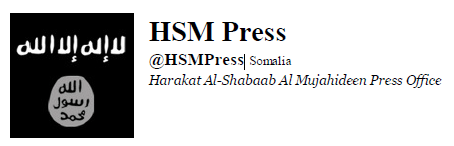
Notice the flag?

It’s that black banner again.

*

There has been some controversy over whether or not there was an element of support for AQ in Libya, and at the recent Tahrir Square demonstrations, and black banners have featured heavily in the discussions.

Let’s get our black banners straight. First, Libya.
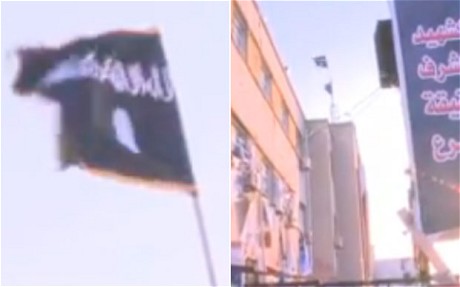
This was the black flag allegedly flown in Libya after the ouster of Col. Gadhafi.  It was published as illustrated here by the Daily Telegraph, under the headline “Libya: Al Qaeda flag flown above Benghazi courthouse” and with the commentary ” The black flag of Al Qaeda has been spotted flying over a public building in Libya, raising concerns that the country could lurch towards Muslim extremism.”

Note the resemblance to the logo al-Shabaab is using.

*

Juan Cole pooh-poohed the idea that this was an AQ flag, calling it a “silly urban legend going around” and quoting a Libyan scholar-friend on the point:

I looked up the mentioned flag, it appears to be a black flag with the shahada [Muslim profession of faith] in it. A black flag goes back all the way to the prophet, and the addition of the shahada makes it a Jihadist flag. There have been Jihadists in Libya from day one, and they fought against Qaddafi. But is Al-Qaeda, as in the global network taking over? No.

Cole’s friend’s comments are worth reading in full: they provide context on the various factions and their relative strengths, and Cole sums it all up in terms of the specific issue of AQ and Benghazi thus:

What this informed observer is saying is that a miniscule group of jihadists put up that flag, in the chaos of the post-revolutionary period, but that they are highly unrepresentative of politics in Benghazi.

Fair enough. But that wasn’t just a black flag with the Shahada, was it?

When Cole’s friend rites “A black flag goes back all the way to the prophet, and the addition of the shahada makes it a Jihadist flag,” Cole comments “Moreover, the black flag as a symbol is not a monopoly of al-Qaeda. Revolutionaries raised a black flag in the medieval Abbasid Revolution of 750 AD.”

Indeed. They may also have produced the ahadith about the army with black banners from Khorasan, which give such flags a distinctively Mahdist application – ahadith which Ali Soufan tells us have been used extensively in AQ recruitment.

So there are black banners and black banners. There was “Khalifa Abdullah’s great black banner, black-lettered with text from the Koran and the Mahdi’s sayings” mentioned in Burleigh‘s account of the Battle of Omdurman – and a little earlier, the Bab had instructed his followers to “gather under the black standard which was being raised in Khurasan” according to Munirih Khanum‘s Memoirs and Letters.

*

Aaron Zelin has a post at The Wasat which allows for a quick comparison between various black flags and banners. Here’s the flag that Aaron identifies as that of the Islamic State of Iraq:

That’s an AQ-related flag, and it distinctly features what is believed to be the seal of Muhammad:

So I wouldn’t be so sure that “No, that wasn’t an al-Qaeda Flag over Benghazi” Dr. Cole.

*

What about Egypt?

In another piece — this one entitled “Did the Muslim Brotherhood Threaten to Kill “All Jews”?” — Dr. Cole wrote:

The Muslim Brotherhood and other religious parties in Egypt (including the Salafis and the Gama’a al-Islamiya) held a rally at al-Husayn Square in Cairo last Friday to which a few thousand people came. The big rally was at Tahrir Square in downtown Cairo and was dominated by secular forces.

Cole is entirely right in rebutting a YNet correspondent’s claim that “a Koran quote vowing that ‘one day we shall kill all the Jews’ was uttered” at the al-Husayn site:

Beck, who clearly does not know what he is talking about, said that the crowd repeatedly quoted a verse in the Qur’an that spoke of killing all Jews. There is no such verse in the Islamic holy book. The Jewish revelation from God to Abraham and Moses is retold in the Qur’an, which has positive stories of the Children of Israel. The castigation of the Children of Israel in the Qur’an is of the same sort you see in the Hebrew Bible, and often put in the mouth of Moses or another Jewish prophet.

Indeed, a commenter on the YNet article from Quebec went further:

Eldad Beck wrote: “Time and again, a Koran quote vowing that ‘one day we shall kill all the Jews’ was uttered at the site”.

There is NO such verse in the Qur’an. In fact, the Qur’an says this:

“Those who believe in the Qur’an, those who follow the Torah and the Sabians and Christians–anyone who believes in G-d and the Last Day and who does righteous deeds need not be in fear and will not grieve.” (5:69)

There were indeed hotheads in the crowd who yelled that they would “fight the Jews (i.e., Israelis)”. If Mr. Beck spoke Arabic fluently, he would not have mistaken the shouted word “mutaqalah” (to fight, combat, overcome) with the word “qatala” (to kill). In addition, he would know that in Palestinian colloquial Arabic “al-yahud” (the Jews) usuallhy has the limited meaning of “the Israelis”.

Sadly the errors (or willful misrepresentations) of Beck have been repeated in dozens if not hundreds of paper and electronic media.

If he made an innocent error, he should apologize and set the record straight.

If not, let him stand before the Mercy Seat of Ha-Shem and explain why he violated the commandment given to Moses: “You shall not bear false witness against your neighbour.”

*

The thing is — getting back to our black banners with Shahada and distinctive seal of Muhammad — there were in fact demonstrations in Tahrir Square just a week earlier, at which those pesky black flags were in evidence:
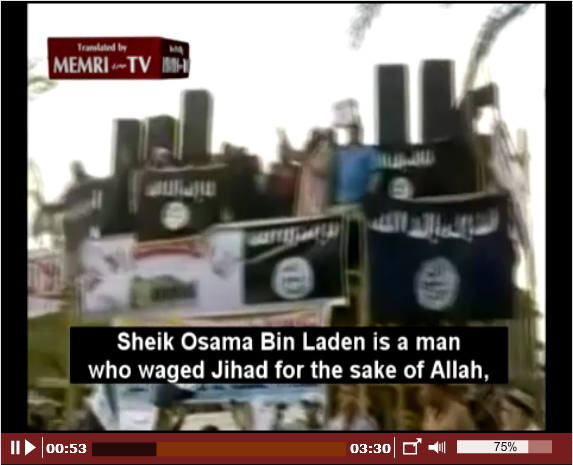
MEMRI brought us the video of which that is a screen-capture, and provided a transcript of Sheikh Tawfiq al-Afni‘s address to the crowd, of which this is an excerpt:

Tawfiq Al-Afni (On stage): ”Sheikh Osama bin Laden is a man who waged Jihad for the sake of Allah, and we pray that Allah will unite us with him and the martyrs in Paradise. My brothers, in Islam, we say with great pride that we adhere to the Jihad for the sake of Allah…”

Crowd: “Allah Akbar.”

Tawfiq Al-Afni: “We are not waging Jihad for worldly benefits or for positions. By Allah, we have only come to pledge our allegiance to Islam. We wage Jihad for the sake of Allah and the Koran. […]

“We respond to Your call. Please turn our skulls into a ladder for your glory.”

Crowd:
“We respond to Your call. Please turn our skulls into a ladder for your glory.”

Black banner, Shahada, seal of Muhammad, Tahrir Square.

*

So it’s important that we should know these things (oh, and much more besides):

  • The black banners are in Tahrir and Somalia, as they have been in Mahdist movements stretching back to the Abbasids.
  • Black banners featuring the seal of Muhammad appear to have a connection with AQ, often indicative of sympathetic support, if not active participation.
  • That such voices exist in Egypt should not make us think that they represent a majority, nor indeed that they are the voice of the Muslim Brotherhood, but rather that they are among the voices raised in a tumultous situation.
  • There are many secular voices raised in Tahrir, and also Islamist voices with a willingness to take the path of politics and compromise.
  • We should remember that there are voices in Tahrir of both terror and reconciliation. We should not forget the voices of those Muslims who protected Coptic churches, nor of the Copts who protected Muslims while they bowed their heads in prayer
  • And no-one, no-one left or right should forget that the Egyptian army, too, has a voice, and a megaphone, and much more besides.

Switch to our mobile site