zenpundit.com » iraq

Archive for the ‘iraq’ Category

The U.S. is Not Going to Disengage from the Mideast

Tuesday, December 16th, 2008

Dave Schuler of the Glittering Eye is involved in a formal debate at Outside the Beltway with Dr. Bernard Finel over the role of the United States in the Mideast. Dr. Finel is arguing for a grand bug-out, or at least a serious reduction in “footprint” and “fingerprint”, and Dave is going to argue the negative.

Here is the introduction by Dave:

Pulling Out: Debating Middle East Disengagement (Intro)

One of my common patterns of thought is to frame any given proposition as a debate proposal, I did so in this specific context, and said as much in the comments to the post. Dr Finel was kind of enough to respond to my comment with enthusiasm, welcoming a debate with me on the subject.

Over the next week or so we’ll be debating the following proposition:

Resolved: that the United States should disengage from the Middle East

Dr. Finel will make the affirmative case; I will provide the negative.

Dr. Finel’s affirmative case will be posted in the next day or so; it will be followed by my cross-examination; I’ll state my negative case; Dr. Finel will cross-examine me; and so on.

Debating is a form seen only occasionally in the blogosphere and I think this is an exciting project. The longer format, extending over multiple posts, will enable us to explore the subject in more detail than is usually found in the hit-and-run blog post. It’s an important topic and, regardless of the immediate situations in Iraq and Afghanistan, is worthy of substantial reflection, rarely seen as a consequence of the poverty of our public discourse which is mainly limited to headlines, op-eds, and sound bites and is often enmeshed in partisan squabbling.

Dr. Finel, who is a senior fellow at the American Security Project, has opened with the following post:

Pulling Out: Debating Middle East Disengagement (Affirmative)

….The second issue is oil. The U.S. presence in the Middle East does serve to reduce some of the risks associated with the Western world’s reliances on Middle Eastern oil. It does not lower the cost necessarily, but it may reduce some potential for volatility in supply. But the cost of this risk mitigation is tremendous. We pay for lowering the supply risk with increased risk of terrorist attacks, greater hostility from the Arab population, and the costs of men and materiel associated with military commitments. Are there other ways to reduce those risks? Of course there are. They include investments in alternative energy, oil exporation at home, better fuel efficiency from cars. Certainly those are costly measures in the short-run, but so is deep involvement in a volatile region. In the long-run, the calculus is easy. Energy independence is a strategic imperative.

This excerpt shortchanges the breadth of Finel’s argument, which you should read in full here.

First, I’d like to commend both gentlemen for making use of the formal debate method. Construction of a reasoned argument in a civil debate is the blogosphere at it’s best. I intend to follow this debate as it evolves.

I know Dave to be a deeply thoughtful, well informed and even tempered commentator. I do not know Dr. Finel, though his c.v. seems impressive to me and he probably has a number of interesting things to say on terrorism policy. As a strategist however, he is not winning me over, though in terms of tactics, he accurately identifies many points of irritation that traditional U.S. policy has for the Arab World. The answer for that irritant is not amputation.

The thesis that regions of the world will move to a better state of polity with an absence of American presence or influence is not “counterintuitive” as Finel suggests – it’s a position lacking in real world evidence. The world’s absolute worst regimes have the least interaction with the United States or with globalization and movements like Islamism have intrinsic drivers, not simple Act-React mechanisms.

Alternate energy sources are a long term – a very long term – solution. In terms of technological application with immediate policy effect, it is the equivalent of Edward Teller’s vision of SDI in 1987. By all means, invest in alternative energy but even throwing $ 100 billion at the problem in fiscal year 2009 is not going to disconnect the United States, much less the West, from oil in 2010 or even 2020. Any reduction in our own oil consumption by the use of alternate energy sources in coming decades will more than be made up by rising Asian demand and the Gulf will increase, rather than decrease, in importance as a geopolitical “choke point”.
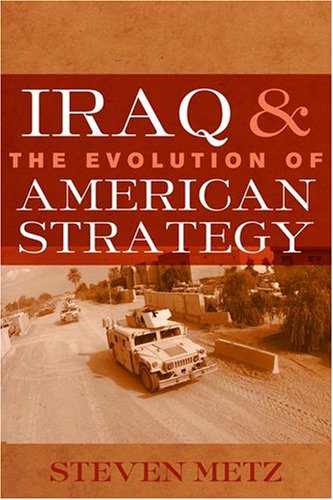
Metz on Iraq and the Evolution of American Strategy

Tuesday, November 25th, 2008

Nothing like a change in administrations to generate a string of excellent books on strategy and national security.

I’ve just ordered Iraq and the Evolution of American Strategy by  Dr. Steven Metz  of the Strategic Studies Institute ( and also of the Small Wars Council ). As I do not yet have a copy of Iraq and the Evolution of American Strategy, which also contains a foreword by Dr. Colin Gray, I will yield the floor to the comment  of Lt. General Paul K. Van Riper:

“Two institutions failed the American people in the run-up to the ongoing war in Iraq. Neither the Congress nor the media provided oversight of the Executive Branch, which is constitutionally required of the first institution and expected of the latter. As a consequence a fundamentally flawed strategy was implemented by an equally flawed military plan. The results have been tragic and costly. Dr. Steven Metz does our nation a great service by exploring the causes of this U.S. strategic debacle, one that may well exceed that of the Vietnam War. Recognizing a problem and its cause are the first steps in setting things right. In this book Dr. Metz identifies the problem, explains what caused it, and most importantly, shows us a better path for the future.”

One for the top of your bookpile.

Austin Bay Interviews General Petraeus

Friday, August 8th, 2008

Austin Bay scored an interview recently with General David Petraeus. For those newer readers not familiar with Austin, he’s a long time blogfriend ( one of my earliest; if I recall correctly, we were also on the H-Diplo listserv together in the pre-blogging era), an author, professor, journalist and Iraq war veteran, where as a colonel in the Army Reserves he commanded an armored unit and was awarded the Bronze Star.

The video of the interview is here ( registration required for the full interview).

A PajamasMedia podcast of the interview can be found here.

Several blog posts by Bay with excerpts from the interview:

Terror Connects to Crime In Iraq: Analysis by General David Petraeus

General Petraeus: “….We have, in fact, put considerable emphasis on how Al-Qaeda, in Iraq, generates resources. And they do it, again, like a mafia does, that we would be familiar with. It’s through extortion of successful businesses; extortion of money for protection rackets, or what have you; insisting that a cell phone business, for example, give them a cut of their profits or they’ll blow the cell phones down – cell phone towers down; taking a cut out of the cement business, the real estate business, the financial businesses, and so forth.
And you see the same on the militia side; although, again, much reduced now and they don’t control the port of Umm Qasr anymore. They don’t control various other elements that they did control until about six to eight months ago.
So progress there. And then beyond that, certainly corruption is a concern and a problem and one that the Iraqis have very much recognized and about which they’re very concerned. They’ve launched an anti-corruption program.
But this is going to be a serious issue. There is considerable money. There is a very young and still very much developing government largely led by individuals who – very good people and good leaders of opposition parties for many years but have not necessarily exercised strategic leadership in the past and very much growing into their jobs but with bureaucracies that are still very much developing as well.”

UPDATE 2: An Interview With General David Petraeus

AUSTIN BAY: Gen. David Petraeus, let’s pick up on your rheostat analogy. You’re giving us a conditions-based approach to assessing victory in a very intricate, complex and long struggle. Now this is an incremental victory-one step up; a half-step back. Enemy action results in a coalition response; coalition actions result in an enemy response. That’s war among human beings. It strikes me that some of those conditions include a sovereign Iraq that is largely responsible for its own internal security, but is also a United States ally. These are some of the conditions mentioned in the Update Strategic Overwatch video at the ArenaUSA.com. That said; if you would, please comment on a sovereign Iraq emerging as a US ally.

Did you get a chance to look at that video?

GENERAL DAVID PETRAEUS: Just briefly, I’m afraid, Austin. But let me just come back to what you just said because the way you stated that is exactly right. It is incremental, and it does have fits and starts. It is this exercise of pushing the stone up a hill, a Sisyphean endeavor at times where you do make two steps up and one step back. Sometimes you get one step up and two steps back.
But, overall, over the course of the past year or so, really since the start of the surge of offenses in particular, that was the large comprehensive offensive launched in June 2007 when we had all of the surge brigades on the ground, since that time, there has been a fairly steady degree of improvement week in/week out, month in/month out. Certainly, again, there have been flare-ups at times. The militia counterattacks, when Prime Minister al-Maliki ordered Iraqi forces and the Basra, were really quite a substantial – more than a flare-up.
But, over time, those were dealt with, more than dealt with, in fact, and very severe losses inflicted on the militia.

 Somehow,  in addition to reporting, Austin  finds the time to write novels,  a syndicated column, blog, give TV interviews and teach undergraduates. I am feeling quite lazy in comparison. LOL!

The Kilcullen Story

Tuesday, July 29th, 2008

A frank but impolitic shorthand assessment of Iraq by one of the fathers of the new American COIN doctrine heated up quickly. Full coverage at SWJ Blog.

Mad Props Department

Wednesday, April 23rd, 2008

A co-worker’s husband, Justin, who happens to be a hell of a nice guy, was just nominated for the Bronze Star. Incidentally, he had bureaucratically manuvered out of a safe and easy stateside assignment in order to lead an infantry platoon in Iraq.

A good dude.


Switch to our mobile site

