Egypt: the conspiracies
Thursday, February 10th, 2011[ by Charles Cameron ]  Zombies! Can’t live without them! Sources: Ursula Lindsey — Steve Benen
[ by Charles Cameron ] Zombies! Can’t live without them! Sources: Ursula Lindsey — Steve Benen
[ by Charles Cameron ]
King Abdullah of Saudi Arabia is currently recovering from two recent surgeries in hospital in the US, may he, may we all be blessed with good health.
1.
Dr. Kamal El-Helbawy of the Centre for the Study of Terrorism in London was quoted yesterday by [Iranian] Press TV as saying that a coup might take place in Saudi Arabia:
“It is possible that a coup could happen, and I see nothing to prevent that from happening,” Dr. Kamal Helbawy of the Center for the Study of Terrorism said in an interview with Press TV aired on Saturday. “Both in Qatar and Oman in the past, the sons of the kings stole the leadership from their fathers, and I think there is a rift in the house of Saud,” he added. [ … ] “With his old age and sickness, there is suspicion about succession. There has been tension in the family for several decades. I believe there is a political and religious crisis,” Helbawy said.
[ h/t Habiba Hamid ]
2.
I have no special insight into the affairs of the Kingdom. I only mention this press report because just today I ran across a reference to the Kuwaiti Shi’ite author Jaber Bolushi and his book [downloadable here in Arabic], Appearance of Imam Mahdi in 2015 — which brings us back to King Abdullah.
We need (IMO) to get used to the idea that every newsworthy event has the potential to spark some kind of reaction in the apocalyptic mind.
I do not wish to suggest that any given event will necessarily spark a Mahdist response — just that it may — and that we should therefore keep tabs on Mahdist and messianic sentiment in general, and note carefully what “signs of the times” might prove persuasive to those who seek such things.
3.
The Sunni site where I found Bolushi’s book mentioned, contained the following among a list of “signs” of the soon-coming of the Mahdi:
Death of King Abdullah of Saudi Arabia (we wish him long life) in 2015: The Shia believe that King Abdullah will be the last king of the House of Saud before the appearance of the Mahdi. Jaber Bolushi cites a Hadith attributed to Prophet Mohammad [saw] (the Shia claim this Hadith used to be reported in Musnad Ahmad, but was later removed) in which the Prophet mentions that the last man who will govern Al-Hijaz (the region that includes Mecca & Medina) before the Mahdi will be called Abdullah and he will be the successor of his brother who is named by the name of an animal. The previous king of Saudi Arabia was King Fahd (Fahd means leopard). It is worth noting that King Abdullah is currently 84 years old. After he dies, a dispute will occur among the royal family as to who should succeed him. There will be a strife and blood shed. Then, people will search for the Mahdi and offer him allegiance between Rukun and Maqam in the Haram Masjid in Mecca.
4.
My point is not to discuss the health of King Abdullah – I wish him well – nor the specifics of this particular prophecy – date-setting seems to me to be a fool’s errand, even according to the scriptures of the various religions where it is practiced.
My point, again, is that today’s news – whatever it is — will be “read” and understood within dozens of conflicting apocalyptic contexts, most of which we are in general unaware of, with possible repercussions on the world stage that may therefore take us by surprise.
5.
Jean-Pierre Filiu in his recently published book, Apocalypse in Islam, writes that:
ambitious militia leaders, such as Muqtada al-Sadr in Iraq and Hasan Nasrallah in Lebanon, consciously exploit popular messianic feeling in order to assert their authority at the expense of the Shi’i clerical establishment, without allowing themselves to fall captive to apocalyptic rhetoric. [ … ] For the moment, only the Iraqi militia known as the Supporters of the Imam Mahdi has actively sought to translate the rise of eschatological anxiety into political action. Yet one day a larger and more resourceful group, eager (like Abu Musab al-Suri) to tap the energy of the “masses” as a way of achieving superiority over rival formations, may be strongly tempted to resort to the messianic gambit. An appeal to the imminence of apocalypse would provide it with an instrument of recruitment, a framework for interpreting future developments, and a way of refashioning and consolidating its own identity. In combination, these things could have far-reaching and deadly consequences.
That’s the point.
Charles Cameron is the regular guest-blogger at Zenpundit, and has also posted at Small Wars Journal, All Things Counterterrorism, for the Chicago Boyz Afghanistan 2050 roundtable and elsewhere. Charles read Theology at Christ Church, Oxford, under AE Harvey, and was at one time a Principal Researcher with Boston University’s Center for Millennial Studies and the Senior Analyst with the Arlington Institute:
Originally posted at Chicago Boyz.com
Of Weaponry and Flags
by Charles Cameron
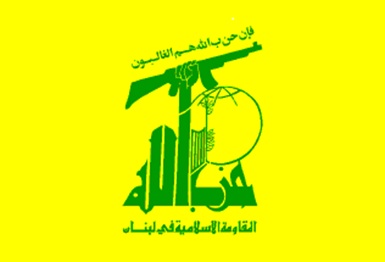
A day or two ago, Abu Muqawama asked whether the Hizballah flag showed an AK-47, and in general what flags carried what weapons as emblems.
As it happens, I’d just been viewing a pro-jihadist United States of Islam video and made the following screen-capture as an illustration of my continuing concern about the “black flags of Khorasan” and the issue of whether AQ and or its franchises and or portions of the Taliban consider themselves to be fighting the apocalyptic war of the end of time.
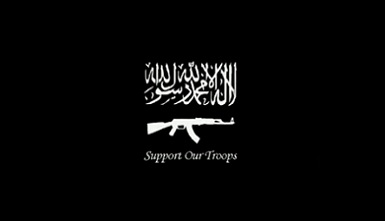
Note also that the filmmaker’s ironic borrowing of the phrase “Support Our Troops” to urge support of the troops of the Mahdi will not be lost on some viewers.
This screen-capture, from the United States of Islam video, in turn reminded reminded me of the Saudi flag, which likewise carries the shahada or Muslim profession of faith and a weapon – a sword.
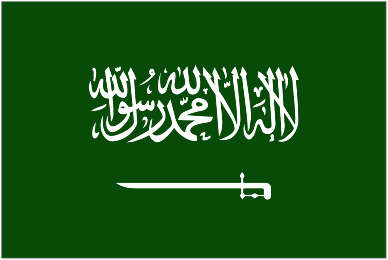
According to a note on an earlier version of the World Flag Database:
The script in the centre of the flag is the Islamic creed, “There is no God but Allah, and Mohammed is the Prophet of Allah”. The flag is therefore considered sacred and special protocol rules apply: the flag does not dip in salute, nor is it ever flown at half-mast. Note that the creed always reads properly from right to left, with the sword hilt to the right, so the reverse of the flag is not a mirror image of the obverse. When making the flag, the creed must be reproduced precisely, including the accent marks. The use of the flag on any commercial item (especially clothing) is not recommended as it might be considered inappropriate, or even insulting.
The Shahada is the central testament of faith of Islam, as is the Shema Yisroel of Judaism and the Credo of Christianity, and I respect it as such – and likewise the Saudi flag., on which it is displayed.
*
Flags, however, are potent symbols, and the graphical power of the “black flags of Khorasan” motif should not, in my view, be underestimated. The particular video that I took that screen-capture from makes use of “mix” flags of its own devising:
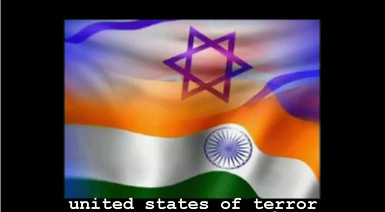
– merging the American and Indian flags – or the flags of India and Israel –
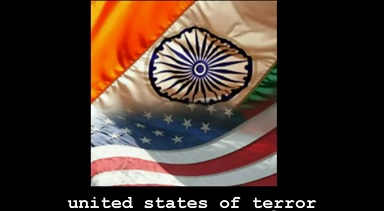
to create an imagery of the “United States of Terror” to juxtapose against their own black flags as the “United States of Islam” – giving us Huntington’s “Clash of Civilizations” in visceral graphic form.
And that conjunction of India with Israel bears thinking about, too… not only in terms of military aid between the two nations, but also of the symbolic juxtaposition of the Al-Aqsa Mosque and Jerusalem with the Babri Masjid and Ayodhya…
Indeed, the Indian flag itself also deserves consideration in our context.
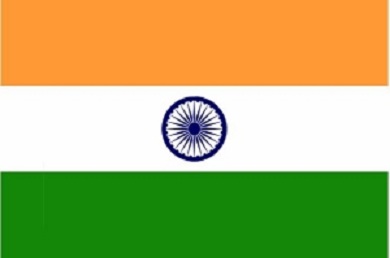
Originally, Mahatma Gandhi had hoped that it would feature the charka or spinning wheel which he had made famous. As an informative article on the subject from The Hindu puts it:
For Gandhiji, the charka represented not a mere hand-spinning device that could provide employment and income to the poor, but much more. “The message of the spinning-wheel is much wider than its circumference. Its message is one of simplicity, service of mankind, living so as not to hurt others, creating an indissoluble bond between the rich and the poor, capital and labour, the prince and the peasant.” (Young India, September 17, 1925). “Above all, charka is a symbol of non-violence” (Collected Works of Mahatma Gandhi, Vol. 71, first edition, p.234).Gandhiji was, therefore, all the more sad when a correspondent from Hyderabad brought to his notice, on the eve of Independence, K. M. Munshi’s indictment in his broadcast speech that the wheel in the new flag represented the Sudarshana Chakra (discus of Lord Vishnu), a symbol of violence! But Gandhiji consoled himself that “under no circumstances, can the Asoka Chakra become a symbol of violence as Emperor Asoka was a Buddhist and a votary of non-violence” (Harijan Sevak, August 17, 1947).
So there’s another weapon-flag connection – albeit one where non-violence seems to triumph over violence.
*
But let me get back to the yellow Hizbollah flag with which we started, and quickly note the resemblance (which I don’t claim to be the first to note, but cannot presently find my source for) between its portrayal of a rifle raised in a victorious fist, and this poster from the Irgun:
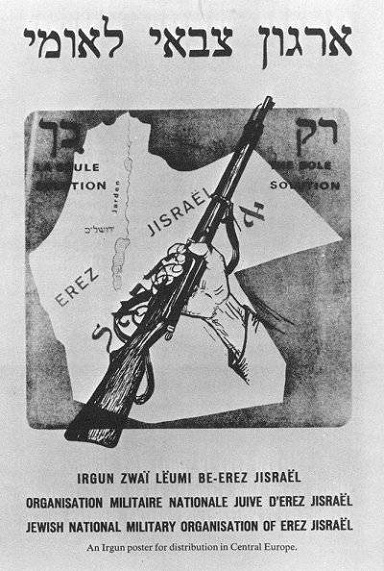
And that’s enough about weaponry and flags for now, I think.
I hope to follow this post up shortly with a more detailed account of the United States of Islam video mentioned above, and its many and curious references and resonances.
THE 4GW ANTI-STATE

“al Qaidastan” Rising
Fourth Generation Warfare, according to it’s leading theorists, is designed to challenge the legitimacy of the state. It’s “kinetic” attacks are really a form of ju-jitsu designed to strike the enemy society at the mental and moral levels and thereby cripple the state apparatus through which modern nation-states govern themselves.
Repeated successful mitary forays by 4GW entities, perhaps in alliance with local ethnic and criminal organizations, can create a “TAZ” or temporary autonomous zone, outside the rule of law. “Temporary” is a useful descriptor because, frequently, police, paramilitary or Army units are able to “re-take” the TAZ from 4GW control because these decentralized forces melt away, go underground or shift to a less direct form of conflict such as system disruption or the use of IED type munitions.
However, there are now enough examples of recent vintage to tentatively answer the question of what happens when a TAZ under the domination of a 4GW group slides toward permanency? Al Qaida, is now doing so for the second time in it’s history, as detailed by Pramit Pal Chaudhuri:
On September 6 the Islamic Emirate of Waziristan marked the first anniversary of its de facto recognition. On that day last year, the Taliban used the name when it signed a ceasefire agreement with the Pakistani government. The ceasefire is in tatters, but the terror trail of the recent plots in Germany and Denmark indicates that the Emirate is doing fine.
The Emirate’s writ is spreading among the mountainous areas that make up the Federally Administered Tribal Areas (FATA) that run along the Pakistan-Afghan border. Going by trends, the Emirate is more than just a safe haven: It is on a nightmare path of nation-building. Osama bin Laden will be its sultan; Mullah Omar its spiritual leader; heroin and smuggling its economic drivers; and terrorism its primary export. “Al Qaeda is building a mini-state, an enclave, in the FATA,” says Rohan Gunaratna, author of Inside al Qaeda.
Besides the heartland of South and North Waziristan, “al Qaedastan” also encompasses a belt of tribal land going up to Mohmand and Bajaur areas. Its sphere of violent influence, says a former member of the Afghan National Security Council, includes bordering Afghan provinces like Loya Paktia and, increasingly, Nangarhar…
…The malik, a local chief who helped keep the peace since the British Raj, and represented an older secular Pashtun nationalism, has been marginalized. The mullah now holds sway. “The Durrani tribal maliki that once dominated these areas is being physically eradicated,” says Michael Shaikh of the International Crisis Group.
Some argue this is nothing more than Durrani nobility being replaced by an upstart subtribe, the Ghilzai. But the spread of Islamicism is blurring tribal distinctions. “Today’s Taliban are fighting for an extremist ideology, not for Ghilzai supremacy,” says an Afghan official. An example of how this ideology is taking root is how it has ended the centuries-old feuds between the Waziri and Mehsud subtribes.
The “al Qaedaization” of the Taliban can be seen in their use of suicide bombing, human shields and bloodier kidnappings, practices abhorrent in traditional Pashtun culture. The Afghan government has no doubt this represents foreign tutelage. Says the Afghan ambassador to the U.S., Said Tayeb Jawad: “Al Qaeda is the commander, the Taliban the foot soldier. Al Qaeda provides strategic guidance“
William Lind, during the Israeli-Hezbollah War, suggested that after having attained a critical mass of legitimacy through sustained political-military success, 4GW organizations faced a choice of “To Be or Not To Be, a State“. Lind argued that statehood was equivalent with vulnerable “targetability” and that Westphalian-era mummery was something that 4GW forces could best do without.
To an extent, Lind was correct. Neither Hezbollah, nor the Islamic Courts Union, HAMAS, al Qaida or even the Taliban during the period of their rule of Afghanistan, have ever formed a proper and recognized state apparatus. Nor have they, when enjoying longer-term territorial control, remained covert guerilla-terrorist networks either. Instead, they have tried to lock in their comparative advantages with an Anti-State model existing alongside or symbiotically integrated with, the sovereign state.
The 4GW Anti-State has certain recognizable characteristics or tendencies:
*Corporative: The 4GW organization openly lives by it’s own codes, not the state’s, with final authority for enforcement. The 4GW entity may impose these codes on the people over whom they exist (Taliban), or apply them primarily to their own membership (HAMAS) but the state has de facto ceded that prerogative.
*Post-Westphalian: The borders and claims of the nation-state are irrelevant, whether we are discussing a Pushtunistan-based “al Qaidastan” that crosses the Durand Line or a Transnational Criminal Organization network like a Russian mafiya clan with cells under discipline from Novgorod to Brighton Beach to Budapest to Tel Aviv. The 4GW Anti-State can be geographic or virtual as the primary loyalty attachment for the membership is a psychological and social one.
*Hegemonic Governance: The 4GW entity frequently, as HAMAS and Hezbollah have amply demonstrated, provide a sophisticated array of public goods and other services, often free of charge, in order to cultivate political legitimacy among the larger population. They do not accept all of the de jure responsibilities for the local population that are normally traditional for a rcognized sovereign and suppress rival authorities or independent-minded individuals with arbitrary force. In matters outside of the interests of the 4GW entity, residents are left to their own devices ( or the mercy of smaller predators) so that resources are conserved.
*Symbiotic Coexistence: The 4GW group is shielded, to a degree, from international intervention by coexisting within the confines of a recognized and sovereign nation-state that is unwilling (Sudan, Iran) or unable (Afghanistan, Pakistan, Lebanon, Iraq) to bring them to heel and even more unwilling to let outsiders do so. Like a parasite, a 4GW entity, if unchecked, is capable of hijacking it’s host nation-state to serve it’s own needs as al Qaida did in Afghanistan before 9/11.
The Anti-State model is useful for 4GW forces at a certain threshold of magnitude because it offers some of the defensive advantages of statehood with far fewer of the responsibilities or liabilities with running a state.
UPDATE:
John Robb was kind enough to link and had this comment:
“Mark, over at ZenPundit, has an excellent (!) post on the virtual-state (not sure that 4GW, as a description of a form of warfare, works as a label for this). “
Thanks, John! I’m not sure it works either – LOL! An explanation though:
I used “4GW” primarily because I was interested in how such movements are developing semi-permanent, alternative, forms of governance to the nation-state. Bobbitt’s “Virtual-State” could work well in many instances for what 4GW forces are in a structural or behavioral sense but the term also has broader application.
Then there is also the issue where 4GW entity is overlapping pre-modern (at times, ancient), subnational, territorial/tribal identities that are the very antithesis of “the state”. A schizoid hybrid, if you will. The analogy can be misleading because these phenomena have aspects that are very unlike the state of Max Weber, despite usurping some of the functions, so I used ” Anti-State”. I’m not wedded to the term yet as the whole issue needs more fleshing out and discussion (and as Fabius noted in the comments, empirical investigation).

Zenpundit is a blog dedicated to exploring the intersections of foreign policy, history, military theory, national security,strategic thinking, futurism, cognition and a number of other esoteric pursuits.
Customized Web Site & Blog Design

