zenpundit.com » propaganda

Archive for the ‘propaganda’ Category

Why [still] bother with Breivik?

Friday, August 5th, 2011

[ by Charles Cameron — popular opinion, informed decision-making, journalism and analysis in reference to Oslo / Utoya ]

.

At least two regulars here on ZP, Cheryl Rofer and Joey, have wondered whether it’s even worth bothering to track Anders Breivik’s thought — fifteen hundred pages of cut and paste from all across the web, interspersed with page after page of his own musings.

Joey wrote, “I’m not sure this guy deserves the kind of close analysis he is getting” — and Cheryl:

I’m not at all sure that examining his “writings” tells us much beyond that these themes have been pulled into a particular orbit of hating. What might be interesting is why those themes have been found so suitable for that purpose.

I believe that tracking Breivik’s thought processes are important for two main reasons, and for two main audiences: the general public (and by extension the journalists who inform them), and policy makers, military and civilian (and thus also the intel analysts who brief them).

1: media and public

It’s important for the general public not to be left with the wrong impression, specifically as regards who or what is to blame — so that the events in Oslo do not contribute to a further deterioration in public debate.

There are a number of ongoing public conversations around Islam, Islamophobia, Christianity, the clash of cultures, the “socialist” left or “fascist” right, the media, the internet, the pernicious effect of gaming, etc., where it’s not just useful but necessary to establish some clarity on what can and cannot fairly be said about Brevik — who he was, who influenced him, who ignored him, who publicized him, who he really hated, whether he was simply mad, and above all, whose fault “it” was.

And as always the truth is more nuanced than black and white – so that in all this morass of claims and counterclaims, there are slippery slopes to be avoided, and significant distinctions to be drawn..

2: analysts and policy makers

There are also a number of areas of intel analysis where his writings may provide significant leads, and where intelligent intelligence (forgive the play on worlds) is at a premium.

As an example, I have suggested that just as it’s important to know the history of the far enemy and global jihad concepts in studying contemporary jihadism, it would be helpful to know if Breivik’s manifesto is the first place where Hindutva and Odinist and militant Christian and Masonic strands have been brought together in what I can only call an “ecumenical” manner.

I’ve no doubt some of this is of importance to those whose job it is to prosecute or defend Breivik himself: but it’s the significance Breivik has as a marker of otherwise barely detected currents of thought — “undertows” in my personal shorthand — and of the fact that such currents can now easily connect across the net to create an increased complexity of the unexpected, that most concerns me.

*

By now, most of the specific groups and individuals mentioned by Breivik have been identified, and those with specific interest in them have taken note: thus the Indian press has reported on his interest in Hindutva and quotations from Sita Ram Goel, both the UN-recognized “International Templar Order” and his own Masonic order have disowned him, and so on – so there’s no point in my posting separate comments on the role of the Hindutva movement in his thinking, nor of his fascination with the Templars and their symbolic presence in other places of interest such as Joseph Di Mambro and Luc Jouret‘s Order of the Solar Temple (locus of mass suicides/murders in France, Switzlerland and Quebec, 1994), or more recently the Michoacan La Familia cartel offshoot Los Templarios – a link which John Robb was one of the first to make…

ap-templar-09-small.jpg

Mexico, not Norway…

I will, however, post two more roundups of articles: one of pieces that strike me as outliers from the usual media coverage, touching on some of these specifics, the other noting the most thoughtful and informed coverage I have seen from scholars of religion.

I offer these as resources for those who have good reason for continuing interest in Breivik, in the hope that they may turn up some data points that are illuminating when connected — but also to help correct some of the erroneous linkages that have already been made.

*

I am also hoping to make a post here shortly on Romanticism and the significance of myths, rituals and dreams — focusing mainly on the recent Requiem and obsequies for Otto von Habsburg, but with, I suspect, relevance to a strong romantic streak in Breivik, too…
2083 — Breivik and the Qur’an, deception and warfare

Wednesday, July 27th, 2011

[ by Charles Cameron — deception and warfare, analysis of 2083 manifesto ]

.

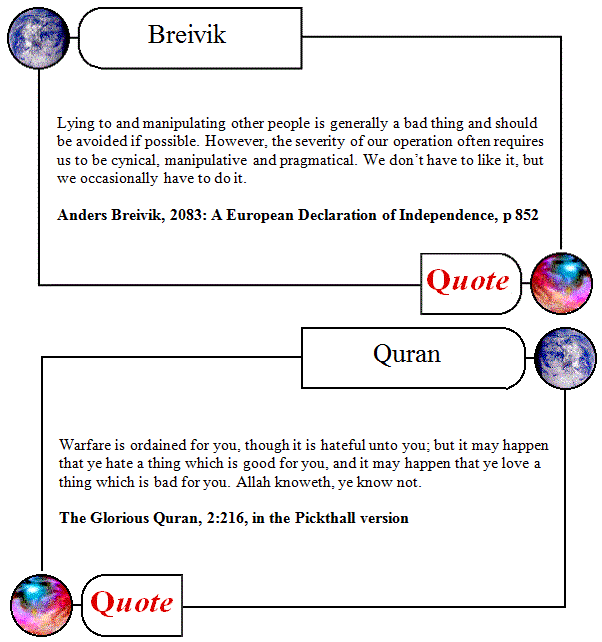
breivik-and-quran.gif

The parallelism of interest here is between two versions of “sometimes you must do what you dislike”.

.

In case anyone might object that Breivik is “only” talking about lying while the Qur’an is speaks of warfare, however, a reminder might be in order that Breivik was in fact waging a crusade and taking numerous lives in accordance with his own rhetoric, and also that one of the aspects of Islam that he most emphasizes is that it permits lying — see (eg) his comments on Taqiyya, section 1.5, p. 78, and his repeated use of the hadith from Bukhari (vol 4, book 52, # 269):

Narrated Jabir bin ‘Abdullah: The Prophet said, “War is deceit.”

2083 Graphics — the badge of the Justiciar Knight

Wednesday, July 27th, 2011

[ by Charles Cameron — graphic from 2038 manifesto ]

.

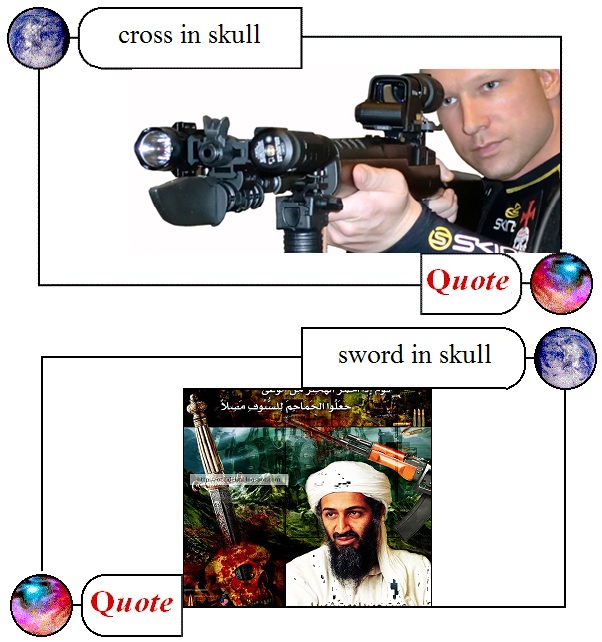
Earlier today, I posted a detail from a portrait of Anders Breivik and commented on the cross in skull motif.

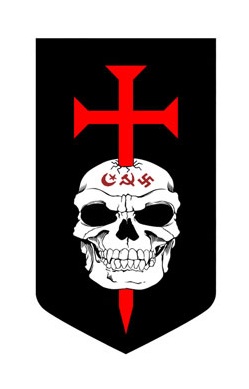
Breivik’s manifesto has a section on medals, regalia and uniforms, and there’s a subsection there titled The badge of the Justiciar Knight, which presents the following image (p. 1101.):

skull.jpg

accompanied by this text:

The badge of the Justiciar Knight illustrates a white skull, marked with the symbols of communism, Islam and Nazism on the forehead, impaled on the cross of the martyrs. The background is black. The badge of the Justiciar Knight illustrates our patriotic struggle/ opposition against all three primary hate ideologies of our time: Islam, Multiculturalism (Communism) and Nazism.

The badge of the Justiciar Knight is worn on the left upper arm while the national flag is worn on the right upper arm.

Our military uniform with commendations, insignia and badges should be worn during the trial after a successful operation in cases where the Justiciar Knight survives. The commendations and insignias should be provided post-operation by an Overseer.

In smaller print, Breivik adds:

I ordered two badges from: Indian Art Company (indianartco@gmail.com). They have a high resolution image on file (file name: dagger and skull). The two badges cost me a total of 220 USD (150 USD for badges and another 70 USD for Fedex shipping).

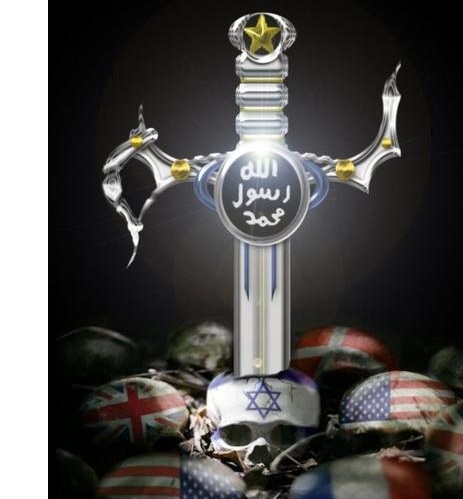
For what it’s worth, I’ve also found another fairly interesting sword in skull graphic:

48721.jpg

This one can be found in at least a dozen places on the web, and was apparently used by “DNS Team” hackers to deface an Israeli commercial website in January 2009.

2083 Graphics — a couple of details

Tuesday, July 26th, 2011

[ by Charles Cameron – graphic from 2038 manifesto compared with UBL martyr graphic & US “hunting permit” ]

.

I should say first off that I am grateful to Chris Anzalone aka Ibn Siqilli for his “In Pictures” series of posts of Islamist and related graphics, and especially his “martyrsseries, all which inspired my own first post on 2038 graphics a couple of days back.

It was his post on “Usama bin Laden, the Martyr, As Seen in Jihadi-Takfiri Artwork” today that gave me the idea for this post, when I noticed something familiar-but-different in one of the bin Laden graphics, and went back to check the portraits of Anders Breivik at the end of the 2083 manifesto.

Let’s call this pair of images Symbolic Analogy:

dq-symbolic-analogy.jpg

Once you start looking at the details, of course, other things pop out…

Like these two Hunting Permits:

dq-hunting-permits.jpg

As they say on this eHow page on How To Identify Military Insignia:

Military insignia make for good collector’s items because there are a variety of patches and badges, many with interesting, funny or bizarre imagery. If you happen to inherit some insignia, or a patch at a flea market or antique store catches your eye, identifying your treasure could take some work. Before you take your insignia for a professional appraisal, see if you can figure out what it is on your own. …

Examine your military insignia and note every detail. Figure out what the imagery is, whether you are looking at a pirate or unicorn, and whether it is a fabric patch or metal badge. Take special notice of any text or numbers on your insignia, even if you can’t understand them.

Guest Post: John R Hall: “Norway’s cultural Christian apocalyptic crusader?”

Monday, July 25th, 2011

Blog-friend John R. Hall is a Professor of Sociology at the University of California – Davis, and the author of such books as Gone from the Promised Land: Jonestown in American Cultural History; Apocalypse Observed: Religious Movements and Violence in North America, Europe, and Japan with Philip D. Schuyler and Sylvaine Trinh; and Apocalypse: From Antiquity to the Empire of Modernity. His current research involves deploying a social phenomenology to retheorize modernity in relation to contemporary society.

David Ronfeldt suggested that John’s long and detailed remarks taking off from my own post, 2083 Graphics – a first look, deserved to be a post in its own right and not be lost in the comments section, and with Zen’s approval, I am delighted to present it here as Dr Hall’s first Zenpundit guest-post. — Charles Cameron

___________________________________________________________________________________________

I have just completed a very preliminary examination of the Norwegian manifesto posted just before the Oslo bombings. It is an astonishing and significant document, far from the incoherent ravings of a mad person, as I would wish it to be. And it is incredibly chilling in its ruthless rationality and relative coherence. Here, I offer some initial reflections. I have concentrated on the portions from page 717 forward, where the author details ideology, revolutionary strategy, and utopian vision of a future, federated Europe. Beginning on p. 1388, the author offers an autobiography and c.v. of Breivik, which presumably will be checked out by investigators and the media, plus a quite detailed account of his actions over the past several years. A number of important comparisons already have been made – to al Qaida and the Oklahoma City bombing, for example. But in many ways, if the perpetrator indeed acted alone, he is something of a piece with the Unabomber, who similarly combined ruthless action with a carefully elaborated manifesto. There are important difference, to be sure. In particular, the Unabomber worked to conceal his identity so that he could carry out multiple actions, and he operated out of an environmental left ideology rather than a Christian nationalism.

The latter part of the document depicts its account of pre-emptive war as a new mode of writing, exploring scenarios rather than writing fiction or history, thereby claiming to eliminate its usefulness to authorities seeking to use it as evidence when bringing charges against the author or a perpetrator of the acts it describes.

As others already have commented, the label of ‘Christian fundamentalist’ seems wrong, at least in conventional use of the term today. Certainly the author represents himself as a nationalist/European federalist conservative opposed to ‘cultural genocide’ of the Enlightenment West, and seemingly he proposes reinstitution of monarchy as more representative of a nation than democracy can be. Only very late in the missive, p. 1134, does he embrace Europe’s return to the traditional Catholic Church, for its apostolic succession of authority and its capacity to guide believers in matters of scripture. This development is to be coupled with a re-initation of patriarchy, developed in substantial detail (p. 1141ff.), and concern about ‘the ongoing genocide of the Nordic tribes’ and a discussion of its genetic basis and the dangers of miscegenation and sexual promiscuity (including a discussion of ‘erotic capital,’ leading to a frank discussion of the possibility that the state could ‘play an essential role in national reproduction’ (p. 1157ff.; quote, p. 1185). The treatise goes on to mention future education, economic, pollution-control, population-control, crime, cultural/anti-multicultural, deportation, and youth policies, as well as discussing financing an organization, categories of traitors (A, B, and C). In short, it is a comprehensive (in Mannheim’s terms) ‘utopian’ vision, i.e., one that could never be realized in the world as it is presently institutionalized.

Yet there is certainly a basis for recognizing the claims of a ‘Christian’ basis for the ideology, and a religious fundamentalism as well. This latter claim, I make in relation to Martin Riesebrodt’s important comparative study of U.S. Protestantism at the dawn of the twentieth century and Iranian fundamentalism 70 years later or so – both of them strongly based in an ideology of patriarchy, as is the Oslo killer’s manifesto (A Pious Passion, U. California Press, 1993).

Yet this is not simply ideological quasi-religious fundamentalism/nationalism. Rather, the utopian program has all the markings of an apocalyptic crusader, and more generally, the apocalyptic warring sect that I described in Apocalypse (Polity, 2009). The lever by which the author makes contact with Christianity (beyond its status as the cultural basis of European civilization, is a modern-day ‘PCCTS, Knights Templar’ struggle to initiate a European ‘civil war’ against ‘enablers’ – cultural marxists and multiculturalists who are ‘aiding and abetting’ cultural genocide, most significantly in efforts to accommodate Islam within Europe. The challenge, as the author sees it, seems to be to eliminate Islamic migration to Europe, assimilate or force emigration of Muslims, and to excise all Islamist or Arab influenced culture, art, and architecture from European countries. The Knights Templar, described as an ‘ancient Christian European military order,’ is being re-founded not by Christians alone, but by 12 individuals, including a ‘Christian atheist’ and a ‘Christian agnostic.’ Eventually, p. 1309, the manifesto is clear that its appeal is to ‘cultural Christians,’ although it invokes the Bible and Church crusading history, especially the work of Bernard de Clairvaux, to justify the contemporary initiative. One of many elements is the crucial proposal to engage in asymmetric warfare – a vein that is classically that of the apocalyptic warring sect, using a ‘clandestine cell organization,’ combining the rhetoric of ultimate belief in a cause with the cold, rational logic of how to operate. In considerable detail, the manifesto outlines a mode of operations that foreshadows the actions in and near Oslo, including the chilling note, page 886, that it will take ‘the SWAT team 10 – 40 minutes to reach you,’ and therefore, it is worthwhile to divide up the components of a planned action accordingly.Similarly, the author mentions, p. 995, ‘announcing your operation’ ‘only seconds before you initiate’ it, and suggests, p. 927, ‘hide a knife behind a smile,’ a recommendation, along with subsequent ones, that foreshadows the killer’s use of a police uniform and a story about helping to ensure the safety of the island camp participants before beginning to slay them – a technique that he used twice, in different places on the island.

In a variety of passages, the document offers a detailed handbook of asymmetric operations of war, including attacks and sabotage, and evaluation of a variety of targets, accompanied by a detailed catalogue of equipment, weapons (including bombs made from fertilizer – see esp. p. 1015), and armor, where to buy materials, and how to create weapons, detailed discussions of chemical, biological assaults, and attacks on nuclear reactors, as well as dietary recommendations, and an outline of a training regimen, recommendations concerning alliances with certain criminal networks [a theme that reprises the analysis of Eric Hobsbawm that I cited several weeks ago].

The author also announces that the apprehension of a Knights Templar is not the end of the operation: it ‘will mark the initiation of the propaganda phase’ (p. 948), and afterward, the task will be one of ‘countering the misinformation campaign’ (p. 1073), and comments on the use of trial opening and concluding statements for propaganda purposes (p. 1108-14). Alternatively, if you die, you will live on as a martyr in the memory of those carrying on the cause.

The scope of the publication is almost encyclopedic. It also includes historical analysis of how the past millennium of European history lead to the present crisis and need for re-formation of the Knights Templar, as well as a sketch of the umbrella organization, membership, military uniforms for dress occasions, medals, appropriate tombstones, a proposal for subsequent compensation (upon victory) for people who contribute to the resistance movement (a sort of rational-choice approach to mobilizing supporters), and on and on.

In short, the document envisions apocalyptic war as the means to reach a new European conservative/nationalist/Christian utopia. Yet unlike many other visions of apocalyptic war, this manifesto goes far toward detailing what that utopian world would look like. Even if, as it seems, this action is that of a lone individual, it is a dangerous development that we ignore at our peril.

John Hall


Switch to our mobile site