zenpundit.com » myth

Archive for the ‘myth’ Category

Creativity and the laughable

Monday, May 16th, 2011

[ by Charles Cameron — creativity, Taliban, Leonardo, pareidolia, Virgin Mary, Kwan-yin ]
*

.
Sharing, as I do with Zen, a keen interest in the creative process, I am used to the idea that an idea that seems trivial at first, the very expression of which risks making oneself a laughing-stock, may well carry the seed of success.

Whitehead is quoted as saying, “Every really new idea looks crazy at first.” Einstein, “If at first the idea is not absurd, then there is no hope for it.” Nils Bohr, “Your theory is crazy, but it’s not crazy enough to be true.” The idea is not even confined to physicists and mathematicians. Mark Twain observed, “The man with a new idea is a crank – until the idea succeeds.” And Winston Churchill, “No idea is so outlandish that it should not be considered with a searching but at the same time steady eye.”

I was therefore intrigued to read this account of the origins of the Taliban’s recent Kandahar prison break:

One of the surprising mujahideen squad in the city of Kandahar, who by his connections gained full knowledge of the inside and outside of the prison, pondered one day whether it could be possible to dig a tunnel from the inside of a house on the other side of the street to the prison as a means to releasing the prisoners. This fantasy and imagination seemed laughable at first even to its owner; he dared not share his opinion with others. But, after more time and continued thinking, he reached a conclusion. On one of these days, while he was riding a motorcycle with two of his comrades, he shared that view with them. They thought it impossible initially and deemed it a fruitless, dangerous attempt. Finally, they placed their trust on God and shared their opinion with the mujahideen high command in Kandahar. With guidelines from the command, the aforementioned four revealed [to] their trusted comrades their decision to implement this plan regardless of its risks and even if it looked impossible.

The sentence that really got my attention was this one:

This fantasy and imagination seemed laughable at first even to its owner; he dared not share his opinion with others.

*

Leonardo da Vinci once wrote of having “a new and speculative idea, which although it may seem trivial and almost laughable, is none the less of great value in quickening the spirit of the invention.”

His “trivial and almost laughable” idea?

It is this: that you should look at certain walls stained with damp or at stones of uneven colour. If you have to invent some setting you will be able to see in these the likeness of divine landscapes, adorned with mountains, ruins, rocks, woods, great plains, hills and valleys in great variety; and then again you will see there battles and strange figures in violent action, expressions of faces and clothes and an infinity of things which you will be able to reduce to their complete and proper forms. In such walls the same thing happens as in the sound of bells, in whose strokes you may find every word which you can imagine.

Essentially, Leonardo is suggesting that we use what’s effectively the Rorschach technique to induce pareidolia (I think that’s the state) and elicit mental contents – images triggered by the mind’s eagerness to sense meaning – thus imitating the universe itself in bringing something out of nothing, out of the potent void.

*

This is, however, the same psychological mechanism that brought us the sale of a grilled cheese sandwich for $28,000 on eBay – because it “looked like” the Virgin Mary

That’s not a note I’d like to end on, however — so I’ll just remind myself that we don’t “know” what the Virgin Mary looks like, and pass on to the rather charming story of a similar pareidolic image, this one possessing the almost miraculous property of looking simultaneously like the Blessed Virgin and the bodhisattva of compassion, Kuan-Yin:

Situated in the East Bay area, near the lovely city of San Francisco, the Purple Lotus School is witnessing yet another miracle. … In April 1996, when the great “Merit Wall” on campus had just been constructed, a mysterious face appeared on the wall immediately after the cement dried. … Buddhists who have witnessed this phenomenon believe this to be the face of the compassionate Bodhisattva Kuan-Yin. … Others have believed this image to be that of the Virgin Mary. Magia and Junia Chou, the daughters of the Purple Lotus Society’s Master Samantha Chou, attend a Catholic elementary school. Upon seeing the image, both called out earnestly and delightedly, “Look! It’s the Virgin Mary!” … With the essence of Enlightenment and universal wisdom in mind, perhaps one can argue that a distinction between the two is not important after all.

*

It’s laughable, I know — but I must confess I like the “meaning” I can draw from that…
Recommended reading — in stereo

Wednesday, May 11th, 2011

[ By Charles Cameron ]
.
quo-dark-side-of-force.jpg

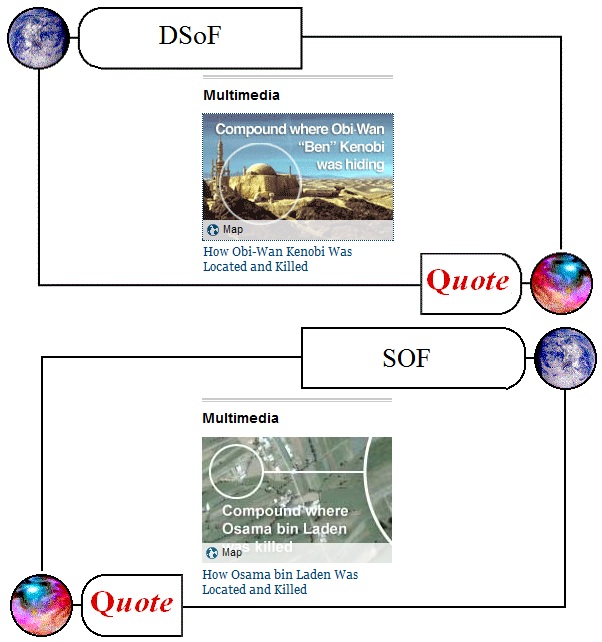
I’m always on about the power of polyphonic thinking, right? Okay, IMO, these two pieces are well worth reading in stereo:

http://www.galacticempiretimes.com/2011/05/09/galaxy/outer-rim/obi-wan-kenobi-is-killed.html
http://www.nytimes.com/2011/05/02/world/asia/osama-bin-laden-is-killed.html

h/t @abumuqawama

The DARPA arts

Friday, April 29th, 2011

[ by Charles Cameron ]

.

Blog-friend Cameron Schaefer has a piece up at Small Wars Journal today in which he quotes Boyd (writing that his approach “incorporated science, but more closely approximated the often chaotic, creative impulses of art”) and Mahan (“art, out of materials which it finds about, creates new forms in endless variety”), and concludes:

Approaching strategy in an indirect fashion, as more of an art than science may make some uneasy, specifically those who find safe haven in the concreteness of checklists and formulas. Yet, the nature of strategy reflects the nature of the world. It is infinitely complex, it is always changing and it is filled with humans that often do irrational things. Literature (see Charles Hill) and psychology have as much of a place at the strategy table as military history… as do mathematics, physics, political science and technology. So, when asking, “what must one study to be a great strategist?” the answer seems to be, “everything else.”

Okay, so that (and Hill‘s work, which Zen reviewed recently) gives us the significance of the arts in strategic thinking which, one hopes, is practiced before going in to battle, and may indeed give one second thoughts about it…

*

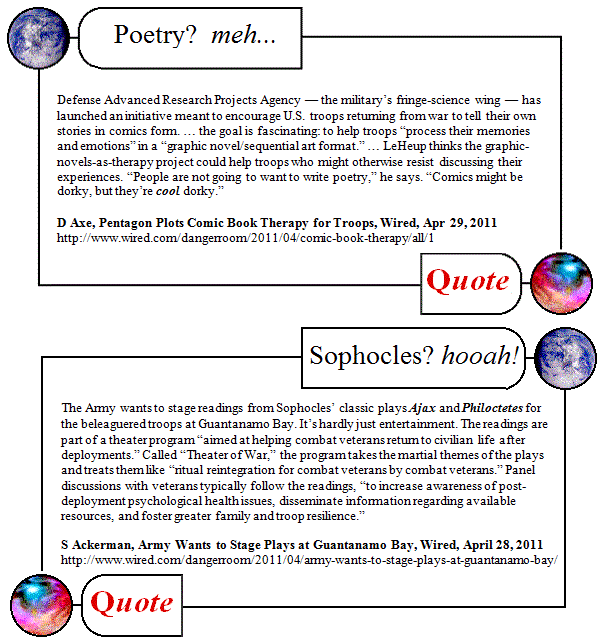
Literature and the arts are also important after battle, though – and the US Military and DARPA have clearly been thinking about that side of things:

quodarpa-arts1.gif

Sources: ComicsPlays

Poetry? meh… Sophocles? Chlanna nan con thigibh a so’s gheibh sibh feoil!

*

Lionel Tiger and Robin Fox in The Imperial Animal characterize modern health care as the “bureaucratization of mercy” and propose that for comparison, we set it beside:

the Greek ideal of the hospital as the place with the best food, the finest furnishings and paintings, and the most skilled musicians and comedians.

The greatest healing center in ancient Greece was the Asclepion at Epidavros / Epidaurus, which housed an amphitheater that could seat more than ten thousand people for dramatic and musical performances without amplification.

At Epidavros, patients would be healed by watching those same dramas of Sophocles to which the US Army is now turning for therapeutic relief in Guantanamo — for as Tiger and Fox (what a pair of names) go on to argue:

It is not the healthy, but the sick who most vitally needed such agreeable and re-creative stimuli; and the resources the community had were most beneficially and sanely used in helping them ease their personal disarray and feel encouraged by this display of their community’s careful concern.

*

It’s also interesting to note that the graphic novel Silver Shields mentioned in Axe‘s piece as a precursor to DARPA’s “Online Graphic Novel/Sequential Art Authoring Tools for Therapeutic Storytelling” project is “set during the ancient Greek invasion of Afghanistan more than two millenniums ago” as a metaphor for America’s current situation…

A two part meditation, part i: scenario planning the end times

Wednesday, April 13th, 2011

[ by Charles Cameron ]
.

Some people like banking, I prefer religion.

I’m perennially fascinated by the way myths and rituals, meditations and sacraments can not just motivate and move people but change them. That’s just the way I am. I spent ten minutes this morning listening to a zen nun explaining on YouTube how to strike a bell (she preferred to think of it as “inviting” the bell), how to listen to it, how to wake up.

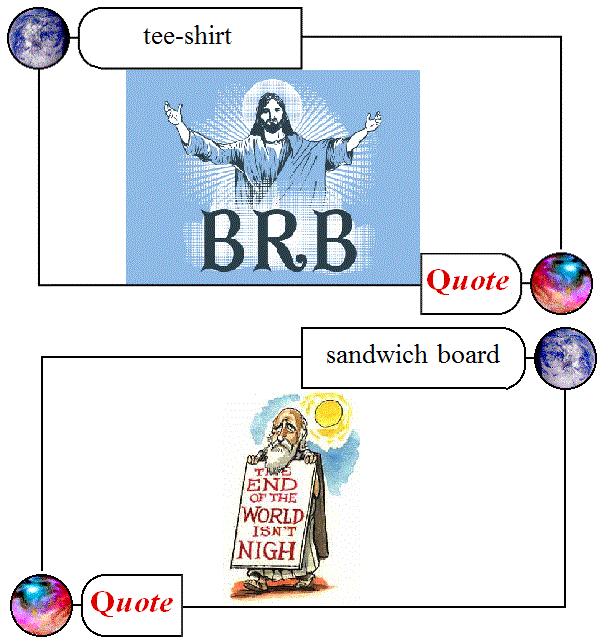
So when it comes time for scenario planning, I find the logistical and economic side of things less interesting than the tada! End of the World! excitement that seems to pop up all over the place from time to time. On billboards here in California (with a date certain: May 21st, 2011), for instance. In videos from Iran (coming soon to a theater of war near Jerusalem). And on Glenn Beck (ditto).

It seems to be a meme that cartoonists and satirists enjoy, too…

.

quo-end-times.gif

*

The thing is, there are two worldviews here, which we could conveniently label sacred and secular – though there’s no reason why one can’t hold a “sacred” view of the world (as I do) and not expect it to end any time soon (I don’t), or a “secular” view, and expect a new ice age or terminal global warming around the next bend in the road…

Two worldviews. And here’s where we get a “clash of cultures”.

Either there exists a definitive blueprint for the future of geopolitics – in Daniel, Ezekiel, and Revelation — or the future of geopolitics is something we’ll have to wrangle ourselves, using our best intelligence, wisdom and material resources.

On Sunday, you can go learn about the blueprint in an evangelical church – or you can kick back with the Sunday supplements and “Meet the Press”. And nobody much minds if you do one thing, and your neighbors do the other.

Things get interesting, however, when geopolitical decision times come around, and a great nation must decide what to do about the Palestinians, say, or Iran.

*

Okay.

Joel Rosenberg is a writer of popular, well-crafted thrillers – a Tom Clancy for the end times set.

Since his books are engaging, and since Glenn Beck frequently features Rosenberg on his show, his most recent novel, The Twelfth Imam, has been enjoying pretty decent sales, making it to #8 on the NYT best-seller list, #8 on Publisher’s Weekly and #10 on the WSJ hard-cover fiction lists in one week, not so long ago. And since I’m a student of comparative eschatology, I read his work with considerable interest, and follow his blog.

Today, he wrote:

As international support builds for the Palestinians to unilaterally declare their own state at the U.N. General Assembly opening session in September, I am growing increasingly concerned the President Obama is preparing to endorse such a move and even push for it. This would be a terrible mistake.Bible prophecy makes it clear that in the last days the nations of the world will divide up the land of Israel. But the Scriptures are also crystal clear that the nations will face the judgment of Almighty God for doing so. “For behold, in those days and at that time, when I restore the fortunes of Judah and Jerusalem, I will gather all the nations and bring them to the Valley of Jehoshaphat [“the Lord judges”]. Then I will enter into judgment with them there on behalf of My people and My inheritance, Israel, whom they have scattered among the nations; and they have divided up My land.” (Book of Joel 3:1-2).

Let the nations be warned by the God of Israel: they are on a dangerous and disastrous road. Let us pray they turn around before it is too late.

*

That’s actually a pitch for geopolitics by Biblical fiat — as Rosenberg explicitly points out:

One could wish the clear warning of the Bible would be enough to dissuade the President from dividing the land of Israel. I am not sure it will. Perhaps sheer politics will help.

If you believe in the sacred “Biblical blueprint” theory, and believe that the end times are very rapidly approaching, this should encourage you. If you believe in the secular “let’s hope our politicians don’t fubar this one” it might worry you – because you don’t trust some writers a couple of millennia ago to have an accurate appraisal of today’s Middle East, when even our intelligence services don’t claim to be able to predict the outcomes of various interventions in a complex situation, with unknown unknowns to boot.

And of course you might also be Israeli (and hold a sacred or secular viewpoint), Iranian (secular or sacred), or just not interested in geopolitics.

In Iran, the holders of a sacred, end times tradition are in power. In the US, the holders of a sacred, end times tradition exert some political influence. If you’re in Israel, you may hope and / or pray the Iranian end timers don’t visit their scenario on your head. If you’re a Palestinian, you may hope and / or pray the American end timers don’t visit theirs on yours.

I think it’s good to be aware of these things, but not get too excited.

*

More to follow in A two part meditation, part ii: of monks and maniacs.

The Year of Living Memory

Wednesday, April 6th, 2011

[ by Charles Cameron ]

*

Some people’s — and more to the point, some peoples’ — living memory appears to be longer than others. China, for instance, has what you might call long term living memory.

*

But first, the Crusades. When Bush 43 first used the word “crusade” in reference to the US response to 9/11, I went to Google and checked, and the first listing for “crusade against” that came up was to The Crusade Against Dental Amalgam. I’m the suspicious type, and as I suspected, the word “crusade” simply doesn’t have the same valence for most twenty-first century Americans that it has for many in the twenty-first century Arab world. In the US, a crusade is a concerted effort to change just about anything, the use of mercury in dental fillings being just one example.

Across the Arab world, however, the word has very different connotations: thus Amin Maalouf writes in The Crusades through Arab Eyes:

The Turk Mehmet Ali Agca, who tried to shoot the pope on 13 May 1981, had expressed himself in a letter in these terms: I have decided to kill John Paul II, supreme commander of the Crusades. Beyond this individual act, it seems clear that the Arab East still sees the West as a natural enemy. Against that enemy, any hostile action — be it political, military, or based on oil — is considered no more than legitimate vengeance. And there can be no doubt that the schism between the two worlds dates from the Crusades, deeply felt by the Arabs, even today, as an act of rape.

That’s long term living memory for you.

*

I’m writing this because I just read a fascinating article by Robert Barnett on the New York Review of Books blog titled The Dalai Lama’s ‘Deception’: Why a Seventeenth-Century Decree Matters to Beijing — need I say more?

The title will suffice for those who don’t have much time today — I understand, we’re all under the fire-hose one way or another — while those with the ability to sneak in ten or fifteen minutes laterally while the clock’s not watching can and should definitely read the whole thing…

*

I have just one side-observation though — the article tells us, among many other things directly relating to Tibet and the history of the Dalai Lamas:

And again, when Jiang Zemin made a brutal decision to annihilate the basically harmless Falungong cult in 1999, it is believed that he saw it as analogous to the religious movement that had started the Taiping Rebellion and nearly toppled the Qing in the mid-19th century.

I think that’s right — but what Barnett doesn’t mention, since Taiping is only an aside for him, is that the rebellion was only eventually quelled at the cost of between twenty and thirty million lives…

I mentioned my own hunch that memories of Taiping were behind the Chinese government’s fierce response to Falun Gong in question time after Ali A Allawi‘s talk on Mahdist movements in Iraq at the Jamestown Foundation a few years back, and he responded that similarly, the reason the Iraqi government took such fierce action against a small Mahdist uprising near Najaf — even calling in US air support as I recall, for an incident perhaps best compared in US terms with Waco — was that they remembered the Babi movement in their own neck of the woods, and the tens of thousands who died back in the 1850s, around the same time as the Taiping in China.

*

Living memory — which could almost be a definition of history, or at least of what historical research aims to create — can itself be long term or short, perishable or perennial.

And then there’s Psalm 90, which declares “For a thousand years in thy sight are but as yesterday when it is past, and as a watch in the night.”

Now (and I’m being playful here, albeit with a touch of serious intent) does that suggest a Memory that reaches back in perfect detail through the eons to the Big Bang and perhaps before it? Or … “twentieth century? nineteenth? the Crusades?.. it’s all a bit of a blur, I’m afraid — it all rushes by so fast…”

*

There seems to be a choice set before us as individuals — and more to the point, as peoples:

Shall we choose Lethe, and the restfulness of oblivion, or Mnemosyne — the mother of all Muses? There are, you know, immediate educational implications, and serious geopolitical implications down the road, for the choice we make…


Switch to our mobile site