zenpundit.com » Strategy and War

Archive for the ‘Strategy and War’ Category

Guest Post: Few’s The Serenity Prayer for Grand Strategy

Thursday, May 26th, 2011

[Cross-posted from SWJ Blog]

Major Mike Few, one of the SWJ Blog’s trusty editors opines on the nuts and bolts of “doing grand strategy”. Pay close attention to points #2 and #7. Hopefully, the first of many guest posts here by Major Few, if I can steal some of his time from Dave Dilegge 🙂 :

The Serenity Prayer for Grand Strategy: Nine-Step Recovery Method for Reframing Problem Solving

by Mike Few

Recently, our authors began to shift from problem definition to reframing problem solving. Over the last year, we published some remarkable works effectively describing Iraq, Afghanistan, Mexico, Libya, and others. Simultaneously, we published several series on design and wicked problems.

The challenge we are posing is can someone produce a concise document applying design to an existing problem? If we cannot find practical application or wisdom, then the process becomes a moot effort. Below is my white board attempt to provide an example and discussion for others to follow. This blog post is similar to many of the discussions our authors and readers have daily in the classroom and nightly at the pub or dinner with colleagues. Simply put, I am merely merging the sum of our published thought and discussions.

Three years ago, I was challenged to determine if my experiences in big wars and counterinsurgency could be applied to the macro level. On the tactical level, I found that I simply relearned the lessons of those that had come before me, the countless art of war and warfare. However, when I consider how my thinking had changed, I feel that perhaps there are some lessons that can be applied for us all.

In combat, I finally learned the limits of my own control. This understanding freed me to concentrate focusing on changing the things that I could control. I look at framing problem solving in international relations in a similar manner. It’s kind of like the Serenity Prayer for Grand Strategy. So, as a practical exercise, below is an example of how I would use Design, Wicked Problems, and Military Decision Making Process using the example of Mexico.

1. Define what we cannot control. We cannot “fix” Mexico. They are a sovereign nation-state, and they must choose to work on their internal issues. Moreover, our “solution” to their problems may not be a proper fit despite our best intentions. Our intervention efforts in Central and South America over the past sixty years (or more) have had mixed results.

2. Define the problem as it is not as we wish to see it. Are we really in a war on poverty, drugs, education, terrorism, and governance? Are we really at war? Labels are often limiting, but there needs to be some common framework to understanding. Typically, that can be driven by good communication and active listening. We must learn to transcend how “I” see the problem and work towards how the collective group sees the problem accounting for all stakeholders.

3. Define our relationship. How does the US and Mexico see each other? This perception requires a degree of self-introspection and humility. Are we a brother attempting to help our sibling overcome addiction or work through difficult financial times? Are we a parent disciplining a spoiled child? Are we a spouse in a broken marriage? How we see ourselves defines our national interest. If we see ourselves as the parent, then we’re self-imposing a conceptual block.

As Martin Luther King wrote while sitting in the Birmingham Jail,

“Moreover, I am cognizant of the interrelatedness of all communities and states. I cannot sit idly by in Atlanta and not be concerned about what happens in Birmingham. Injustice anywhere is a threat to justice everywhere. We are caught in an inescapable network of mutuality, tied in a single garment of destiny. Whatever affects one directly, affects all indirectly. Never again can we afford to live with the narrow, provincial “outside agitator” idea. Anyone who lives inside the United States can never be considered an outsider anywhere within its bounds…In any nonviolent campaign there are four basic steps: collection of the facts to determine whether injustices exist; negotiation; self-purification; and direct action.”

4. Describe what we are currently doing and how we can adjust these things.

– Impact of NAFTA
– Border Security
– FID efforts in Mexico
– Counter-Drug efforts in Mexico
– Counter-Drug efforts in the United States
– Anti-Gang efforts in the United States

5. Discuss the cost benefits of future intervention efforts and internal reforms

– Comprehensive immigration reform
– Dream Act
– Expanded Counter-Drug efforts
– Expanded FID efforts to better strengthen Mexico’s Army and Police internal security forces
– State Department “better” governance efforts (Plan Colombia)- to include judicial and economic issues
– Legalizing drugs in the continental United States (demand side interdiction)
– Comprehensive Prison Reform in the United States
– Treasury Department financial interdiction to narco banking
– Promoting and expanding free press in Mexico through Twitter, Facebook, and new media

6. Describe Area of Influence- Central and South America

– Illegal immigration from Guatemala
– Drug Trafficking from Colombia

7. Ask the hard questions

-What are the key factors driving the problem?
-What is the causality?
-And, if the analysis is from a U.S. perspective, to what degree and in what ways is the problem a problem for the United States?
-what ways do those in power benefit by the status quo?

8. Rethinking the Assumptions

-What are the desired outcomes?
-Is the policy driving the process or is the effort outcome based?
-Are our efforts helping or hurting?

9. Timing of Implementation

– Simultaneous, Sequential, or Cumulative
-Prepare to accept that some items are not decision points; Rather, they are processes that change and morph over time.

Special thanks to those that contributed to the proofreading of this post, and I would like to specifically highlight Dr. Nancy Robert’s methodology for teaching any class on problem solving,

A. Creativity
B. Problem Framing
C. Systems thinking
D. Entrepreneurship and Innovation
E. Collaboration in Networks

Now, let the discussion and writing continue…
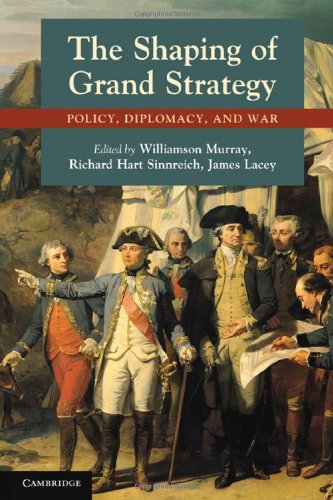
Book Review: The Shaping of Grand Strategy

Tuesday, May 24th, 2011

The Shaping of Grand Strategy: Policy, Diplomacy, and War by Williamson Murray, Richard Hart Sinnreich and James Lacey (Ed.)

As readers of this blog know, grand strategy is an important and timely subject that speaks directly to the difficulty American leaders have had in navigating the ship of state in the waters of the international arena. The Shaping of Grand Strategy: Policy, Diplomacy, and War by Williamson Murray, Richard Hart Sinnreich and James Lacey (Ed.) and contributing authors Colin S. Gray, Marcus Jones, Jeremy Black and John A. Lynn III postulates what grand strategy is and explain from historical case studies how statesmen struggled to fashion one in peace and war.

The Shaping of Grand Strategy has a number of strengths to recommend it to the serious student of history or strategic practitioner:

Focus: The case studies are all anchored in the Westphalian state system starting with the early modern period of European absolutism and apex of “national” monarchies and transitions through a Bismarckian 19th century to finish with the West’s cataclysmic 20th century battle with totalitarianism. This gives the chapters by different scholars a sense of cohesion and chronological succession.

Balance: The Shaping of Grand Strategy gives scholarly treatment from both the theoretical, strategic studies perspective as well as the historical case study. I learned some things about Louis XIV’s Europe and the Great Britain of the Pitts and the Hanoverian dynasty of which I was unaware. Theory bookends history in this tome.

Nuance: Each scholar gives his subject an adult treatment. Controversial points are interesting rather than shrill and each author engages an impressive synthesis of historiographic material as they cover a broad ground in investigating grand strategy. Each chapter is sound and engaging.

Limitations, such as they are, to be considered:

Absent: Powerful non-Western case studies. The ancient world.  Revolutionary war (French, Soviet or Islamist insurgent) as a grand strategy. Geoeconomics asnd political economy as a foundation for grand strategy. 

Weak: Insufficient treatment of the impact of nuclear weapons and deterrence on grand strategy, which frankly deserved a chapter of it’s own.

If you are composing a syllabus for a class on grand strategy or strategy, The Shaping of Grand Strategy would serve as an excellent generalist core for the course, supplemented by cognate, specialist or subtopical readings.

Some things that struck me while reading The Shaping of Grand Strategy:

  • Colin Gray’s distillation of the strategic dilemmas faced by Truman and an almost Boydian implicit explanation of what grand strategy is and why it needs a compelling moral power:

High policy does not emerge in a vacuum, though it can be invented in a hurry without much forethought when necessity presses. Policy requires a North Star for guidance that can inspire, yielding to would-be leaders the fuel they require to recruit and satisfy their followers

  • James Lacey’s realistic and granular treatment of the relationship between military strategy and grand strategy in the WWII Anglo-American Alliance and his generally admiring assessment of FDR as a strategist vs. a critical treatment of George Marshall.
  • Marcus Jones’ emphasis of the importance of the strategist himself and the uncertainty of decision making in his chapter on Otto von Bismarck.
  • The drawing of historical parallels with today  by John Lynn and Richard Sinnreich as well as the investigation of the reasons for grand strategic failure of British appeasement by Williamson Murray.

The Shaping of Grand Strategy is a tight, concise and focused academic book that furthers the discussion of grand strategy by providing coherent and detailed examples as well as a readable an interesting analysis from which both the professional or the the student can profit.

Strongly recommended.

Elkus on the Troubled History of Raiding

Tuesday, May 10th, 2011


Adam reminds us that punitive raiding is not by itself a substitute for clear strategies or coherent policies in a well-written piece posted at The Atlantic Monthly :

From Romans to SEALs, a Troubled History of Raiding

The Osama bin Laden raid has been hailed as the centerpiece of a new style of “collaborative” warfare that leverages intelligence fusion and networked interagency teams to focus precision force on America’s enemies. Collaborative warfare, while impressive, is only the latest and greatest in a genre of military operation that dates back thousands of years: the punitive raid. From the days of the Roman Empire through Sunday’s raid in Abottabad, Pakistan, governments have relied on punitive raids and manhunts to eliminate challengers to state power without resorting to costly, large-scale occupations. 

But a look at the history and evolution of punitive raiding reveals that it is not a substitute for sound strategy — and can be far more costly than policymakers might suspect and may have political costs that outweigh the strategic benefits. Punitive raids — whether they consist of a large column of raiders advancing by horseback or an airmobile squad of commandos about to drop into an enemy cross-border haven — have always been deceptively appealing as low-cost alternatives…

Read the rest here.

Barnett at Battleland: “Right out of John Boyd’s strategy…”

Monday, May 9th, 2011

Dr. Barnett is now a blogger for TIME Magazine’s Battleland

Right out of John Boyd’s strategy: disconnect, isolate & disempower your enemy

But Osama, looking far older than his 54 years, had none of that.  He was down to just a sad little entourage, and his comms were reduced to thumb drives smuggled in now and then. He is isolated, almost imprisoned, and he looks like a man sapped of all vitality.

…This is right out of American strategist John Boyd’s playbook:  you beat your enemy by isolating him, denying him allies, keeping him in the dark and – bit by bit – wearing down his energy: “Interaction permits vitality and growth, while isolation leads to decay and disintegration.” 

Read the rest here.

Answering Ronfeldt’s Question About the Nature of Strategy

Wednesday, May 4th, 2011

RAND emeritus scholar and co-author of the classic Netwars and Networks, David Ronfeldt asked an astute question in reaction to my post proposing a grand strategy board:

I almost always see strategy defined as the art of relating ends and means.  It’s defined that way time after time, often but not always with a few extra criteria added here and there.  Usually something about plans or resources.  But I’ve long felt that I’d prefer to define strategy as the art of positioning.  That presumes a consideration of ends and means, but in my view, it’s not as abstract a definition, and gets to the core concern right away.  In looking around for who else may favor such a definition, the best and almost only leader I find is Michael Porter and his writings about corporate strategy.  He’s says explicitly that strategy is the art of positioning – apropos market positioning in particular.  maybe in some long-forgotten moment, that’s where I got the notion in the first place.  Meanwhile, i’ve been told that, of military strategists, Jomini emphasizes positioning the most.  This is not my area of expertise.  I’d like to know more:  is the “ends and means” view so accepted, so basic, so adaptable, that it’s not worth questioning?  What’s to be gained, and/or lost, by the “positioning” view?  Is there any strategy that isn’t about positioning? 

This is a great question, because it is a clarifying question about fundamentals.

I am not familiar with Micheal Porter’s work, but Chet Richards pointed out in his excellent Certain to Win that there are some significant differences in applying strategic thinking to business compared to using strategy in war. While war and the market both represent dynamic, competitive environments which require actors to adapt to survive, war is a destructive enterprise while business is ultimately transactional, cooperative and constructive, though you may have to overcome competition and conflict first. Conflict and competition on which the state and society place tight legal constraints to which buyers and sellers must conform.  Arguably, this explains the drift toward oligopolistic competition in regulated capiltalist economies: the constraints of rule of law which govern market actors would tend to give an even greater emphasis to “positioning” in peaceful economic competition than in warfare.

What about “positioning” and strategy generally?

Strategy is indeed defined by most experts as the alignment of Ends -Ways -Means. In my opinion, it is the most practical starting point for people of any level of strategic skill to consider what is to be done in the short or medium term within a known framework ( a theater, region, an alliance system, nation-state etc.). “Positioning” falls within this trinity under “ways” – for example, something as simple as seizing the high ground or as complicated as maneuver warfare theory is, in essence, an effort to acquire a comparative advantage over your opponent. Having comparative advantages are always good but they are usually transitory rather than being something that can be “locked in” permanently ( though man has tried – ex. the Great Wall of China, Constantinople on the Dardanelles, the age of fortresses in 16th-17th C. Europe, Mercantilist Policy, Massive Retaliation etc.). Normally, you have to keep moving, tactically adjusting your position in response to your opponent’s efforts to re-balance.

Positioning also exists outside the trinity of Ends-Ways-Means as the initial starting conditions that shape subsequent strategy. The phrase “Where you stand depends on where you sit” conveys the lesson that our perspectives, our premises, are deeply affected from where we begin. Geopolitical theory is rooted in this idea but positioning can be something other than physical location – politics and culture are positional because they are embeded with values and what we value to some extent determines what our Ends are going to be and how we perceive and define the problem for which we will employ a strategy to overcome.

The latter kind of positioning can be *very* problematic because ideological concerns inflame passions, distort our rational calculus of matching means to ends and generally introduce ever larger amounts of irrationality into strategic decision making at the expense of empirical observation. Boyd would call this a “mismatch” with reality from a corrupted OODA Loop and a textbook example would be the behavior of Imperial Japanese leaders in WWII. Launching an unwinnable war with the United States and prosecuting it almost to national annihilation was driven to a demonstrable extent by Japanese cultural norms related to honor, debt (on-giri), the “Imperial Will” and dysfunctional constitutional arrangements that made extricating Japan from a strategic cul-de-sac politically impossible. To a lesser extent, American prosecution of the war in Vietnam and the occupation of Iraq share similar irrationality derived from a priori ideological positioning.

A final observation:

When time horizons are very long and/or the problem is ill-defined and the framework boundaries vague or unknown or uncertainty high, the cognitive requirements for strategic thinking shift and it may not be possible to move beyond speculating as to Ends to the point where action should or even can be taken effectively. More information may be required. 0r greater means than exist. The problem may only be a hypothetical potentiality, rather than an actual problem. This point is one that is likely to be disputed as even being in the realm of strategy and could belong in that of theory or politics, depending on your perspective.

Many readers here are students of strategy or even professional strategists. In the interest of brevity, I’ve avoided getting into the specifics of schools of strategic thought or Clausewitz vs. Sun Tzu or Jomini, but I’d like to invite readers to weigh in on Dr. Ronfeldt’s question or my response as they wish.


Switch to our mobile site
