zenpundit.com » Perception

Archive for the ‘Perception’ Category

John Robb on the OODA Loop

Thursday, December 1st, 2011

John Robb at Global Guerrillas had a nice primer on John Boyd’s OODA Loop recently and he put on a twist that I thought was very useful:

HOW TO WIN ANY CONFLICT

….I’m Inside Your OODA Loop

How does all of this apply to conflict?  The simple answer is that conflict, in its most basic form, is a contest between decision making loops.  The side with the FASTER and BETTER decision making loop wins any conflict.  Why?  They adapt quicker.   Here’s some more detail:

A FASTER decision making loop means that you accomplish a successful OODA loop quicker than an opponent.  If you can do this, you are inside your opponent’s OODA loop.  This means that by the time your opponent responds to your last actions, you are already onto your next ones.  Get far enough ahead and the opponent’s decision making process will collapse and victory is assured.

A BETTER decision making loop?  That’s question that can lead to endless debates and theory crafting.  My approach to improving a decision making loop?  Connectivity.  The more connected a loop is, the better the decision loop is.  Connectivity falls into three categories:

  1. Mental — improves decisions by connections to a superior mental model of the current situation.  A superior model/strategy is predictive of events. It can tell you what data is important and what isn’t.  Weak strategies/tactics fall apart upon first contact w/enemy.
  2. Physical   — improves observation through connections to better sources of data, cleaner w/less distortion  — improves action by making it possible to actually accomplish the desired decision in the real world
  3. Moral — better orientation due to connections to strong traditions, extensive experience, and collected wisdom.  Training can help here.

The opposite is true also.  Damage an opponents connectivity, and their decision making loops are less effective.

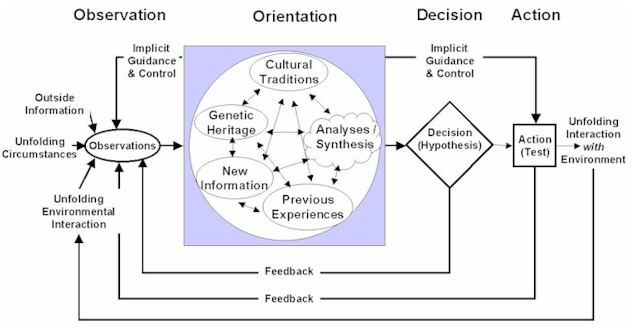
One of the difficulties with discussing OODA is that many people who either oppose the concept or do not know much about it, will explain the OODA Loop only as “getting inside your opponents OODA Loop” in terms of the capacity to “go faster” -i.e cycle through your own OODA Loop faster than your opponent, making more decisions, taking more actions, leaving them in the dust, disoreinted and going into a downward spiral to defeat. Usually, misrepresented like this:

Ok, well going “faster” is a small part of it, but not sequentially and there’s neurological limits on this that arrive pretty quickly in terms of thinking speed in any case. Robb’s use of “BETTER” helps capture more of the critical and subtle qualitative nature of the “Orientation” box:

What are some of the possible effects of a “virtuous cycle” of better decisions?

Position yourself with more options
Gain new perspectives (“Observation”, “Orientation”)
Position yourself with the greatest comparative advantage (best option)
Lock in a comparative advantage
Position yourself with the longest potential decision tree (no quick “dead ends” or “cul de sacs”)
Change the tempo of interaction in your favor
Change the rules of interaction in your favor
Prevent a conflict with additional potential oponents
Lower your costs or increase theirs
Assure minimum gains
Arrive first
Increase or decrease the distance between yourself and your opponent
Broaden or narrow the field of conflict
Gain time
Seize or maintain the initiative
Define or redefine “victory”
Foreclose a critical option or set of options to your opponent
Force your opponent to act on your terms (“Check”)
Lower the morale of your opponent

Confuse, mystify or mislead your opponent
Attract allies or supporters
Increase your resources or potential maximum gains
Repair, remediate or replace previous losses

John is correct that “connectivity” helps you gain many of these benefits. 

Remember:

 “Being on the winning side is a lot more fun!”

ADDENDUM (Some interesting commentary on OODA):

Adam Elkus

I’ve Got the OODA Blues

Joseph Fouche:

Libeling Boyd

How Not to be Like Boyd

Who’s Afraid of Genghis John?

TDAXP, PhD

Variations of the OODA Loop 1: Introduction
Variations of the OODA Loop 2: The Naive Boydian Loop
Variations of the OODA Loop 3: The Sophisticated Boydian Loop
Variations of the OODA Loop 4: Pseudo-Boydian Loops
Variations of the OODA Loop 5: Post-Boydian Loops
Variations of the OODA Loop 6: Bibliography

The Haqqani come to high Dunsinane

Wednesday, November 23rd, 2011

[ by Charles Cameron — why is non-actionable (useless) intelligence sometimes the most intelligent (useful)? – importance of multiple frames for complex vision ]
.

spec-taliban-to-high-dunsinane.png

I have fun choosing my data points, I’ll admit, and I enjoy the art of juxtaposition for its own sake — but the particular juxtaposition above is frankly useless.

Readers of the Chuang-Tzu, however, will be familiar with the idea that the useless is not without its uses

Here, then, is the method to this madness.

What I want to establish in myself – and in others who choose to follow me – is a rich supply of frames, of analogies, of patterns that can be seen at a glance. And the ways to do this are (a) to read widely in those arts and sciences which make frequent use of symmetry, analogy, metaphor, and pattern, and (b) to practice, oneself, the techne of analogy-, metaphor-, symmetry-, and pattern-making.

1.

In the two image-frames above, the lower image shows a still from a Haqqani network training video from SITE — which could be viewed as the fulfillment (albeit in Afghanistan, and waking reality) of a prophecy made earlier (about Scotland, a not-entirely-dissimilar country, mountainous, clannish, proud), in suitably oracular fashion, in Shakespeare’s Macbeth Act IV Scene 1 (shown in the upper frame, from the First Folio edition).

Here, you might say, the Taliban come to high Dunsinane Hill.

But…

This is not actionable intelligence.

The injunction to “keep a lookout for people on the move pretending to be trees” is not a useful addition to tradecraft.

It is, however, vivid. And it’s an instance of “the leap” from one idea to another that’s at the heart of the process of insight and discovery. It is an example of a specific skill of considerable analytic importance.

2.

Karl Weick and Kathleen Sutcliffe, in Managing the Unexpected: Assuring High Performance in an Age of Complexity, p. 42, [quoted in Fishbein and Treverton and Jeffrey Cooper ] define mindfulness thus:

By mindfulness we mean the combination of ongoing scrutiny of existing expectations, continuous refinement and differentiation of expectations based on new experiences, willingness and capability to invent new expectations that make sense of unprecedented events, a more nuanced appreciation of context and ways to deal with it, and identification of new dimensions of context that improve foresight and current functioning.

How’s that for a prose version of the basic OODA insight?

3.

Obviously, I am not talking about the kind of tactical intelligence that is concerned with materiel and logistics here, but with mindset and morale.

This may get overlooked, since…

Emphasizing current intelligence for actionable exploitation may have created an unintended mind-set that undervalues the immense importance of knowing and understanding the adversary’s intentions throughout the course of the confrontation, even at cost of foregoing exploitation of these sources for temporary advantage on the battlefield or in the diplomatic conference room.

[Cooper, Curing Analytic Pathologies: Pathways to Improved Intelligence Analysis, p.30]

4.

What I am talking about here is that “willingness and capability to invent new expectations that make sense of unprecedented events, a more nuanced appreciation of context and ways to deal with it, and identification of new dimensions of context that improve foresight and current functioning mentioned above.

New dimensions of context? What this boils down to is multiple frames of vision… which the IC understands very well, as expressed in the often-repeated chess master analogy — good for strategic thinkers of all stripes. Here’s Robert Sinclair‘s version, in Thinking and Writing: Cognitive Science and Intelligence Analysis, p. 13:

Simon estimates that a first-class player will have 50,000 of these patterns to call on — by no means a small number, but orders of magnitude less than the theoretical possibilities that flow from any given position. The expert can use them to drastically reduce the number of choices he must consider at any point in a game, with the result that he often hits on an effective move with such speed that the observer attributes it to pure intuition.

Enter Neustadt and May, whose book Thinking in Time Zen reviewed here just the other day — enter, in fact, history, as a store of stories.

Richards Heuer explains [Psychology of Intelligence Analysis, p. 38]:

An analyst seeks understanding of current events by comparing them with historical precedents in the same country, or with similar events in other countries. Analogy is one form of comparison. When an historical situation is deemed comparable to current circumstances, analysts use their understanding of the historical precedent to fill gaps in their understanding of the current situation. Unknown elements of the present are assumed to be the same as known elements of the historical precedent. Thus, analysts reason that the same forces are at work, that the outcome of the present situation is likely to be similar to the outcome of the historical situation, or that a certain policy is required in order to avoid the same outcome as in the past.

And the analogies and insights can come from fiction as well as history, as Charles Hill is quoted here as saying:

That is why Alexander the Great carried the Iliad with him on his conquests, and why Queen Elizabeth studied Cicero in the evenings. It is why Abraham Lincoln read, and was profoundly influenced by, Walt Whitman’s “Leaves of Grass,” and why Paul Nitze paged through Shakespeare on his flights to Moscow as America’s chief arms negotiator.

Further, the appropriate insights and possible framings can come from future and/or speculative histories — hence the meetings between IC members and various science fiction authors and thriller screenwriters which then DDI Jami Miscik arranged in an attempt “to see beyond the intelligence report and into a world of plot development”.

As I noted a few days back, I’m particularly impressed by Frank Herbert‘s ability to recognize the importance of the oil / desert / ecology / major powers / jihad / Mahdi complex – back between 1957 and 1965, while writing Dune.

5.

But all this takes me back to a comment I made a while back on Mark Stout‘s On War and Words blog, on “the notion of the kinship of spycraft and literature.” I wrote there:

I think that idea has a lot of merit. Chaucer was a spy, as was Kit Marlowe, and Wordsworth, and Basil Bunting. Somerset Maugham and Graham Greene spied, and John le Carre – and if I’m not mistaken, much of the early OSS was recruited from the Yale literature department by the likes of Archibald MacLeish…

My own suggestion would be that this is because the literary mind is well suited to understanding and expressing complex relationships, just as (it has been suggested) the engineering mind is suited to seeing things in black and white – you’ve probably seen Diego Gambetta and Steffen Hertog’s paper on Engineers of Jihad, in which they determine that “engineers, in particular, were three to four times more likely to become violent terrorists than their peers in finance, medicine or the sciences”.

I don’t know whether that allegation is accurate, or just an artifact of their research methods – but if it’s true that literature offers a different (and in some ways more subtle) means of modeling the kinds of complex situation we’re all facing these days, maybe we need to increase the intake of lit and humanities majors into the IC, and stop being so tech-centric about our analytic methods. The human mind might just be better at selecting and connecting the right dots than our datamining programs.

Keith Oatley‘s paper Shakeapeare’s invention of theatre as simulation that runs on minds might give us a hint or two.

And we’re back to Shakespeare.

6.

Why?

Because what’s important in all this is the quality of imagination expressed. And the core insight is that the greatest poets, dramatists, science fiction writers and historians create pocket universes — worlds invented or perceived in which the logics of the many binary oppositions, tides, undertows, tipping points and emergent patternings of our profoundly complex world are found in miniature.

The mind in a nutshell, the world in a grain of sand…

Perhaps clearest statement of this perspective comes from the great scientist Gregory Bateson, who writes about poetry in these terms:

One reason why poetry is important for finding out about the world is because in poetry a set of relationships get mapped onto a level of diversity in us that we don’t ordinarily have access to. We bring it out in poetry. We can give to each other in poetry the access to a set of relationships in the other person and in the world that we are not usually conscious of in ourselves. So we need poetry as knowledge about the world and about ourselves, because of this mapping from complexity to complexity.

7.

If it is great imaginative power that provides the deepest insights into a complex world, great minds and hearts will be those you need to follow — not minds cowed by the pressures of bureacracy and success.

“You want some new ideas? Read some old books” Marine Gen. James Mattis told his audience at the 14th annual American Veterans Center conference the other day, in a speech which “recommended books by and about leaders like Nelson Mandela, Martin Luther King Jr., George Washington and Abraham Lincoln.”

Great hearts, great minds. And not always well-tolerated by those around them.

8.

Jami Miscik again, at a conference discussing “The Power of Impossible Thinking: A Prerequisite for Profitable Growth“:

Embrace the maverick.

Miscik is clear that the purpose isn’t only to be widely read, but to be independently and courageously thoughtful.  Bureaucracies are not by nature the most friendly places for independent thinking, stove-piping and soloing, seniority and comfort all militate against it — hence the need to embrace the maverick, to develop (in fact) a culture that embraces the maverick.

Miscik addresses that issue, too: “She also warned the audience that a single spate of change is not enough; an organization will always have to change again.”

Or as Sinclair has it in Thinking and Writing (op. cit., p. 9):

I do believe diversifying the workforce in this way would require a cultural shift at least comparable to that involved in a shift to online substantive collaboration. Without such a shift, the directorate, like any organism under threat, would identify people who failed to fit the dominant pattern as foreign bodies and extrude them.

9.

I am thinking, in all this, of those whose task it is to provide the richest, highest level analysis of “the adversary’s intentions” — the readers of minds by which history is about to be written.

Those whose job it is to be concerned about the threats that face us, from the Haqqani, from the Chinese, from Pakistan, from wherever, will do their job better, with greater insight – with greater critical doubt and critical confidence – if their minds are richly sown with myths and histories, matter for analogies pattern languages, than if they have focused down along the scope of a single silo…

As Mattis, Hill, Miscik, Sinclair, Bateson, Oatley, Heuer and company, each in their own way, suggest…

10.

When you come right down to it, audacious, insightful thinking is its own form of special ops.

The Peace Officers and the Practitioner

Thursday, November 17th, 2011

[ by Charles Cameron — disturbing and keeping the peace, OWS Oakland, paradox ]

.

disturbing-the-peace.jpg

Paradox.

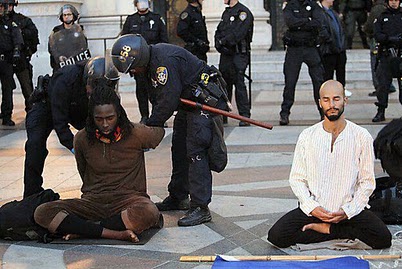
It’s a bit like the koan where a zen monk is asked “is it the flag or the wind that moves?” — is peace what the meditator is dipping into, or is peace what the occupier / meditator is disturbing while the peace officers are maintaining it for the rest of us?

Here’s a photo taken a few moments / minutes later:

meditator-arrest.png

And in fact, the whole incident does seem to have passed off pretty peacefully (in both senses of the word): as the Chronicle’s SFGate blog put it in a caption:

Police peacefully detain Occupy Oakland protester, “Pancho” Ramos Stierle who was meditating while police cleared out the Occupy Oakland camp early in the morning on Monday, November 14, 2011.

*

And the zen master said, “Neither and both: it’s the mind that moves.”

To what End?

Friday, November 11th, 2011

[ by Charles Cameron — prophecy, millennial date-setting, when prophecy fails, scenario planning, hubris ]

.

when-prophecy-fails-9781578988525.jpg

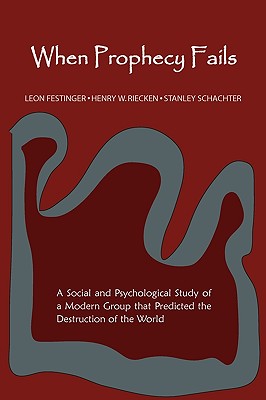
To what End, prophecy and prediction?

Stephen O’Leary was right in his guess that Harold Camping would “recalculate” if and when (emphasis on the “when”) his May 22 prediction for the end of the world earlier this year failed. Camping did indeed recalculate, and his new prediction, for October 21, similarly passed without trumpets of the sort to be expected. This time, Camping apologized, admitting:

when it comes to trying to recognize the truth of prophecy, we’re finding that it is very very difficult.

He also said, with respect to his own failed prophecies:

God has done to us similarly to what he did to a couple of other great men of faith, one being Abraham…

First, the point I want to make. Then, more from Harold Camping, for those who are interested in the great question that’s raised When Prophecy Fails

1.

Here’s what I want to explore. Stephen O’Leary writes:

One thing that apocalyptic predictions throughout history have in common is that, without exception, they have all been proven wrong.

Stephen is an old friend of mine, and the author of the classic work Arguing the Apocalypse: a theory of Millennial Rhetoric (Oxford, 1994), and in the quote above he’s writing on May 19th in the Wall Street Journal’s “Speakeasy” blog.

What Stephen is saying here is something of a commonplace among millennial scholars, and his colleague Richard Landes, with whom he founded the Center for Millennial Studies, also a friend, picks up on it at the very end of his magisterial (I’ve used that term for this book before, and will again) Heaven on Earth: The Varieties of the Millennial Experience (Oxford, 2011), when he writes:

Whereas the rule, “apocalyptic prophecies are always wrong” holds, it does not hold about the future, especially a future in which humankind has the ability to self-destruct or, short of that, inflict cataclysmic damage on itself and the miraculous and crowded planet on which we live.

Religious predictions of the Coming One have (thus far) all failed, in other words, but scenarios of an End based on human behavior in aggregate may yet prove out.

Which then raises another question:

What is the relation of prophecy to scientifically informed prediction? Are religious predictors of apocalypse perhaps intuiting what some scenario planners are also anticipating – and thought to be foolish only because they express it in religious language, their native tongue?

Are they merely noting that Pride comes before (as well, perhaps, as after) a Fall?

2.

For those who may be interested, here’s more from the tail end of Camping’s statement [Family Radio: “Messages from Mr. Camping” 11/8/2011]:

We were ready to say, “Good bye to them. It’s all over. It’s all over. It’s time for the end.”

And now at the last moment, God has come and said, “No, no, it’s not the end. I still have some other plans.”

So what do we do? What do we do? Do we argue with God: “Wait a minute God. You said it so plainly. We were so convinced. There were so many proofs of the Bible, that it cannot have been that we were incorrect — maybe in a tiny detail here or there, but no God, we’re sure that it had to happen.”

But it didn’t happen. And we know that God brought it right to the very edge, right to the very day and past the day that the, there should have been judgment seen all over the world.

So, the first question I have to ask all of us — I have to ask myself this very, very carefully — Are we ready see that we did not understand God’s plan altogether? Are we ready to stand back and wait and do some more studying and recognize that maybe God is not finished with bringing salvation to the world.

As a matter of fact, we know that only about a third of the world had ever heard of the Bible before five months ago. Now by God’s mercy through the actions of Family Radio, as stupid as some may think they may have been, as incorrect as some may think they may have been, yet they all fit into a part of a plan where now the whole world has heard about the Bible. They’ve heard about the God of the Bible. God now is ready for the next action based on that kind of information, what will that be?

And that is where we have to start our thinking. We have to begin to think it out, “How does all of that impact our future teaching of the Bible?” And so, in our next study, we’re going to begin to examine that. Thank you very much.

3.

And so the wheel turns, the road goes ever on.

Does it?

Major General Fuller is Right

Saturday, November 5th, 2011

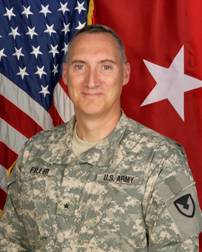
Major General Peter Fuller lost it yesterday and committed an unpardonable political sin – spontaneously telling the truth to reporters:

US general fired from Afghan training job

….Referring to Karzai’s recent assertion that Afghanistan would side with Pakistan if Pakistan got into a war with the U.S., Fuller was quoted as calling the comments “erratic,” adding, “Why don’t you just poke me in the eye with a needle! You’ve got to be kidding me . I’m sorry, we just gave you $11.6 billion and now you’re telling me, I don’t really care?”

Fuller said the Afghans have at times made unreasonable requests for U.S. assistance.

“You can teach a man how to fish, or you can give them a fish,” Fuller was quoted as saying. “We’re giving them fish while they’re learning, and they want more fish! (They say,) ‘I like swordfish, how come you’re giving me cod?’ Guess what? Cod’s on the menu today.”

Fuller also said the Afghans don’t understand the extent to which the U.S. is in economic distress or the “sacrifices that America is making to provide for their security.” He said the Afghans are “isolated from reality.”

Allen said the “unfortunate comments” don’t represent the solid U.S. relationship with the Afghan government….

 The relationship of the Karzai’s regime to the United States is a lot like that of a 32 year-old drug-addict living in his parent’s basement. The parents keep muddling through life, hoping their son will suddenly wake up one morning and decide to clean up his act, get a job, move out, get married and have 2.5 kids, a dog and a house with a white picket fence. The parents cling to that hope and cherish it but the reality is that the son staggers out of bed every day, sometime in the afternoon, only to go find their dealer, score some heroin and get high.

Karzai’s egime has less chance of governing Afghanistan effectively than the average heroin addict does of kicking their habit. And the reason is a) far and away Hamid Karzai and, secondarily b) Most Afghans fear a strong central government. The US has managed to do two things at the strategic level that a nation should never do in fighting a counterinsurgency war – support a government  that will not take sensible measures even in the interest of it’s own survival and permit insurgents a sanctuary and third country sponsorship.

General Fuller’s career is now effectively over. Too bad we cannot say the same for Mr. Karzai.


Switch to our mobile site