zenpundit.com » Character

Archive for the ‘Character’ Category

The Deep Shadow of Abraham Lincoln

Monday, November 26th, 2012

Just saw the Steven Spielberg epic Lincoln.  

The performance of Daniel Day-Lewis as Abraham Lincoln was titanic; all the anger and villainous darkness he channeled into his earlier memorable characters Bill “the Butcher” and Daniel Plainview are eclipsed in his Lincoln by wisdom and a transcendent, melancholic grace. The supporting cast was equally strong, with Sally Fields alluding in word and deed to the shrewish madness that troubled First Lady Mary Todd Lincoln; Tommy Lee Jones humanized – probably more than is historical – the implacable political ferocity of Radical Republican leader Representative Thaddeus Stevens; and James Spader added lighthearted realism as Secretary of State Seward’s cagey political fixer and bagman, William N. Bilboe.

Spielberg has done a magnificent storytelling of the passage of the 13th Amendment to abolish slavery in the United States and he has done even better at capturing Lincoln’s towering stature as a statesman. Day-Lewis’ Lincoln is Periclean – in possession of heroic, historical vision and mastery of grand strategy along with an intimate grasp of the granular, grubby mechanics of political deal making and a humane tolerance of other’s frailties needed to make things happen.  The scene where Day-Lewis explains to his squabbling Cabinet Lincoln’s coup d’oeil –  the real Constitutional, moral, military and political exigencies of emancipation governing the imperative questions of the 13th Amendment –  is one of the most brilliant expositions of strategy in the fusion of policy, politics and war that I have ever seen on screen.

In a sense, that was the genius of Abraham Lincoln – surpassing his own humble origins to solve herculean problems without ever losing sight that lasting resolution of Civil War and slavery were going to have to occur on Earth with fallible human beings, operating in a political reality that would never be ideal. The limits of vision of Lincoln’s contemporaries, copperhead and abolitionist, is marked but the comparison between Abraham Lincoln and politicians of our own day is yet for the worse.  Our problems are so much smaller, our resources and capabilities infinitely vaster than the severe test the Republic faced in Lincoln’s time, yet our leaders are grossly inadequate even to these.

Martyrdom naturally magnified the legacy of Abraham Lincoln, but even without the assassination he would have still been reckoned our greatest president, one of the rare individuals whose leadership made an irreplaceable mark upon history. If one of Lincoln’s rivals for the Republican nomination had become president in 1860 instead, or had Lincoln not been re-elected in 1864, the Union cause would have failed.  We would not be who we are nor the world what it is without a United States in the 20th century to stem the tide of  first German domination, then Fascism and then Soviet Communism. The world would be a poorer, darker place and we would be lesser peoples of lesser nations of the former United States.

Lincoln’s shadow is not merely long, it is deep.

The Last Lion, Winston Spenser Churchill, Defender of the Realm, 1940-1965 — finally released!

Saturday, November 3rd, 2012

[by J. Scott Shipman]

The Last Lion, Winston Spenser Churchill, Defender of the Realm, 1940-1965, by William Manchester and Paul Reid

In the 1980’s, William Manchester wrote two of three planned volumes on the life of Winston Churchill. He had notes for the final volume but illness prevented him from completing. Instead, he brought in Paul Reid to finish his masterpiece. While it took 25 years, the wait was well worth it; Reid thus far (I’m halfway through) has channelled Manchester’s style and presenting a seamless connection to the first two volumes.

Strongest recommendation.

Cross posted at To Be or To Do.

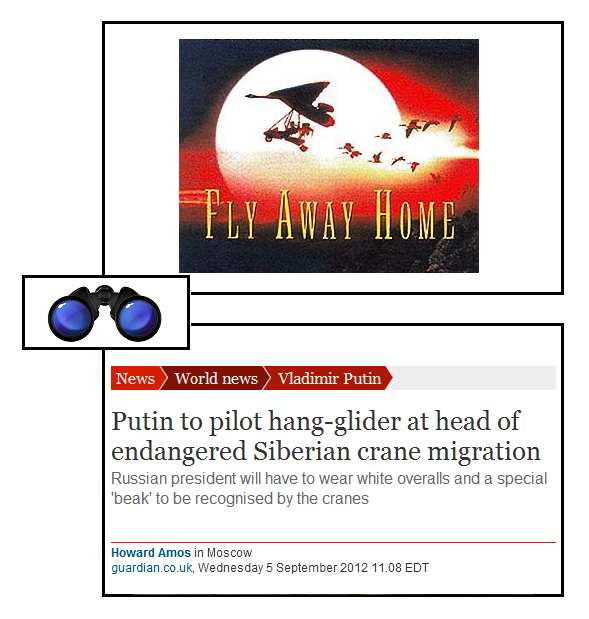
Fly away home, 007

Thursday, September 6th, 2012

[ by Charles Cameron — Putin the Magnificent and his gaggle of geese ]
.

--- upper image from the motion picture soundtrack album

In the film version, according to Wikipedia, there’s “an emergency landing at a U.S. Air Force base on Lake Ontario”

**

[ nothing too original here, the Guardian story mentioned the film ]

Gloria Mundi Rapid Transit

Sunday, September 2nd, 2012

[ by Charles Cameron — that’s the thing: only what’s deep survives ]
.


.

I don’t think the shadow on the wall behind and to the right of Noah Levine (above, left) is wearing a mohawk — I think it’s the shadow of a Tibetan monk wearing the kind of headdress you’ll see on the young Tulku (above, right)… but even so, the picture does remind me of this one, which I posted a few days ago, titled “choir punk”:
.


.

The similarities are more than visual, however — and they’re instructive.

**

As you may recall, the lower of the two images is one that I used to illustrate my opening post on the topic of Pussy Riot, and it illustrates the theme that punk and Orthodoxy have something important in common. The upper image (left) shows another punk who got religion — in this case, Buddhism. His name is Stephen Levine, and he’s the guy who set the Dharma Punx wheel rolling, coming out of a life of prison, punk and crack addiction into the stillness of meditation in much the same way that the punk monks featured in that earlier piece came out of their own nihilism, punk and despair into the stillness of contemplation…

From nihilism to peace.

I’ve never been into punk music myself, I’m a Bach and Gregorian Chant man — but what’s striking me here is the sense that punk knows the first thing there is to know: that the things we do to try to keep ourselves happy necessarily ring hollow after some time. Possessions, status — these things may appease us for a while, but they don’t truly satisfy.

The punk knows this, and the monk knows this — whether the monk in question is Buddhist or Christian or whatever. Only the monk makes the discovery that leads out of contemptus mundi into the alternative strategy.

**

And somehow, you need to reach full tilt boogie to get there, howsoever full tilt boogie may be defined in your own case, and whatever form the contemplative, relaxed, inward life may take.

Here are two versions of what it takes:

Samuel Johnson, I’d say, is seeing something very close to either one of these when he says:

Depend upon it, Sir, when a man knows he is to be hanged in a fortnight, it concentrates his mind wonderfully.

**

A close brush with death — or sure knowledge of one’s mortality. A red-hot iron ball stuck in your throat. Rock bottom…

All of these things can concentrate the mind wonderfully, and the concentrated mind can do things, can allow things that the bothered mind would get insanely bothered by.

You may wear rose-tinted glasses for a while, and get away with it. You can try out the dark glasses of ironic superiority. Both ways of looking involve a measure of self-delusion, however, for they catch surfaces and miss the depths.

At times — when you or someone you love gets an unexpected and advanced cancer diagnosis, say, or you lose your house to the bank — the illusions get stripped away, and you simply see. And what you see will either be enough to make you cry and rage, or enough to make you dance and sing.

Because when the illusions get stripped away, only what’s deep survives.

**

I’d like to take this just a step further.

The old Lakota medicine man Archie Fire Lame Deer told his biographer, Richard Erdoes:

I am no wino or pishko, but I am no saint either. A medicine man shouldn’t be a saint. He should experience and feel all the ups and downs, the despair and joy, the magic and the reality, the courage and the fear, of his people. He should be able to sink as low as a bug, or soar as high as an eagle. Unless he can experience both, he is no good as a medicine man.

I don’t suppose anything I say in words can get this exactly right anyway, but I’ll try.

If you try to give advice to someone who is suffering more than you have ever suffered, your advice is liable to come across as uncomprehending and shallow. You have to have known your own blues to sing the blues. And you have to be in peace to convey peace…

And that, it seems to me, is what allows monks to hear and understand and talk, peer to peer, with punks — and that’s what allows punks to become monks.

**

Noah Levin’s book, Dharma Punx, is available on Amazon, as is the DVD of Meditate and Destroy, the 2007 documentary about him.

**

Punk may still not be my kind of music — but I’m beginning to see the punk mohawk as a kind of instinctive tonsure…

“No one is really listening, they are just pretending.” – Madhu, Part II

Thursday, August 30th, 2012

[by J. Scott Shipman]

Since the original post of “No one is really listening, they are just pretending,” there are indications that pretending may actually be doing institutional harm.

The US Naval Institue recently sponsored the Joint Warfighting Conference 2012, and my friend Lucien Gauthier (YN2/SW) wrote a very good recap of the event. In his post, Lucien remarked on the comments of retired USMC General James “Hoss” Cartwright. Cartwright’s comments have been described by others around the blogosphere as “unleashed,” and indeed his comments may have raised a few eyebrows. But this sentence of Lucien’s post, while perhaps stating the obvious may reveal one challenge the Navy and DOD face in the credibility and trust department:

“Gen Cartwright had the luxury of no longer being in uniform and so his candor was particularly poignant.”

Now I don’t know General Cartwright, but I know people who do and they report he is a fine officer, and my remarks aren’t about him, but the implications of Lucien’s observation. The suggestion “…the luxury of no longer being in uniform and so his candor…”  struck me, for what is the reverse? “…in uniform, no candor?” If our highest ranking officers wait until they are retired to be candid, what does that say for those remaining in uniform, and what does it say about the environment? Does the environment inspire pretending? How many serving “pretend” daily just to get by, or worse, to get promoted?

A few months ago in a conversation with a young naval officer, one of the brightest I know, I was talking about “to be or to do” and the value of honesty always. The officer remarked, “Well sometimes you have to let the boss think the idea was his…” or something to that effect. I made the point that this is part of the problem: if these leaders are so uptight they need to be handled, then they are part of the problem. Trust can grow only where honesty is ubiquitous.

Recently, the Navy Times published a short query entitled, “Tell us what you think: Faith in Navy Brass?” One of the questions surprised me: “Do you trust the Navy’s leadership and still take them at their word?” If those who responded (be sure to read the comments) are to be believed, the answer is a resounding, “no.” Curiosity piqued, I conducted an informal poll among a small group of naval officers (active duty and retired) asking the same question. The answer: “no.” Since my Navy days, I’ve heard the old saw, “A bitching Sailor is a happy Sailor,” but this seems different.

At least ten commanding officers have been relieved of command eight months into 2012. Two were relieved due to unfavorable command climate surveys, so one could conclude the Navy is listening and taking action in some quarters. The recent decision by Secretary of the Navy Ray Mabus to require breathalyzers of Sailors and Marines reporting for duty introduces evidence of distrust, and his decision is nothing short of institutional micromanagement. At their core, a micromanager does not trust their subordinates.

When the folks on the pointy-end of the spear aren’t trusted, leaders should not be surprised when those folks return the favor. So to leaders, while you may think some of your subordinates agree with you, they may pretending, and are you ok with that? Are you ok with that if you learn you are the cause? Less pretending, more honesty.

Postscript: For more evidence, check out his post at the USNI Blog, The Wisdom of a King. Another fine example of the importance of trust can be found in a September 2012 Proceedings article by LCDR B.J.Armstrong, Leadership & Command (both come highly recommended).

Cross-posted at To Be or To Do.


Switch to our mobile site