zenpundit.com » science fiction

Archive for the ‘science fiction’ Category

Somebody at DARPA is a Fan of Daniel Suarez

Tuesday, April 12th, 2011

Freedom (TM) by Daniel Suarez

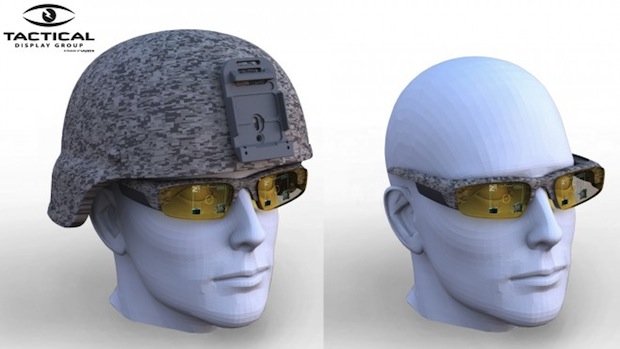
Remember those augmented reality glasses that the daemon operatives like Loki used to connect to the Darknet? Well, DARPA did…

DARPA Designing Augmented Reality Goggles to Fight Friendly Fire 
 

DARPA smart tech

Remember how the Beastmaster could see through the eyes of his pet eagle? DARPA does. And it’s pursuing augmented reality goggles tech that’ll let troops see through the eyes of a nearby unmanned aerial vehicle (UAV) in order to more accurately target its weapons.

The issue of accurate targeting and weapons-fire has a renewed interest in the wake of NATO mistakenly destroying rebel armor in Libya rather than Gadhaffi’s hardware, but it’s never been an easy task. One of the very best ways to deliver today’s smartest weapons is to have an “eyes-on” soldier in the field near the target relaying real time data up to the aircraft that’s about to drop a bomb–but this situation is not often practical or desirable and can be dangerous for both the soldier and the incoming aircraft.

vuzixgoggles

Read the rest here. 

Very cool. If John was not so busy with his new company, he probably could tell his readers how to combine this off-the-shelf modified tech with DIY drones.

An always fun thought experiment is to figure out how far ahead DARPA really is in the lab compared to whatever toy they feel comfortable giving a press release. And then there’s what exists on the drawing board that is technically feasible but not particularly economical at the present time to pursue seriously. Imagination usually far outstrips budgets

The integration of religion and popular culture

Friday, March 25th, 2011

[ by Charles Cameron ]

*

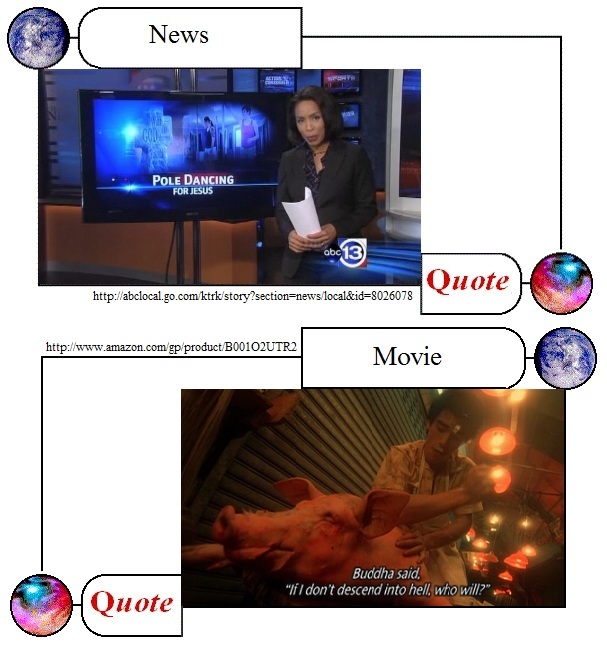
Yesterday, I stumbled on the account of pole dancing for Jesus with the accompanying graphic. I was a little taken aback, I’ll admit, but Jesus didn’t confine his ministry to the pious and scholarly, he befriended women of questionable morals and enforcers from the Roman mob as I recall, or “publicans and sinners” to give them slightly more pleasant names – so I sat up, took notice, downloaded the image, and re-sized it to fit in the top position of one of my DoubleQuotes – while wondering if I’d have to wait till Doomsday to find a suitable companion piece.

quopole-dancing.jpg

All in a day’s screen-gazing, I wound up watching the Wong Kar-Wai film, Fallen Angels, last night, and lo: the screen-shot in the lower part of the DoubleQuote revealed itself.

There are interesting paradoxes embedded in each image, of course, pitting what you might call “deep” theology against pious expectation – but they also illustrate another matter of some interest to me, the degree to which religion is now richly integrated into popular culture.

*

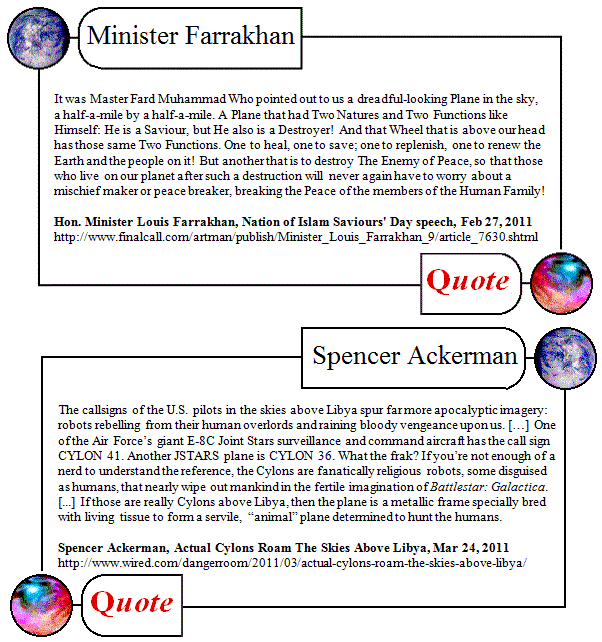
My second DoubleQuote, which contains today’s haul, deals with the same theme, I suppose — this time showing how what used to be the separate realms of science fiction and religion are now intermingled, with Minister Farrakhan speaking of an “end times” space craft that is an integral part of NoI eschatology in his annual Saviours’ Day speech, while alien aircraft flown by religious robots feature in a tongue-in-cheek news report about the war over Libya from Spencer Ackerman at the Wired War Room.

It is perhaps not surprising that Minister Farrakhan also cites Scientology with approval in the same speech, nor that that religion was itself the offspring of science fiction writer L Ron Hubbard. We are in a fertile period for the religious imagination, I believe, grappling to find new ways to answer the age-old questions — and science fiction and “signs in the skies” are among the vehicles, along with new religious movements and old religions renewed, by which we are coming to terms with life in this post-nuclear age…

quosigns-in-the-sky.gif

I’m not much of a prophet, but I predict that the confluence of science fiction with religion will prove to be one of the keys to an understanding of our times…

Call and Response

Thursday, March 3rd, 2011

[ by Charles Cameron ]

Okay, don’t take this one too seriously:

quo-witches.gif

I’m a big fan of Frank Herbert‘s Dune, and the news that there’s now a Goodnight Dune version for kids on the web caught me off guard and carried me away…

Hat tip to Bryan Alexander of Infocult

Elementary, my dear Watson — for humans

Wednesday, March 2nd, 2011

[ by Charles Cameron ]

On the face of it, the two events described here – the super-match in which IBM’s Watson computer beat two human Jeopardy champs, and the crowd-sourced protein-folding experiment in which nearly 60,000 gamers fared better than a supercomputer — would seem to say, respectively, that computers can defeat humans, and that humans can beat computers. So what’s to believe?

quoexperiments.gif

I don’t think the opposition holds up on closer inspection, however.

Watson may have beaten the human contestants in Jeopardy, but as the paragraph I quoted shows, it was nonetheless a human that “had the last word”.

Ben Zimmer in The Atlantic goes on to describe just how clever that “last word” actually was:

If you are a fan of The Simpsons, you’ll be able to identify it as a riff on a line from the 1994 episode, “Deep Space Homer,” wherein clueless news anchor Kent Brockman is briefly under the mistaken impression that a “master race of giant space ants” is about to take over Earth. “I, for one, welcome our new insect overlords,” Brockman says, sucking up to the new bosses. “I’d like to remind them that as a trusted TV personality, I can be helpful in rounding up others to toil in their underground sugar caves.”
.
Even if you’re not intimately familiar with that episode (and you really should be), you might have come across the “Overlord Meme,” which uses Brockman’s line as a template to make a sarcastic statement of submission: “I, for one, welcome our (new) ___ overlord(s).” Over on Language Log, where I’m a contributor, we’d call this kind of phrasal template a “snowclone,” and that one’s been on our radar since 2004. So it’s a repurposed pop-culture reference wrapped in several layers of irony.

Frankly, Watson isn’t up to that level of clever – it would take a Sherlock or a Mycroft to pull that off…
.
So in that first instance, the computer apparently beats the humans, but the humans come across as brighter than the computer all the same.
.
More or less the opposite happens with my second example. Here we have tens of thousands of humans pitted against a single computer, and the humans appear to have the edge – but do they?
.
It’s not the individual human brain that wins here, but what you might term “massively parallel human processing” – which isn’t nearly as impressive.
.
So there are in fact three kinds of ingenuity on display here: the original small-group human ingenuity that constructed the machine, the machine’s own mechanical ingenuity, and the combined ingenuity of sixty thousand humans in distributed collaboration

*

Look, here’s my challenge. The folks at IBM need to read Hermann Hesse’s Magister Ludi, and figure out how to create the sort of computer that could best Joseph Knecht at his own game

Let’s make that a little easier. they need to be able to recognize rich analogies across wide disciplinary distances — well enough to come up with a relationship comparable in its impact on two previously unrelated fields of knowledge to, say, the Taniyama-Shimura conjecture linking elliptic curves and modular forms

Simpler still: they need to be able to play one of my HipBone Games – see Derek Robinson‘s description of the games in The HipBone Games, AI and the rest — well enough to pass a Turing test.

*

Elementary, my dear Watson…

Signs of the times

Monday, January 3rd, 2011

[ by Charles Cameron ]


Switch to our mobile site