zenpundit.com » graphical thinking

Archive for the ‘graphical thinking’ Category

Jottings 7: Two for the iconography of terror

Tuesday, May 7th, 2013

[ by Charles Cameron — taking a break from my pressing writerly duties ]
.

I wouldn’t have noticed these two offerings quite so clearly if I hadn’t been pointed to each of them in the last couple of days. Both look to be of considerable interest:

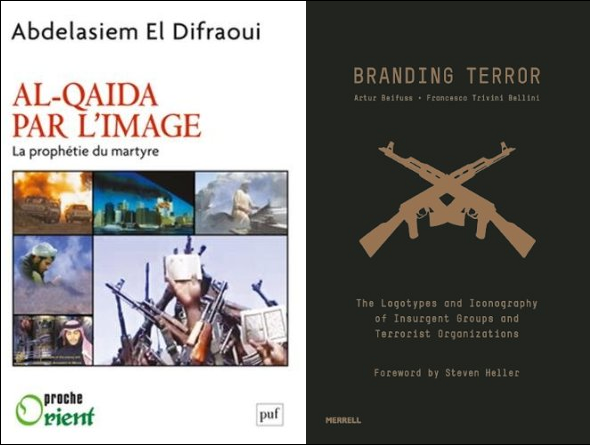
Artur Beifuss & Francesco Trivini Bellini, Branding Terror: The Logotypes and Iconography of Insurgent Groups and Terrorist Organizations
Asiem El Difraoui, The Jihad of Images

Hat-tip Nico Prucha at Jihadica, and who or whatever pointed me to HuffPo — idenitfy yourselves and be saluted!

**

The first image in the HuffPo slideshow for Branding Terror (lower image, below, AQIM) really hit me square between the eyes, because when I was in Mashhad, Iran, in the early seventies, I snarfed up a postcard with a very similar design — Shi’ite rather than Sunni, and not so distinctly violent (upper image):

Some things just don’t seem to change.

On the HipBone and Sembl games: update

Thursday, November 29th, 2012

[ brief intro by Charles Cameron, then shorter version of Dr. Cath Styles‘ presentation of Sembl at the National Digital Forum in New Zealand, 20 November 2012 ]
.

Charles writes:

I’ve been working for almost twenty years on the development of a playable variant on Hermann Hesse‘s concept of the Glass Bead Game.

It’s an astonishing idea, the GBG — that one could build an architecture of the greatest human ideas across all disciplinary boundaries and media — music, religion, mathematics, the sciences, anthropology, art, psychology, film, theater, literature, history all included — and it has engaged thinkers as subtle as Christopher Alexander, the author of A Pattern Language [See here, p. 74]. Manfred Eigen, Nobel laureate in Chemistry and author of Laws of the Game [see here], and John Holland, the father of genetic algorithms [see here].

Here’s Hesse’s own description of the game as a virtual music of ideas:

All the insights, noble thoughts, and works of art that the human race has produced in its creative eras, all that subsequent periods of scholarly study have reduced to concepts and converted into intellectual values the Glass Bead Game player plays like the organist on an organ. And this organ has attained an almost unimaginable perfection; its manuals and pedals range over the entire intellectual cosmos; its stops are almost beyond number.

My own HipBone Games were an attempt to make a variant of the game that would be simple enough that you could play it on a napkin in a cafe, and has in fact been played online — and more recently, my friend Cath Styles has adapted it for museum play, and introduced the basic concept and our future hopes in a presentation at the National Digital Forum 2012, New Zealand — which you can see very nicely recorded in Mediasite format.

Do take a look — Cath makes a first-rate presentation, and I love the Mediasite tech used to capture it.

Since the slides are shown in a small window concurrently with Cath’s presentation, I’ve edited her presentation for Zenpundit readers, and reproduced many of her slides full-size with some of her commentary below.

**

Sembl, the game of resemblance

Cath speaking:

In its first form, Sembl is an iPad game, called The Museum Game, at the National Museum of Australia. We’ve just released it in beta as a program for visiting groups.

Cath then talks about feedback from children and adults about their experience of playing the game. Some kids homed in on the principle of resemblance, others emphasised the social side of the game. She talks, too, about their teacher, and her observations about the ways the game engaged her kids.

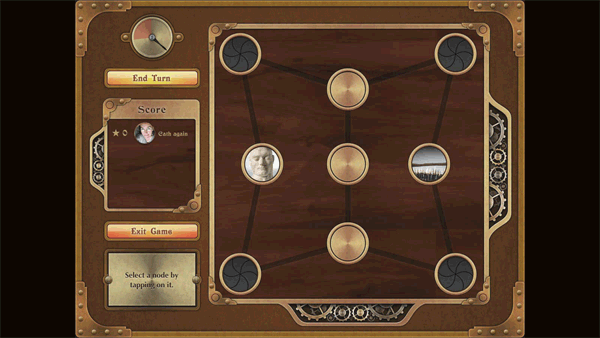
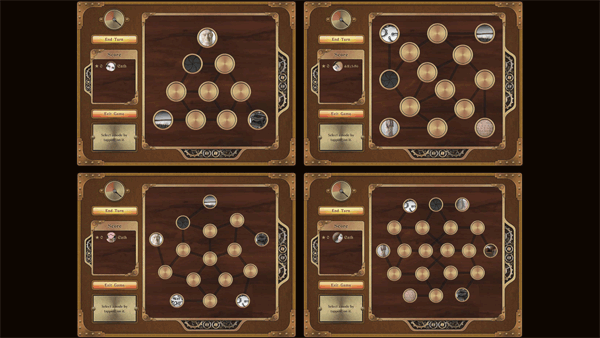
She then shows us various Sembl gameboards for iPad:

Sembl Museum gameboard for four teams of younger players

Four different Sembl Museum gameboards

Cath speaks:

But The Museum Game is just one form of Sembl. The Museum Game is played in real time, on site, and players take photos of physical objects to create nodes on the board.

The next step is to make a web-based form, that you could play at your own pace, and from your own place. Then, Sembl becomes a game-based social learning network, which amplifies the personal value of the game – it becomes social networking with cognitive benefits.

But it’s the bigger picture – of humans as a community – that I most want to explore: Sembl as an engine of networked ideas, or linked data.

Charles notes: I’m skipping the educational part — and the bit about my own role in the game’s development, to get to the core of her presentation as I see it: the cognitive facilitation it provides

Cath again:

Another way of saying this is that the Game provides a structure and impetus for dialogue, between the museum and visitors, between visitors and things, among visitors and between things. And this is not dialogue in the sense of an everyday conversation. It’s deeper than that. It’s a mutual experience of looking both ways, simultaneously.

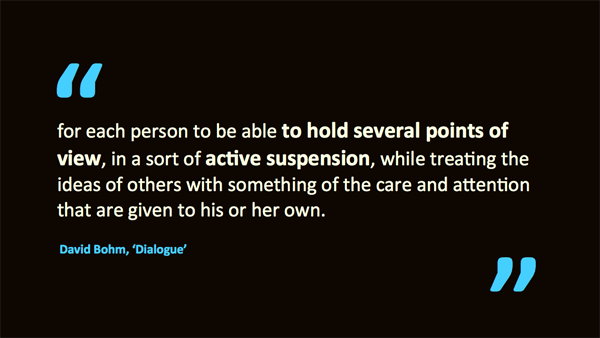
Cath next quotes David Bohm, the eminent quantum physicist:

to hold several points of view in active suspension – quotation of David Bohm

Cath speaks:

For Bohm, dialogue means holding several points of view in active suspension. He regarded this kind of dialogue as critical in order to investigate the crises facing society. He saw it as a way to liberate creativity to find solutions.

Cath then drops in an important topic header:

Toward a game-based social learning network

Cath:

The concept of Sembl, in its deepest sense, is social learning – game-based social learning. In its first instantiation, it is game-based social learning in a museum and – if things turn out as I hope they will – from next year it will be playable at any other exhibiting venue that has the infrastructure and the will to host games – galleries, libraries, botanic gardens, zoos and so on.

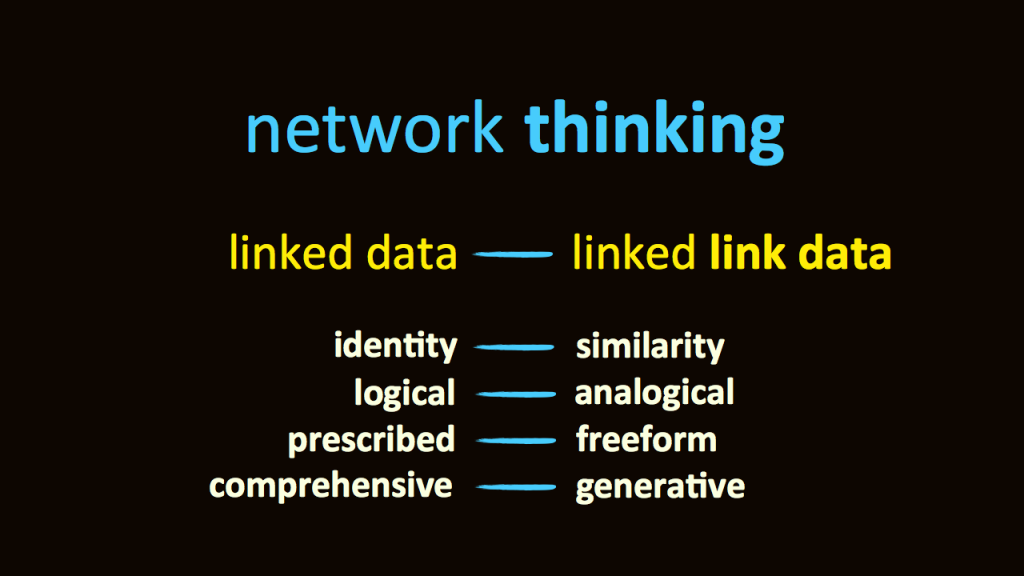
network thinking – how Sembl network links differ from traditional linked data links

A web-based form of Sembl can generate linked data with a difference. It’s linked link data, and quite different to normal linked data.

  • Instead of connections based on what a thing is – sculpture, or wooden, or red – Sembl generates connections based on a mutual resemblance between two things. Which, amazingly enough, is a great way of gaining a sense of what each thing is. And if your interest is to enable joyful journeying through cultural ideas, or serendipitous discovery, this approach just wins…
  • Instead of compiling logical links, Sembl cultivates the analogical.
  • Instead of building and deploying a structured, consistent set of relationships, Sembl revels in personal, imprecise, one-of-a-kind, free association, however crazy.
  • Instead of attempting to create a comprehensive and stable map of language and culture, Sembl links are perpetually generative, celebrating the organic, dynamic quirks of cognitive and natural processes.

But the most important way that Sembl is distinct from other systems of network links is that those who generate the links learn network thinking. Which is a critical faculty in this complex time between times, as many smart people will tell you.

Poets have always known the virtues of analogy as a path to the truth.

Tell all the truth but tell it slant – poem by Emily Dickinson

Sembl promotes dialogic, non-linear thinking, and new forms of coherence.

deliberative thinkers – quotation of Charles Cameron

It’s distinct from deliberative thinking, which is rational and causal and logical and linear.

eccentric thinkers – quotation of Charles Cameron

It’s another kind of thinking, which might be informed by rational thought, but its purpose is not singular.

bridge-builders – quotation of Charles Cameron

You might say its purpose is to create – and cohabit – a state of grace, from which ideas simply emerge.

every move you make is a creative leap

If playing Sembl gives us practice in polyphonic thinking, if it helps cultivate connectivity and our capacity to find solutions to local and global problems, it is good value. As Charles says, every move is a creative leap.

Cath concludes:

If you’re interested in working with us to supply content, develop strategy or raise capital, we’re keen to talk.

And I can’t tell you how much I’m anticipating being able to invite everyone to play.

thanks

**

Cath can be reached via Twitter at @cathstyles, and I’m at @hipbonegamer. The Sembl site is at Sembl.net.

Next up: what Sembl has to offer the IC.

Describing Ahmed al-Jabari, with a side of traffic patterns

Tuesday, November 20th, 2012

[ by Charles Cameron — this began with two quotes about the killing of Ahmed al-Jabari and ended up reminding me of traffic flows ]
.

So very much depends on nuance, doesn’t it? There are, after all, one-way streets and two-way streets:

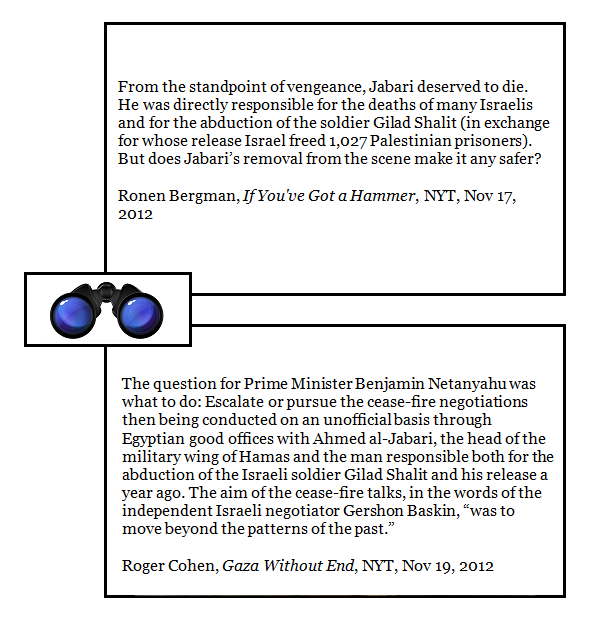
Surely there’s more nuance in describing al-Jabari as “the man responsible both for the abduction of the Israeli soldier Gilad Shalit and his release a year ago” than as “directly responsible for the deaths of many Israelis and for the abduction of the soldier Gilad Shalit”.

**

Does that mean that abducting Gilad Shalit and releasing Gilad Shalit cancel each other out?

In my opinion, not.

But if in this case, (x) plus (-x) does not equal 0, it’s because that “plus” doesn’t represent an addition, it represents an incarceration — one in which Shalit himself was “cared for” under Jabari’s instructions, according to Gershon Baskin in his own NYT piece, Israel’s Shortsighted Assassination

No, Mr. Jabari was not a man of peace; he didn’t believe in peace with Israel and refused to have any direct contact with Israeli leaders and even nonofficials like me. My indirect dealings with Mr. Jabari were handled through my Hamas counterpart, Ghazi Hamad, the deputy foreign minister of Hamas, who had received Mr. Jabari’s authorization to deal directly with me. Since Mr. Jabari took over the military wing of Hamas, the only Israeli who spoke with him directly was Mr. Shalit, who was escorted out of Gaza by Mr. Jabari himself. (It is important to recall that Mr. Jabari not only abducted Mr. Shalit, but he also kept him alive and ensured that he was cared for during his captivity.)

Cared for, maybe — but still incarcerated.

In street terms, there are times when a multi-lane two-way street gets divided so that perhaps three lanes go one way and only one the other — when, in moral terms, there’s no moral equivalency, but still some truth, some justice on both sides. That’s the sort of situation that calls for even more nuance… some of which, to my mind, Baskin provides with what is essentially a “no, but” formulation — no, Jabari was not a man of peace, but, it is important to recall…

**

Look, I think the ability to envision flow patterns is one of the keys to understanding complicated and complex situations — and graphics does a better job of it than linear thinking. Contraflow lane reversal is an interesting example:

Credit: Matthew Hausknecht et al., Dynamic Lane Reversal in Traffic Management

Neither General Gordon nor the Mahdi lived to see this one:

The White Nile Bridge connecting Khartoum, Sudan and Omdurman, with 4 lanes total. Traffic is generally directed equally, 2 lanes to Khartoum and to lanes from except in the morning, where it’s 3 lanes towards Khartoum, and in the evening, 3 lanes towards Omdurman.

**

Of course, you don’t want your efforts to make an unexpected Dynamic Lane Reversal and blow back on you.

Credit: Blowback contraflow by Charles Cameron, h/t Matthew Hausknecht et al

But that at least seemed to be James Zogby‘s concern, when he wrote:

One can only wonder whether when the Israelis made the decision to assassinate Ahmed al Jabari they were foolish enough to assume that their attack would be the end of it. Having been down this same road before, where assassinations only led to escalation and then full-scale hostilities, one might have hoped that someone in the Israeli high command would have recalled 2008 or 2006 (and so many other tragic, bloody episodes in the past) and cautioned that “no good will come of this.” When I heard an Israeli Ambassador tonight saying that “we must finish them off, so we can sit with moderates and talk peace,” it became all too clear that no lesson had been learned.

**

I sometimes wonder whether maybe outcomes are above the human pay grade.

Reading a partisan cartoon: the parable of a dog’s ears and teeth

Friday, November 16th, 2012

[ by Charles Cameron — on the difficulties that may be posed when “reading” graphics ]
.

**

The question I want to ask in this post is: how much can you safely read into a political cartoon?

Here is the particular cartoon I have in mind:

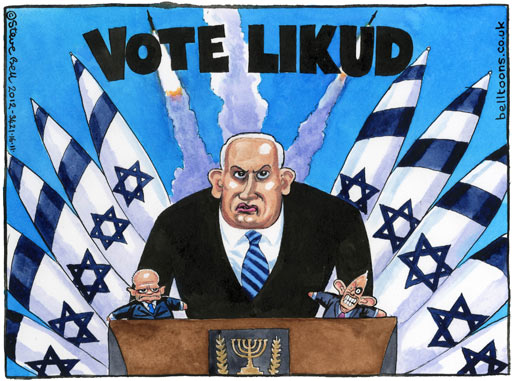
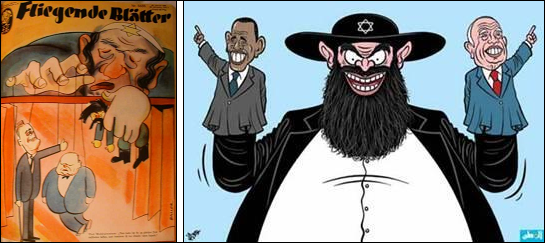
It was published in The Guardian (UK) yesterday, and as you may be able to see, it portrays Israeli PM Benjamin Netanyahu as a puppet-master, with British politicians Tony Blair and William Hague as his puppets, and was published to illustrate the cartoonist’s view of British reaction to the Gaza situation.

How much can we read into it?

**

If you are used to seeing cartoons such as these —

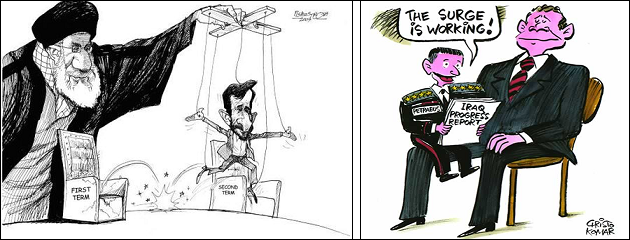
showing Khamenei pulling Ahmadinejad‘s strings and Petraeus as a puppet of GW Bush, when you come across the Netanyahu cartoon in the Guardian, you may well view it as another in a long series of political cartoons suggesting that someone is running someone else’s show behind the scenes. It’s the old idea of the eminence grise, in other words, expressed in cartoon form.

**

If, on the other hand, you’ve been exposed way too often to cartoons like these —

the one portraying Churchill, FDR and Stalin as Jewish puppets, taken from a 1942 issue of the Nazi paper, Fliegende Blätter, or the one depicting McCain and Obama as Israeli puppets, taken from a 2008 issue of the Saudi paper, Al-Watan… you may well see the same cartoon in a very different — and distinctly antisemitic — light.

**

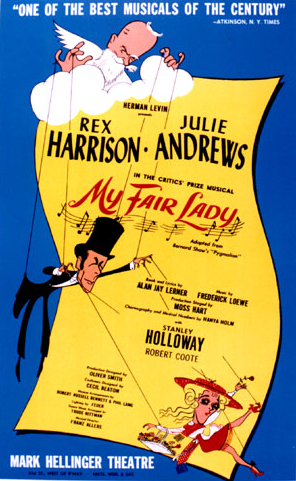
The last two graphics, at least, are extremely offensive, and I would like to offer another graphic here — one which also uses our “puppet master” theme — as a visual equivalent of offering a glass of water to cleanse the palate:

I’ll be addressing this My Fair Lady poster from a very different angle, in a later post in my “form is insight” series — this one on “dolls within dolls”, the “world stage which we have dotted with stages of our own devising” and “turtles all the way down”…

**

Having hopefully reduced the emotional freight which some of the cartoons above must surely have carried with them, I would now like to offer you some background which seems relevant to me. Characteristically, perhaps, it comes from a very different field of knowledge.

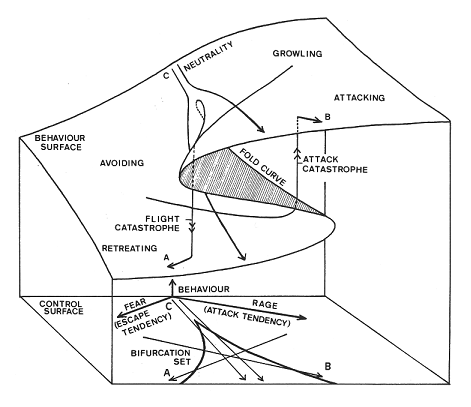
EC Zeeman‘s April 1976 article Catastrophe Theory in the Scientific American was my introduction to the mathematician Rene Thom’s remarkable body of work, an introduction which sailed mostly over my head — but one of Zeeman’s points, which he illustrated with the graphic below, made perfect sense to me.

The annotation to this illustration read in part:

If an angry dog is made more fearful, its mood follow* the trajectory ‘A’ on the control surface. The corresponding path on the behaviour surface moves to the left on the top sheet until it reaches the fold curve; the top sheet then vanishes, and the path must jump abruptly to the bottom sheet. Thus the dog abandons its attack and suddenly flees. Similarly, a frightened dog that is angered followes the trajectory ‘B’. The dog remains on the bottom sheet until that sheet disappears, then as it jumps to the top sheet it stops cowering and suddenly attacks.

My translation:

A dog that reaches the point where its ears are fully pinned back, indicating full-on fear, and its teeth are also fully bared, indicating full on rage, will behave differently depending on whether its fear level or its rage level was the first to be raised to “full”.

Just as a dog’s reaction to a full on mix of rage and fear may depend on which stimulus came first, so — I am suggesting — our own reaction to the cartoon in question — inherently antisemitic, or merely critical of a particular Israeli operation — may depend on our previous exposure to cartoons, politics, the Israeli-Palestinian conflict, or antisemitism.

**

We now have several levels of ease or difficulty in reading graphics. The Zeeman graphics are hard to read because they’re too small to be legible — but put them in the context of Zeeman’s article, and view them full size as originally published, and the only problem might be in following Zeeman’s text, itself a popularization and simplification of Rene Thom‘s work.

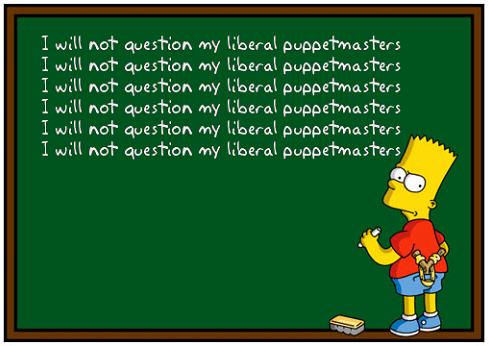
The Bart Simpson graphic is fairly straight forward, and regular viewers of the show would “read” it in line with hundreds of similar frames in which Bart writes repeated lines on a classroom chalkboard, from Season 1 episode 2’s “I will not waste chalk” to Season 23’s “There’s no proven link between raisins and boogers”.

And then there’s the disputed Netanyahu graphic… which can be “read” differently, depending on what previous “puppet master” associations the viewer beings to the task. Here, it seems to me, the task of interpretation can be viewed in one of two ways: (i) as an exploration of how it is likely to be read, which I’m suggesting will depend on previous association, and (ii) as an exploration of what “must have been” in the cartoonist’s heart.

**

Assessing the cartoon’s probable impact on segments of the public is one thing — knowing what the cartoonist intended, even though we tend to conflate the two, is quite another. Not for nothing does St Paul in I Corinthians 2.11 ask (in my own translation)

Who knows the qualities of a man but the spirit of that man within him?

Cross-grain thinking, 2: mapping the jihadist mind & AQ’s #3 spot

Sunday, November 11th, 2012

[ by Charles Cameron — the different types of “leaders” should give us an idea of the different mental operations in play in the individual minds of the led, as well as the “mind” of the organization — plus fun ]
.
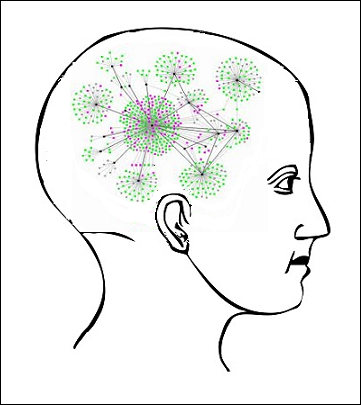
credit for mind map aspect of composite image to valdis krebs

.

Okay, I made my basic point here quite nicely in that little tag-line that gives you the brief overview of each of my posts right next to my name, so I’ll just repeat it here, very slightly amplified for focus:

The different types of “leaders” we identify in AQ should give us an idea of the different mental operations usually in play in the individual minds of jihadists, as well as within the “mind” of the organization itself.

I tried to show how cross-grain thinking in general, and thinking that includes both “subjective” and “objective” realities specifically, might play a considerable role in understanding some pressing contemporary issues in my recent post on Mozart — a figure so removed from those problems that some of you may have skipped it. Here’s my ending, with the Mozart details safely removed:

I think we should track that pattern, know as much as we can of that pattern, write the biography of the way in which some piece of music weaves between inspiration and thought, composer and instrument, mind and matter, performer and audience, studio and home digital music center…

Then, perhaps, we could begin to map other patterns – in some ways simpler and more urgent ones.

The sorts of “simpler and more urgent” patterns I was thinking of there include:

  • how discussions become deliberations and deliberations decisions
  • how scenarios are built and understood and sometimes poorly configured to our later detriment
  • how foreign policy plus feedback loops can create blowback and how to minimize it..
  • and specifically,

  • how the “jihadist” radicalization process moves from floating frustration and shame, via identification of a plausible “other” to rage against, to commitment, then via theology (!!) (for divine sanction of otherwise unpalatable acts) to the recognition of a binding moral obligation (fard ‘ayn in AQ terms) — and thence to camps for training in weaponry and the requirements and subtle limitations on Quranically sanctioned war…
  • **

    That last one has been an interest of mine, sitting in the back of my mind as an unanswered problem, quietly gathering data and forming insights for a while now, under a rubric along the lines of the question:

    Can we figure out a rough map of the workings of the “typical” mind of a potential jihadist as it radicalizes?

    It occurs to me that the leadership of an organization likely maps well to the organization’s functions, and those functions to the thought processes in which members are involved so a map of the aspects of leadership may well give us a rough draft of a mind-map for the individual member, including the passage from uninvolved observer to active participant: the process of radicalization.

    This may seem pretty obvious to some of you, but it’s a fresh idea for me, and to me it’s important because we already map communications networks and organizational flows, but the mind — the individual mind is one place we don’t seem to go.

    So I’m thinking in terms of sketching the mind of a “person” who is in some ways AQ as a whole, considered as if it were one sensate human-like being, filled with the usual variety of thoughts and emotions, ideals and pragmatisms, hopes and fears, hunches and hard data, clarities and confusions.. And I’m thinking of doing this by treating “leaders” as though they were distinct but coordinated processes in a single mind.

    We track and map people and their connections, we track and map groups and their connections, we track and map communications and their connections — are we tracking and mapping memes as such? ideas and their connections? minds?

    If we are already tracking ideas and minds — or if we aren’t doing that yet, but could — I’d be on the lookout for possible positive and negative feedback loops within the system, some that enhance the overall operation and could be disrupted, and some that fragment and damage it and could be amplified.

    So that, among other things, God willing, we could learn better ways to dampen some of the oscillations of hate…

    **

    I was looking at a comment in the recent ICSR report, Al-Qaeda at the Crossroads [h/t @azelin], and ran across this quote which struck me from an oblique angle:

    About ten core leaders have been subsequently killed, including Atiyah Abd al-Rahman, Abu Hafs al-Shahri, Samir Khan, Anwar al-Awlaki, and Abu Yahya al-Libi.

    Let’s take a look at these folk: Atiyah Abd al-Rahman was reported via Bill Roggio at Long War Journal as al Qaeda’s “operations chief” and a major planning a major attack on the US for the tenth anniverary of 9/11, as AQ’s “general manager” and bin Laden‘s “chief of staff”. Abu Hafs al-Shahri was another “operations chief”. Samir Khan was a publicist, the editor of the English-language magazine Inspire. Anwar al-Awlaki was a minor theologian with a talent for publicity and a decent understanding of his American audience…

    And as for Abu Yahya al-Libi, here’s an excerpt from an NYT piece about him:”I call him a man for all seasons for A.Q.,” said Jarret Brachman, a former analyst for the Central Intelligence Agency who is now research director of the Combating Terrorism Center at West Point. “He’s a warrior. He’s a poet. He’s a scholar. He’s a pundit. He’s a military commander. And he’s a very charismatic, young, brash rising star within A.Q., and I think he has become the heir apparent to Osama bin Laden in terms of taking over the entire global jihadist movement.”

    On that telling, al-Libi alone would be almost enough for my purposes — but let’s go with the whole list. The AQ mindset involves courage, poetry, scholarship, punditry and command and control. Specify that the scholarship needs to include theology (AQ at one point sent al-Libi to Mauretania for advanced Islamic studies) as well as strategy and guerrilla warfare (think Abu Mus’ab al-Suri, who was well-read in Taber’s The War of the Flea, Chairman Mao, Che Guevara, and Vo Nguyen Giap), and the significant influences on the jihadist mind begin to swim into focus.

    **

    See, I’m nudging my way to something fairly close to the Lincoln mention in Fred Kaplan‘s Slate piece about Petraeus the other day:

    Toward the end of the war, as the senior planning aide to Army Chief of Staff Gen. George Marshall, Lincoln realized that the Army needed to breed a new type of officer to help the nation meet its new global responsibilities in the postwar era. This new officer, he wrote to a colleague, should have “at least three heads—one political, one economic, and one military.” He took a demotion, from brigadier general to colonel, so he could return to West Point and create a curriculum “to improve the so-called Army mind” in just this way: a social science department, encouraging critical thinking, even occasionally dissent.

    How would we map these mental processes? How would we map the jihadist’s equivalent?

    **

    While I was fishing around for AQ leadership lists in search of an education, I ran across Robert Mackey‘s amusing piece on his NYT blog back in 2010, titled Eliminating Al Qaeda’s No. 3, Again, in which he mentioned as killed or captured claimants to the #3 spot Mustafa Abu al-Yazid, described as “a top financial chief for Al Qaeda” and quotes a colleague as saying “many of Mr. Yazid’s predecessors in Al Qaeda’s No. 3 slot” – from the Bush years alone, he lists Abu Zubaydah, Khalid Shaikh Mohammed, Abu Faraj al-Libbi, Hamza Rabia and Saif al-Adel.

    Okay, we should definitely add “financial chief” to my list above.

    The humorist and the artist in me often lead the more serious analyst in me to insights I’d not otherwise have access to, and since I’m worrying away at the notion that analysis needs to feature both “interior” (mind, heart) and “external” (world) realities, I keep the artistry and humor in my analyses, and hope that makes them more rather than less accessible — so let’s run with the AQ#3 nonsense for a bit.

    Mackey’s is a slightly tongue in cheek treatment of a reasonably serious topic. On Twitter the humor gets more incisive, with Andy Borowitz claiming 9,000 AQ#3s have been killed, and AQ#3 in person setting up a twitter account and tweeting merrily away for a while, see the two sample tweets in this SPECS graphic:
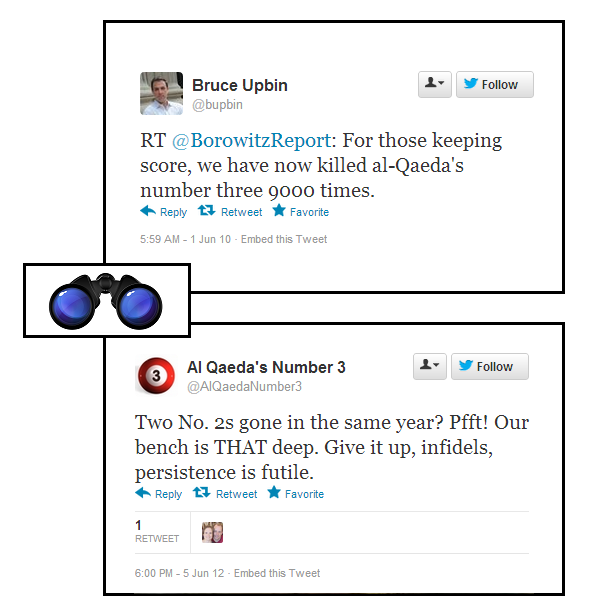
    My sources for those two tweets were Bupbin and AlQaedaNumber3.

    To be honest, I find the AQ#3 business both irritating — since it shows how little depth our popular understanding of who we’re dealing with really has — and amusing — because it’s so very ripe for satire…

    **

    I’ve been working at this post so long I’m mentally cross-eyed, so feel free to fill me in or chew me out…

    Switch to our mobile site