zenpundit.com » counterpoint

Archive for the ‘counterpoint’ Category

Iconic: compare and contrast III

Saturday, December 24th, 2011

[ by Charles Cameron – Iraq war, beginning and ending, analytic power of similarity ]

.

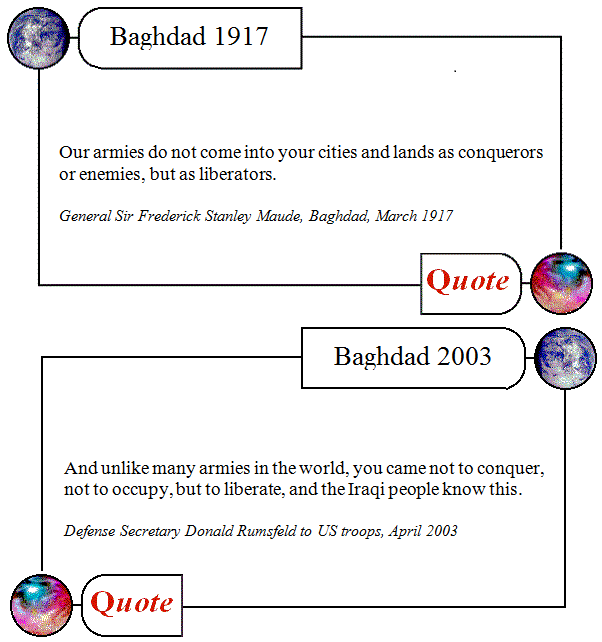
I’ve thanked Zen for his Iconic Compare and Contrast post already, but I’d like to run with his juxtaposition of images from the end of the Iraq war, and book-end it with an early DoubleQuote of mine from the beginning, thus:

That’s the beginning of the war, as I saw it “binocularly” — and here’s its ending, as Zen captured it:

Different though they are — one verbal, one visual — I think they go well together. I think they belong together.

But that’s essentially an aesthetic intuition.

*

And — apart from thanking Zen — that’s the thing I want to talk about.

The two quotes, eighty-six years apart, about an (anglophone) army in Baghdad coming there to liberate, not to conquer, are similar enough that they should give us pause for thought. They challenge us to think long and hard about the similarities between the two situations — and they challenge us to think no less hard and long about their differences.

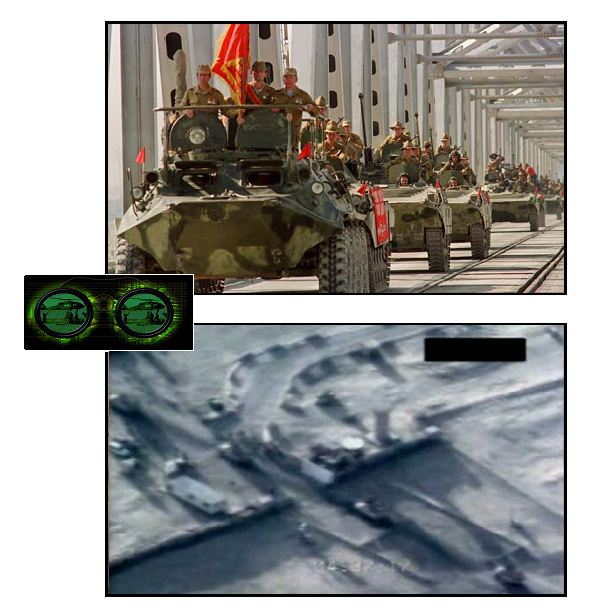
Likewise, it’s the similarities between the two images Zen chose — of the Soviet withdrawal from Afghanistan and the US exit from Iraq — that give that juxtaposition its power.  And Zen has chosen very carefully:

Not only are there two lines of vehicles stretching back from the foreground away into the distance in each image, but the angle from which the two columns are seen is about the same — and there are even two “tracks” in each photo reinforcing the vanishing point — two tracks to the right of the vehicles in the Afghan photo, the edge of the road and a what looks like the shadow of an overhead cable in the photo from Iraq.

*

But let’s take this a bit further. The following juxtaposition is every bit as much a juxtaposition of the Soviet and American withdrawals as the pair of images Zen picked, but this time we have an aerial view of the US convoy — so the visual “rhyme” between the two images is no longer there — and even though the aerial shot is an intriguing one, what a difference that makes!

There’s nothing in that juxtaposition to make you go, yes!

On the level of what’s being referred to, the troop withdrawals from Afghanistan and Iraq,  this pair of images has the same properties as the two images that Zen selected.  But it doesn’t capture our attention in nearly the same way.

And the same would have been true if I’d picked a different sentence from Rumsfeld‘s speech to juxtapose with General Maude‘s “not as conquerors or enemies but as liberators” — such as, “You’ve unleashed events that will unquestionably shape the course of this country, the fate of the people, and very likely affect the future of this entire region.” I’d still be comparing and contrasting two speeches from the beginnings of two occupations of Baghdad.  But there’d be no oomph to the comparison.

*

Because — and this is what I am trying to get at, the basic principle of HipBone analysis and what distinguishes it from otherwise similar modes of brainstorming and mind-mapping — the recognition of pattern, of salient sameness, of close parallelism or opposition is the criterion for success or failure in a HipBone-style juxtaposition.

Zen’s graphic example has that closeness — even down to those two parallel tracks beside and to the right of the vehicles.  My two quotes from Maude and Rumsfeld have that.  And it’s that closeness of match that makes a juxtaposition powerful.

Analogy works this way, rhyme works this way, fugue works this way, graphic match (in cinematography) works this way — it’s basic to the arts, basic to rhetoric, and basic to the way our analogically-disposed minds think.

It is not a method for arriving at conclusions, it’s a method for posing questions. And it sits right at the juncture where analysis admits it is not a science but an art.

Zen’s Iconic Compare and Contrast: Nine Years

Saturday, December 24th, 2011

I would like to depart from my usual style and take a leaf out of Charles Cameron’s playbook – notably his last post. Consider this a “Part II”.

Here are my selections:

Friendship Bridge, Afghanistan – February 16, 1989

….Many troops wondered how the Iraqis, whom they had worked closely with and trained over the past year, would react when they awakened on Sunday to find that the remaining American troops on the base had left without saying anything.

“The Iraqis are going to wake up in the morning, and nobody will be there,” said a soldier who identified himself only as Specialist Joseph. He said he had emigrated to the United States from Iraq in 2009 and enlisted a year later, and refused to give his full name because he worried for his family’s safety…..

Tampa Highway, Iraq – December 18, 2011

War without a strategy is like driving without a map – and in both cases you may not like your destination.

Iconic: compare and contrast

Thursday, December 22nd, 2011

[ by Charles Cameron — iconic images, riot police, compare and contrast, repetition with variation ]

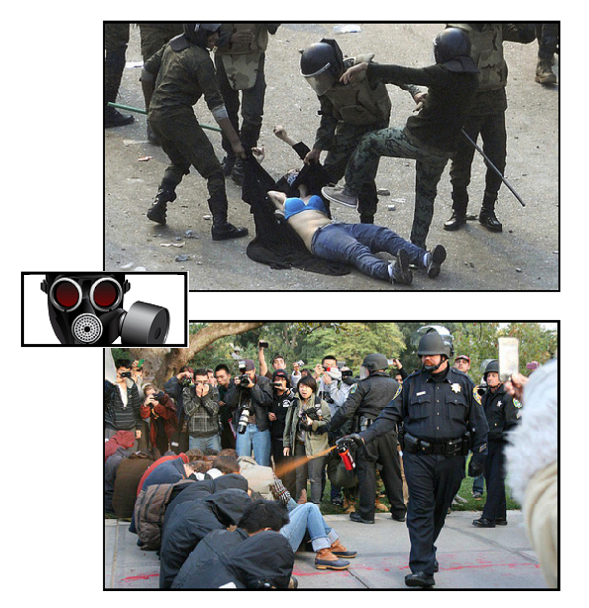
First, let’s be clear that both these images have been widely considered iconic.

Thus NPR reported of the first photo:

There have been countless accounts of violence recorded during the uprisings in Egypt but the image that perhaps has captured the most attention is the most recent. The image has been widely referred to as the “girl in the blue bra.”

While Real Clear Politics quotes Michael Moore on the second:

“The images have resonated around the world in the same way that the lone man standing in front of the tanks at Tiananmen Square resonated. It is an iconic movement in Occupy Wall Street history,” Michael Moore declared on MSNBC’s “Last Word” program.

Moore was referring to police pepper spraying students at an “Occupy” protest at UC Davis.

So we have two similarities between the two images: they both show police in riot gear taking action against demonstrators, and they have both caught the public eye as somehow being representations that can “stand in” for the events they seek to portray.

Beyond that, it’s all compare and contrast territory — or variations on a theme, perhaps — and different people will find different reasons to attack or defend the demonstrators or the police in one, the other, or both cases.

1.

These are, for many of us, “home” and “away” incidents, to borrow from sports terminology, and some of our reactions may reflect our opinions in general of what’s going on in Egypt, or in the United States.

We may or may not know the rules of engagement in effect in either case, on either side.

In a way, then, what the photos tell us about those two events, in Tahrir Square and on the UC Davis campus, may tell us much about ourselves and our inclinations, too.

2.

As I’ve indicated before, I am very interested in the process of comparison and contrast that the juxtaposition of two images — or two quotes — seems to generate. And I’ve quoted my friend Cath Styles, too:

A general principle can be distilled from this. Perhaps: In the very moment we identify a similarity between two objects, we recognise their difference. In other words, the process of drawing two things together creates an equal opposite force that draws attention to their natural distance. So the act of seeking resemblance – consistency, or patterns – simultaneously renders visible the inconsistencies, the structures and textures of our social world. And the greater the conceptual distance between the two likened objects, the more interesting the likening – and the greater the understanding to be found.

I’d like to examine these two particular photographs, then, not as images of behaviors we approve or disapprove of, but as examples of juxtaposition, of similarity and difference — and see what we might learn from reading them in a “neutral” light.

3.

What I am really trying to see is whether we can use analogy — a very powerful mental tool — with something of the same rigor we customarily apply to questions of causality and proof, and thus turn it into a method of insight that draws on our aha! pattern recognition and analogy-finding intuitions, rather than the application of inductive and deductive reason.

And that requires that we should know more about how the mind perceives likenesses — a topic that is often obscured by our strong emotional responses — you’re making a false moral equivalence there! or look, one’s as bad as the oither, and it’s sheer hypocrisy to suggest otherwise!

So among other things, we’re up against the phenomenon I call “sibling pea rivalry” — where two things, places, institutions, whatever, that are about as similar as two peas in a pod, have intense antagonism between them, real or playful — Oxford and Cambridge, say, and I’m thinking here of the Boat Race, or West Point and Annapolis in the US, and the Army-Navy game.

Oxford is far more “like” Cambridge than it is “like” a mechanic’s wrench, more like Cambridge than it is a Volkswagen or even a high school, more like it even than Harvard, Yale, Princeton or Stanford — more like it than any of the so-called “redbrick universities” in the UK — so like it, in fact, that the term “Oxbridge” has been coined to refer to the two of them together, in contrast to any other schools or colleges.

And yet on the day of the Boat Race, feelings run high — and the two places couldn’t seem more different. Or let me put that another way — an individual might be ill-advised to walk into a pub overflowing with partisans of the “dark blue” of Oxford wearing the “light blue” of Cambridge, or vice versa.  Not quite at the level of the Zetas and the Gulf Cartel, perhaps, but getting there…

4.

So one of the things I’ve thought a bunch about is the kind of analogy that says a : A :: b : B.

As in: Egyptian cop is to Egyptian protester as UC Davis cop is to UC Davis protester.

Which you may think is absolutely right — or cause for impeachment — or just plain old kufr!

And I’ve figured out that the reason people often have different “takes” on that kind of analogy — takes so different that they can get extremely steamed about it, and whistle like kettles and bubble over like pots — has to do with the perceptual phenomenon of parallax, whereby some distances get foreshortened in a way that others don’t.

5.

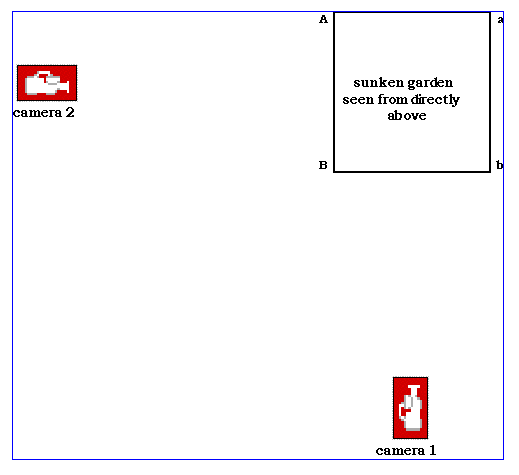
So my thought experiment sets up a sunken garden — always a pleasure, with two video cameras observing it, as in this diagram:

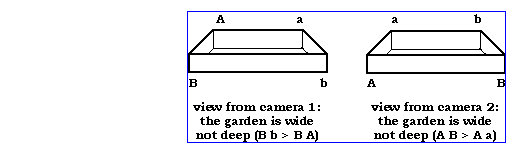
And from the two cameras, the respective views look like this:

In this scheme of things, Aa (Oxford) seems very close to Bb (Cambridge) seen from the viewpoint of camera 1 — but from camera 2’s standpoint, Aa (Oxford) and Bb (Cambridge) are at opposite ends of the garden, and simply couldn’t be father apart.

6.

Now, my thinking here is either so obvious and simple as to be a platitude verging on tautology — or one of those subtle places where the closer examination of what looks tautological and obvious leads to the emergence of a new insight, a new “difference that makes a difference” in Bateson’s classic phrase.

And clearly, I hope that the latter will prove to be the case here.

7.

What can we learn from juxtapositions? What can we learn from our agreements about specific juxtapositions — and what can we learn from our specific disagreements?

Because it’s my sense that samenesses and differences both jump out at us, as Cath Styles suggested — and that both have a part to play in understanding a given juxtaposition or proposed likeness.

Each juxtaposition will, in my view, suggest both a “sameness” and a “difference” — in much the same way that an arithmetic division of integers, a = qd + r, gives both quotient and dividend.

And then we have two or more observers of the juxtaposition, who may bring their own parallax to the situation, and have their own differences.

8.

Tahrir is to Tienanmen as Qutb is to Mao?

Or is pepper spray just a food additive?

And how do icons become iconic anyway? Are they always juxtapositions, cops against college kids, girl vs napalm, man against line of tanks?  Even in the iconic photo of Kennedy from the Zapruder film, the sudden eruption of violence into the stateliness of a presidential parade is there — a morality play in miniature.

Any thoughts?

The Said Symphony: moves 13 – 15

Wednesday, December 21st, 2011

[ by Charles Cameron – extended analytic game on Israeli-Palestinian conflict — continuing ]

.

It has been a while since I last played a move in the Said Symphony: our game has been quiet since July, and it is now December.  Meanwhile, the world has moved on, and many of the knowns of the Middle East have become unknowns – the Egyptian view of Israel among them.

My next move, then, will recognize this lapse of time — but for those who may be unacquainted with the game, and wish to follow it, here is a quick recap.

The Said Symphony Game, played in the spirit of Hermann Hesse‘s fictional Glass Bead Game, is an attempt to “concept-map” the various voices in the Israeli-Palestinian conflict and its wider context, both contemporary and historical/mythological, so that its many voices can be held in counterpoint in the mind, and parallelisms and oppositions discerned between them as in a great fugue of Bach or Beethoven — inspired by the Palestinian public intellectual and music critic’s suggestion:

When you think about it, when you think about Jew and Palestinian not separately, but as part of a symphony, there is something magnificently imposing about it. A very rich, also very tragic, also in many ways desperate history of extremes — opposites in the Hegelian sense — that is yet to receive its due. So what you are faced with is a kind of sublime grandeur of a series of tragedies, of losses, of sacrifices, of pain that would take the brain of a Bach to figure out. It would require the imagination of someone like Edmund Burke to fathom.

The game thus far:

The game is a solo game, and you may wish to read it slowly.

I will now play moves 13 – 15.

____________________________________________________________________________________________

Move 13: Pause

Move Content:
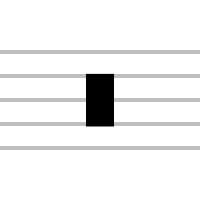
The rest [in this case a “long” rest] is the indication in the score of a musical silence: that is, a silence heard as musical, silence within the music. The rest extends over time, the music continues – so I’m adding a fermata or hold to the rest, which will extend it further, thus:

To my way of thinking, the pause is, above all else, a sabbath, a time of rest:

“Labor is a craft, but perfect rest is an art”, writes Abraham Joshua Heschel in his great, short book, The Sabbath — “He who wants to enter the holiness of the day must first lay down the profanity of clattering commerce … He must go away from the screech of dissonant days” and “How else express glory in the presence of eternity, if not by the silence of abstaining from noisy acts? These restrictions utter songs to those who know how to stay at a place with a queen…”

Links claimed:

There are other pauses, pauses of dissonance, pauses of rending.

To Auschwitz: The pause that Auschwitz enforces on us is a silent scream, atonal, ultra-modern in its sensibility, the attempt of a little, unmoored, desacralized western consciousness to get to moral grips with the factory extermination of one’s fellow beings by the millions, perpetrated by people who wear the same shoes and suits and ties, and carry the same briefcases as ourselves. It lacks all that has previously been called  musicality: it cannot cope.

I do not believe there is any escaping this scream: it is to be heard and held, embraced even. It is ugly, and it is an ugliness increaed by magnitude, by repetition, by number.

To Golgotha: The pause that Golgotha asks of us is of another order.  Christ, “when he had cried again with a loud voice, yielded up the ghost.” The Word is silenced. Only after three days will it begin to speak again.

Comment:

Leading into the next move, I have suggested that the rest is a musical silence – whether it be the deathly silence we may sense in Golgotha, the hideous silence that Auschwitz draws from our exhausted lungs, or the encompasing silence of glory of which Rabbi Heschel speaks.

It is a musical silence, a silence in each case to be listened to – tolerable or intolerable – a John Cage zen silence if you will…

In that silence, sounds can be vaguely sensed, emerging as if a morning mist is lifting, and some bird or twig or trill takes form…

Our board thus far:

[ my appreciation and thanks to Cheryl Rofer, who corrected me with regard to the notation of rests ]

____________________________________________________________________________________________

Move 14: Jerusalem


And so a new movement in our Symphony begins.

I have been aching for this moment: as move 14, I play Jerusalem

Move 14: Jerusalem

Move content:

Jerusalem is at the heart of the Israeli / Palestinian and Israeli / Arab problem, and thus of much of the tension in the  Middle east and the world.

It is also the city of peace, Salem – and you might say the ultimate hope, not of this game, which cannot aspire so high, but of the heart, is expressed in the three words: shalom salem salaam… In fact, ubi shalom, ibi salaam might be the motto of this work: where there is peace, let there be peace.

In making the opening move of this second movement of my game Jerusalem, then, I am taking us into the heart of the conflict, and into the heart of the hope for peace.

Jerusalem is a contested city, and we shall explore that contest in the moves to come.

Links claimed:

First, to the rest in 13: because in the silence, three sounds can be heard.  I quote here the words of Jamal Zahalka, a Palestinian Knesset Member — not for who he is but for their music:

The sound of the Muezzin, the church bells and the blowing of the shofar have always existed.

Those are the sounds “that can be vaguely sensed, emerging as if a morning mist is lifting”, in the silence of the musical rest.

Second, to Golgotha, the place outside Jerusalem where, according to the Christian telling, the body of the man who compared his body to the temple was so cruelly tortured that he “yielded up the ghost” – and at that moment, as if in sympathy, in the spiritual heart of Jerusalem and all Israel “behold, the veil of the temple was rent in twain from the top to the bottom; and the earth did quake, and the rocks rent…”

Third, to the Glass Bead Game: because “the holy city, new Jerusalem, coming down out of heaven from God, made ready as a bride adorned for her husband” of Revelation 21.21 finds its intellectual avatar in “the hundredgated cathedral of the mind” to which Hesse’s Game aspires.

Fourth, to William Blake, prophet, for whom Jerusalem was so urgent a matter that he must have it with him in England – as many Americans must have it with them in America — singing (as I myself have lustily sung):

And did those feet in ancient time.
Walk upon England’s mountains green:
And was the holy Lamb of God,
On England’s pleasant pastures seen!

And did the Countenance Divine,
Shine forth upon our clouded hills?
And was Jerusalem builded here,
Among these dark Satanic Mills?

Bring me my Bow of burning gold;
Bring me my Arrows of desire:
Bring me my Spear: O clouds unfold!
Bring me my Chariot of fire!

I will not cease from Mental Fight,
Nor shall my Sword sleep in my hand:
Till we have built Jerusalem,
In England’s green & pleasant Land

But Blake did better than to write these words – he illuminated them, and I shall place the text as he presented it at the bottom of this post.

Next: to Bob Dylan.  Well, there’s this:

— but it seems to be someone’s personal graphic for a compilation of Dylan songs, so this – Dylan at the Wailing Wall, 20 February 1983, attending his son’s Bar Mitzvah – will have to suffice:

And finally, I find there’s a peruasive link to Moral Equivalence — because Palestinians claim possession of the Noble Sanctuary and parts of the old city, while Israelis claim the same rights over the whole of Jerusalem including the Temple Mount – the Temple Mount and Noble Sanctuary being one and the same physical space — and there are wise and foolish, hardliners and diplomats, scholars and treatises on both sides, and in the interstices between them.

And the question is: are the claims and complaints of one side justified and the other baseless, or is there a moral equivalence between them.?

That is a question of balance on the scale of justice, to be tempered, one always hopes, with mercy.

Comment:

What are the claims and counter-claims, ancient and modern – and what do the peace-makers say?

Addendum:

A page from Blake’s Preface to Milton:
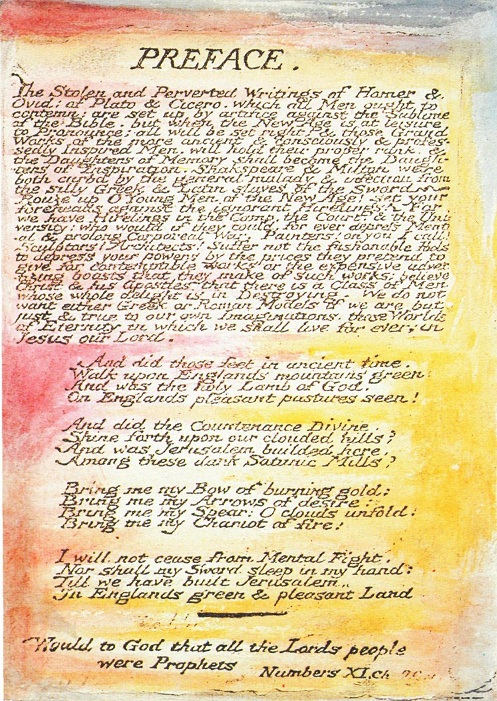
It would be a marvel to have purchased his book at the time, to have held it and read and savored it, each copy uniquely illuminated by his own hand…


____________________________________________________________________________________________

Move 15: Netanyahu’s Leopard

Move 15: Netanyahu’s Leopard

sforzando

Move content:

“A leopard has sunk its teeth in our flesh, in the flesh of our children, wives, our elderly, and we will not be tempted to believe that this leopard has now changed its spots. We will not ignore its voracious growls. We will strike it down.”

From the desk of Israeli Prime Minister Netanyahu, speech at the Memorial Ceremony for Victims of Terror, October 5th, 2011.

Links claimed:

To rest or pause, I suppose, because the lull between intifadas may seem like a sort of temporary truce, but it’s really mostly an opportunity for the enemy to regroup and rearm; and then to Jerusalem, because Jerusalem is Irael and Israel Jerusalem; and finally to — what was it — moral equivalence because there is no moral equivalence, is there?

I’m sorry if that seems a bit abrupt, but the musical signature at the top of the move says sforzando, and we’ve got work to do.

Comment:

Getting into the thick of it, Netanyahu’s speech doesn’t leave much room for compromise.  And sforzando, a musical term, literally means “forcibly” — “with strong emphasis”.

Conflict is not pretty, in the way one might hope that symphonies and other works of art and beauty might be.  There’s death to be distributed and withheld, and wealth and power — and the urgency they bring to the fight.
 

Hitchens, Hitchens!

Monday, December 19th, 2011

[ by Charles Cameron — a mixed week for the scythe-man ]

.

h/t Log 24


Switch to our mobile site