zenpundit.com » scriptures

Archive for the ‘scriptures’ Category

When the morning stars sang together, and all the sons of God shouted for joy

Thursday, August 27th, 2015

[ by Charles Cameron — my title is taken from the book of Job — known to Islam as the prophet Ayyub — chapter 38 verse 7 ]
.

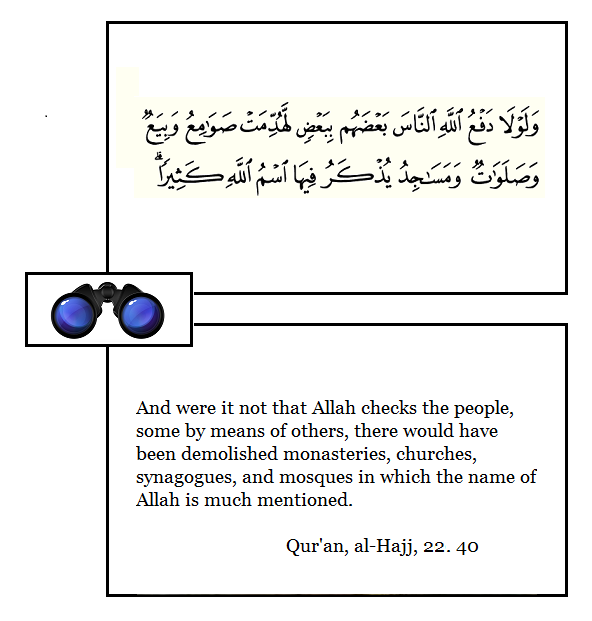
Let’s begin with Qur’an 22. 40:

SPEC Quran 22.40

I can deeply appreciate a perspective as respectful as this.

**

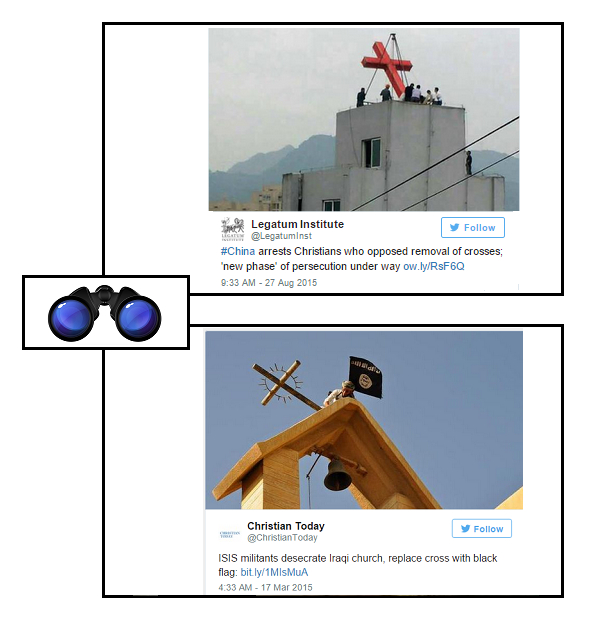
Consequently, I am even more deeply saddened when the Islamic State tears down the crosses atop churches —

SPEC DQ china is

than I am when the Chinese do the same exact thing..

**

And I’d suggest that the phrase “were it not that Allah checks the people, some by means of others, there would have been demolished monasteries, churches, synagogues, and mosques” as indicating that those who check / repel / drive back those others who demolish such places of worship, do so in accordance with the divine will..

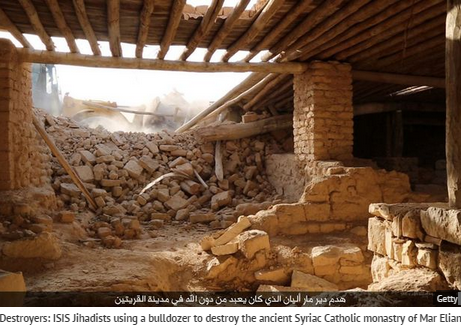
Here, members of the Islamic State bulldoze a monastery..

bulldozing Mar Elian

Such acts, then, should be checked, prevented, surely, by those who honor the Qur’an.

The question that remains is how best to accomplish this.

**

Likewise, there is the phrase about “monasteries, churches, synagogues, and mosques in which the name of Allah is much mentioned”..

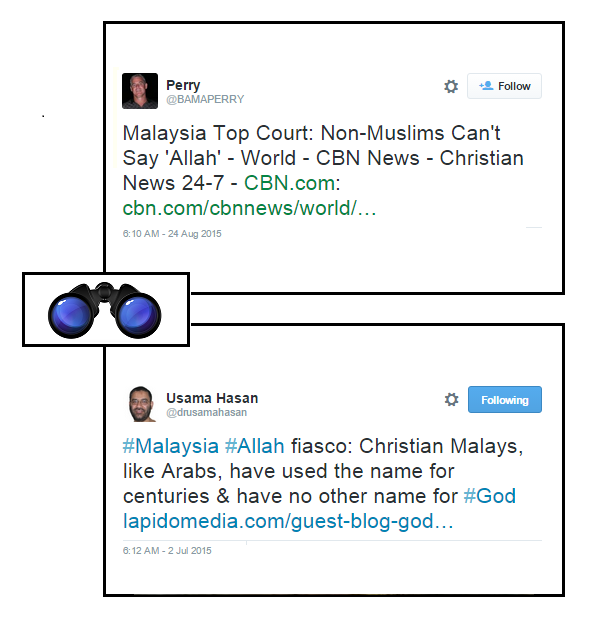
Apparently, the “name of Allah” was “much mentioned” in monasteries and churches at the time of the Prophet, and we may therefore wonder why Malaysian Muslims would wish to ban the use of that name by Christians —

SPEC malaysia

— when as KL Chan pointed out in his recent LapidoMedia post Do Muslims have a monopoly on the word Allah? — even if we ignore the clear evidence of the Qur’an itself,

One of the oldest evidences of Christian use of the word ‘Allah’ can be found in a Bible translation from 1514.

That’s two years after Michaelangelo finished painting the Sistine Chapel ceiling, and three years before Martin Luther posted his 95 Theses to the door of Wittenberg Cathedral.

As Usama Hasan says, it’s a fiasco.

**

Sources:

  • BibleGateway, Job 38.7,
  • Qur’anic Arabic corpus, Qur’an 22.40
  • Legatum Institute, China arrests Christians
  • Christian Today, Isis militants desecrate Iraqi church
  • Daily Mirror, ISIS Jihadists using a bulldozer
  • Perry, Malaysia Top Court
  • Usama Hasan, #Malaysia #Allah fiasco

  • Christianity, culture, compassion, camels — and their shadows too

    Saturday, August 22nd, 2015

    [ by Charles Cameron — by way of TS Eliot, Mario Vargas Llosa and others, and leading to a post on camels and their shadows ]
    .

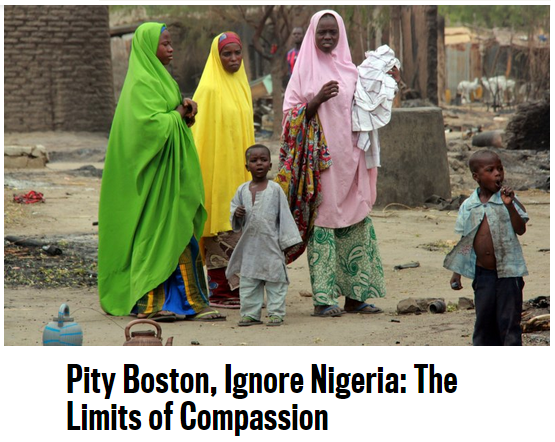
    limits of compassion

    **

    In the year I was born, 1943, TS Eliot published a series of essays titled Notes Toward the Definition of Culture in the New English Weekly. Mario Vargas Llosa supposedly references Eliot’s essays in his own Notes on the Death of Culture: Essays on Spectacle and Society — which Joshua Cohen then distills into this paragraph:

    Eliot defines culture as existing in, and through, three different spheres: that of the individual, the group or class, and the entire rest of society. Individuals’ sensibilities affiliate them with a group or class, which doesn’t have to be the one they’re born into. That group or class proceeds to exercise its idea of culture on society as a whole, with the elites — the educated and artists, in Eliot’s ideal arrangement — ­leveraging their access to the media and academia to influence the tastes of the average citizen, and of the next ­generation too. As for what forms the individual, it’s the family, and the family, in turn, is formed by the church: “It is in Christianity that our arts have developed,” Eliot writes; “it is in Christianity that the laws of Europe have — until recently — been rooted.”

    I’m not sure of the bibliographic details here, but you’ll note the similarity of Eliot’s claim in quote marks above to certain claims made concerning America in recent years — and indeed, to others in Anders Breivik‘s Manifesto.

    It’s the concept of culture as comprised of the sensibilities of individuals, groups and society that first and most interests me here, though — and the significance of family, and I’m hoping Michael Lotus will have something to say about that.

    **

    Here’s more from Eliot:

    It is in Christianity that our arts have developed; it is in Christianity that the laws of Europe — until recently — have been rooted. It is against a background of Christianity that all of our thought has significance. An individual European may not believe that the Christian faith is true, and yet what he says, and makes, and does will all spring out of his heritage of Christian culture and depend upon that culture for its meaning .. I do not believe that culture of Europe could survive the complete disappearance of the Christian faith. And I am convinced of that, not merely because I am a Christian myself, but as a student of social biology. If Christianity goes, the whole culture goes.

    **

    Now take a cool sip of water to cleanse the palate..

    **

    This may nor may not seem to resonate with Eliot’s ideas:

    Slovakia prefers its desperate refugees to be Christians, please

    Slovakia would prefer to accept Christian refugees under a European plan to resettle people who have fled from wars and poverty in the Middle East, Asia and Africa, the Interior Ministry said on Thursday.

    The Central European country will take 100 people from refugee camps in Turkey and 100 people from Italy, preferably Christians, a ministry spokesman said.

    “We want to choose people who really want to start a new life in Slovakia. Slovakia as a Christian country can really help Christians from Syria to find new home in Slovakia,” spokesman Ivan Netik said.

    “For most migrants we are only a transit country. In Slovakia we have really tiny community of Muslims. We even dont have mosques.”

    If Muslim asylum-seekers chose Slovakia, they would not be discriminated against, he said. But Slovakia would not take in refugees who did not want to stay in the country but intended to move on.

    “We do not discriminate against any religion, but it would be a false, insincere solidarity if we took people .. who dont want to live in Slovakia,” he said.

    That. btw, is the most nuanced version of the Slovakian response to the refugees I’ve seen.

    Comnpassion? A conceptual radius of compassion?

    Are there, should there be, limits to compassion?

    **

    In an upcoming post on the shadows of camels, I’ll explain my overall intent in posting such items as this one — and it is not to suggest that Breivik is the same as Slovakia, or Eliot the same as Breivik, or Christianity across Europe equivalent to camels or the shadows of camels across the desert.. nor that compassion should or should not have a radius, conceptual or otherwise.

    Recent hacks and the King James Version

    Saturday, August 22nd, 2015

    [ by Charles Cameron — the OMB and Ashley Madison hacks — and some verses to consider alongside them ]
    .

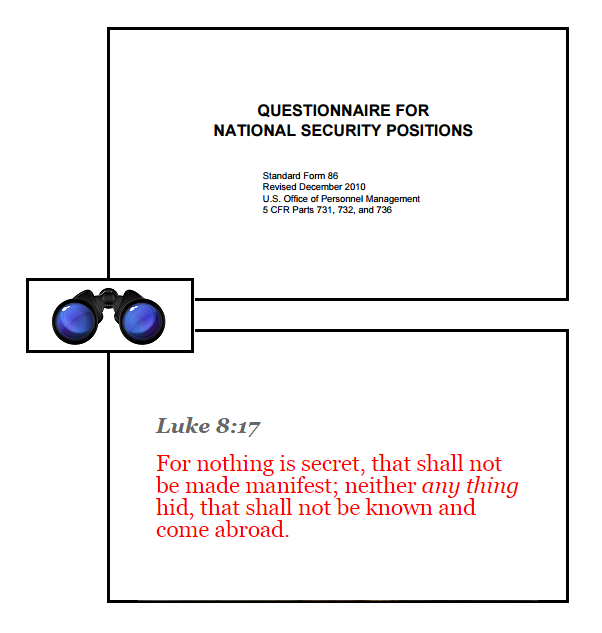
    SPEC OMB hack

    Given my interest in apocalyptic, which Wikipedia describes thus

    An apocalypse (Ancient Greek: apokalypsis, from apo and kalypto meaning “uncovering”), translated literally from Greek, is a disclosure of knowledge, i.e., a lifting of the veil or revelation. In religious contexts it is usually a disclosure of something hidden.

    — it is only natural that the revelation of secrets should provide a sometime theologian such as myself with scriptural memories..

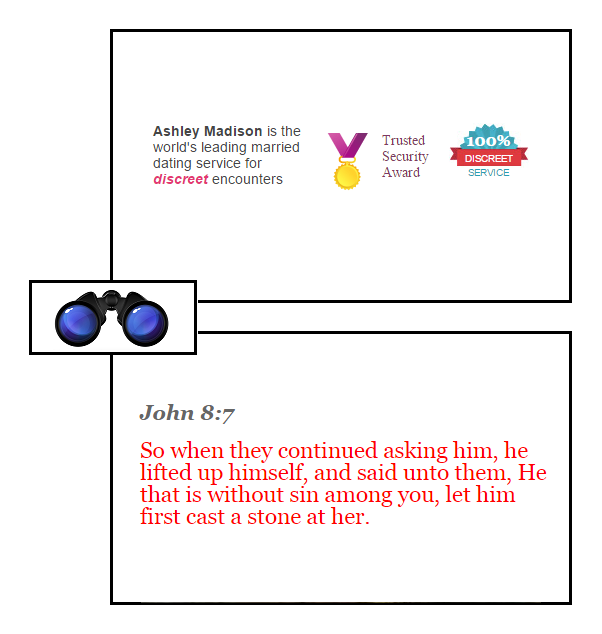
    SPEC Ashley Madison hack

    **

    It has long seemed to me that “Judge not, that ye be not judged. For with what judgment ye judge, ye shall be judged: and with what measure ye mete, it shall be measured to you again” (Matthew 7. 1-2) offers an extraordinarily non-vengeful, non-violent option within the tit-for-tat, eye-for-an-eye scriptural formulation of justice.

    No man’s land, one man’s real estate, everyone’s dream?

    Monday, August 17th, 2015

    [ by Charles Cameron — borders and distinctions from Trump to Revelation, plus one ]
    .

    Donald Trump‘s “three core principles of real immigration reform”:

    1. A nation without borders is not a nation.

    **

    G Spencer-Brown wrote of his book. Laws of Form, “The theme of this book is that a universe comes into being when a space is severed or taken apart” — or as Heinz Von Foerster rephrased him, “Draw a distinction and a universe comes into being”. Indeed, his book opens with the words:

    We take as given the idea of distinction and the idea of indication, and that we cannot make an indication without drawing a distinction.

    He writes:

    Distinction is perfect continence.

    That is to say, a distinction is drawn by arranging a boundary with separate sides so that a point on one side cannot reach the other side without crossing the boundary. For example in a plane a circle draws a distinction.

    Similarly, Gregory Bateson defines an idea as “A difference or distinction or news of differences”.

    **

    Borders are both physical and metaphysical: the border between the physical and the metaphysical passes through human beings, who are themselves both metaphysical and physical.

    Borders may thus be heeded or ignored.

    Smugglers don’t necessarily ignore them, they may take them very seriously, as do those who police them. Birds, however, ignore them, fishes, lizards, languages..

    There are would-be states that straddle national borders, as the Basque peoples straddle the border between France and Spain:
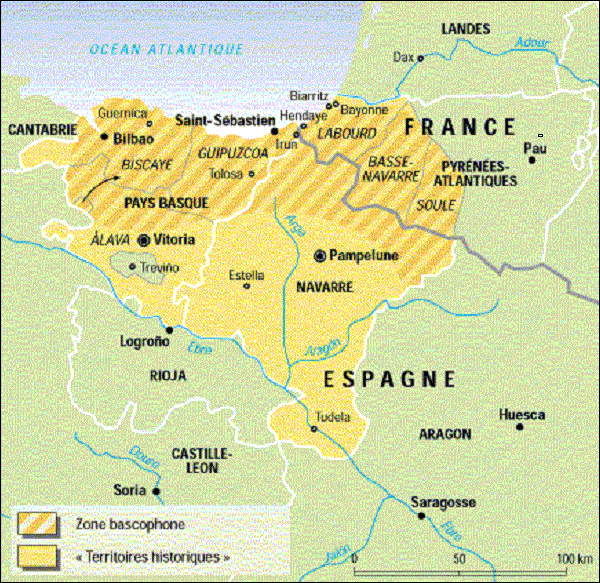
    Basque France Spain 600

    There are also would-be states that literally erase national borders, as in the case of IS bulldozing thw border between Iraq and Syria:
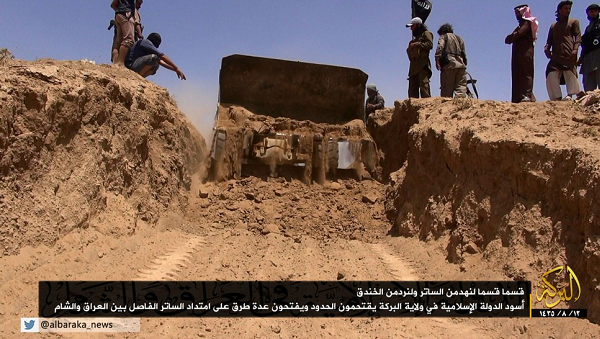
    Iraq Syria Border 600

    Thus while borders may be tidy in separating one from a second, they are also untidy in straddling them, neither one nor two, yet (like Janus) both.. They are, in short, thresholds, limina. And so wahat we know of liminality applies to them. I have discussed tthis previosuly on Zenpundit in Liminality II: the serious part — suffice it to say here that limiality is a condition that exacerbates, intensifies.

    **

    The anthropologist Mary Douglas, in her book Purity and Danger: An Analysis of Concepts of Pollution and Taboo, quotes Leviticus 19.19:

    You shall keep my statutes. You shall not let your cattle breed with a different kind; you shall not sow your field with two kinds of seed; nor shall there come upon you a garment of cloth made of two kinds of stuff.

    Why these disjunctions? Dougles notes the repeated refrain in just such contexts:

    Ye shall therefore be holy, for I am holy

    and points out that Ronald Knox correctly — if “rather thinly” — translates this:

    I am set apart and you must be set apart like me

    She then tells us:

    Holiness means keeping distinct the categories of creation. It therefore involves correct definition, discrimination and order.

    noting that:

    The word ‘perversion’ is a significant mistranslation of the rare Hebrew word tebhel, which has as its meaning mixing or confusion.

    and concludes

    ideas about separating, purifying, demarcating and punishing transgressions have as their main function to impose system on an inherently untidy experience. It is only by exaggerating the difference between within and without, above and below, male and female, with and against, that a semblance of order is created.

    **

    The upper image, below, is taken from my recent post on Matrioshka cartography, and waas taken in turn from Say goodbye to the weirdest border dispute in the world in the Washington on August 1st..

    SPEC DQ maps

    … while the lower image is from Welcome to Liberland, the World’s Newest Country (Maybe) in the New York Times Magazine, dated Aug 11

    **

    Lydia Kiesling, in her post Letter of Recommendation: Uzbek in the NYT magazine today, writes:

    National borders can be risibly at odds with reality, especially in Central Asia, where Turks, Mongols, Persians and others roved and mingled, where ‘‘Uzbek’’ was, for a time, more of a descriptive antonym of ‘‘Tajik’’ — no­­madic versus settled — than an ethnic classification.

    And why not?

    They are, after all, distinctions drawn in the mind, lines drawn on paper. Thus the Sykes-Picot map:

    Sykes_Picot_Agreement_Map_signed_8_May_1916 600

    Sykes was quite clear about the “lines dorawn on paper” part. He is reported to have said:

    I should like to draw a line from the e in Acre to the last k in Kirkuk

    The map, in other words, is not the territory: the map is a map.

    To take another instance of importance in today’s world, the Durand Line:

    Durand_Line_Border_Between_Afghanistan_And_Pakistan 600

    Not only is the map not the territory in this case — it can be seen, as one-time Afghan president Hamid Karzai said, as “a line of hatred that raised a wall between the two brothers” — Afghanistan and Pakistan.

    **

    Sympathies which exist across borders can be potent forces for their dissolution. In a poem titled “Their Eyes Confer Fire” written in the 1980s about Basque country, I wrote

    We have
    little time,
    Marie explained,
    for those
    who, because
    it is hard
    to draw
    lines
    across actual
    mountains,
    carve up
    this earth on
    paper.

    France, Spain:
    we disdain
    boundaries, borders,
    and border guards.

    A canny reader noted that the entire poem could be read not as a description of the Basques as they exist in reality, but as a paean to the corpus callosum joining the two hemispheres of the brain — and thus the two modes of cognition of which I so recently wrote.

    **

    Returning to Lieberland, or Gornja Siga as the locals call it, we learn:

    Gornja Siga has come, over the last few months, to assume an outsize role in the imagination of many — not only in Europe, but also in the Middle East and in the United States. Its mere existence as a land unburdened by deed or ruler has become cause for great jubilation. There are few things more uplifting than the promise that we might start over, that we might live in the early days of a better nation. All the most recent states — South Sudan, East Timor, Eritrea — were carved from existing sovereignties in the wake of bitter civil wars. Here, by contrast, is a truly empty parcel. What novel society might be accomplished in a place like this, with no national claim or tenant?

    Consider one sentence alone as the key to that “outsize role in the imagination”:

    There are few things more uplifting than the promise that we might start over, that we might live in the early days of a better nation.

    The apocalyptic yearning here and its kinship with the Amrican dream are hard to miss — it is like a conflation of Matthew 5.14:

    A city that is set on an hill cannot be hid.

    with Revelation 21.1-2:

    And I saw a new heaven and a new earth: for the first heaven and the first earth were passed away; and there was no more sea. And I John saw the holy city, new Jerusalem, coming down from God out of heaven, prepared as a bride adorned for her husband.

    **

    Plus:
    On the various uses and modes of DoubleQuotes thinking

    Monday, August 10th, 2015

    [ by Charles Cameron — working my way towards that ever-elusive Grand Theory of Linkage ]
    .

    Standard_legirons_taiwan01
    Ahem — not unlike my DoubleQuote format, these Taiwanese leg-irons offer another form of linkage

    **

    Here’s a cross-cultural DoubleQuote embedded in a Guardian paragraph — from Xiaolu Guo, writing on the Analects of Confucius in Ten Books that Changed the World:

    If you are Chinese, lines from the Bible such as “Love your enemies and pray for those who persecute you” can only bewilder you, as Confucius said nearly the opposite: “It is only the truly virtuous man who can love and hate others.” Hate is a necessary moral stance for a Chinese man.

    **

    More elaborately, Marcy Wheeler over at emptywheel has an entire post using what’s in effect a DoubleQuotes form of argument, comparing Buffalo’s ISIS Supporting Terrorist and Its Klan Supporting Terrorist as her title puts it, and including such quotes as these..

    Concerning Michael O’Neill:

    On January 21, 2015, the Niagara County Sheriff’s office responded to a report of an explosion at the house of Chair of the Niagara County Legislature, William Ross. They discovered that his stepson, former corrections officer Michael O’Neill, who lived with his mother and stepfather at the house, had blown off his leg while working with explosives in the garage. In addition to the one that exploded, there were 6 completed Improvised Explosive Devices in the garage, along with shrapnel, fireworks powder, and other explosives precursors.

    and..

    That evidence shows that the work bench at which Ross’ stepson was emptying fireworks for powder and adding nails to IEDs was decorated with a Stormtrooper poster, a picture of Nathan Bedford Forrest, a Confederate flag, and a poster advertising, “The KKK wants you.” O’Neill also appears to have had a sword (most visible in Exhibit 14) not mentioned in any legal document.

    Concerning Arafat Nagi:

    A week later, on July 29, also in the Buffalo area, FBI Agent Amanda Pike arrested US citizen Lackawanna resident Arafat Nagi on charges of attempting to materially support ISIS. The complaint laying out the case against Nagi relied on trips to Turkey and Yemen (Nagi has family in the latter), a slew of tweets supporting ISIS, and some 2012 and 2013 purchases of military equipment — including body armor and a machete — and Islamic flags from eBay. The complaint also included pictures Nagi had tweeted out depicting ISIS and extremist flags and Abu Bakr al-Baghdadi

    — and concluding:

    Still, these two extremists were working their way through the same court room at the same time. The contrast between the two cases is instructive.

    Read her entire piece for further elaboration.

    **

    A DoubleQuote in my DQ format is intended to work as a sort of haiku, or perhaps a stem christie, incorporating in miniature a change of direction or leap of insight — they come to much the same thing.

    A single, glorious gothic arch — you get the picture.

    It is becoming ioncreasingly obvious, though, that the DoubleQuote method of comparison and contrast has far wider application — and as my collection of DoubleQuotes in the Wild has hopefully shown, that the basic idea continues to strike artists, writers and analysts as a powerful means of corralling and communicating concept and meaning.

    It’s a naturally occurring form for thought, in other words, and at best my graphical DoubleQuotes format can bring a formal unity to many of its possible examples, and thus sharpen it — as a the general idea of a branch can be “formalized” into the concept of a fishing rod or baseball bat — into a tool.


    Switch to our mobile site