zenpundit.com » poetry

Archive for the ‘poetry’ Category

Gaming the Connections: from Sherlock H to Nada B

Sunday, December 29th, 2013

[ by Charles Cameron — the game of Connect the Dots in play and practice ]
.

CIA's (now ret'd) Nada Bakos examines the Al Qaida board in the HBO docu, Manhunt

.

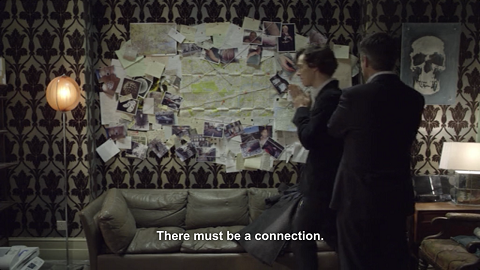
Manhunt, the HBO documentary, does what (not having been there and seen that at the time) appears to be a decent job of recreating some of the cognitive stratregies employed by CIA officers in the OBL hunt. The one I’m interested in here is the building of a “link chart” or cognitive map — law enforcement “evidence board” — the idea being (a) to note known connections visibly, and (b) to encourage the mind to make intuitive leaps that reveal previously unknown connections between nodes… or “dots”.

Sophisticated software does this sort of thing algorithmically with regard to (eg) network connections via phone-calls, but the human mind is still better than AI at some forms of pattern recognition, and that’s the aspect that interests me here.

Aside:

For more on the cognitive significance of the link chart in Manhunt, see my post Jeff Jonas, Nada Bakos, Cindy Storer and Puzzles.

**

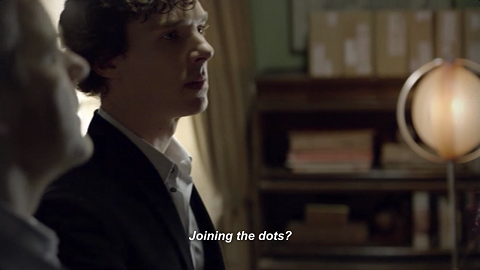
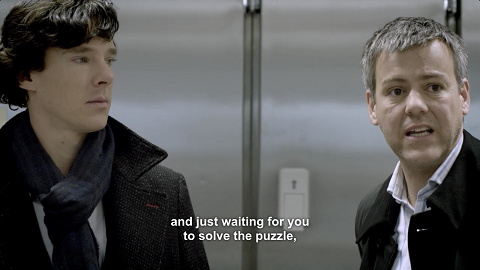
Benedict Cumberbatch‘s Sherlock lays out the way it works —

**

Okay, so one way to visualize connections is to make a fairly random collage of relevant photos, names, dates and places, and tie it together with links of string or ribbon. That’s the equivalent of what in HipBone games terms we’d call a “free-form” game, and it works well for the “divergent”, initial brainstorming phase of thought. But it does little to bottle its own energy, to focus down, to force the mind — in the no less powerful “convergent” phase — into perceiving even more links than occur spontaneously in building the link chart in question.

HipBone‘s preformatted boards take the cognitive process to that second stage. They work on one of the most powerful ingredients in creativity: constraint. Business writer Dave Gray of Communication Nation puts it like this:

Creativity is driven by constraints. When we have limited resources — even when the limits are artificial — creative thinking is enhanced. That’s because the fewer resources you have, the more you are forced to rely on your ingenuity.

But that premise doesn’t just hold true for business problem-solving — it’s at the heart of creative thinking at the Nobel level, too, in both arts and sciences. Consider mathematician Stanley Ulam, writing in his Adventures of a Mathematician:

When I was a boy I felt that the role of rhyme in poetry was to compel one to find the unobvious because of the necessity of finding a word which rhymes. This forces novel associations and almost guarantees deviations from routine chains or trains of thought. It becomes paradoxically a sort of automatic mechanism of originality…

Here’s how the poet TS Eliot puts it:

When forced to work within a strict framework the imagination is taxed to its utmost – and will produce its richest ideas.

A Hipbone Gameboard such as the Waterbird, Dartboard, or Said Symphony board is chosen precisely to challenge the mind with third, fourth and fifth rounds of “creative leaps” — thus adding both divergent and convergent cognitive styles to this form of graphical analysis.

That’s my point here — and a plug for HipBone-Sembl style thinking.

**

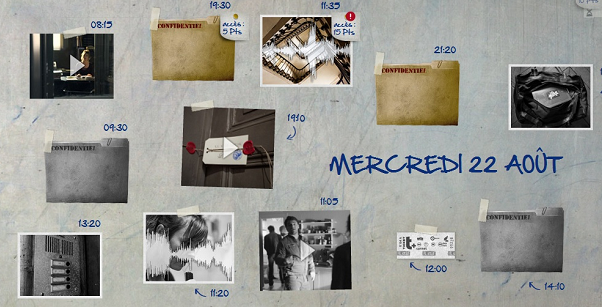
I can’t resist adding a couple of instances in which the meme of “connecting the dots” via a link chart or evidence board has crept from TV series that I enjoyed into the world of games — this first one based on the terrific French detective series, Engrenages, retitled Spirals for British consumption:
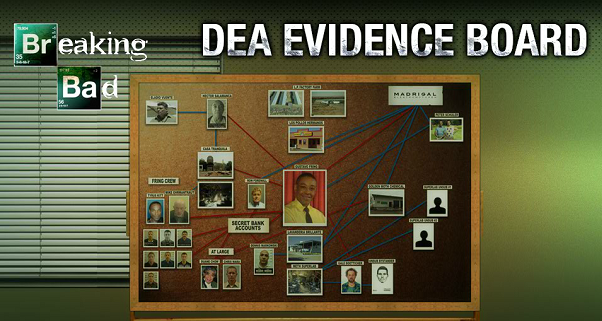
— and this one for fans of the US TV series, Breaking Bad:
Matrioshka forensics

Sunday, December 29th, 2013

[ by Charles Cameron — it still takes a live human to see what the human eye cannot see but the machine can ]
.

This would appear to be (one version of) the state of the art in facial recognition:

Image within image within image — the gentleman on the right is more or less recognizable as a reflection in the eye of the gentleman on the left — thus giving new potential meaning to the phrase “you are the apple of my eye” (cf Zechariah 2:8, also Oberon in Midsummer Night’s Dream III.ii.102 ff., and Stevie Wonder, You Are The Sunshine Of My Life).

**

Or — to switch disciplines while remaining with the matrioshka form, because such patterns are of interest to the inquiring mind — as Gary Snyder puts it in his marvelous poem, One Should Not Speak to a Skilled Hunter:

The secret.
and the secret hidden deep in that.

**

For another version of the state of the art in facial recognition, see: Where’s Ms. Waldo?. Aloha!

How are the mighty fallen…

Sunday, December 8th, 2013

[ by Charles Cameron — an event in Kyiv, in which Lenin may remind one of Saddam… ]
.

Statue of Lenin, toppled, in Kiev / Kyiv, December 2013

**

I apologize for the bank which tries to hitch a ride on Ben Kingsley’s reading of Shelley here, but this is the best reading of Ozymandias I was able to find.

Shelley’s poem gives, I believe — in the context of recent events in Kyiv — some clarity to another well-known observation of his, in A Defence of Poetry:

Poets, according to the circumstances of the age and nation in which they appeared, were called, in the earlier epochs of the world, legislators, or prophets: a poet essentially comprises and unites both these characters. For he not only beholds intensely the present as it is, and discovers those laws according to which present things ought to be ordered, but he beholds the future in the present, and his thoughts are the germs of the flower and the fruit of latest time.

— or more succinctly:

Poets are the unacknowledged legislators of the world.

Mandela – countless silken ties of love and thought

Friday, December 6th, 2013

[ by Charles Cameron — mostly written as news came from the hospital that his condition had turned critical, updated and posted now that his death has been announced ]
.

Already I am feeling the presentiment of grief, and so much of what I feel stems from this picture:

**

Nelson Mandela is dear to me not so much as the great first President of the new South Africa, nor as the statesman he doubtless was, but the man who loved my own mentor, Trevor Huddleston, so much.

So it is not global with me, it is personal, and as news of his health reaches the critical mark and his family gathers in deep concern, I sense my own potential for grief rolling in over the near hills.

Robert Frost, in his great poem A Silken Tent, speaks of “silken ties of love and thought” that bind us one to another, indeed to “every thing on earth the compass round” — in my case it is his love of Trevor that binds me to the man — and the little detail in Mandela’s autobiography where he recalls Trevor addressing a group of South African police who were approaching to arrest him, saying:

No, you must arrest me instead, my dears.

It’s that “my dears” that I can hear so easily in Trevor’s voice, and that Mandela was so brilliant to catch, recall and tell…

Less personally it is the Isitwalandwe, the signal honor these two men shared, for each was “one who wears the plumes of the rare bird”.

**

I respect also the insurgent Mandela, who emerged from his long imprisonment with calm and clarity — Mandela the meditator if you will. This passage from a letter he wrote in jail in 1975 moves me, as Merton moves me:

Incidentally, you may find that the cell is an ideal place to learn to know yourself, to search realistically and regularly the process of your own mind and feelings. In judging our progress as individuals we tend to concentrate on external factors such as one’s social position, influence and popularity, wealth and standard of education. These are, of course, important in measuring one’s success in material matters and it is perfectly understandable if many people exert themselves mainly to achieve all these. But internal factors may be even more crucial in assessing one’s development as a human being. Honesty, sincerity, simplicity, humility, pure generosity, absence of vanity, readiness to serve others – qualities which are within easy reach of every soul – are the foundations of one’s spiritual life. Development in matters of this nature is inconceivable without serious introspection, without knowing yourself, your weaknesses and mistakes. At least if for nothing else, the cell gives you the opportunity to look daily into your entire conduct, to overcome the bad and develop whatever is good in you. Regular meditation, say about 15 minutes a day before you turn in, can be very fruitful in this regard. You may find it difficult at first to pinpoint the negative features in your life, but the 10th attempt may yield rich rewards. Never forget that a saint is a sinner who keeps on trying.

Here, I believe, is the secret which gave us this man.

**

And because it is so very beautiful, I offer you also Frost’s poem:

The Silken Tent
.

She is as in a field a silken tent
At midday when the sunny summer breeze
Has dried the dew and all its ropes relent,
So that in guys it gently sways at ease,
And its supporting central cedar pole,
That is its pinnacle to heavenward
And signifies the sureness of the soul,
Seems to owe naught to any single cord,
But strictly held by none, is loosely bound
By countless silken ties of love and thought
To every thing on earth the compass round,
And only by one’s going slightly taut
In the capriciousness of summer air
Is of the slightlest bondage made aware.

**

Update:

Mandela’s death has been announced, and I feel as though I knew it already, back in those days at the end of June when he was hospitalized, when every day and each breath might have been his last. I feel little grief now, I wish him peace — but more than that, I feel gratitude. Nelson Mandela showed us, through foul weather and fair, what a human with integrity is, and what such a single human, in the companionship of others, can do.

So many of us must be feeling this gratitude today. Mandela has gone from among the living, to exert his influence now — his person, his strength, his story — in the ever-opening realm of inspiration and human possibility.

Dawn and Decadence, Innovation, & The Face of Battle — top 3

Friday, October 4th, 2013

[by J. Scott Shipman]

From Dawn to Decadence, 500 Years of Western Cultural Life, by Jacques Barzun

In a year where I’ve not been able to read as much as normal and with 89 days remaining in 2013, these three titles are the best so far. I’m not finished with Dawn, but it seems like the late Professor Barzun is an old friend (here is a video from 2010). Barzun’s opus was published when he was 93 and was almost ten years in the making. Dawn has been sitting on my shelves for four or five years and I’d started it two or three times only to get bogged down and lose interest. Well over half way finished and I’m pretty sure I’ll be rereading this title for years to come (co-blogger Lynn Rees reports he’s read it four times). Barzun’s scope covers the gamut: religion, literature, poetry, theater, painting, sculpture, philosophy, and the aristocracy/life at court. Since many of these topics are interconnected he uses an ingenious method to assist the reader in keeping up. He uses this: (<page number)(page number>) to direct the reader to something previously discussed or something he will cover later. In the text, he will recommend “the book to read is” “the book to browse is” in brackets. I’ve found this method distracting as I’ve read three books he referenced since I started… Barzun also provides generous lift quotes in the margins to give the reader a flavor for a particular writer or idea/example. If the book had a traditional bibliography, I dare say it would cover a couple hundred pages–at least. Dawn has been a pleasure I’ve been taking in small doses and am in no hurry to finish. This is the best book of the genre that I’ve read.

Men, Machines and Modern Times, by Elting Morison

Elting Morison’s Men, Machines is reviewed at Amazon by former House Speaker Newt Gingrich as “purely and simply one of the best books ever written on the process of innovation and the interaction of technology, culture, systems, and individual personalities.” I could not agree more. Morison’s book is a collection of essays dealing with change and man’s inherit but paradoxical reaction to it:

Yet, if human beings are attached to the known, to the realm of things as they are, they also, regrettably for their peace of mind, are incessantly attracted to the unknown and things as they might be. As Ecclesiastes glumly pointed out, men persist in disordering their settled ways and beliefs by seeing out many inventions…Change has always been a constant in human affairs…

From gunnery at sea to 19th Century railroads, Morison provides illustration after illustration of man, his institutions, and the almost universal resistance of both to change. Morison observes of inventors (real “disruptive thinkers’) [this was written in the early 1950’s]:

I once collected evidence on the lives of about thirty of these men who flourished in the nineteenth century. A surprising number turned out to be people with little formal education, who drank a good deal, who were careless with money, and who had trouble with wives or other women.

Morison devotes one essay to the characteristics and ills of a “bureau.” He describes the difficulty of getting anything accomplished within an average bureaucracy—largely because bureaucrats live for process and harmony. He says:

Taken together, a set of regulations provides a pattern of behavior for the energies bureaus are set up to regulate….Regulations are a way of keeping a system of energies working in harmony and balance…First it is easier to make a regulation than to abolish it.

Morison’s eighth and concluding essay provide Some Proposals for dealing with change and newness—in a word, solutions to many of the problems identified earlier. That said, only the most dedicated reader will complete the seventh (and longest) chapter, according the Morison, originally intended to be a book about the history of 19th Century American railroad innovation. Overall, I concur with Speaker Gingrich and highly recommend this title.

The Face of Battle, by John Keegan

A title needing no introduction at Zenpundit, I’ll only offer this title as one of the best books of the genre I’ve read. Keegan covers three battles across 500 years of history, Agincourt, Waterloo, and The Somme. In each, he brings alive the battlefield and provides the conditions faced by combatants—often up close and personal. Keegan’s scholarship, insight, and importantly, his humility in addressing a topic he admittedly had no first hand experience make this a must read for anyone in the profession of arms, and recommended for anyone seeking more insight into how we fight.

That’s a wrap, be back soon! 


Switch to our mobile site