zenpundit.com » Islam

Archive for the ‘Islam’ Category

Polishing the heart: full circle

Sunday, February 14th, 2016

[ by Charles Cameron — happy daze! from Joan Halifax via Henry Corbin to Hui Neng & David Remnick ]
.

From Roshi Joan Halifax:

**

Steven Nouriani, The Meeting of Two Rivers, in Copenhagen 2013 – 100 Years On:

As Corbin (1969) indicated, the heart is thought to be like a mirror in which every moment the various manifestations of the Divine Forms can be reflected on a microcosmic level. The more we polish the heart, the more we develop the Himma (aptitude) to experience Divine epiphanies out of Mundus Imaginalis.

Henry Corbin, Creative Imagination in the Sufism of Ibn Arabi, p 222.

In its unveiled state, the heart of the gnostic is like a mirror in which the microcosm from of the Divine Being is reflected

**

Sachiko Murata, Chinese Gleams of Sufi Light, p. 225, n. 8:

The Sufi path is rather to empty oneself of all causes, to “polish the heart” by cleansing it of the rust of things, and to find God’s light in the heart.

**

Luang Pu Thuat, quoted in Dharma Legacy of Ajaan Dune Atulo:

To make yourself a good-looking wandering monk isn’t proper at all. It goes against the purpose of going out to wander. Each of you should reflect a great deal on this. The purpose of wandering in meditation is only one thing: to train and polish the heart so that it’s free of defilements. To go wandering in meditation only in body, but without taking along the heart, is nothing excellent at all.

**

Morihei Ueshiba, founder of Aikido:

The only cure for materialism is the cleansing of the six senses (eyes, ears, nose, tongue, body, and mind). If the senses are clogged, one’s perception is stifled. The more it is stifled, the more contaminated the senses become. This creates disorder in the world, and that is the greatest evil of all. Polish the heart, free the six senses and let them function without obstruction, and your entire body and soul will glow.

**

Shen-hsiu, in The Platform Sutra: The Zen Teaching of Hui-neng, Red Pine, tr.:

The venerable Shen-hsiu held up a lantern and wrote his gatha on the middle of the south corridor wall at midnight, and no one saw him. His gatha went:

The body is a bodhi tree
the mind is like a standing mirror
always try to keep it clean
don’t let it gather dust.

to which Hui Neng‘s responds, from the same source:

Unless you know your own mind, studying the Dharma is useless. But once you know your mind and see your nature, you understand what is truly important. My gatha went:

Bodhi doesn’t have any trees
this mirror doesn’t have a stand
our buddha nature is forever pure
where do you get this dust?

Then I composed another one:

The mind is the bodhi tree
the body is the mirror’s stand
the mirror itself is so clean
dust has no place to land.

**

BBC, Valentine’s Day: Countries that don’t love February romance

Last year, there were clashes at a university in Peshawar over Valentine’s Day.
Liberal students were celebrating with red balloons and cake while another group felt such a show was un-Islamic.
Dozens of students threw rocks in the scuffle, leading to gunshots being fired by both sides and rooms in a student dormitory being set on fire.

**

David Remnick, Dangerous Liaisons:

Love is wonderful; Valentine’s Day, less so. Often, it’s cheesy and boring. Here’s your antidote: a collection of stories about dangerous love, doomed love, and other forms of bad romance. … Consider these pieces a Valentine from us.

**

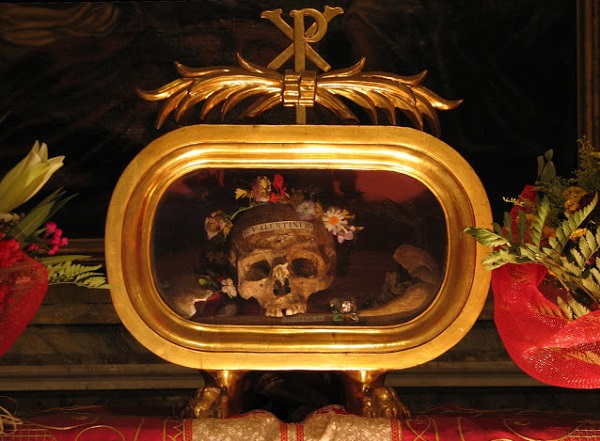
Veneration of relics:

2262875989_948afb24d8_b
Relics of St. Valentine, Santa Maria in Cosmedin, Rome, photo by Fr Lawrence Lew OP
Political candidates and religion

Monday, February 1st, 2016

[ by Charles Cameron — responding properly to Tim Furnish ]
.

Political candidates and religion is not quite the same as church and state — an issue on which, as a Brit living in the States, I am profoundly impressed both ways. However, religion in politics very much interests me, and in my news scan early this morning I noted this tweet:

To which I responded:

Tim Furnish picked up on this, and tweeted:

**

From my point of view, I think that’s both a fair question and a great DoubleQuotes opportunity, so I followed Tim’s lead to the NYT piece he was refering to, and the result, phrased in headlines, is as follows:

Cruz Clinton

Sources:

  • AP, Now deeply Christian, Cruz’s religion once wasn’t so obvious
  • NYT, Hillary Clinton Gets Personal on Christ and Her Faith
  • **

    For myself, I’m glad that Hillary Clinton “rarely talks about faith on the campaign trail” and that Ted Cruz‘s religion “once wasn’t so obvious”. Tithing as an obligation isn’t anything I worry about — the widow’s mite story gets to the heart of things, I think — and I’m a fan of reticence in matters of faith in any case:

    Therefore when thou doest thine alms, do not sound a trumpet before thee

    pretty much puts the kybosh on publicity, methinks, as does:

    when thou prayest, enter into thy closet, and when thou hast shut thy door, pray to thy Father which is in secret..

    Similary, the second of MaimonidesEight levels of charity is this:

    to give to the poor without knowing to whom one gives, and without the recipient knowing from who he received. For this is performing a mitzvah solely for the sake of Heaven.

    And the Qur’an, Sura 76. 8-9, suggests:

    They give food, for the love of Him, to the needy, the orphan, the captive: “’We feed you only for the Face of God; we desire no recompense from you, no thankfulness..”

    I’m not dogmatically tied to these views, Tim, but I admire them greatly — IMO, there’s simply so much beauty in such advice!

    Juxtaposition: Christian and Islamic apocalypticisms

    Monday, January 25th, 2016

    [ by Charles Cameron — being the revised version of the second part of my previous post ]
    .

    In an earlier post, rightly critiqued by evangelical pastor-writer-filmmaker Joel Richardson, I conflated Christian and Islamic “divine law movements” with Christian and Islamic “apocalyptic movements”. They are, as Joel pointed out, not the same, though perhaps somewhat related. I have left the first part of that post, dealing with “divine law”, standing, under the original title Juxtaposition: Qutb & Bahnsen.

    Here is my revision of the second part of that post, in light of Joel’s comment. It concerns the similarities and differences between Christian and Islamic “apocalyptic movements”, with special attention to the question of violence or nonviolence on the part of their followers.

    **

    Firts, let’s be clear that Sunni hadith — of which there are very many, and of which some are considered sahih (authentic) and some daif (dubious), &c — can be found to support the idea that the Mahdi’s coming will be violent. The particular hadith favored by the Islamic State is an obscure one, but it supports that point and is used by IS to suggest divine sanction for their own violent actions:

    The Last Hour would not come until the Romans would land at al-A’maq or in Dabiq. An army consisting of the best (soldiers) of the people of the earth at that time will come from Medina (to counteract them). When they will arrange themselves in ranks, the Romans would say: Do not stand between us and those (Muslims) who took prisoners from amongst us. Let us fight with them; and the Muslims would say: Nay, by Allah, we would never get aside from you and from our brethren that you may fight them. They will then fight and a third (part) of the army would run away, whom Allah will never forgive. A third (part of the army). which would be constituted of excellent martyrs in Allah’s eye, would be killed and the third who would never be put to trial would win and they would be conquerors of Constantinople.

    The various black banners from Khorasan hadith, often used in Al-Qaida recruiting, similarly describes the Mahdi as a warrior-messiah:

    Ibn Majah and Al-Hakim recorded that the Prophet said, “If you see the black flag coming from Khurasan, go to them immediately, even if you have to crawl over the snow, because indeed amongst them is the Caliph al-Mahdi .. and no one can stop the army until they get to Jerusalem.”

    FWIW, Harun Yahya is the only Sunni source I’ve run across for the doctrine that the Mahdi’s activities will be non-violent:

    Hazrat Mahdi (as) is a man of peace who evades war. Hazrat Mahdi (as) will make the morality of the Qur’an dominate the Earth not by war but by love and the remembrance of Allah. That Hazrat Mahdi (as) will dominate the world by means of peace and love, which is one of his attributes, is related in the hadith as follows:

    People will seek refuge in the Hazrat Mahdi (as) as honey bees cluster around their sovereign. He will fill the world that was once full of cruelty with justice. His justice will be as such that HE WILL NOT WAKE A SLEEPING PERSON OR EVEN SHED ONE DROP OF BLOOD. The Earth will return to the age of happiness.

    Almost all Sunnis who believe in the coming of the Mahdi believe also that he will come to establish peace by means of warfare.

    **

    Here likewise is a Shia view of the issue:

    Since the objective behind the uprising of Hadrat al-Mahdi is the establishment of divine government throughout the world and the elimination of tyranny and tyrants, it is natural that the Imam will face many difficulties and obstacles in realizing this objective.

    By conducting military operations, he has to remove those hurdles along the way and overrun one country after another so as to prevail in the east and west of the world and establish the government of divine justice on earth.

    The Mahdi, in this view, will again be a warrior-messiah. The question remains open as to whether his would-be followers can themselves hasten his coming by violence, or whether they must await hiom peaceably. Tim Furnish has addressed this question with specific reference to the use of nuclear weapons.

    **

    Since there is presently considerable concern about the potential violence of an Islamic Mahdist movememnt — Tim Furnish, for instance, has written, “Muslim messianic movements are to fundamentalist uprisings what nuclear weapons are to conventional ones” — Joel Richardson has made the difference between Muslim expectation of the Mahdi and Christian expectation of the Second Coming of Christ explicit, writing:

    I explained to my host that unless a supernatural man bursts forth from the sky in glory, there is absolutely nothing that the world needs to worry about with regard to Christian end-time beliefs. Christians are called to passively await their defender. They are not attempting to usher in His return. Muslims, on the other hand, are actively pursuing the day when their militaristic leader comes to lead them on into victory. Many believe that they can usher in his coming.

    Perhaps it is worth noting that Joel Richardson’s quote, above, suggests that in his view at least, Christians will not take up the sword until the Second Coming of Christ, and that from Harun Yahya’ statement it is unclear whether there will be bloodshed along the way to the Mahdi’s reign of justice and peace.

    Intriguingly enough, Richardson and Yahya have met:

    **

    As I said in the earlier version of this post, I’d welcome comments from Joel Richardson, who has commented here on ZP before, Adnan Oktar, and / or Ceylan Ozbudak — especially in clarification of any points I have left obscure or gotten wrong. Thanks.

    Juxtaposition: monks in Qur’an and in IS practice

    Sunday, January 24th, 2016

    [ by Charles Cameron — I suppose you could call this a discrepancy between word and deed, talk and walk ]

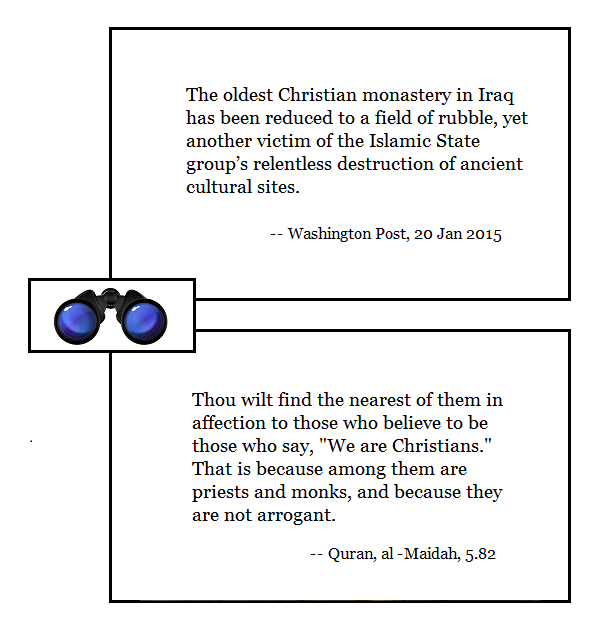
    SPEC DQ monks

    No comment required, IMHO.

    Juxtaposition: chess in Wahhabism and Buddhism

    Sunday, January 24th, 2016

    [ by Charles Cameron — on the focus of similarity — sameness or differences? ]
    .

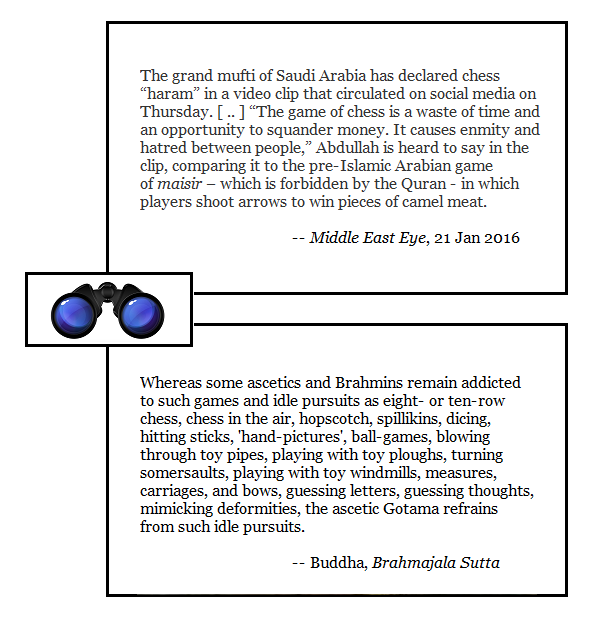
    SPEC chess is haram

    As I said recently, juxtaposition does not imply eqivalence.

    It is only too easy these days to see a headline like Chess is ‘haram and a waste of time,’ says grand mufti of Saudi Arabia and view it purely in terms of Islam. It is in fact an Islamic ruling, though non-binding (there was, in fact, a chess tournament scheduled to take place in Mecca today, January 22, 2016), and can also be found in Shia sources (Grand Ayatollah Sistani of Iraq has also ruled against the game) — but many people who intensely dislike Islam may nonetheless admire Buddhism, and the Buddha dispproved of the game, even when played “in the air”..

    Hey, to get a better sense of what “in the air” means here, let’s take a look at a different, more informative translation (albeit on that would not have fit into the procrustean bed of my DoubleQuote format:

    Whereas some honorable recluses and brahmins, while living on food offered by the faithful, indulge in the following games that are a basis for negligence: atthapada (a game played on an eight-row chess-board); dasapada (a game played on a ten-row chess-board); akasa (a game of the same type played by imagining a board in the air); pariharapatha (“hopscotch,” a diagram is drawn on the ground and one has to jump in the allowable spaces avoiding the lines); santika (“spellicans,” assembling the pieces in a pile, removing and returning them without disturbing the pile); khalika (dice games); ghatika (hitting a short stick with a long stick); salakahattha (a game played by dipping the hand in paint or dye, striking the ground or a wall, and requiring the participants to show the figure of an elephant, a horse etc.); akkha (ball games); pangacira (blowing through toy pipes made of leaves); vankaka (ploughing with miniature ploughs); mokkhacika (turning somersaults); cingulika (playing with paper windmills); pattalaka (playing with toy measures); rathaka (playing with toy chariots); dhanuka (playing with toy bows); akkharika (guessing at letters written in the air or on one’s back); manesika (guessing others’ thoughts); yathavajja (games involving mimicry of deformities) — the recluse Gotama abstains from such games and recreations.

    **

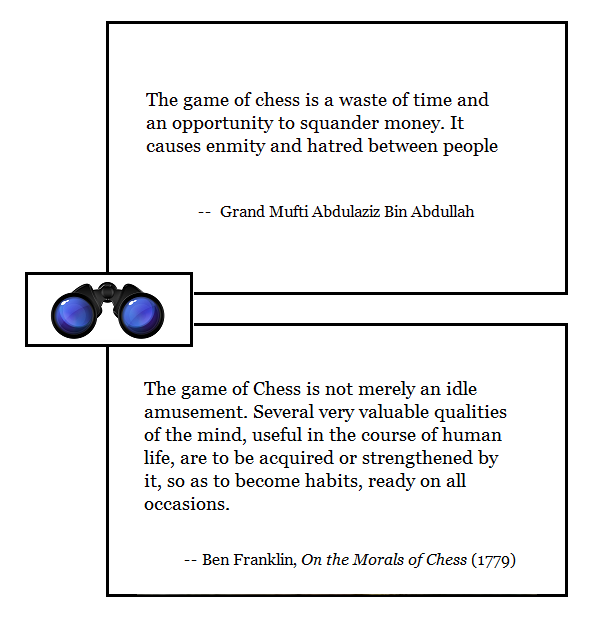
    I trust that that juxtaposition of Mufti and Buddha carries an element of surpise. By way of contrast, one could always make a less surprising (less challenging?) juxtaposition, between the Grand Mufti — Sheikh Abdul Aziz al-Sheikh — and Benjamin Franklin:

    SPEC-chess-is-haram 2


    Switch to our mobile site