[ by Charles Cameron — from sand he came, to sand he shall return ]
.
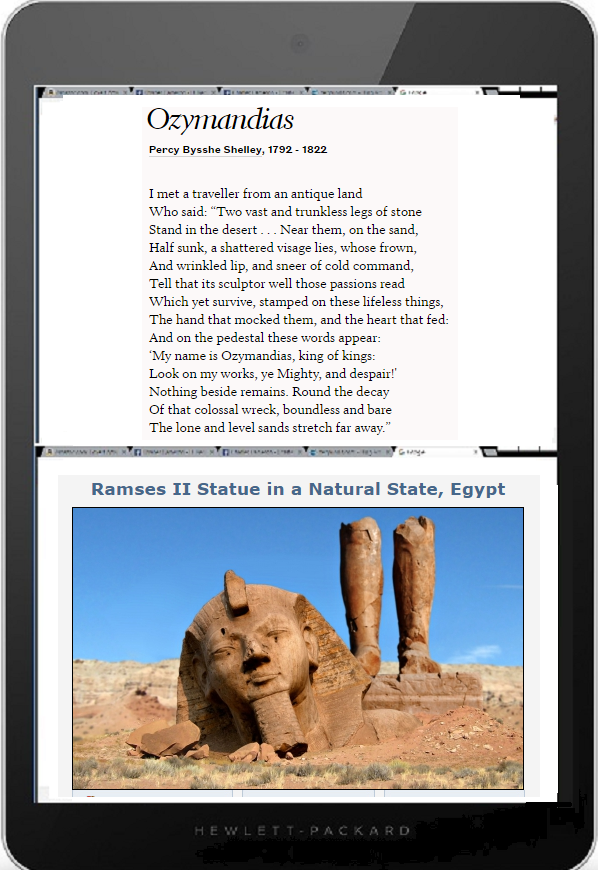
The two images below — the upper image from Wm Benzon‘s New Savanna blog today, the lower from Wikipedia‘s article on Ramesses II —
— between them evoke Percy Bysshe Shelley‘s celebrated poem Ozymandias.
I was going to call Shelley’s poem “longstanding” — but given the erosion to which both images and the poem itself testify, it seems plausible that Shelley’s poem — like Shelley himself — may soon be dust.
**
Mark you, if I were DoubleQuoting the poem, I’d do it thus:
More details fit — the shattered visage, the trunkless legs of stone — but the image is by the same token further from Benzon’s photo, my starting point for this now quadrangular voyage.
To be exact, the lower image in the second DoubleQuote came from the DeskTop Nexus site, but a version of Foreman’s article is where I found it, and I tracked it to Foreman’s original pamphlet from there.
[ by Charles Cameron — moving from a consideration of Holbein’s Ambassadors to a celebrated scene in Ridley Scott’s Blade Runner — and thence, wide-angle, to Kumbh Mela ]
.
Here’s the Bladerunner scene:
What Ridley Scott depicts is a camera with the ability to see around corners — a fantastic piece of science fictional cinematography, demonstrating a sufficiently advanced technology with a skill amounting to wizardry.
**
How close, though, can state-of-the-art cameras come to seeing around corners? Here’s what Nature has to say:
The recovery of objects obscured by scattering is an important goal in imaging and has been approached by exploiting, for example, coherence properties, ballistic photons or penetrating wavelengths. Common methods use scattered light transmitted through an occluding material, although these fail if the occluder is opaque. Light is scattered not only by transmission through objects, but also by multiple reflection from diffuse surfaces in a scene. This reflected light contains information about the scene that becomes mixed by the diffuse reflections before reaching the image sensor. This mixing is difficult to decode using traditional cameras. Here we report the combination of a time-of-flight technique and computational reconstruction algorithms to untangle image information mixed by diffuse reflection. We demonstrate a three-dimensional range camera able to look around a corner using diffusely reflected light that achieves sub-millimetre depth precision and centimetre lateral precision over 40 cm×40 cm×40 cm of hidden space.
Here’s another illustrative video:
‘
**
Okay, seeing is simple, but we’re Zenpundit, so there’s gotta be a military angle we can see around, no?
Here are two possibilities — the first is called CornerShot:
while the second is called ShotView:
**
We’re still pretty far from Ridley’s Blade Runner, but the idea of seeing / shooting around corners has clearly caught the imagination of others.
Okay, those last two videos are for those interested in matters martial.
For my own sake, and for the possible interest of blog-friend Pundita, let’s take a look at a video of Ramesh Raskar, head of MIT Media Lab’s Camera Culture research group and one of the authors of the Nature paper quoted above.
Here Dr Raskar is talking about that most fascinating of Hindu festivals — and largest of human gatherings? — the Kumbh Mela
Talk about wicked problems — and crowd-sourcing solutions — and genius — and the manifold intersections of the secular and the sacred!
[ by Charles Cameron — the power of images in which overwhelming humanity is juxtaposed with overwhelming force ]
.
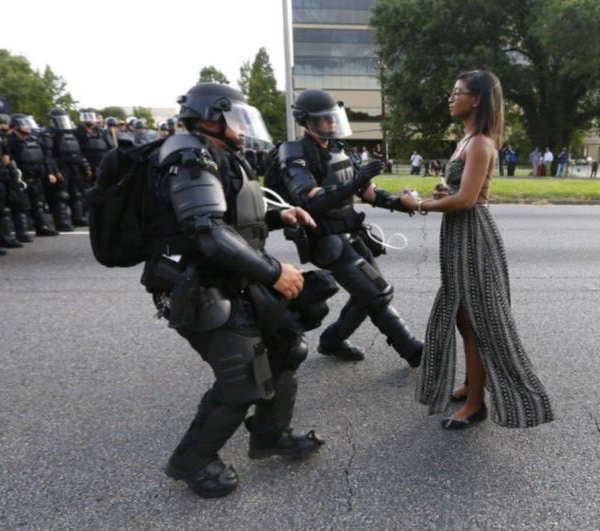
The image of Ieshia Evans standing truth to power became an instant icon last week, as did an earlier photo of a man facing down a line of tanks at Tienanmen Square. Now, that photo of individual courage in the face of a tank has a cousin from Turkey, and Kenneth Roth has paired the two of them in what I term a DoubleQuote in the Wild:
[ by Charles Cameron — protest and arrest in Baton Rouge ]
.
Reuters – Jonathan Bachman
It is the stunning balletic quality of this image that catches my attention here, and gives this post a title drawn from Lewis Carroll‘s Lobster Quadrille in Alice’s Adventures in Wonderland.
The day I thought of asking pardon, I felt unburdened and relieved. I had lost my humanity because of the crime I committed, but now I am like any human being.
Cansilde Munganyinka:
After I was chased from my village and Dominique and others looted it, I became homeless and insane. Later, when he asked my pardon, I said: ‘I have nothing to feed my children. Are you going to help raise my children? Are you going to build a house for them?’ The next week, Dominique came with some survivors and former prisoners who perpetrated genocide. There were more than 50 of them, and they built my family a house. Ever since then, I have started to feel better. I was like a dry stick; now I feel peaceful in my heart, and I share this peace with my neighbors.
**
**
Another perpetrator / survivor pair:
François Ntambara
Because of the genocide perpetrated in 1994, I participated in the killing of the son of this woman. We are now members of the same group of unity and reconciliation. We share in everything; if she needs some water to drink, I fetch some for her. There is no suspicion between us, whether under sunlight or during the night. I used to have nightmares recalling the sad events I have been through, but now I can sleep peacefully. And when we are together, we are like brother and sister, no suspicion between us.
Epiphanie Mukamusoni:
He killed my child, then he came to ask me pardon. I immediately granted it to him because he did not do it by himself — he was haunted by the devil. I was pleased by the way he testified to the crime instead of keeping it in hiding, because it hurts if someone keeps hiding a crime he committed against you. Before, when I had not yet granted him pardon, he could not come close to me. I treated him like my enemy. But now, I would rather treat him like my own child.
Zenpundit is a blog dedicated to exploring the intersections of foreign policy, history, military theory, national security,strategic thinking, futurism, cognition and a number of other esoteric pursuits.