[ by Charles Cameron — Khamenei fatwa against Iranian nukes: its existence, documentation, flexibility, authority, background ]
.
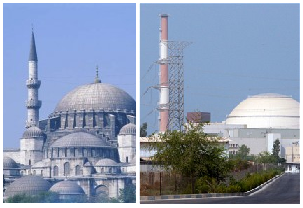
any resemblance between the New Mosque in Istambul, Turkey (left), and the nuclear facility at Bushehr, Iran (right), is purely circumstantial
1.
Blog-friend Cheryl Rofer of The Nuclear Diner and Phronesisaical raised some questions in her comment on a post of mine, and I’d like to respond to the degree that I am able. Cheryl wrote:
On that fatwa against nuclear weapons: it just doesn’t seem to be available anywhere. I haven’t looked today, but I have previously, as have others, and it’s not on the interwebs, or seemingly anywhere else.
I agree that it’s an important part of the entire situation, if it exists. One would want to know how far its influence goes in the Iranian government and among the Iranian public.
Conversely, one might want to know why it’s so unavailable. Was it the view of one person, removed by others? Politically unsound for other reasons?
2.
Hi, Cheryl:
I’ve seen a fatwa referenced, but haven’t seen a text (and wouldn’t be able to read it if I did).
I wonder whether the word “fatwa” is being used somewhat loosely here, to refer to a statement by the Supreme Authority, for the guidance of the faithful, but perhaps not issued as a fatwa as such.
Iran’s Statement at IAEA Emergency Meeting describes it as a fatwa, and this AhlulBayt News Agency report calls it a fatwa in the bulleted headline, but refers to it in the “box” as “Imam Khemenei’s [sic] message to the conference on nuclear disarmament in Tehran, that declared weapons of mass destruction as haram (unlawful)” and states that it “was registered as an official UN document on Thursday.”
So that might be one place to look…
3.
Whether or not the text of a formal fatwa exists, Ayatollah Ali Khamenei has certainly stated his views on the topic himself and through his emissaries on numerous occasions. Thus Kamal Kharrazi, who was Iran’s Minister of Foreign Affairs at the time, wrote in January 2004 (New Perspectives Quarterly):
Iran’s supreme leader, Ayatollah Khamenei, has reiterated on several occasions a fatwa prohibiting the production, stockpiling and use of nuclear weapons. He repeated his fatwa most recently in an address Nov. 25. Given the importance of the fatwa institution in Shiite Islam, the broad significance of this should not be underestimated.
Some of Khamenei’s statements were listed in this November 2004 Radio Free Europe / Radio Liberty Iran Report:
In a 5 November commentary in the “Los Angeles Times,” Iranian Ambassador to the United Nations Mohammad Javad Zarif referred to “serious ideological restrictions against weapons of mass destruction, including a religious decree issued by Ayatollah Ali Khamenei, the leader of the Islamic Republic of Iran, prohibiting the development and use of nuclear weapons.”
“We believe that the use of nuclear weapons is religiously forbidden,” Foreign Ministry spokesman Hamid Reza Assefi said on 12 September according to state television. “This is the leader’s fatwa [religious decree].”
“The religious verdict of our leader is that using weapons of mass destruction is forbidden, is ‘haram’ [‘unlawful’ in Islam],” Supreme National Security Council official Hussein Musavian said in an 11 September interview that appeared in the 12 September “Financial Times.” “For Iranians, this verdict is much more important than the NPT [Nuclear Non-Proliferation Treaty].”
More than one year ago, on 25 October 2003, Supreme National Security Council Secretary Hojatoleslam Hassan Rohani told students at Shahrud Industrial University that Khamenei believes nuclear weapons are religiously illegal, IRNA reported.
One can have reservations about Khamenei’s ability to legitimately issue a religious decree, given his questionable theological standing. Nevertheless, as Supreme Leader and commander-in-chief of the armed forces he can ban or permit anything he wants.
4.
Juan Cole addressed the matter of Khamenei’s “ability to legitimately issue a religious decree” in his October 2009 Salon piece, Does Iran really want the bomb?
I was on an email list where someone expressed suspicion of Supreme Leader Ali Khamenei’s 2005 fatwa against the possession and use of nuclear weapons by an Islamic state.
One suggestion was that Khamenei is not a real Shiite jurisprudent and has eschewed having followers inside Iran. But, no, Khamenei is a mujtahid or independent jurist and has the standing to issue a fatwa or considered ruling on the law.. A mujtahid may always decline to accept muqallidun or followers, which Khamenei appears to have done for Iranian nationals, without that affecting his legitimate right to issue fatwas. The theory of ijtihad or independent jurisprudential reasoning holds that the law inheres in the reasoning processes of the jurisprudent; whether the jurisprudent has followers or not is irrelevant to the discovery of the law in a particular instance. Moreover, as rahbar or supreme leader,, Khamenei’s pronouncements on such matters might even be seen as a hukm or standing command. Finally, since he sets policy on such matters, what difference, in any case, would it make what exact jurisprudential standing his fatwas enjoy?
The only real question is whether he is lying and insincere.
5.
As to whether it is strange that no published text of a fatwa under his name exists, Mehdi Khalaji writes (in Michael Eisenstadt and Mehdi Khalaji, Nuclear Fatwa: Religion and Politics in Iran’s Proliferation Strategy, a very detailed MERIP Policy Focus offering from this September):
Interestingly, no written texts exist for the Supreme Leader’s fatwas, though Shiite juridical tradition grants equal weight to an oral and written legal opinions-a phenomenon to be discussed further in the next section.
and again:
As such, even though Ayatollah Khamenei has produced no written record on the religious prohibitions pertaining to nuclear weapons, his verbal statements on the subject are considered his religious opinions, or fatwas, and therefore binding on believers.
[ see also Cole above on hukm ]
6.
Khalaji also suggests that Khamenei’s more recent statements have been more flexible, and indeed that it is not uncommon for jurisprudents to change their minds (and “opinions”):
Supreme Leader Khamenei has stated that the production, stockpiling, and use of nuclear weapons are forbidden under Islam. But his recent language on the subject has become more equivocal, emphasizing only the prohibition on their use and not on their production or stockpiling. And should the needs of the Islamic Republic or the Muslim umma change, requiring the use of nuclear weapons, the Supreme Leader could just as well alter his position in response. This means that, ultimately, the Islamic Republic is unconstrained — even by religious doctrine — as it moves toward the possible production and storing of nuclear weapons.
7.
An example of a more recent statement of this sort would be the one reported in this VOA piece from February 2011:
Iran’s Supreme Leader Ayatollah Ali Khamenei christened a new, Iranian-built warship, as a military band honored him on the ship’s deck. Addressing a crowd of military commanders after the ceremony, he told them that “Islam is opposed to nuclear weapons and that Tehran is not working to build them.”
8.
Putting this in context, Cole in the Salon piece I quoted above suggests that Khamenei may be going for “latency” rather than “possession” – latency having the power of a threat, but not trespassing the limits of actual development allowed under treaty:
Latency is the possession of a nuclear energy program and of reactors, which would allow the production of an atomic bomb on short notice if an extreme danger to national autonomy reared its ugly head. Nuclear latency is sometimes called the ‘Japan option,’ because given its sophisticated scientific establishment and enormous economy, Japan could clearly produce a nuclear weapon on short notice if its government decided to mount a crash program.
9.
As to the question of how far the influence of Khamenei’s opinions go, Khalaji writes:
Iranian nuclear decision-making, therefore, bears the significant imprint of one man’s personality and politics — an imprint that may be unaffected by the will of other men, the decisions of other institutions, or, most ironically, the legal scruples or moral dictates of his own religion.
10.
Timothy Furnish, whose paper A Western View on Iran’s WMD Goal: Nuclearizing the Eschaton, or Pre-Stocking the Mahdi’s Arsenal? also explores the matter with background and in considerable detail, suggests that it is more likely that “Tehran … finds its potential nuclear policy fettered by Qom “:
But the preponderance of evidence — Islamic history in general, specific Shi`i traditions and teachings as well as modern religio-political discourse in Iran – indicates, rather, that the rationality and spirituality of Iranian Mahdism is holding at bay its undeniable jihad aspect. Tehran thus, ironically, finds its potential nuclear policy fettered by Qom: mainstream Shi`i theology does not support violence (nuclear or conventional) in order to precipitate the return of the 12th Imam; furthermore, employing nuclear weapons is verboten in the Mahdi’s absence — except, perhaps, under the rubric of defensive jihad, were Iran itself to be attacked or invaded. Seen in this light, the Islamic Republic’s pursuit of nuclear weapons falls from the overly-alarmist apocalyptic register into a more mundane, and manageable, geopolitical one.
Coming from Dr Furnish, that says a great deal.
10.
And that’s what I have, Cheryl, all. I’m happy to learn more…