zenpundit.com » iran

Archive for the ‘iran’ Category

Striking Iran: Two Games and a World – Pt 2

Tuesday, November 15th, 2011

[ by Charles Cameron board game and board-room simulation of an Israeli strike on Iran ]

.
nyt-osiraq.png

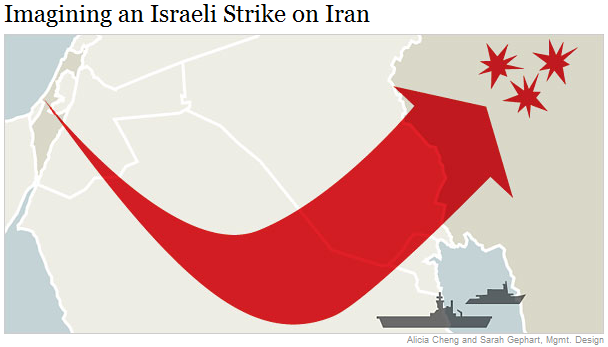
[graphic & headline from the New York Times]

[continuing from part I]

5.

Osiraq Redux

Karim Sadjadpour described a very different style of game in Foreign Policy just one day after Michael Peck’s description of Persian Incursion. It was conducted by the Brookings Saban Center, and also written up by Kenneth Pollack in the Center’s Middle East Memo of February 2010, and by David Sanger at the New York Times.

Here is Pollack’s description of the structure of the Brookings game:

The simulation was conducted as a three-move game with three separate country teams. One team represented a hypothetical American National Security Council, a second team represented a hypothetical Israeli cabinet, and a third team represented a hypothetical Iranian Supreme National Security Council.

As a scholar of religion, I would be tempted to add, after the manner of the Athanasian Creed, “Yet there are not three hypotheticals but one hypothetical.”

More:

The U.S. team consisted of approximately ten members, all of whom had served in senior positions in the U.S. government and U.S. military. The Israel team consisted of a half dozen American experts on Israel with close ties to Israeli decision-makers, and who, in some cases, had spent considerable time in Israel. Some members of the Israel team had also served in the U.S. government. The Iran team consisted of a half-dozen American experts on Iran, some of whom had lived and/or traveled extensively in Iran, are of Iranian extraction, and/or had served in the U.S. government with responsibility for Iran.

This game begins with an Israeli strike – that is to say, the strike itself is not what is gamed here: the game is designed to be “a day-long simulation of the diplomatic and military fallout that could result from an Israeli military strike against the Iranian nuclear program.” Again, I will not rehearse nor comment in much detail on what has been reported of play, both in Pollack’s official Brookings report on the game and in Sadjadpour’s account, noting only that the Brookings game features a response from Hizbollah which (as Michael Peck noted) was lacking in the board game.

6.

Differences of style

What interests me is the difference in style between the two games, the two approaches:

  • The emphasis on the initial strike in Persian Incursion focuses that game more tightly on questions of materiel and logistics, while the Brookings game naturally puts greater emphasis on the responses of individuals and groups. And I’d suggest that the structures of the two games in some sense parallels that distinction:
  • The board game is played by two players, typically experienced grognards, wargame hobbyists or designers, often with military backgrounds. Their skill is in decision-making in the context of such games, and Larry Bond has provided them with an exhaustively-researched briefing on the issues he considered salient.
  • The board-room sim is played by a couple of dozen players, each of them already possessing their own highly detailed “takes” on the specific aspects of the game their voices will “represent”.

One might say that Persian Incursion is an entertainment and the Brookings game a high-level albeit informal strategic deliberation — but that comparison fails to account for the detailed research that has gone into PI — and the Harpoon gaming system which underlies it. Both games are serious attempts, at the limit of human imagination, to figure out — to “game” — one specific, now perhaps looming, future.

Taking both games with equal seriousness, then, we can say that both players of PI have Larry Bond and his two associates (in the form of those booklets, maps, target specs and so forth) as their intel resources, whereas the Brookings game features the combined (cooperating and competing) intelligences of the two dozen or so participants.  That’s not quite crowdsourcing, as is the Naval Postgraduate School‘s ongoing MMOWGLI anti-piracy game, but it is polyphonicit allows and attends to a variety of voices…

Of course, if those various voices are selected in such a way that they form too much of a “choir” or “chorus” this advantage is diminished: there’s no great benefit to hearing a dozen or two versions of group-think. And while the individual voices in a group may in fact propose usefully distinct ideas, there’s always the possibility that some key factor or factors will be overlooked, because a single world-view is operating where a true polyphony would require a deeper and richer diversity.

Is Persian Incursion more practical, having a greater emphasis on actual force projection? Is Osiraq Redux more realistic, having a wider set of expertises to draw on?

7.

Omnium gatherum

For the sake of completeness, I should mention that a game not unlike the Brookings game of 2009 was played by a similarly qualified group at the behest of the Atlantic magazine in 2004, as reported by James Fallows. I was particularly intrigued by this piece because Mike Mazaar, with whom I once collaborated briefly, was playing SecDef.

What I’d hope for from ZP’s readers would be some discussion of these two different approaches to gaming, and of gaming itself– along with scenario planning — as a means of exploring possible futures where the impact downstream may be considerable.

The piece of the puzzle that I fear may be missing from both games, as those who know me will have guessed, is the potential influence of messianism — from the Israeli / Judaic, the U.S. / Christian Zionist, and the Iranian / Mahdist sides. But then I generally expect the seriousness of millennial aspirations to be discounted, and try to keep track of those things accordingly myself.

Three puzzle pieces that I would find relevant would be:

(i) the Ayatollah Khamenei‘s fatwa “that the production, stockpiling and use of nuclear weapons are forbidden under Islam and that the Islamic Republic of Iran shall never acquire these weapons”;

(ii) Timothy Furnish‘s observation:

The Leader of the Islamic Republic of Iran, Ayatollah Ali Khamenei has issued the Fatwa My own study of both geopolitics and of Shi`i traditions on the 12th Imam leads me to conclude that the clerical regime does NOT believe in nuking Israel (or anyone else), because while the Mahdi will return at a time of great violence and upheaval, there is no Shi`i teaching that creating such bloodshed would induce Allah to send him. Also, I think the ayatollahs are crazy like foxes, not literally crazy-and they know full-well what would be the Israeli (and perhaps American ) response to any use of nuclear weapons against Israel. The Mahdi would not be happy to return and rule over a radioactive wasteland..

For more detail, see also Furnish’s A Western View on Iran’s WMD Goal: Nuclearizing the Eschaton, or Pre-Stocking the Mahdi’s Arsenal?

and (iii) Benjamin Netanyahu‘s statement in opening the Knesset:

Our policy is guided by two main principles: the first is “if someone comes to kill you, rise up and kill him first,” and the second is “if anyone harms us, his blood is on his own hands.”

The first is “im ba l’hargekha, hashkem l’hargo” — a well-worn phrase that can be found in the Talmud and derives from Exodus; I’m unsure whether the second — “If anyone harms us, his blood is on his own hands” — comes from a Talmudic source, or whether it is an abbreviated restatement of Ezekiel 33 1-9.

8.

Some trivia for good measure…

As Michael Peck points out, the game’s graphic designers write Persian Incursion using a faux-Devanagari script more properly associated with Sanskrit and Hindu sources than Iranian Shi’ism…a minor pity, that.

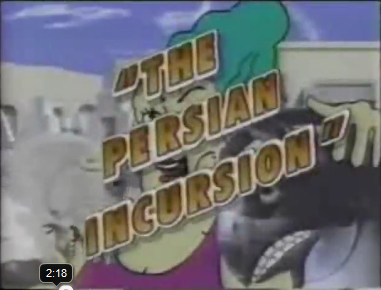
And ha! — I’m left wondering whether the title, Persian Incursion, came to Larry Bond or his crew out of the ethers — or whether someone had been watching…
persian-incursion-carmen-sandiego.png

Where in the World is Carmen Sandiego, Season 5, Episode 39?

GMTA?
Striking Iran: Two Games and a World – Pt 1

Tuesday, November 15th, 2011

[ by Charles Cameron — board game and board-room simulation of an Israeli strike on Iran ]

.

persian-incursion.png

1.

We suppose we can game the world.

It may in fact be the best thing we can do, or the only thing: we guess, guesstimate, estimate the possible outcomes of an act or series of acts — and somehow in there, we hope to match the major trends in the complexity we seek to understand with selected complexities of our own that we build into our games.

And yet as Richard Danzig noted in the opening paragraph of his Driving in the Dark: Ten Propositions About Prediction and National Security which I quoted here yesterday, “whereas routine, short-term predictions are generally right, strategic judgments about future environments are often, one might say predictably, wrong.”

So we have knee-jerk responses, which can suitably be expressed in barks or sound-bites, and we have deliberative inquiry, which requires suitably nuanced exegesis. And our games and simulations are attempts at the deliberative approach.

2.

The chess board:

So the question of an attack on Iranian nuclear facilities is once again in the air, and we would like to be able to peer as far down the chess-board as a Kasparov, computing the counter-move an adversary would make against a friend’s counter-move to the adversaries response to an initial move. Sadly, though, we all too often find ourselves in the bind that a senior US official in Iraq described to Anthony Cordesman a while back, where our best efforts at gaming the situation are “like playing three dimensional chess in the dark while someone is shooting at you.”

Except that my own version of the board may be more accurate:

it’s more like an n-dimensional spider’s web, with multiple gravities, tugs, and tensions – and some of those tensions are in the category of known unknowns that one of your predecessors talked about, some of them unknown unknowns, and some of them literally unknowable – hidden in the hearts of more devious men than you, and known only to God.

3.

So, anyway, we game things out as best we can.

And since the idea of bombing Iran’s nuclear facilities has been in the news of late, so have two attempts to “game” that particular possibility and its sequelae.

What interests me here is not the outcomes envisioned – but the inherent differences between the two games. Let’s take a look.

4.

Persian Incursion.

As Michael Peck — he splashed Persian Incursion into our consciousness with one post on Foreign Policy and another on Danger Room last week, not to mention an interview on NPR – puts it:

Persian Incursion is basically two games in one. There is a highly detailed military game of a seven-day Israeli air offensive in which Israel plans and executes its strikes while the Iranian air defenses try to stop them. But there is also a political game that unlocks the military aspect. Persian Incursion assumes that an Israeli attack is only possible if one of Iran’s neighbors — Saudi Arabia, Turkey, or a U.S.-influenced Iraq — either publicly or tacitly allows Israeli entry into its airspace for the strike on Iran. (The rules state that though Israel could chance an initial airstrike without an agreement, it would need permission for follow-up attacks.) With that in mind, the game comes with various starting scenarios, such as a super-radical Iran that scares its neighbors into allowing Israeli access, or Turkish support for an Israeli strike (note that the game came out in 2010, before the current Israeli-Turkish spat).

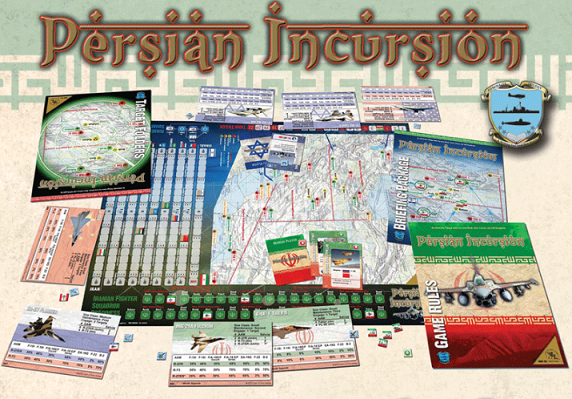
Here’s how Clash of Arms, the publisher, describes the game packet:

Persian Incursion provides comprehensive and detailed information on:

• Orders of battle for the Israeli and Iranian Air Forces and the Iranian Air Defense Force
• Analysis of the Iranian nuclear and oil infrastructure
• Iranian ballistic missiles and Israeli ballistic missile defenses
• Target folders for Iranian nuclear facilities, oil terminals and refineries, and airfields
• Variable starting conditions

Components:

• Rulebook; Briefing Package and Target folders;
• 17 x 22″ Full color map;
• Short Deck of “Super Cards” (4.25 x 6″);
• 2 Full decks of playing cards (110 cards);
• Cardboard counters;
• Box and dice.

Now I am absolutely not the guy you want to ask about the game-play, or about the game’s possible implications for policy analysis. Michael Peck may well be that guy, but even he doesn’t leave the game with a clear sense of how things might play out in real time:

The real question of this exercise, however, is whether an Israeli strike on Iran is a good or bad idea. Persian Incursion’s answer is an unqualified “maybe.” Israel can’t stop Iran from retaliating with missile attacks and terrorism. But it also can’t guarantee complete destruction of Iran’s nuclear program. Perhaps most importantly, the key to victory is winning the public-opinion, political war.

And when you get granular, “public opinion” turns out to mean the interwoven opinions of many, many and diverse people — some influential, some easily influenced, some whose world-view features a rigorous scientism, some a potentially wrathful deity – all of whom are themselves beset by a myriad of doubts, certainties, hopes, fears, bouts of toothache and who knows what else…

Modeling even one of those minds (and associated hearts) would be quite a trick…

So. That’s the “reference library” approach, to use Peck’s term:

Persian Incursion isn’t a novel — it’s a reference library inside a game. The background information included is staggering. Besides the rules book, there is a target folder and a briefing booklet listing the precise dimensions of Iranian nuclear facilities down to the meter…

The gamer has what we’ll assume is a highly accurate representation of the materiel side of things. Morale, at the granular level of a Netanyahu or a Khamenei?

Who can game the workings of a single human mind (and heart)?

[continued in Pt 2]

OWS, Obama, Iran and the Imam Mahdi

Thursday, November 10th, 2011

[ by Charles Cameron — two or three glimpses from Iran re the OWS movement ]

.

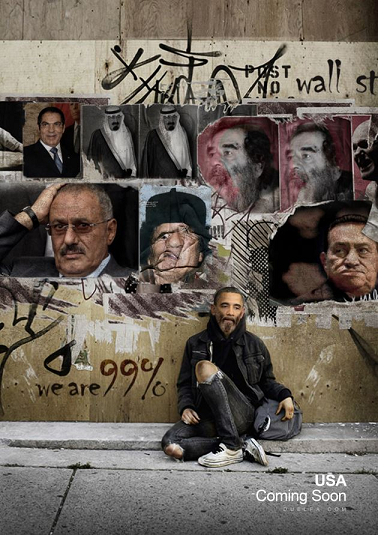
obama_as_99_percent_iranian_propaganda.png

You have have seen this already if you follow Aaron Weisburd, whose Internet Haganah has more detail on IRGC involvement in propaganda with an OWS flavor, including another striking graphic that’s just too fine for me to resist:

the-band.png

What interests me, though, is an additional “dot” provided by Tim Furnish, who (as always) is tracking the Mahdist aspects.

On his MahdiWatch blog today, Dr Furnish points us to a piece by one Charles Dameron (not even a typo-relative of mine) on Radio Free Europe / Radio Liberty, headlined Iranian Ayatollah: OWS A Sign Of The 12th Imam, and carrying the following report:

Most Occupy Wall Street (OWS) protesters would probably tell you that they’re out to change the world, or at least the United States’ marginal tax rates on high earners.But most of them — one hopes — probably wouldn’t profess to having any interest in hastening the reappearance of a religious messiah and ushering in a global, cataclysmic Day of Judgment.

Don’t tell all of this to Iranian Ayatollah Mohsen Heydari. He’s convinced that the OWS protests are the self-evident harbinger of a long-awaited event in Shi’ite eschatology: the reappearance of the 12th (Hidden) Imam, whose End of Times return will bring Islamic peace and justice to the world.

“The Occupy Wall Street movement is the big step to prepare the ground for the appearance of the 12th Imam,” Heydari told mosque congregants in the Iranian city of Ahvaz, the capital of the oil-rich province of Khuzestan, on November 7.

The remarks came during a special prayer service for the celebration of Eid al-Adha, a major religious holiday that ends on November 9.

Talk about the imminent arrival of the 12th Imam is a perennial feature of political and religious discourse in post-revolutionary Iran. President Mahmud Ahmadinejad famously expressed his wish that God would “hasten the emergence of your last repository, the Promised One, that perfect and pure human being, the one that will fill this world with justice and peace,” during a speech to the UN General Assembly in 2005.

I am not in any way suggesting that Iranian “borrowing” of OWS imagery should be held against OWS, though I think the more thoughtful OWS supporters would wish to be aware of it.

The important point, it seems to me, is that the overtly apocalyptic tie-in with expectation of the return of the Twelfth Imam is yet another indicator of the significance of the Mahdist current within Iranian military and government circles.

Scenario planning and prophecy

Friday, October 14th, 2011

[ by Charles Cameron — futurism, prediction, Christian and Islamic apocalyptic traditions, fiction ]
.
clancy-rosenberg.jpg

Two new thrillers.  And what caught my eye — fascinated as I am by the whole business of prophecy and prediction, scenario planning and science fiction — was Wolf Blitzer‘s pronouncement about Tom Clancy on his CNN blog today:

Sometimes nonfiction seems to follow fiction, especially, it seems, in the case of Tom Clancy and his spy novels.

Here’s Blitzer’s supporting evidence:

In 1994, he wrote a thriller called “Debt of Honor.” Long before the terrorist attacks of 9/11, Clancy had a character fly a Boeing 747 into the U.S. Capitol. Clancy’s “The Teeth of the Tiger,” published in 2003, features a man named Mohammed who has a network of Colombian drug cartel thugs who plot evil deeds against the U.S. His newest book is entitled “Against All Enemies.” A major plot line has Taliban terrorists joining hands with Mexican drug cartel killers to launch attacks in the United States. A friend who’s read all the Clancy books alerted me to this when he heard of the Obama administration’s accusations that Iran plotted to have members of a Mexican drug cartel kill Saudi Arabia’s ambassador to the United States, Adel al-Jubeir. “Seems like terrorists are big Clancy fans,” my friend suggested…

Not so fast, Wolf and Wolf’s friend. They might equally well have been reading Joel Rosenberg (also, or instead).

Clancy does this sort of stuff because he’s a scenario planner turned novelist — Rosenberg does it because he’s a student of prophecy turned novelist.  Come to that, I rather like the idea that prophecy and scenario planning might be related.

Here’s an excerpt from Wikipedia’s current article about Rosenberg:

Nine months before the September 11th attacks, Rosenberg wrote a novel with a kamikaze plane attack on an American city. Five months before the 2003 invasion of Iraq, he wrote a novel about war with Saddam Hussein, the death of Yasser Arafat eight months before it occurred, a story with Russia, Iran, and Libya forming a military alliance against Israel occurring the date of publishing, the rebuilding of the city of Babylon, Iran vowing to have Israel “wiped off the face of the map forever” five months before Iranian President Ahmadinejad used similar language, and the discovery of huge amounts of oil and natural gas in Israel (a major gas discovery occurred in January 2009).

Neat, hunh?

Or of course, they could just all be playing Steve Jackson‘s 1995 Illuminati card game

illuminaticardgametowers.jpg

I suppose we should add role-playing and card-reading to our list of prognostic activities…

*

In any case…

I enjoy Joel Rosenberg’s books.  His thrillers are full of Christian and Islamic apocalyptic elements, of course, which are of continuing interest to me — especially when they cross over into each others’ territories.  I’ve been meaning to write up my review of the first book in his current series for months now — my copy must have a hundred or so little colored flags in it, marking passage of interest, plot points and so on.

And there are things Rosenberg gets seriously wrong that are important. It’s dangerous when someone who influences thousands through his Epicenter conferences and his appearances with Glenn Beck is unable to distinguish the Hojjatiyeh Society (a small group that may not even exist at this point) from Twelver (ie orthodox Shi’ite) Islam.

But it’s because I think:

  • that Islamic apocalyptic is important and all too often overlooked,
  • that he thinks so, too,
  • that his tying it in with policy proposals carries some weight,
  • that the brisk pace of his novels reaches readers who have not much other access to ideas about the Mullahs, the Twelfth Imam or Mahdi, and the issue of the Iranian nuclear program, and
  • that there are scholars in a position to clarify and correct some of his mistakes and misconceptions,

that I still hope to review the first book in the current series, The Twelfth Imam, and his new book, The Tehran Initiative, right alongside it.

Heck, I’d be more than happy to review the new Clancy, too.

Iranian Assassination – Narco-Cartel Plot Charged

Wednesday, October 12th, 2011

The US Attorney General Eric Holder, supported diplomatically by the Kingdom of Saudi Arabia, charged the Iranian government earlier today with a plot to enlist a Mexican narco-cartel to assassinate the Saudi Ambassador to the United States. SECSTATE Hillary Clinton, the FBI Director and President Barack Obama have all weighed in on this issue with strong public statements:

U.S. authorities said they had broken up a plot by two men linked to Iran’s security agencies to assassinate Saudi Ambassador Adel al-Jubeir. One was arrested last month while the other was believed to be in Iran.

Iran denied the charges. But President Barack Obama called the plot a “flagrant violation of U.S. and international law” and Saudi Arabia said it was “despicable.” Revelation of the alleged plot, and the apparent direct ties to the Tehran government, had the potential to further inflame tensions in the Middle East, and the United States said Tehran must be held top account.

Secretary of State Hillary Clinton, in a Reuters interview, expressed hope that countries that have hesitated to enforce existing sanctions on Iran would now “go the extra mile.” At a news conference, FBI Director Robert Mueller said the convoluted plot, involving monitored international calls, Mexican drug money and an attempt to blow up the ambassador in a Washington restaurant, could have been straight from a Hollywood movie.

U.S. Attorney General Eric Holder alleged that the plot was the work of the Islamic Revolutionary Guard Corps, which is the guardian of Iran’s 32-year-old revolution, and the Quds force, its covert, operational arm. “High-up officials in those (Iranian) agencies, which is an integral part of the Iranian government, were responsible for this plot,” Holder told the news conference.

“I think one has to be concerned about the chilling nature of what the Iranian government attempted to do here,” he said….

I confess that I am not quite sure what to make of this story. 

If accurate – the case originated with a DEA confidential informant in Mexico – it would amount to a new stage of reckless boldness by Iran’s hardline Pasdaran clique of security and intelligence agencies run by the Iranian Revolutionary Guards and their retired leadership that have a semi-hegemony over the Iranian regime. It also points to the danger to American national security of a long, basically open, border with a failing state Mexico that is deeply embattled in a polycentric counterinsurgency war with the rapidly morphing narco-cartels (that said, I do not expect the administration to move a policy inch to repair the latter). Why would Iran do this – and in such a harebrained manner?

Some possible motives:

* Internal factionalism – Iran recently released imprisoned American hikers, albeit after a substantial ransom payment. Potentially, this could be viewed in the topsy-turvy world of Iranian Islamist politics as a “goodwill gesture” toward the United States. Historically, such gestures provoke rival factions in Iran to initiate anti-American actions, including acts of terrorism, usually via proxies. If an intel operation was “factional” rather than blessed by a wide elite consensus, it might very well be a marginal idea carried out on a shoe-string.

* Counterpressue – Indirect Iranian skirmishing against the US which is drawing down in Iraq and is pressuring Iran’s ally Syria. Also against the Saudis who brutally suppressed a predominantly Shia “Arab Spring” rising in Bahrain which, if it had succeeded in toppling the regime, would have added Bahrain to the regional “Shia Revival”.

* Opportunism – The Pasdaran leadership may have  believed the stories of American decline, assessed our extensive military commitments and budgetary problems and taken the Obama administration’s temperature and concluded that the benefits of carrying out the assassination outweighed the remote risk direct  of US military retaliation.

Some points to consider:

* Proximity – Iran could more easily, with less risk and with far greater likelihood of success, carry out acts of anti-American terrorism closer to home in Iraq, Lebanon, Afghanistan the Gulf States, even in Saudi Arabia or Egypt.  Acts of terrorism in the American homeland risk a massive overreaction by Washington ( the US only needs the Navy to deal out severe consequences to Iran) which might welcome a legitimate pretext to bomb all of Iran’s suspected nuclear facilities and national security sites.

* Self-Preservation by the Mexican narco-cartels make such cooperation with Iran less likely, having the example of their Colombian predecessors in the 1980’s before them when they raised the ire of the USG sufficiently. The narcos have their hands full fighting the Mexican Army and one another without adding the CIA, Global Predator drones or the SEALs to their plate.

* Friends of MeK – By some miraculous deus ex machina, the cultish, 1970’s era Iranian Marxoid terrorist group, the People’s Mujahedin of Iran (MeK) have spent a wealth of funds to buy the lobbying services of a glittering array of former top US national security officials and general officers – despite being on the State Department’s official terrorist list.

….Among the new faces: former Indiana Congressman Lee Hamilton (D), who once chaired the House Foreign Affairs Committee, and who served as vice chairman of the 9/11 Commission; Ambassador Dell Dailey, who was the State Department’s Coordinator for Counterterrorism from July 2007 to April 2009; General Michael Hayden, director of the CIA from 2006 to 2009; and not one, but two former chairmen of the Joint Chiefs of Staff. Former Attorney General Michael Mukasey, former New Mexico Gov. Bill Richardson, former Under Secretary of Defense for Policy Walter Slocombe and ex-Sen. Robert Torricelli (D-NJ) also spoke.

In what should be a national scandal, those names are not even a comprehensive list of the very influential former politicians, K Street lobbyists and Beltway law firms accepting payments to whisper in the ears of current officials in the national security community, regarding Iran, on behalf of the MeK. Not sure how it is legal to do so either, since aiding a group on the State Department’s list by providing services normally can get you hauled into Federal  court pronto, if you are an ordinary American citizen. A most curious situation….

I have no brief for Iran, the regime is a dedicated enemy of the United States, but a group of exiled Iranian Marxist-terrorists who used to work for Saddam Hussein hardly have our best interests at heart.

It will be interesting to watch this case unfold, but in the meantime, opinions are welcome in the comments, particularly on the Mexican narco-cartel angle.

Hat tip to James Bennett.


Switch to our mobile site